


 by Tom Gurney
Tom Gurney BSc (Hons) is an art history expert with over 20 years experience
Published on June 19, 2020 / Updated on August 9, 2026
Email: tomgurney1@gmail.com / Phone: +44 7429 011000
Landscape with a Stone Bridge by Rembrandt: Introduction
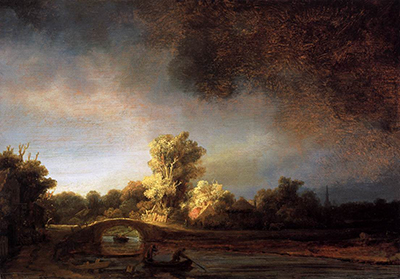
Rembrandt's Landscape with a Stone Bridge is a small painting with unusually large weather. A stone bridge crosses water in a low landscape. Boats, figures, a wagon, cottages, trees and a distant church tower occupy the scene, but the real drama comes from the sky. Light breaks through cloud and strikes part of the land just as darker weather approaches.
The Rijksmuseum identifies the work as Landscape with a Stone Bridge, by Rembrandt van Rijn, dated c. 1638. It is an oil painting on panel, measuring 29.5 x 42.5 cm, with the object number SK-A-1935. The museum also records title variants including The Stone Bridge and Landscape with Stone Bridge.
The painting matters because Rembrandt painted only a few landscapes. He drew and etched landscapes with great sensitivity, but landscape in oil remained a smaller part of his career than portraits, self-portraits, biblical scenes and history paintings. This panel therefore gives a rare view of Rembrandt asking a landscape itself to carry mood, movement and invention.
It should not be treated as a simple record of one place. The Rijksmuseum notes that the scene is composed from elements studied from reality, but probably does not represent a specific location. That caution is important. The painting feels Dutch in its water, low road, cottages, boats and sky, yet it also feels assembled for effect. Rembrandt is not only reporting a view. He is making one.
Contents
- Introduction
- First Look at the Scene
- Light Before the Storm
- An Imagined Dutch Landscape
- The Bridge Motif
- Relation to Drawings and Etchings
- A Rare Painted Landscape
First Look at the Scene
The bridge gives the painting its name, but it does not work alone. It crosses a river or canal that begins near the foreground and moves the eye through the landscape. On the water are small boats with figures. On the road are several people, and at the left a wagon moves through the scene. Near the center are cottages or a hay barn among trees. Farther back, a church tower appears in the distance.
Those details make the scene inhabited. The painting is not an empty view of weather over land. People travel, row, walk and work within it. Their scale is small, but that smallness helps the sky feel immense.
The composition depends on contrast. The bridge and water create passage. The road and figures create daily movement. The trees and buildings gather the eye near the illuminated center. The distant church tower gives the landscape a settled horizon. Above all this, the sky presses downward and opens at the same time.
The painting rewards slow looking because its drama is not placed in one heroic object. The bridge is important, but so are the boats, cottages, path, trees and distance. Rembrandt lets ordinary parts of a Dutch landscape become charged by light.
Light Before the Storm
The Rijksmuseum emphasizes the painting's dramatic illumination: a sunbeam breaks through the clouds, making the approaching storm seem more threatening. That is the key to the work. The light does not simply brighten the scene. It makes the darkness more active.
This is a familiar Rembrandt strength in an unfamiliar setting. In many figure paintings, light gathers around a face, a body or a decisive gesture. Here it falls across landscape. The effect is not theatrical in the sense of a staged biblical event, but it is still deeply dramatic. The land seems caught at the instant before weather changes.
The storm is approaching, not fully arrived. That suspended moment gives the painting much of its force. The viewer senses the air thickening. The bridge and cottages are still visible, but the clouds make the whole landscape unstable. Light and darkness do not cancel one another. They make each other sharper.
Because the work is on panel and modest in size, the drama is concentrated. Rembrandt does not need a large canvas to make the sky feel powerful. The small scale may even intensify the effect: the viewer comes close, notices the tiny human movements, and then feels the weather expanding beyond them.
An Imagined Dutch Landscape
Landscape with a Stone Bridge looks plausible, but plausibility is not the same thing as topography. The Rijksmuseum's caution that the scene probably does not show one specific place protects the painting from a too-literal reading.
Rembrandt could have observed bridges, roads, cottages, boats, trees and canals separately. He lived in a world where such motifs were ordinary. Yet the painting combines them into a scene that feels deliberately arranged. The bridge makes a threshold. The water leads inward. The illuminated cottages and trees become a visual focus. The sky turns the whole view into a moment of transition.
This matters because Rembrandt's landscape imagination often sits between observation and invention. His drawings can be direct and economical, catching a road, a cottage, a bank of trees or a bridge with a few strokes. His etchings can turn weather and land into an entire printed world. In this painting, he brings that habit of looking into oil, but he does not simply copy a view.
The result is a landscape that feels remembered as much as seen. It has enough everyday detail to be convincing and enough artifice to feel concentrated. That balance is one reason the painting still seems mysterious.
The Bridge Motif
The stone bridge is the named motif, and it deserves attention. Bridges are practical structures, but in pictures they also create movement. They join two banks, carry roads over water and give the eye a path through space. Here the bridge helps organize the landscape without turning into a fixed symbol.
It is tempting to make the bridge mean one thing: passage, safety, connection, endurance or transition. Those ideas are possible, but the painting does not need a single key. The bridge works first as form. It interrupts the water, anchors the foreground and connects the road to the inhabited middle ground.
Its material weight also matters. A stone bridge feels more permanent than the figures or boats around it. It stands under a sky that is changing quickly. That contrast between built structure and moving weather gives the painting much of its quiet tension.
The bridge also helps explain why the work feels different from a wide panoramic landscape. Rembrandt is not spreading attention evenly across a broad vista. He gives the viewer a route into the image, then lets light and cloud transform that route into something more charged.
Relation to Drawings and Etchings
Rembrandt's landscape drawings help prepare the eye for this painting. They show his interest in cottages, canals, roads, bridges, trees and open skies. A drawing can make such subjects feel immediate, as if the artist paused and caught the land before it changed.
Landscape with a Stone Bridge shares that alertness, but oil paint gives it a different density. The panel has color, surface and tonal depth. The light does not come from blank paper, as it often can in drawings or prints. It comes through paint, through the relation of bright passages to darker sky and ground.
The comparison with The Three Trees is especially useful. That 1643 etching is a print, not a painting, but it also makes weather the subject. In The Three Trees, storm, rain, clearing light and small human activity fill a sheet of paper with atmosphere. In Landscape with a Stone Bridge, Rembrandt uses oil to create a similarly charged moment, but on a smaller and more intimate panel.
The comparison with The Mill also helps. The Mill is a later and more famous painted landscape, now in the National Gallery of Art, Washington. It uses a dominant windmill, water, figures and a dramatic sky to give ordinary Dutch land a monumental presence. Landscape with a Stone Bridge is less monumental, but it belongs to the same broader question: how can landscape itself carry feeling?
A Rare Painted Landscape
Rembrandt's rarity as a landscape painter should not be overstated into isolation. He knew the visual language of Dutch landscape, and he made landscapes in other media. But within his painted work, landscapes are few enough that each one has special value.
This painting shows him concentrating on problems that run through his art: light against darkness, human smallness, ordinary detail, and the emotional force of a moment just before or just after change. The subject is not a biblical crisis or a sitter's face. Yet the painting still has the pressure of event.
That is what makes it more than a pleasant view. The road, boats, bridge and cottages all belong to daily life, but the light changes them. The sky turns a familiar scene into an atmosphere. The bridge becomes a place of passage under unsettled weather.
Seen this way, Landscape with a Stone Bridge belongs naturally beside Rembrandt's paintings, drawings and etchings. It is compact, but not minor. It shows that his imagination could make a landscape speak without adding a grand narrative. A bridge, a storm, a beam of light and a few figures are enough.
Frequently Asked Questions About Landscape with a Stone Bridge
The Rijksmuseum dates the painting to c. 1638.
It is oil on panel and measures 29.5 x 42.5 cm, with a recorded depth of 5.5 cm.
The scene is probably not a specific documented location. The Rijksmuseum describes it as composed from elements studied from reality, rather than a direct topographical view.
The light breaks through cloud and illuminates part of the landscape. That brightness makes the approaching storm feel more dramatic, because light and darkness intensify one another.
It belongs with Rembrandt's broader landscape imagination, especially his drawings, the etched The Three Trees, and the painted The Mill. Each uses weather, ordinary land and small human activity in a different medium.
Discussion
What feels most important in Landscape with a Stone Bridge: Rembrandt's light, the figure's expression, the material surface, the historical source, or the way the work sits beside his other paintings and prints?
Reader Insights
Begin with one detail in Landscape with a Stone Bridge, then move outward to light, gesture, surface and the surrounding space.
Connect the work to Rembrandt's biography, workshop, medium and the museum record rather than reading it as an isolated image.
Which detail changes the interpretation most once you know the date, subject, attribution history or present collection?
Join the Conversation
Have a thought or observation about Landscape with a Stone Bridge? Share it below. Thoughtful responses may be added to this section as the Rembrandt pages develop.
References
- Rijksmuseum, Landscape with a Stone Bridge, object SK-A-1935: https://www.rijksmuseum.nl/en/collection/object/Landscape-with-a-Stone-Bridge--d27d7ce1f58c87131f14425799c2d0a4
- Rijksmuseum, persistent object URL for Landscape with a Stone Bridge: https://id.rijksmuseum.nl/200106038
- Rijksmuseum, Landscape with a Stone Bridge, One hundred masterpieces story: https://www.rijksmuseum.nl/en/stories/rembrandt-van-rijn/story/landscape-with-stone-bridge
- Google Arts and Culture / Rijksmuseum, Landscape with a Stone Bridge: https://artsandculture.google.com/asset/the-stone-bridge-0001/JgGFA2oS-dZ4Wg
- Rijksmuseum, The Three Trees, object RP-P-OB-444: https://www.rijksmuseum.nl/en/collection/object/De%2Bdrie%2Bbomen--4c0c780d82c4055bfd186ad2c117239e
- The Metropolitan Museum of Art, The Three Trees, object 29.107.31: https://www.metmuseum.org/art/collection/search/354633
- National Gallery of Art, Washington, The Mill, object 1201 / accession 1942.9.62: https://www.nga.gov/artworks/1201-mill
 Rembrandt.jpg)