


 by Tom Gurney
Tom Gurney BSc (Hons) is an art history expert with over 20 years experience
Published on June 19, 2020 / Updated on August 9, 2026
Email: tomgurney1@gmail.com / Phone: +44 7429 011000
The Polish Rider by Rembrandt: Introduction
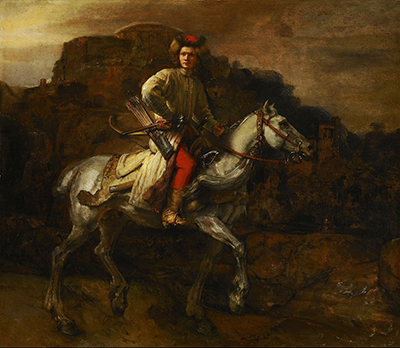
The Polish Rider is one of the most mysterious paintings connected with Rembrandt. A young horseman moves through a dark, unsettled landscape. He is armed, richly dressed and strangely calm. His horse steps forward, his head turns, and the rider looks outward with an expression that feels alert but unreadable.
The painting is in The Frick Collection in New York and is usually dated to about 1655. It is an oil on canvas, accession number 1910.1.98. Frick-linked and exhibition sources give slightly different measurements, but the picture is roughly 117 x 135 cm, or about 46 x 53 inches. Those facts are firm enough. Almost everything else is more difficult.
Who is the rider? Why is he dressed in Polish or eastern European military costume? Is the picture a portrait, an allegory, a historical image, a biblical allusion, or something deliberately suspended between categories? How much of the painting should be assigned to Rembrandt himself, and how should we understand the areas that look unfinished, restored or handled differently from the most brilliant passages?
Those questions are not distractions from the painting. They are the reason The Polish Rider has held attention for so long. The work is compelling because it looks specific without explaining itself. It gives the viewer enough evidence to look closely, but not enough to close the case.
Contents
- Introduction
- A Frick Painting With a Polish Past
- The Rider and His Costume
- Who Is the Polish Rider?
- Horse, Landscape and Movement
- Finish, Restoration and Condition
- The Attribution Debate
- Rembrandt, Workshop and the 1650s
- How to Look at The Polish Rider
A Frick Painting With a Polish Past
The Polish Rider entered Henry Clay Frick's collection in 1910 and has been one of the Frick's most famous Rembrandt paintings ever since. Before that, it had a long and important Polish history. Wawel Royal Castle's account of the work connects it with King Stanislaw II August Poniatowski's collection at the Lazienki Palace in Warsaw, where it was known as a Cossack on horseback. It later passed through Polish aristocratic ownership before reaching the Tarnowski family at Dzikow.
The painting's modern reputation grew sharply after the 1898 Rembrandt exhibition at the Stedelijk Museum in Amsterdam. By then it was already being seen through the name The Polish Rider. That title has stuck, even though it does not identify the sitter in the way a portrait title normally would.
This is important because the title can mislead a modern reader. It sounds descriptive and certain, but it is partly historical interpretation. The rider may be Polish, or dressed in a costume that seventeenth-century viewers associated with Polish or eastern cavalry. The title records a tradition of reading the picture, not a signed statement from Rembrandt.
At the same time, the Polish connection is not casual. The painting's history in Polish collections, its old title traditions, and the costume and equipment of the rider all make Poland central to the picture's reception. A vague "exotic costume" story is too weak for the evidence. The question is more interesting: why does a Dutch painting from about 1655 appear to know so much about a Polish-style horseman?
The Rider and His Costume
The first thing most viewers notice is the rider's poise. He is young, long-haired and finely dressed. He turns his head while the horse continues forward, as if he has seen or heard something beyond the frame. His expression is open, but not easy to read. He does not look like a victorious commander showing himself to the viewer. He looks like someone travelling through uncertain ground.
The costume and arms make the figure unusually vivid. Frick's archived exhibition text describes the rider as wearing Polish dress and carrying two swords, a war hammer and a quiver of arrows. Wawel's account gives a more specifically Polish reading, noting a padded and quilted zhupan, leather boots, red trousers, a fur-trimmed hat, a bow case, a quiver, sabres and a horseman's pick or war hammer.
Those details matter because they are not generic decoration. They point toward seventeenth-century Polish-Lithuanian military culture, especially light cavalry traditions. Wawel cites the work of Zdzislaw Zygulski Jr., who argued that the costume, arms, seat and even the horse suggested a Polish light cavalry officer. The argument does not settle the sitter's identity, but it explains why the painting has been so strongly claimed within Polish art-historical memory.
The rider's equipment also makes the image feel caught between portrait and romance. A portrait usually asks the viewer to recognise a person, a rank or a family role. This picture gives rank-like signs, but withholds a name. The weapons, cap, coat and saddle create specificity, while the landscape and silence push the image toward allegory or story.
That balance is one reason The Polish Rider does not behave like Rembrandt's usual portraits. It has the scale and presence of a major figure painting, but the sitter remains elusive. It asks the viewer to study costume as evidence, then refuses to let costume become a complete answer.
Who Is the Polish Rider?
Many identities and meanings have been proposed. The rider has been read as a Polish nobleman, a light cavalry officer, a Lisowczyk, a Christian knight, a symbolic soldier, a biblical or allegorical figure, and even, in some proposals, a figure connected to Rembrandt's own circle. Wawel's essay also raises possibilities such as the prodigal son crossing a boundary, a Miles Christianus or Soldier of Christ, and other biblical or symbolic readings.
The Lisowczyk idea is one of the most historically charged. The Lisowczycy were a Polish-Lithuanian light cavalry formation known for both military effectiveness and violence. The difficulty is chronology. Wawel notes that the formation had been disbanded by 1635, about twenty years before the painting was made. That does not make the visual association meaningless, but it makes a direct identification difficult.
This is where the painting resists easy classification. If it were a straightforward portrait of a known Polish nobleman, one would expect stronger documentary support. If it were pure allegory, the costume details might not need to be so persuasive. If it were a biblical subject, the signs are unusually indirect. If it were only a romantic image of a foreign rider, the painting's intensity would seem oddly specific.
The safest public reading is to keep the possibilities open. The picture may draw on real Polish or Polish-Lithuanian costume and cavalry imagery without preserving a certain sitter's name. It may turn historical dress into a moral or poetic image of youth, courage, travel or danger. It may also contain meanings that were clearer to its first viewers than they are now.
That uncertainty should not be treated as failure. Some paintings are powerful because their subject is solved. The Polish Rider is powerful because it remains coherent while unresolved. It shows a rider with extraordinary material specificity, then leaves his purpose suspended.
Horse, Landscape and Movement
The horse is not a neutral support for the rider. It gives the painting its slow forward motion. The animal steps through a dark landscape, while the rider's head turns away from the direction of travel. That difference creates tension. The horse moves on; the rider listens or looks elsewhere.
The landscape deepens the uncertainty. Frick's archived exhibition text points to barren nocturnal terrain, a domed citadel or fortified buildings on a hill, trees, a tower, a pool and a small fire. The setting feels half-real and half-imagined. It is not the clean setting of a formal equestrian portrait. It is a threshold landscape, a place of travel, risk and watchfulness.
The horse's body has also played a role in the attribution debate. Some passages look less resolved than the rider's face, costume and weapons. The hindquarters, legs, lower edge and parts of the landscape have attracted special attention. Later restoration and damage complicate the view further. The Art Newspaper's discussion of recent analysis and earlier Rembrandt Research Project literature notes the importance of a strip added to the bottom of the canvas and later work around the horse's feet.
This does not mean a viewer should stare only at the painting's problems. It means the painting's present appearance has a history. The difference between brilliant finish and sketchier handling may reflect Rembrandt's working process, studio participation, later completion, later damage, restoration, or some combination of those factors.
For a general reader, the practical lesson is simple: The Polish Rider should not be judged as if every inch of the canvas had the same status. Some areas are among the reasons the picture has been admired as Rembrandt; others are among the reasons it has been questioned.
Finish, Restoration and Condition
The painting's finish is one of its central mysteries. The rider's face, dress, weapons and equipment can appear precise and deliberate. Other areas are thinner, rougher or less resolved. Frick's exhibition text states that Rembrandt's handling and the degree of finish have been much debated, and that some areas have been considered unfinished or rapidly brought to completion by Rembrandt or another artist.
Wawel's account makes a similar point in accessible terms: the picture is not uniform. It notes possible unfinished areas, later additions, overcleaning and the addition of a narrow strip of canvas at the lower edge. It also stresses that some of the best-preserved and most carefully rendered elements, especially the rider's costume and equipment, still speak strongly for Rembrandt's authorship.
This is the right balance to keep. The painting's condition history should not be used to dismiss the whole work, and admiration should not be used to ignore the problem. Old Master paintings often reach us through damage, cleaning, lining, retouching and conservation. A famous painting may have inspired devotion for centuries while also carrying scars that affect how it is read.
The Polish Rider is an especially clear case because condition, finish and authorship are entangled. A poorly restored hoof is not evidence against Rembrandt's ability to paint horses. A sketchy passage is not automatically another painter's work. A brilliant passage is not by itself proof that every surrounding inch is autograph. Each kind of evidence needs to be held in proportion.
The painting rewards that patience. The viewer can admire the gleaming weapons, the white highlights, the red cap, the horseman's stillness and the eerie landscape while also recognising that the canvas is a complicated material object.
The Attribution Debate
The Polish Rider became famous not only as a beautiful painting, but as a test case in Rembrandt attribution. The debate intensified in the later twentieth century, especially around the Rembrandt Research Project and comparisons with Willem Drost, one of Rembrandt's pupils. The Art Newspaper notes that a 1984 comment by Josua Bruyn drew attention to affinities with Drost's early work, and that later discussion sometimes turned this into a more dramatic story than the evidence supported.
The important point is not that the painting was simply removed from Rembrandt and then restored. The history is more careful than that. The question has been how much of the work is by Rembrandt, whether parts may have been completed by another hand, whether later restoration altered key passages, and how unfinished areas should be understood.
The Rembrandt Database's note on the Frick Collection's five Rembrandt paintings confirms that The Polish Rider is a major documented Frick painting with rich art-historical, provenance and bibliographic material. It also acknowledges the debate around the subject. That database context matters because the painting is not a stray internet attribution problem. It sits inside serious Rembrandt documentation.
Recent commentary has also returned to the issue. The Art Newspaper summarises the later Rembrandt Research Project position as treating the painting as Rembrandt while noting that it was partly unfinished and completed in limited areas by a later hand. That phrasing gives a useful caution. It keeps Rembrandt central without pretending the painting is a simple, untouched autograph surface.
For this page, the best language is therefore careful: The Polish Rider is a Frick painting traditionally and still importantly connected with Rembrandt, but its finish, condition and possible participation by another hand have been central to modern discussion. It should not be presented in the same way as an uncontested, fully documented Rembrandt portrait.
Rembrandt, Workshop and the 1650s
The date around 1655 places The Polish Rider in one of the most difficult periods of Rembrandt's career. By the mid-1650s he was under financial pressure, and in 1656 he declared bankruptcy. It is tempting to connect every unusual element of the painting to that crisis, but caution is needed. A date near bankruptcy does not explain the whole picture.
Still, the context helps. Rembrandt was an artist with a workshop, pupils, patrons, debts, collectors, studio props and a market for powerful images in his manner. A painting could be made under practical pressure as well as artistic ambition. A work might be begun, revised, left unfinished, completed later, or altered after it left the studio.
The Polish Rider fits naturally beside the Rembrandt workshop and attribution story because it shows how difficult authorship can become even for a famous work. The question is not only "Rembrandt or not Rembrandt?" It is also "Which passages? In what condition? With what later changes? Under what working circumstances? Compared to which secure paintings?"
That makes the picture especially useful for readers learning how to approach Rembrandt. It is not a clean label exercise. It is an object that requires looking, history, conservation awareness and humility.
How to Look at The Polish Rider
Start with the rider's face. It is calm, youthful and outward-looking, but it does not offer a clear emotion. The figure is not triumphant, terrified or absorbed in battle. He seems aware, restrained and moving through something.
Then look at the costume. The cap, coat, weapons, quiver and saddle equipment carry much of the painting's meaning. They create the Polish or eastern cavalry association and explain why the title has been so durable. Notice how much narrative pressure comes from clothing and arms rather than from action.
Next, compare the rider with the horse and landscape. The rider is described with greater precision than many surrounding areas. The horse's body and the lower edge of the painting have been central to condition and attribution discussions. The landscape creates mood, but it is not fully explanatory. It gives the rider a world to move through, not a story with a clear destination.
Finally, hold the uncertainty together. The painting does not need to be reduced to one identity theory or one attribution headline. Its strongest effect comes from the way exact details and unresolved meaning coexist. The Polish Rider is a painting of movement, but art history has made it a painting of questioning as well.
Frequently Asked Questions About The Polish Rider
The rider has not been securely identified. He has been interpreted as a Polish nobleman or light cavalry officer, a Lisowczyk, a Christian knight, an allegorical figure, a biblical allusion or another symbolic traveller. None of these identifications is universally settled.
The title reflects the painting's historical reception and the rider's Polish or eastern European costume and equipment. It should not be read as a confirmed sitter name.
The painting is in The Frick Collection in New York. Henry Clay Frick acquired it in 1910, after its earlier history in Polish royal and aristocratic collections.
Some parts of the horse and lower canvas have been questioned because of finish, condition and later restoration. Those issues affect how the painting is read, but they do not erase the strength of the most admired passages.
Discussion
What feels most important in The Polish Rider: Rembrandt's light, the figure's expression, the material surface, the historical source, or the way the work sits beside his other paintings and prints?
Reader Insights
Begin with one detail in The Polish Rider, then move outward to light, gesture, surface and the surrounding space.
Connect the work to Rembrandt's biography, workshop, medium and the museum record rather than reading it as an isolated image.
Which detail changes the interpretation most once you know the date, subject, attribution history or present collection?
Join the Conversation
Have a thought or observation about The Polish Rider? Share it below. Thoughtful responses may be added to this section as the Rembrandt pages develop.
References
- Frick Collection, Rembrandt artist page and works list: https://www.frick.org/art/artists/rembrandt
- Frick Collection archived exhibition page, The Polish Rider: https://www.frick.org/sites/default/files/archivedsite/exhibitions/rembrandt/polish.htm
- Frick Collection publication, Rembrandt's Polish Rider: https://www.frick.org/publications/rembrandts_polish_rider
- Wawel Royal Castle, The King's Rembrandt at Wawel Castle: "The Polish Rider" from The Frick Collection: https://wawel.krakow.pl/en/exhibition-temporary/the-king-s-rembrandt-at-wawel-castle-the-polish-rider-from-the-frick-collection
- Rembrandt Database, The Frick Collection adds five paintings to The Rembrandt Database: https://rembrandtdatabase.org/in-focus/46-the-frick-collection-adds-five-paintings-to-the-rembrandt-database.html
- Rembrandt Database, The Polish Rider: http://www.rembrandtdatabase.org/Rembrandt/painting/201958/the-polish-rider
- The Art Newspaper, Noah Charney, Can AI shed new light on how much of The Polish Rider was painted by Rembrandt?: https://www.theartnewspaper.com/2024/12/01/can-ai-shed-new-light-on-how-much-of-the-polish-rider-was-painted-by-rembrandt
- Rembrandt Database, A Corpus of Rembrandt Paintings: https://rembrandtdatabase.org/literature/corpus.html
- National Gallery of Art, Washington, Issues of Attribution: Rembrandt and Workshop: https://www.nga.gov/research/publications/dutch-paintings-seventeenth-century/issues-attribution-rembrandt-workshop
 Rembrandt.jpg)