


 by Tom Gurney
Tom Gurney BSc (Hons) is an art history expert with over 20 years experience
Published on June 19, 2020 / Updated on August 9, 2026
Email: tomgurney1@gmail.com / Phone: +44 7429 011000
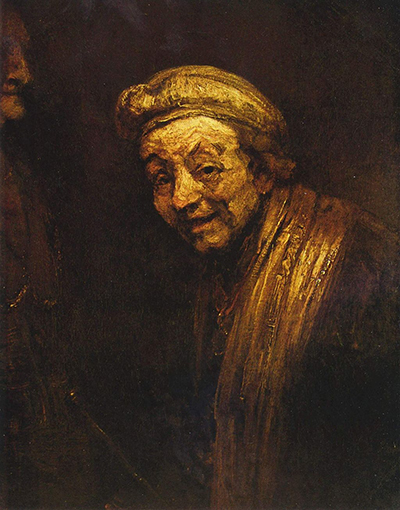
Self-Portrait as Zeuxis is one of Rembrandt's most enigmatic late self-images
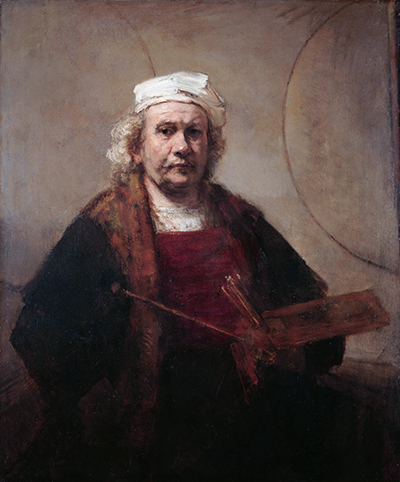
The later years of his career were dominated by self-portraits which were easy logistically to produce and also proved popular in the private art market around Amsterdam. There were around 80 self-portraits in total, which is certainly more than most artists have produced, though these were spread across several different mediums.
Rembrandt uses his trademark lighting techniques to apply focus to his own face, which in this case is themed as Zeuxis laughing. Perhaps having completed so many portraits of himself it was inevitable that he would seek to try new themes in order to keep his enthusiasm fresh.
The amusing tale behind this painting is clarified by the elderly lady who sneaks in from the left hand side of the composition. The story goes that antique painter Zeuxis would laugh himself to death after being commissioned to paint an old woman as the goddess of love. The cheeky grin Rembrandt displays in this self-portrait completes that representation.
This thought-proving piece can now be found at the Wallraf-Richartz-Museum & Fondation Corboud in Cologne for those looking to appreciate its full beauty in person. Naturally, art institutions regularly loan pieces between each other for exhibitions and so it is always advisable to check first before visiting if you are interested in seeing a specfic painting.
That said, the Wallraf-Richartz-Museum features a number of other significant artworks by the likes of Peter Paul Rubens, Jacob Jordaens, Frans Snyders and Antony van Dyck, Frans Hals, Gerard van Honthorst and Pieter de Hooch. There are also several other Rembrandt paintings in their impressive collection.
Object Notes and Research Context
The Wallraf-Richartz Museum identifies the Cologne painting as a late self-portrait, around 1668, oil on canvas, 82.5 by 65 cm, acquired in 1936 with the Carstanjen collection. The familiar title Self-Portrait as Zeuxis is interpretive rather than straightforward: the museum stresses that the work itself does not give a single unambiguous answer.
Several readings have been proposed for the shadowy form at the left edge, including Terminus, Heraclitus and the old woman from the ancient anecdote of Zeuxis. The Zeuxis reading connects Rembrandt with the Greek painter said to have died laughing while painting an old woman. If accepted, the picture becomes a late meditation on art, ageing, comic realism and the refusal of ideal beauty.
The title is therefore not a solved iconographic fact. Its strength is the puzzle: Rembrandt turns his own laughing, ageing face into a testing ground for what painting can reveal, conceal and joke about at the end of a career.
The Zeuxis title gives the page a rare classical afterlife. According to ancient anecdote, Zeuxis laughed himself to death while painting an old woman, so a Rembrandt self-portrait under that title becomes a joke about age, art and unidealised truth. The uncertainty around the left-hand figure is part of the appeal, because the picture refuses a single tidy caption.
This late self-image should also link back to the early etched expression studies. Across his career, Rembrandt used his own face to test emotion, role and painterly surface. By the 1660s that practice had become darker and more philosophical: laughter is still there, but it is bound to ageing, artistic judgement and the knowledge that the painter's own body is now the subject.
The laughter is not simply cheerful. In the Zeuxis tradition, laughter is bound to artistic judgement, age and mortality. That complexity makes the work a stronger late self-portrait page than a short anecdote about Rembrandt laughing at himself.
Within Rembrandt's self-portraits, the work is a late interpretive problem. It belongs with Rembrandt's lifelong self-study, but its title, laughter and possible classical disguise make it more complex than a straightforward autobiographical likeness.
Further Rembrandt Context
This shorter legacy page remains part of the Rembrandt archive. For fuller context, use the refreshed Rembrandt pages below, which explain the artist's biography, media, technique, attribution issues and major works in greater depth.
For secure object data, attribution and collection history, compare Self-Portrait as Zeuxis Laughing with the relevant museum or catalogue record before treating older page text as final.
 Rembrandt.jpg)
Discussion
What feels most useful when looking at Self-Portrait as Zeuxis Laughing: the subject, the handling of light, the medium, the attribution history, or its place within Rembrandt's wider painting output?
Reader Insights
Set this page beside the refreshed Rembrandt hubs before relying on older summaries alone.
Rembrandt pages often need museum records, catalogue history and attribution caution, especially where older sources use broader labels.
Which detail would you most want clarified next: date, medium, collection, attribution, subject, condition or comparison with another Rembrandt work?
Join the Conversation
Have a thought or observation about Self-Portrait as Zeuxis Laughing? Share it below. Thoughtful responses may be added as the Rembrandt archive continues to be reviewed.