


 by Tom Gurney
Tom Gurney BSc (Hons) is an art history expert with over 20 years experience
Published on June 19, 2020 / Updated on August 9, 2026
Email: tomgurney1@gmail.com / Phone: +44 7429 011000
Rembrandt Self-Portrait with Beret and Turned-Up Collar: Introduction
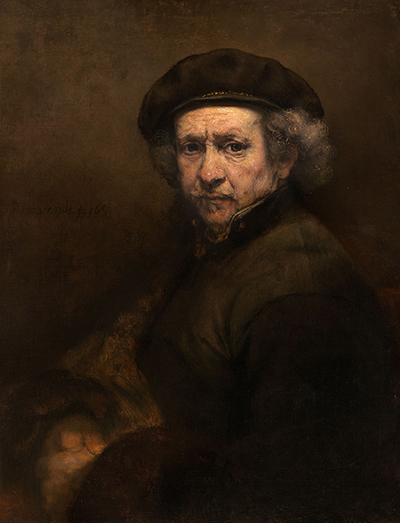
Rembrandt's Self-Portrait with Beret and Turned-Up Collar is officially titled simply Self-Portrait by the National Gallery of Art, Washington. The familiar descriptive name is useful because it points to what viewers notice first: the broad beret, the raised collar, the shadowed body and the older painter's steady look. The museum record anchors the object itself: Rembrandt van Rijn, Self-Portrait, 1659, oil on canvas, 84.5 x 66 cm, accession 1937.1.72, Andrew W. Mellon Collection.
The painting belongs to the last decade of Rembrandt's life, but it should not be treated as a private confession with a single emotional meaning. It was made after financial crisis and loss, yet the picture is more than a sad face. It is also a statement about artistic authority. Rembrandt uses costume, light, pose and paint surface to place himself inside a long tradition of learned painters while still making the encounter feel immediate.
That balance is what makes the work so compelling. The face is old and close. The costume carries memory. The hands and body are subdued. The surface is alive with thick paint, thin paint, scratched lines and later reworking. The painting asks to be read as a self-portrait, a late work, a technical object and a reflection on what it meant for Rembrandt to keep presenting himself as a painter.
Contents
- Introduction
- What The Painting Shows
- A Late Self-Portrait, Not A Simple Confession
- Beret, Collar And Old Master Memory
- The Gaze
- Hands, Body And Shadow
- How The Surface Is Made
- Abrasion And The 1992 Treatment
- Among Rembrandt's Late Self-Portraits
- Why This Self-Portrait Matters
What The Painting Shows
Rembrandt is shown from about the waist up, turned slightly to the viewer's left while his head faces outward. His eyes meet the viewer directly. The skin is worked with strong modeling around the brow, nose, cheeks and mouth. Gray hair escapes beneath the beret. The collar rises around the neck, making the head seem more firmly framed against the brown background.
The body is quieter than the face. The coat and background share a dark tonal range, so the figure does not separate cleanly from the surrounding space. The folded or clasped hands sit low in the composition and are much less sharply described than the head. This difference matters. Rembrandt does not distribute attention evenly. He builds the painting so the viewer moves first to the gaze, then outward to costume, shoulder, hands and surface.
The result is direct without being simple. The painting does not flatter Rembrandt, but it also does not diminish him. Wrinkles, heavy eyelids, sunken cheeks and gray facial hair are visible, yet they are handled with a painter's confidence. The visible brushwork in the face does not hide age. It makes age the place where skill becomes most legible.
A Late Self-Portrait, Not A Simple Confession
The date, 1659, gives the painting unavoidable biographical force. Rembrandt was in his early fifties, and his financial collapse was recent. His possessions and house had been sold, and he had moved into more modest circumstances. A viewer who knows this history naturally feels the pressure of it in the self-portrait.
Yet the National Gallery of Art catalogue warns against letting biography take over the picture. Rembrandt's life has often been romanticized, and this painting has especially invited tragic readings. Earlier viewers saw a dark, brooding image, but the painting's appearance had been affected by discolored varnish and overpaint. After treatment in 1992, the face regained a richer range of pinks and flesh tones, changing the emotional temperature of the picture.
That does not mean the painting is cheerful. It means that its seriousness is pictorial rather than merely biographical. Rembrandt uses a direct gaze, compressed pose and dense face modeling to produce presence. The effect may feel grave, but it is not evidence that the painting simply records despair. It is a constructed image, made by an artist who understood how viewers read faces and how easily a self-portrait can become a story about fate.
This distinction is important for Rembrandt's self-portraits more broadly. They are connected to life, but they are not diary entries. Across paintings, drawings and etchings, Rembrandt used his own face for expression, costume, experiment, market identity and artistic self-definition. The 1659 picture is one of the strongest examples because it turns personal likeness into a claim about endurance.
Beret, Collar And Old Master Memory
The beret and raised collar are not casual accessories. They help Rembrandt present himself as a painter with historical authority. The National Gallery of Art catalogue places the pose and costume in relation to Raphael's portrait of Baldassare Castiglione and to Titian's portrait then known as Ariosto. Rembrandt had already absorbed such Renaissance models in earlier self-portraiture, including works from 1639 and 1640.
By 1659, the relationship is more restrained. The picture does not lean on elegant display or polished courtly pose. The stone ledge and more elaborate Renaissance references that shaped earlier works have largely fallen away. What remains is a quiet, frontal force: the beret framing the head, the body turned at an angle, the clasped hands and the gaze pressing outward.
This old-master memory matters because it prevents the self-portrait from being read only as a record of hardship. Rembrandt is not simply saying, "This is what has happened to me." He is placing himself among painters who used portraiture to convey intellect, dignity and self-command. The reference to Raphael and Titian is not imitation for its own sake. It is Rembrandt using admired models to think about his own status as an artist.
The turned-up collar intensifies that effect. It covers the neck and creates a dark base for the illuminated face. It also gives the figure a kind of guardedness. The viewer sees the face clearly, but the body is protected, shadowed and partially withheld. The costume is theatrical enough to matter, but not so theatrical that it turns the picture into masquerade.
The Gaze
The gaze is the painting's center. Rembrandt looks out with deep-set eyes under a furrowed brow. The eyes are not wide or dramatic. They are steady, compressed and alert. Much of the picture's force comes from the fact that the gaze does not need obvious theatrical expression to hold attention.
Earlier commentators responded strongly to this look, and it is easy to see why. Rembrandt had spent decades studying faces, including his own. He understood how eyelids, brow, cheek and mouth could make looking itself feel active. Here the eyes do not merely identify the sitter. They create a relationship between sitter and viewer.
But the gaze should not be over-translated into a single feeling. It may seem sad, weary, proud, questioning or guarded depending on the viewer's expectations. The painting supports seriousness, but it resists a neat emotional label. This is one reason the 1992 treatment matters. Once the darkened varnish and overpaint were removed, the face no longer read as heavily as earlier viewers had assumed. The gaze remained intense, but the image became less trapped in a single tragic mood.
Rembrandt's best self-portraits often work this way. They invite biographical response while also exposing the instability of that response. The viewer feels addressed by the face, then has to ask how much of that feeling comes from paint, how much from history and how much from the desire to find Rembrandt's inner life in his features.
Hands, Body And Shadow
The hands are easy to miss because the face commands so much attention. They sit low, broadly indicated and partly absorbed into shadow. In many portraits, hands announce status, profession, wealth or character. Here they are present but restrained. They help stabilize the composition without competing with the head.
The National Gallery of Art catalogue notes that treatment in 1992 removed overpaint that had flattened the torso. With the body clarified, the head appeared more firmly set on the figure, and the light also began to register on the left shoulder and the clasped hands. This is a useful reminder that composition is not only an idea. It depends on condition. A darkened or flattened passage can change how a viewer understands the figure's posture and weight.
The body in this self-portrait is therefore both substantial and elusive. Rembrandt gives enough form to make the head feel grounded, but he does not turn the torso into a display of costume detail. The dark coat merges with the background, and the collar creates a bridge between flesh and shadow. The painting's authority comes from this compression: a strong head, a quiet body, a few decisive accents of light.
This relation between head and body also helps connect the painting to Rembrandt's late art. In many late works, the body is not polished from edge to edge. Parts emerge with intensity, while other parts remain broad or dim. The viewer is not asked to admire finish everywhere. The viewer is asked to notice where the painting concentrates life.
How The Surface Is Made
The technical evidence recorded by the National Gallery of Art makes this painting especially rewarding to study. The support is a plain-woven fabric that has been lined, and the original tacking margins have been removed. The painting has a double ground: a thick reddish-brown lower layer and a very thin light-gray layer above it. This prepared surface gave Rembrandt a tonal base on which he could build both dark costume and illuminated flesh.
The design was sketched in transparent brown underpaint, and some of that brown layer remains visible in parts of the sleeve and around areas such as the nostrils, mouth and neck near the collar. This matters because the painting is not built only by covering one layer with another. It allows earlier stages to remain part of the final effect.
The face is handled differently from the background and hands. The figure was painted with opaque, broad, flat brushstrokes, while the background and hands were painted thinly. In the face, Rembrandt used rich impasto for highlights, with short strokes swirled wet-into-wet rather than blended smooth. That surface gives the head a physical presence. The paint catches light as substance, not just as color.
The hair shows another kind of touch. Fine brushstrokes are combined with lines incised into wet paint with the butt end of a brush. Those scratched lines give the curls under the beret a wiry rhythm. They also show Rembrandt thinking with tools. A brush is not only for laying paint down. Turned around, it can cut through paint and make light out of exposed edges.
The beret itself carries evidence of change. The catalogue records white paint under the present dark beret, suggesting that Rembrandt first planned it in a lighter color. That change is valuable because it shows the image being adjusted during the making. The familiar dark beret was not simply filled in from a fixed plan. It was reached through revision.
Abrasion And The 1992 Treatment
The painting is not in untouched condition. The face and hands are largely intact, but much of the figure and the background at the left have suffered from abrasion. Some exposed brown sketch areas are abraded enough that their original force has been reduced. The work also carried discolored varnish and overpaint that affected how it was read.
The 1992 treatment removed discolored varnish and overpaint. It did not erase every sign of damage or every trace of earlier intervention. The blackish paint to the left of the figure and a patchy semi-opaque coating applied in an earlier treatment to disguise abrasion were left in place. That restraint is important. Conservation is not a fantasy of returning a painting to a perfect first day. It is a set of careful decisions about what can be understood, what can be removed and what should remain.
For this self-portrait, the treatment changed interpretation as well as appearance. The face became less heavily darkened, and the relationship between head, torso, shoulder and hands became clearer. Viewers could still see a grave late image, but they no longer had to read it through the exaggerated gloom produced by old varnish and retouching.
This is why technical and conservation evidence belongs in the main story of the painting. It is not a specialist aside. The painting's condition shaped the myths around it, and treatment helped correct some of those myths. Rembrandt's self-fashioning is in the original paint, but later materials also helped create the Rembrandt that viewers thought they saw.
Among Rembrandt's Late Self-Portraits
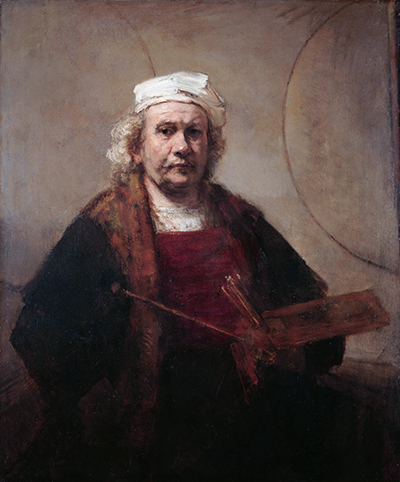
The 1659 Self-Portrait belongs within a larger late group. The National Gallery of Art catalogue connects it to the self-portrait in the Frick Collection from around 1658 and to the later Kenwood self-portrait often known as Self-Portrait with Two Circles. These works do not repeat the same formula. Together, they show Rembrandt testing different ways to present artistic identity in old age.
The Kenwood painting makes the painter's profession explicit through tools and the mysterious circles behind him. The Washington painting is quieter. It does not need studio equipment or an obvious allegorical setting. Costume, pose, gaze and paint surface carry the argument. Rembrandt appears as an old painter, but also as someone knowingly positioned within a tradition of painterly dignity.
This is also why the painting belongs with Rembrandt's self-portraits, not only with his biography. Biography can explain insolvency, family, late work and changing circumstances. Self-portraiture asks a different question: why did Rembrandt return to himself so often, and how did those images shift across media and decades?
The 1659 picture answers by combining vulnerability with control. The face bears age, but the picture does not surrender to decline. The paint is bold, the old-master reference is learned, and the direct gaze remains uncompromising. Rembrandt makes the viewer confront a likeness that is both personal and art-historical.
Why This Self-Portrait Matters
Self-Portrait with Beret and Turned-Up Collar matters because it gathers so many Rembrandt questions into one concentrated image. It belongs to the history of self-portraiture. It belongs to the late paintings. It belongs to the story of Rembrandt's financial crisis and later years. It belongs to the technical history of grounds, underpaint, impasto, incised wet paint, abrasion and restoration.
Most of all, it shows how carefully Rembrandt could turn looking into meaning. The painting does not need a large narrative, dramatic gesture or crowded composition. It uses the face, beret, collar, hands and dark body to make an image of presence under pressure.
It is tempting to stand before the painting and ask what Rembrandt felt. The better first question may be how Rembrandt made the picture capable of producing that temptation. He draws the viewer toward biography, then complicates it through old-master memory, technical confidence and the visible intelligence of paint. The result is one of his most powerful late self-images: not a confession, not a costume piece, but a disciplined act of self-presentation.
Frequently Asked Questions About Rembrandt's Self-Portrait With Beret And Turned-Up Collar
Rembrandt painted it in 1659, during the last decade of his life and after the financial crisis that forced the sale of his house and possessions.
The painting is in the National Gallery of Art, Washington. It is accession number 1937.1.72 and belongs to the Andrew W. Mellon Collection.
The painting uses a double ground, transparent brown underpaint, broad brushwork, thick impasto in the face, wet-into-wet handling and incised lines in the hair made with the butt end of a brush.
Yes. Treatment in 1992 removed discolored varnish and overpaint, making the face less dark and helping clarify the relation between the head, torso, shoulder and hands. The treatment weakened overly tragic readings based on the painting's formerly darkened appearance.
Discussion
What feels most important in Rembrandt Self-Portrait with Beret and Turned-Up Collar: Rembrandt's light, the figure's expression, the material surface, the historical source, or the way the work sits beside his other paintings and prints?
Reader Insights
Begin with one detail in Rembrandt Self-Portrait with Beret and Turned-Up Collar, then move outward to light, gesture, surface and the surrounding space.
Connect the work to Rembrandt's biography, workshop, medium and the museum record rather than reading it as an isolated image.
Which detail changes the interpretation most once you know the date, subject, attribution history or present collection?
Join the Conversation
Have a thought or observation about Rembrandt Self-Portrait with Beret and Turned-Up Collar? Share it below. Thoughtful responses may be added to this section as the Rembrandt pages develop.
References
- National Gallery of Art, Washington, Self-Portrait, 1659, accession 1937.1.72: https://www.nga.gov/artworks/79-self-portrait
- National Gallery of Art, Washington, Arthur K. Wheelock Jr., Rembrandt van Rijn, Self-Portrait, 1659, in Dutch Paintings of the Seventeenth Century: https://www.nga.gov/research/publications/dutch-paintings-seventeenth-century/rembrandt-van-rijn-self-portrait-1659
- Rembrandt Database, mission and scope: https://rembrandtdatabase.org/about/mission-and-scope.html
- Rembrandt Database, A Corpus of Rembrandt Paintings: https://rembrandtdatabase.org/literature/corpus.html
- English Heritage, Kenwood Rembrandt self-portrait route: https://production.english-heritage.org.uk/visit/places/kenwood/history-stories-kenwood/rembrandt-self-portrait/
- National Gallery, London, Self Portrait at the Age of 63: https://www.nationalgallery.org.uk/paintings/rembrandt-self-portrait-at-the-age-of-63
 Rembrandt.jpg)