by Tom Gurney
Tom Gurney BSc (Hons) is an art history expert with over 20 years experience
Published on June 19, 2020 / Updated on October 14, 2023
Email: tomgurney1@gmail.com / Phone: +44 7429 011000
The Balcony
Three brightly lit coffins occupy the balcony in René Magritte’s The Balcony. One bends forward over the seat of a chair. Two stand upright behind and beside it, while a fourth dark shape stands deeper inside the opening. The green railing runs across all of them. We stand in front of a group that has the arrangement of a portrait and the stillness of furniture.
The Museum of Fine Arts Ghent holds this oil on canvas as Perspective II. Manet’s Balcony, inventory 1961-A. Its collection record gives circa 1950, and the inscription on the reverse includes the year 1950 and the number II. The Flemish Art Collection identifies it as the second version, following one made in 1949. The balcony and its arrangement come from Édouard Manet’s Le Balcon, painted in 1868–69 and now in the Musée d’Orsay. [1] [2] [3]
At a Glance
- Catalogue titlePerspective II. Manet’s Balcony
- DateCirca 1950, with 1950 inscribed on the reverse
- MediumOil on canvas
- CollectionMuseum of Fine Arts Ghent, 1961-A
Selected works
The Gradation of Fire
1938 or 1939 in the catalogue indexThe Therapist
1941The Balcony
Circa 1950, with 1950 inscribed on the reverseThe Pilgrim
1966Contents
The railing and the figures behind it
The railing is the first continuous line across the scene. Two green bars cross the coffins at about the same level, and diagonal rods form a repeating pattern beneath them. The rods pass in front of the objects and the chair and cut across the open space below. This gives the balcony a definite front edge. Everything else gains a place in relation to that edge, even when the dark interior supplies few clues to the depth of the room.
The shutters do a similar job at either side. Their repeated horizontal slats mark the edges of the opening. The left shutter is broader in view, while the right occupies a narrow strip. In the lower left corner, a potted plant gives a smaller point of reference. Its leaves and flowers break the hard lines of the ironwork. The pot sits low enough to make the coffins behind it look tall. Those ordinary details hold the setting together while the group becomes more difficult to read as part of a domestic scene.
The nearest coffin has the most unusual shape. A broad upright section comes down to a bend close to the railing. The lower part angles outward over the seat and down towards the floor. This is close to the position of a body sitting on a chair. The dark chair is visible at the side and between the rods. We can see enough of it to recognise how a seated figure would be supported. The straight boards and visible fastenings turn the bends of that pose into something we can follow as a construction.
The two brighter upright coffins give the seated one a scale. The back one rises above the others, with its top set against the darkness. At the right, the pale edge of another catches the light near the shutter. The fourth is much less distinct. It sits to the left in the dark opening and is easier to see once we have recognised the outlines of the three in front. The distribution of light gives a sense of people standing at different depths, even though we are looking at objects that show no expressions or gestures.
Watch: Understanding Magritte
Three complementary films introduce the artist, explore words and images, and examine a painting’s materials. These are broader Magritte comparisons, alongside the work discussed here.
René Magritte: Great Art Explained
An introduction to Magritte’s life, characteristic images and visual puzzles.
Watch on YouTubeWhat Magritte kept from Manet
In Manet’s painting, Berthe Morisot sits at the front left, with Fanny Claus and Antoine Guillemet behind the railing. Another figure is barely visible in the interior. The Musée d’Orsay notes that the painting puzzled viewers at the Salon of 1869. The people appear together without an obvious exchange between them. Their positions, the green ironwork and the dark opening are enough to give the scene its structure. [3]
Comparing the two pictures shows how much of that structure Magritte keeps. The potted plant still has its place at the bottom left, and the shutters still carry the green of the railing upwards. The main alteration comes where we would expect heads, clothes and hands. Magritte gives each coffin a position that can still be compared with a pose. The seated one retains the bending outline of the figure at the front. The more distant shape can be found in roughly the same part of the shadows as Manet’s fourth figure. Recognising the source makes it possible to read a group of objects as a set of replacements, one position at a time. [1] [3]
The wood surface also changes what we can learn by looking at each place. The coffins have differences of height, angle and light, and the fastenings pick out their construction. Manet’s figures give us faces and clothing that can be followed one by one. Magritte’s group depends on the surrounding picture and on the turns of the wood for much of its individuality. Look at the repeated metal studs and the same details that make the coffins resemble one another also help us see which surface faces the light.
The light also changes how the group separates from the interior. In Manet, pale clothes occupy large areas along the railing and dark clothing partly merges with the doorway. Magritte gives much of that contrast to the boards. The two sides of an upright coffin can look quite different where they meet at a ridge. The nearest coffin has a bright front and a darker side that nearly disappears into the chair. The coffins begin to look less alike when we follow those small differences in illumination. A single lighted plane might seem to point straight out at us, while another angles into the room. Those shifts in direction take the place of some of the differences among the figures in Manet. [1] [3]
From a sketchbook to the second version
Ghent also holds a sketchbook sheet with studies for the composition. Its account says that one of the studies contains two coffins, with one placed on the other’s lap. The idea was therefore tried with a different arrangement before the four positions became part of the version shown here. The museum groups the oil with Magritte’s Perspective paintings, in which coffins take the places of figures in existing works. On this balcony the rail and the chair do much of the work of making the change visible. They tell us where the group would sit and stand. The form of each coffin gives us something we can compare with that remembered position. [1] [4]
Magritte artworks directory
| Name | Date | Medium |
|---|---|---|
| Memory of a Voyage | 1963 | Oil on canvas |
| The Blood of the World | 1927; also catalogued as 1926–27 | Oil on canvas |
| The Hunters at the Edge of Night | Paris, 1928 | Oil on canvas |
| The Empty Picture Frame (La saignée) | 1938–39 | Gouache on paper |
| The Glass House | 1939 | Gouache on paper |
| Oasis | 1926 in the illustrated Christie’s catalogue | Oil on canvas |
| Natural Encounters | 1945 | Oil on canvas |
| Attempting the Impossible | 1928 | Oil on canvas |
| On the Threshold of Liberty | 1930 | Oil on canvas |
| The Titanic Days | 1928 | Oil on canvas |
| The Voice of Space | 1931 | Oil on canvas |
| Unexpected Answer | 1932 in the museum catalogue, 1933 on the reverse | Oil on canvas |
| Elective Affinities | 1932 in MoMA’s checklist, also published as 1933 | Oil on canvas |
| The Human Condition II | 1935 | Oil on canvas |
| The Six Elements | 1929 | Oil on canvas |
| The Happy Donor | 1966 | Oil on canvas |
| Clairvoyance (Self Portrait) | Brussels, 1936 | Oil on canvas |
| Philosopher’s Lamp | 1936 | Oil on canvas |
| The Annunciation | Paris, 1930 | Oil on canvas |
| The Lost Jockey | Circa 1942 in the illustrated lot catalogue | Gouache on paper laid down on canvas |
| Homage to Mack Sennett | 1936 in the Thyssen catalogue | Oil on canvas |
| Discovery | 1927 | Oil on canvas |
| Collective Invention | 1935 in the later catalogue index | Oil on canvas |
| The Wonders of Nature | 1953 | Oil on canvas |
| The Balcony | Circa 1950, with 1950 inscribed on the reverse | Oil on canvas |
| The Pilgrim | 1966 | Oil on canvas |
| The Invention of Life | 1928 | Oil on canvas |
| The Therapist | 1941 | Gouache on paper |
| The Gradation of Fire | 1938 or 1939 in the catalogue index | Gouache on paper |
| A Friend of Order | 1964 | Oil on canvas |
| The Poetic World | 1939 in Hammacher’s illustrated monograph | Gouache |
| The Muscles of the Sky | Paris, 1927 | Oil on canvas |
| The Battle of the Argonne | 1959 | Oil on canvas |
| Meditation | 1936 | Oil on canvas |
| The Domain of Arnheim | 1962 | Oil on canvas |
| This Is Not an Apple | 1964 | Oil on Unilite |
| The Meaning of Night | Brussels, 1927 | Oil on canvas |
| The Pleasure Principle (Portrait of Edward James) | 1937 | Oil on canvas |
| Ready Made Bouquet | 1957 | Oil on canvas |
| Popular Panorama | 1926 | Oil on canvas |
| Memory of a Journey | 1955 in the Thyssen catalogue. Tentatively 1958 in the catalogue index. | Gouache on paper, as exhibited at the Thyssen |
| Sheherazade | 1947 | Gouache on paper |
| The Difficult Crossing | 1926 | Oil on canvas |
| The Fair Captive | 1948 in the catalogue raisonné | Oil on canvas |
| The Birth of the Idol | 1926 | Oil on canvas |
| Hegel’s Holiday | 1958 | Oil on canvas |
| Homesickness | 1941 | Oil on canvas |
| The Rape (Le Viol) | 1934 | Oil on canvas |
| The Art of Living | 1967 | Oil on canvas |
| Secret Life IV | 1928 | Oil on canvas |
| The Tomb of the Wrestlers | 1960 | Oil on canvas |
| Young Girl Eating a Bird (The Pleasure) | 1927 | Oil on canvas |
| The Central Story | 1928 | Oil on canvas |
| The Seducer | 1953 | Oil on canvas |
| The Telescope | 1963 | Oil on canvas |
| The Banquet | 1958 | Oil on canvas |
| The Empty Mask | 1928 | Oil on canvas |
| The Cultivation of Ideas | 1927 | Oil on canvas |
| The Enchanted Pose | 1927 | Oil on canvas |
| The Future of Statues | 1937 | Oil on plaster |
| The Return of the Flame | 1943 | Oil on canvas |
| The White Page | 1967 | Oil on canvas |
| The Large Family | 1963 | Oil on canvas |
| Black Magic | 1945 | Oil on canvas |
| Les Amants I | 1928 | Oil on canvas |
| Man in a Bowler Hat | 1964 | Oil on canvas |
| The Portrait | 1935 | Oil on canvas |
| The Sixteenth of September | 1956 | Oil on canvas |
| Heartstrings | 1960 | Oil on canvas |
| The Present | 1939; also dated 1938 or 1939 | Gouache on paper |
| Act of Violence | 1932 | Oil on canvas |
| Fashionable People | 1950, in the 2016 thesis caption | Medium unconfirmed · Attribution follows the published caption |
| The Representation | 1962 | Oil on canvas |
| Memory | 1948 | Gouache on paper |
| The Mysteries of the Horizon | 1955 | Oil on canvas |
| Portrait of Stephy Langui | 1961 | Oil on canvas |
| The Double Secret | 1927 | Oil on canvas |
| Every Day | 1966 | Oil on canvas |
| The Invisible World | 1954 | Oil on canvas |
| Dawn of Cayenne | 1926 | Oil painting |
| Clear Ideas | 1955 (inscribed); possible 1958 execution | Oil on canvas |
| The Face of Genius | 1926 / 1927 | Oil on canvas |
| Good Faith | 1965; earlier record 1964–65 | Oil on canvas |
| The Flash | 1959 | Gouache and pencil on paper |
| Perpetual Motion | 1935; earlier catalogue 1934 | Oil on canvas |
| Personal Values | 1952 | Oil on canvas |
| Not to Be Reproduced | 1937 | Oil on canvas |
| The Red Model | 1935 | Oil on canvas |
| The Menaced Assassin | 1927 | Oil on canvas |
| The Castle of the Pyrenees | 1959 | Oil on canvas |
| The Blank Signature | 1965 | Oil on canvas |
| The Listening Room | 1958 | Oil on canvas |
| Golconde | 1953 | Oil on canvas |
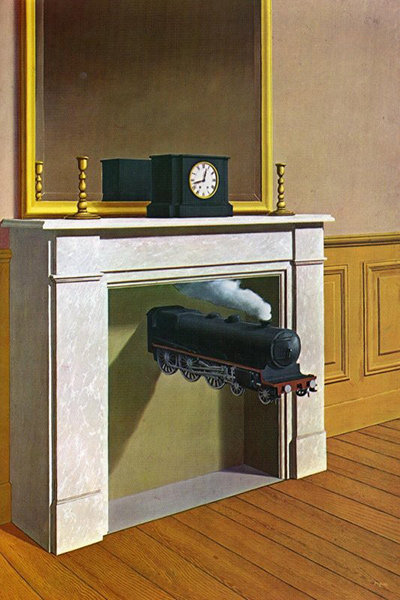
| Time Transfixed | 1938 | Oil on canvas |
| The Treachery of Images | 1929 | Oil on canvas |
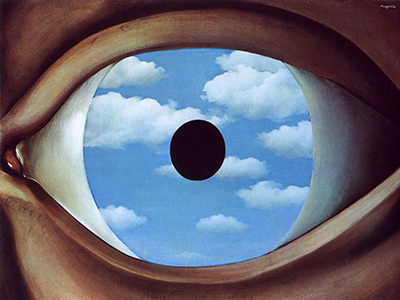
| The False Mirror | 1929 | Oil on canvas |
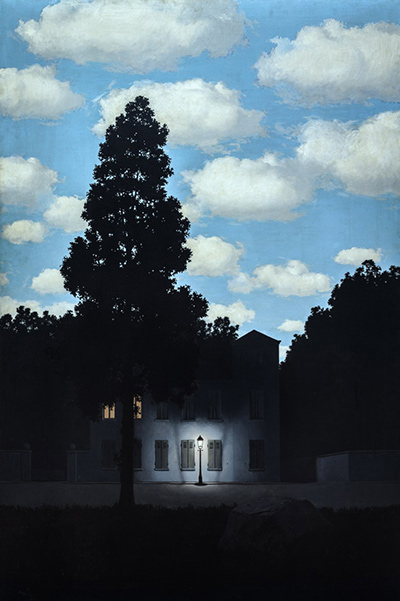
| The Empire of Light | 1953–54 | Oil on canvas |
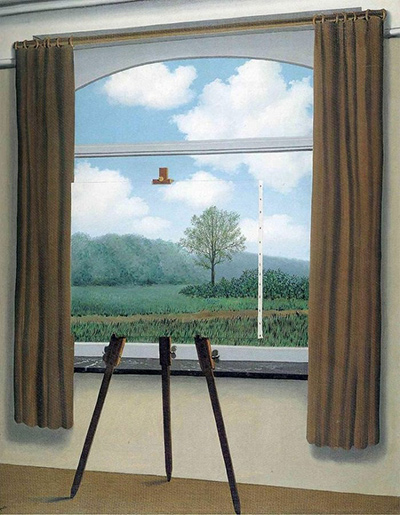
| The Human Condition | 1933 | Oil on canvas |
| Les Amants | 1928 | Oil on canvas |
| The Son of Man | 1964 | Oil on canvas |
Frequently Asked Questions
This is Ghent’s second version, inventory 1961-A. The reverse inscription includes the year 1950 and the number II.
The composition revisits Édouard Manet’s Le Balcon, painted in 1868–69 and now in the Musée d’Orsay.
Discussion
Look closely and compare your reading with others.
Reader Insights
Which part of the setting first makes the coffins read as a group?
How does the seated coffin change when you follow the shape of the chair behind it?
Which detail makes the connection with Manet most apparent?
Join the Conversation
Share a detail, comparison or question about The Balcony below.
References
- Museum of Fine Arts Ghent. Perspective II. Manet’s Balcony. Collection record and reverse inscription, 1961-A. View source.
- Flemish Art Collection. “René Magritte, Perspective II-Manet’s Balcony, 1950, MSK Gent.” Illustrated collection essay. View source.
- Musée d’Orsay. Édouard Manet, Le Balcon. Collection record, RF 2772. View source.
- Museum of Fine Arts Ghent. Page from a Sketchbook with Three Studies among Others for “Perspective: Manet’s Balcony”. Collection record, 2010-B-recto. View source.