by Tom Gurney
Tom Gurney BSc (Hons) is an art history expert with over 20 years experience
Published on June 19, 2020 / Updated on November 5, 2026
Email: tomgurney1@gmail.com / Phone: +44 7429 011000
René Magritte Quotes and Their Context
Magritte's words are most useful when they send us back to a picture. A sentence on a canvas can interrupt the act of recognition. A remark about an image can tell us where the artist was looking when he began to paint it. And a lecture can show how he understood the habits of thought that his paintings disturb.
These passages come from a painting, an illustrated essay, a public lecture, a published interview and a museum learning resource. Their settings matter. We can see an inscription on an object for ourselves. A museum's English rendering of a remark gives us something different, particularly when the occasion on which it was made is unknown.
At a Glance
- Painted inscriptionThe Treachery of Images, 1929
- Illustrated essayLes mots et les images, 1929
- Public lectureLa Ligne de vie, Antwerp, 1938
- Published interviewLes Beaux Arts, 1939
Contents
The painted sentence beneath the pipe
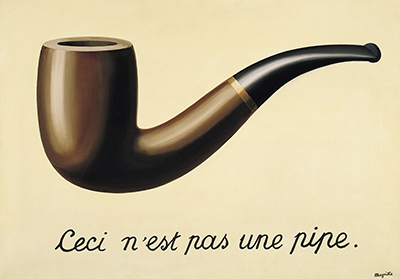
“Ceci n'est pas une pipe” — “This is not a pipe.”
The sentence appears beneath a smoking pipe in The Treachery of Images, the 1929 oil painting at the Los Angeles County Museum of Art. We know where the words come from because they are still there, in flowing script below the painted bowl and stem. [1]
The pipe is easy to recognise. What the sentence unsettles is the step from seeing the shape to saying what is there. If someone asks what the painting shows, “a pipe” is an ordinary and helpful answer. If someone asks whether the thing in front of us can be filled with tobacco, the answer changes. Magritte gives those two senses of recognition room to collide. The pipe looks persuasive enough that the contradiction can register before we work out where it lies.
The lettering matters as much as the wording. It is legible and carefully placed. The open ground gives it the sort of space that a straightforward label might occupy. Our eyes can move from the pipe down to the sentence and back again without ever leaving the picture. That short journey makes us aware of two familiar habits, reading an image quickly and expecting the writing beneath it to settle what we have seen.
What words are made of in a painting
“Dans un tableau, les mots sont de la même substance que les images” — “In a painting, words are made of the same substance as images.”
This is Magritte writing in Les mots et les images, a two-page illustrated essay in the December 1929 issue of La Révolution surréaliste. The English here is a translation of the French. The essay puts short propositions beside drawings. Several of them try out different arrangements of objects, names and images, so the reader can test the proposition on the page. [2]
When we recognise a painted word, we may forget that its letters reach us as lines and shapes. The hand that gives the pipe its visible outline can also trace the letters underneath. The line that curves to form part of a letter has to be painted just as surely as the rim of the bowl. Meaning comes to us through marks in both cases, even though we read the two sets of marks in quite different ways.
The small drawings in the essay extend that observation. Magritte tries out occasions when a name can do the work of a picture or a picture can occupy a word's place in a proposition. Read the sequence across both pages and it becomes apparent that each pairing is a local experiment. A reader can try it again with another word and another image. On the canvas at LACMA, that freedom is tightly controlled. The pipe looks like a single readily identifiable thing, and the sentence keeps drawing our attention back to it.
Speaking to a room in Antwerp
“Mesdames, Messieurs, Camarades” — “Ladies, gentlemen, comrades.”
Magritte opened his Antwerp lecture La Ligne de vie with that address on 20 November 1938. The Royal Museum of Fine Arts Antwerp publishes a French excerpt. In the opening passage, he looks out from the subject of painting to a world he considers incoherent, including the paradox of preparing for war in the name of preventing it. He goes on to place himself alongside people who seek political change. [3]
Watch: Understanding Magritte
Three complementary films introduce the artist, explore words and images, and examine a painting’s materials. These are broader Magritte comparisons, alongside the work discussed here.
René Magritte: Great Art Explained
An introduction to Magritte’s life, characteristic images and visual puzzles.
Watch on YouTubeThe word camarades is worth hearing in its place. He chose it as a way of addressing people gathered in a museum, before explaining how he saw the world they lived in. It makes the voice in this source more immediate than the captions and short propositions of 1929. The person doing the speaking has a position and a public audience.
That context tells us something about the stakes of the lecture. It also gives us a reason to read carefully when a few sentences from it circulate by themselves. A description of the familiar becoming strange can sound like a neutral explanation of an artistic trick. In the opening of the lecture, the familiar includes institutions, official justifications and habits of thought that Magritte challenges directly. This material belongs to what he was saying in 1938. An individual canvas still calls for its own evidence about what he chose to show.
What lies behind an image
In a 1939 interview, Magritte described thinking about what painting forbids a painter to show. As the Boijmans catalogue recounts his reasoning, there is canvas behind the paint and a wall behind the canvas. We can keep naming physical things behind other things. An image gives us a different experience. The museum traces these remarks to Les Beaux Arts, where the interview appeared alongside a reproduction of La saignée. [4]
The gouache lets us see what gave that question force. A yellow frame hangs above the wainscot. Inside it is a wall of bricks. The ordinary expectation that a picture will open a view is frustrated by the thing we would usually expect to find behind it. There is even a narrow shadow to the right of the frame. It makes the frame look like something hung on a wall, while the area inside gives us another surface to look at.
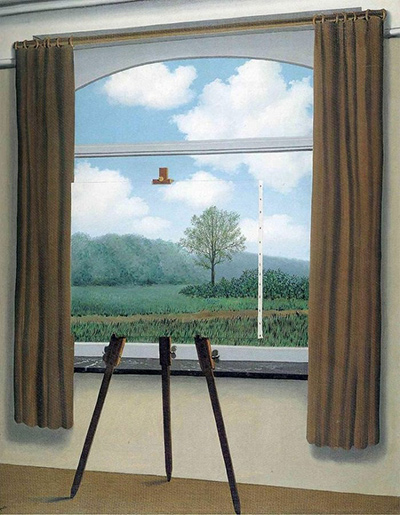
The interview is particularly valuable because its connection with the work can be traced. We have a named publication and a reproduction alongside the reported words. Compare the framed wall with the apparently continuous view in The Human Condition. In that picture, part of what appears to be outside is put in front of the window on an easel. Following the edge of the inner canvas helps us find the interruption. In La saignée, the edge of the frame is easy to see. The puzzle is the view it encloses.
Mystery within familiar reality
“The surreal is reality which has not been separated from its mystery.”
The Art Gallery of New South Wales opens its Magritte learning resource with this English sentence and attributes it to Magritte in 1962. The resource gives the wording and date but leaves the original occasion unidentified. Cite the museum's attribution when repeating it. [5]
The remark invites us to look at what happens between familiar things. In The Present, the eagle's head, dark jacket and talons are distinct enough to name. Each gains a different character through its relation to the other two. The precision of the picture sustains the uncertainty because we can see exactly how its parts have been put together.
In The Representation, footballers and a house appear at two scales within a single landscape. We can recognise their repeated arrangement and still find it difficult to imagine a continuous space in which it could exist. The two paintings give the museum's attributed remark something concrete to illuminate. There is no evidence in the resource that Magritte was speaking about either work.
Reading the source alongside the painting
When a quotation points to a visible detail, begin there. For the pipe, look at the interval between the bowl and the handwriting before reading the words aloud. For La saignée, follow the line of the frame until you can see both the shadow it casts and the bricks it seems to contain. The sources change what we notice because the pictures give us somewhere to test what the words suggest.
With an essay or a lecture, it helps to read the sentences around the familiar line. In the illustrated essay, look for the drawing that sits next to it. In the Antwerp lecture, listen for the audience the artist had in mind. With a translated statement, keep the published attribution attached to the wording. The record of where the words appeared can be as revealing as the words themselves.
Magritte artworks directory
| Name | Date | Medium |
|---|---|---|
| Memory of a Voyage | 1963 | Oil on canvas |
| The Blood of the World | 1927; also catalogued as 1926–27 | Oil on canvas |
| The Hunters at the Edge of Night | Paris, 1928 | Oil on canvas |
| The Empty Picture Frame (La saignée) | 1938–39 | Gouache on paper |
| The Glass House | 1939 | Gouache on paper |
| Oasis | 1926 in the illustrated Christie’s catalogue | Oil on canvas |
| Natural Encounters | 1945 | Oil on canvas |
| Attempting the Impossible | 1928 | Oil on canvas |
| On the Threshold of Liberty | 1930 | Oil on canvas |
| The Titanic Days | 1928 | Oil on canvas |
| The Voice of Space | 1931 | Oil on canvas |
| Unexpected Answer | 1932 in the museum catalogue, 1933 on the reverse | Oil on canvas |
| Elective Affinities | 1932 in MoMA’s checklist, also published as 1933 | Oil on canvas |
| The Human Condition II | 1935 | Oil on canvas |
| The Six Elements | 1929 | Oil on canvas |
| The Happy Donor | 1966 | Oil on canvas |
| Clairvoyance (Self Portrait) | Brussels, 1936 | Oil on canvas |
| Philosopher’s Lamp | 1936 | Oil on canvas |
| The Annunciation | Paris, 1930 | Oil on canvas |
| The Lost Jockey | Circa 1942 in the illustrated lot catalogue | Gouache on paper laid down on canvas |
| Homage to Mack Sennett | 1936 in the Thyssen catalogue | Oil on canvas |
| Discovery | 1927 | Oil on canvas |
| Collective Invention | 1935 in the later catalogue index | Oil on canvas |
| The Wonders of Nature | 1953 | Oil on canvas |
| The Balcony | Circa 1950, with 1950 inscribed on the reverse | Oil on canvas |
| The Pilgrim | 1966 | Oil on canvas |
| The Invention of Life | 1928 | Oil on canvas |
| The Therapist | 1941 | Gouache on paper |
| The Gradation of Fire | 1938 or 1939 in the catalogue index | Gouache on paper |
| A Friend of Order | 1964 | Oil on canvas |
| The Poetic World | 1939 in Hammacher’s illustrated monograph | Gouache |
| The Muscles of the Sky | Paris, 1927 | Oil on canvas |
| The Battle of the Argonne | 1959 | Oil on canvas |
| Meditation | 1936 | Oil on canvas |
| The Domain of Arnheim | 1962 | Oil on canvas |
| This Is Not an Apple | 1964 | Oil on Unilite |
| The Meaning of Night | Brussels, 1927 | Oil on canvas |
| The Pleasure Principle (Portrait of Edward James) | 1937 | Oil on canvas |
| Ready Made Bouquet | 1957 | Oil on canvas |
| Popular Panorama | 1926 | Oil on canvas |
| Memory of a Journey | 1955 in the Thyssen catalogue. Tentatively 1958 in the catalogue index. | Gouache on paper, as exhibited at the Thyssen |
| Sheherazade | 1947 | Gouache on paper |
| The Difficult Crossing | 1926 | Oil on canvas |
| The Fair Captive | 1948 in the catalogue raisonné | Oil on canvas |
| The Birth of the Idol | 1926 | Oil on canvas |
| Hegel’s Holiday | 1958 | Oil on canvas |
| Homesickness | 1941 | Oil on canvas |
| The Rape (Le Viol) | 1934 | Oil on canvas |
| The Art of Living | 1967 | Oil on canvas |
| Secret Life IV | 1928 | Oil on canvas |
| The Tomb of the Wrestlers | 1960 | Oil on canvas |
| Young Girl Eating a Bird (The Pleasure) | 1927 | Oil on canvas |
| The Central Story | 1928 | Oil on canvas |
| The Seducer | 1953 | Oil on canvas |
| The Telescope | 1963 | Oil on canvas |
| The Banquet | 1958 | Oil on canvas |
| The Empty Mask | 1928 | Oil on canvas |
| The Cultivation of Ideas | 1927 | Oil on canvas |
| The Enchanted Pose | 1927 | Oil on canvas |
| The Future of Statues | 1937 | Oil on plaster |
| The Return of the Flame | 1943 | Oil on canvas |
| The White Page | 1967 | Oil on canvas |
| The Large Family | 1963 | Oil on canvas |
| Black Magic | 1945 | Oil on canvas |
| Les Amants I | 1928 | Oil on canvas |
| Man in a Bowler Hat | 1964 | Oil on canvas |
| The Portrait | 1935 | Oil on canvas |
| The Sixteenth of September | 1956 | Oil on canvas |
| Heartstrings | 1960 | Oil on canvas |
| The Present | 1939; also dated 1938 or 1939 | Gouache on paper |
| Act of Violence | 1932 | Oil on canvas |
| Fashionable People | 1950, in the 2016 thesis caption | Medium unconfirmed · Attribution follows the published caption |
| The Representation | 1962 | Oil on canvas |
| Memory | 1948 | Gouache on paper |
| The Mysteries of the Horizon | 1955 | Oil on canvas |
| Portrait of Stephy Langui | 1961 | Oil on canvas |
| The Double Secret | 1927 | Oil on canvas |
| Every Day | 1966 | Oil on canvas |
| The Invisible World | 1954 | Oil on canvas |
| Dawn of Cayenne | 1926 | Oil painting |
| Clear Ideas | 1955 (inscribed); possible 1958 execution | Oil on canvas |
| The Face of Genius | 1926 / 1927 | Oil on canvas |
| Good Faith | 1965; earlier record 1964–65 | Oil on canvas |
| The Flash | 1959 | Gouache and pencil on paper |
| Perpetual Motion | 1935; earlier catalogue 1934 | Oil on canvas |
| Personal Values | 1952 | Oil on canvas |
| Not to Be Reproduced | 1937 | Oil on canvas |
| The Red Model | 1935 | Oil on canvas |
| The Menaced Assassin | 1927 | Oil on canvas |
| The Castle of the Pyrenees | 1959 | Oil on canvas |
| The Blank Signature | 1965 | Oil on canvas |
| The Listening Room | 1958 | Oil on canvas |
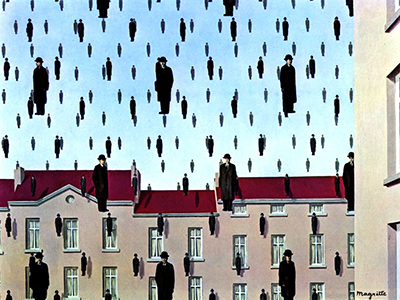
| Golconde | 1953 | Oil on canvas |
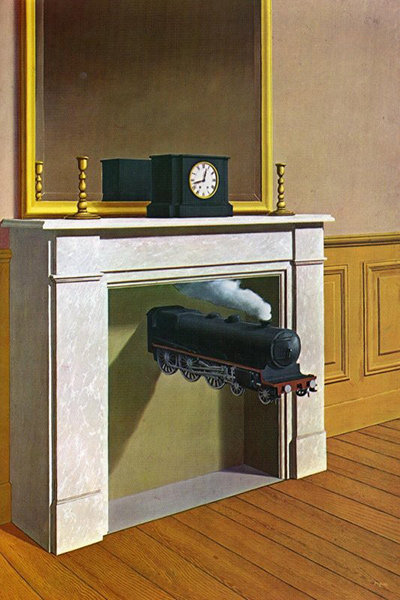
| Time Transfixed | 1938 | Oil on canvas |
| The Treachery of Images | 1929 | Oil on canvas |
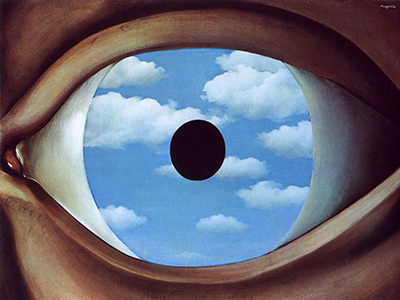
| The False Mirror | 1929 | Oil on canvas |
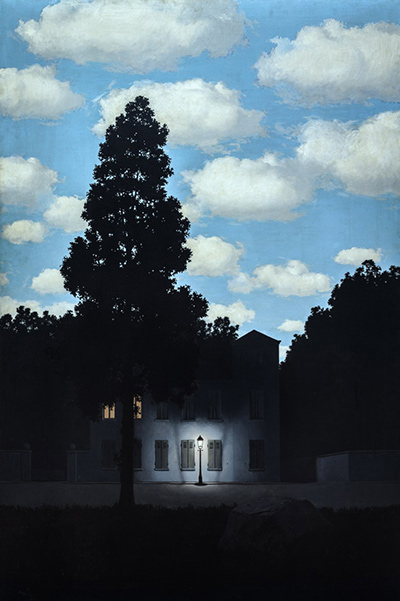
| The Empire of Light | 1953–54 | Oil on canvas |
| The Human Condition | 1933 | Oil on canvas |
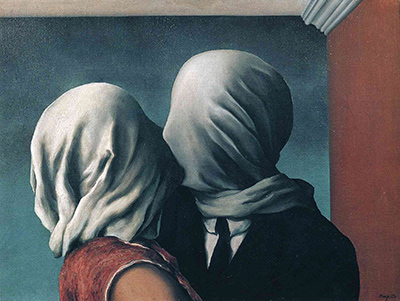
| Les Amants | 1928 | Oil on canvas |
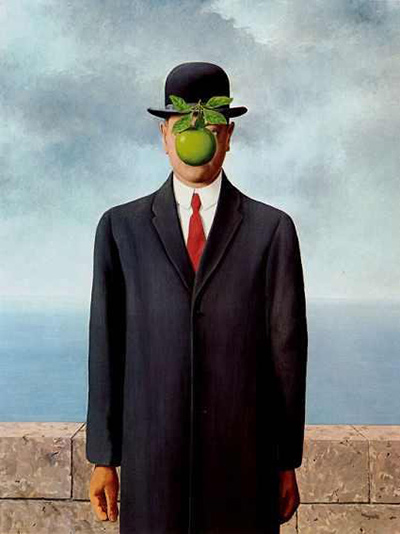
| The Son of Man | 1964 | Oil on canvas |
Frequently Asked Questions
It is painted in French underneath the pipe in The Treachery of Images, an oil painting dated 1929 at the Los Angeles County Museum of Art.
He gave the lecture at the Royal Museum of Fine Arts Antwerp on 20 November 1938.
Discussion
Look closely and compare your reading with others.
Reader Insights
What changes when you look at the lettering beneath the pipe as a painted shape?
How does the framed wall in La saignée differ from the picture that aligns with the view in The Human Condition?
Which detail in one of the paintings gives an attributed quotation new force?
Join the Conversation
Share a detail, comparison or question about René Magritte Quotes and Their Context below.
References
- Los Angeles County Museum of Art, The Treachery of Images, 1929, accession 78.7. View source.
- René Magritte, Les mots et les images, La Révolution surréaliste, no. 12, 15 December 1929, pp. 32–33. French issue transcription. View source.
- Royal Museum of Fine Arts Antwerp, Magritte. La ligne de vie, French exhibition dossier with excerpts from the lecture of 20 November 1938. View source.
- Marijke Peyser, La saignée, Museum Boijmans Van Beuningen collection catalogue, citing the 5 May 1939 interview in Les Beaux Arts. View source.
- Art Gallery of New South Wales, Magritte: Learning Resource, 2024, p. 2, English statement attributed to René Magritte and dated 1962. View source.