

Every Day
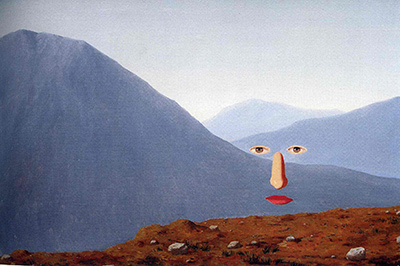
Two eyes, a nose and red lips hover before a range of blue mountains. They occupy the positions we expect within a face, but no head encloses them. The landscape continues through the spaces where cheeks, forehead and chin would ordinarily appear. A recognisable human presence emerges from an arrangement that leaves much of the person absent.
René Magritte painted Every Day, or Tous les jours, in 1966. This oil on canvas measures 50.2 × 73.3 centimetres and is catalogued as Sylvester III 1052. Christie's offered it from a private collection in 2013. [1]
At a Glance
Date of this work
Every Day
1966 [1]Contents
Recognising a face from fragments
The features are separated, yet their relationship is familiar. The eyes establish an approximate horizontal axis, the nose extends below and between them, and the mouth sits lower down. We can read a face almost immediately because their positions supply a structure that survives the missing outline.
This recognition is different from seeing a complete portrait partly covered by another object. There is no visible surface around the features to hide the rest of the head. Mountain slopes occupy the intervening areas. The absent flesh remains imaginable, but the painting does not describe a continuous body behind those interruptions.
Look first at the eyes and then at the gaps beside the nose. The change in attention makes the arrangement alternate between a human likeness and several distinct painted forms. Neither experience fully replaces the other. The features retain enough coordination to keep suggesting a face, even when the landscape's continuity becomes impossible to overlook.
The eyes and the direction of attention
The eyes confront the viewer from within a broad setting. Their relatively small size does not make them incidental: the familiar force of a gaze gives them an importance beyond their share of the painted surface. They establish a point of encounter amid slopes that otherwise seem uninhabited.
Their surrounding flesh-coloured edges distinguish them from the blue behind. These narrow borders provide just enough bodily information for each eye to remain legible. The image does not need fully described brows and cheeks to create the impression of someone looking out.
That impression makes the landscape feel less passive. We might ordinarily inspect a mountain view without expecting it to return our attention. Here, the isolated eyes complicate that relation. The setting remains expansive, but the gaze gives it a strangely immediate point of contact with the person standing before the painting.
Nose, mouth and contrasting colour
The nose is elongated and strongly modelled beside the more compact eyes. Its warm colour sets it apart from the cool mountains. Light and shade give it a sense of volume, even though the surface from which it would normally project is missing.
The lips make another concentrated accent. Their red colour interrupts the comparatively muted landscape, while their horizontal shape answers the line established by the eyes above. The mouth remains closed, offering no explanation through speech or expression that could settle the apparition's identity.
Follow the features downwards in sequence. The eye can connect them into an imagined head, then notice that the spaces between them belong visibly to the mountains. The painting makes that connection easy and difficult at the same time. Its strongest uncertainty lies in the relationship between recognisable parts and a whole that is never fully supplied.
Mountains continuing through the head
The largest slope rises at the left and falls towards the centre. Further ridges recede in lighter blues, creating a readable sequence of distances. The facial features appear against these different planes rather than occupying a separate portrait panel within the landscape.
This continuity gives the gaps their significance. A missing cheek does not become a neutral blank. It reveals more of a mountain whose contour can be followed towards other parts of the picture. The setting actively completes its own forms where the face remains incomplete.
Try concentrating on a ridge as it passes near the eyes. Its direction belongs to the landscape, while their horizontal alignment belongs to the imagined face. Those two systems coexist without becoming one coherent anatomy. The painting lets the eye move between them, continually changing which arrangement seems to organise the scene.
The stony foreground
The lower band offers a different kind of detail. Brown ground, scattered pale stones and small patches of vegetation establish a rough surface close to the viewer. Their irregular distribution contrasts with the more carefully aligned facial features above.
The foreground also gives the scene a place from which to be imagined. We can read a near edge and then look beyond it towards successive mountain slopes. This relatively convincing spatial progression makes the unsupported features more conspicuous. Their strangeness takes place within a setting that otherwise supplies familiar cues of distance.
The warm ground and red lips create a loose colour relationship across that distance. It does not turn the mouth into part of the terrain, but it helps connect the painting visually. The features remain distinct while participating in the larger distribution of warm and cool passages.
A title corrected for exhibition
The catalogue reports that Magritte briefly used Every Morning before instructing Iolas to print Every Day for the early 1967 Paris exhibition. The final title also appears on the canvas's reverse. That documented correction is more secure than assigning a particular daily hardship to the scene. [1]
The ordinary phrase introduces an interesting tension. Mountains and isolated features present an exceptional encounter, while the title refers to repetition and familiarity. The image does not identify a particular routine, occupation or event that would explain the phrase for us.
This leaves the title available as a provocation to attention. An apparently familiar face has been reduced to a few recognisable elements; an apparently familiar landscape has acquired a gaze. The words can encourage us to reconsider the everyday act of recognising things without resolving the painting into a single illustrated lesson.
A likeness without a settled person
Christie's records the painting through the Alexandre Iolas Gallery and a New York private collection acquired in 1967. The catalogue does not identify a sitter. Its collection history and date should remain separate from speculation about whose face the features might represent. [1]
The absence of a named person does not prevent a strong encounter. Indeed, it helps keep attention on how little information can produce the sense of a face. Eyes, nose and lips are sufficiently particular to suggest presence, while the missing head makes that presence hard to locate physically.
Return finally to the spaces beside the nose. They are among the least elaborately painted parts of an imagined face, because no flesh appears there at all. Yet they are essential to the effect. Every Day makes the viewer hold together a human likeness and a landscape that continues exactly where that likeness ought to be.
Selected Magritte paintings
Eleven individually sourced Magritte works, with dates and media distinguishing the particular objects. The Flash is the 1959 gouache and Every Day the 1966 canvas. This selected directory is not a complete catalogue.
| Name | Date | Medium |
|---|---|---|
| Dawn of Cayenne — 1926 oil | 1926 | Oil painting 1926 oil identified in later-version catalogue. |
| The Double Secret | 1927 | Oil on canvas Catalogue record. |
| Act of Violence | 1932 | Oil on canvas Museum object record. |
| Memory — 1948 gouache | 1948 | Gouache on paper Catalogue record. |
| The Invisible World | 1954 | Oil on canvas Catalogue record. |
| Clear Ideas — dated 1955 | 1955; possible 1958 execution | Oil on canvas Catalogue record. |
| The Flash — 1959 gouache | 1959 | Gouache and pencil on paper Object record. |
| Heartstrings | 1960 | Oil on canvas Auction object record. |
| Good Faith | 1965; earlier record 1964–65 | Oil on canvas Exhibition label, p. 111. |
| The Blank Signature | 1965 | Oil on canvas Catalogue record. |
| Every Day | 1966 | Oil on canvas Object record. |
Frequently Asked Questions
No outline of a complete head is shown. The mountains continue through the gaps between the separately depicted features.
The eyes, nose and lips retain their familiar positions relative to one another, allowing recognition to persist despite the missing surrounding flesh.
Discussion
Compare the familiar objects with the spaces they appear to occupy.
Reader Insights
Which gap most strongly disrupts your recognition of a face?
How does the gaze change your experience of the mountain landscape?
What do the warm foreground colours contribute to the isolated features?
Join the Conversation
Share a detail, comparison or question about Every Day below.
References
- Christie's, René Magritte, Tous les jours, 2013, lot 116: object record, provenance, exhibition history and title correspondence. View source.Splash image: Every Day, 1966. Oil on canvas, 50.2 × 73.3 cm. Sylvester III 1052; private collection as recorded in the 2013 catalogue.