 by Tom Gurney
Tom Gurney BSc (Hons) is an art history expert with over 20 years experience
Published on July 5, 2026 / Updated on July 5, 2026
Email: tomgurney1@gmail.com / Phone: +44 7429 011000
René Magritte Technique: How His Paintings Were Made
René Magritte's technique is easy to underestimate because it rarely asks to be admired as technique. His best-known paintings do not show off with loose brushwork, thick impasto or dramatic painterly emotion. They are usually smooth, clear and almost plain. That plainness is not a weakness. It is the means by which the paintings become so unsettling. [5] [1]
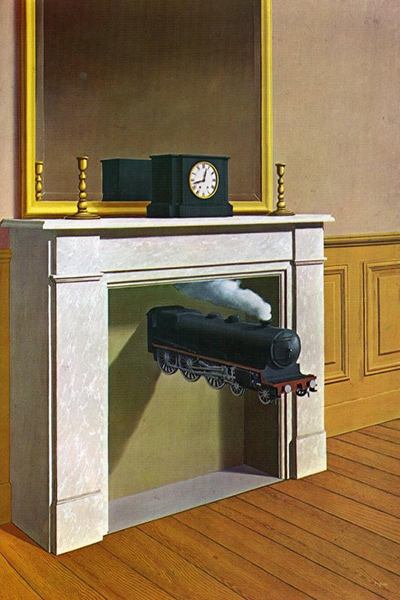
Magritte needed the impossible to look ordinary. A train leaving a fireplace, an apple hiding a face, a pipe denied by its own caption, a night street beneath a daylight sky: these images work because the objects are painted with enough clarity to seem factual. The technique is therefore not separate from the idea. The calm surface is what allows the contradiction to land. [5] [4]
His method joined craft, design, composition and thought. He used oil paint, drawing, gouache, commercial-design habits, repeated motifs and carefully chosen titles to build images that look simple before they become philosophically difficult. [5] [3]
At a Glance
- Main medium: Oil on canvas, with important drawings and gouaches
- Surface: Smooth, controlled and low in visible brushwork
- Drawing: Clear outlines, legible silhouettes and precise placement
- Composition: Ordinary settings changed by scale, obstruction or contradiction
- Key effect: The impossible is made to look calm and factual
Contents
- What Technique Means in Magritte
- Oil Paint and the Smooth Surface
- Drawing, Edges and Placement
- Composition and Scale
- Colour and Light
- Titles as Part of the Technique
- Repetition, Versions and Variations
- Commercial Design and Visual Clarity
- Materials, Reuse and Conservation Evidence
- Technique in Key Paintings
What Technique Means in Magritte
When discussing René Magritte's technique, it is important not to reduce the subject to materials alone. The physical handling of paint matters, but Magritte's technique is also a way of arranging thought. He uses traditional-looking representation to make impossible relationships appear as if they had been calmly observed. [5] [2]
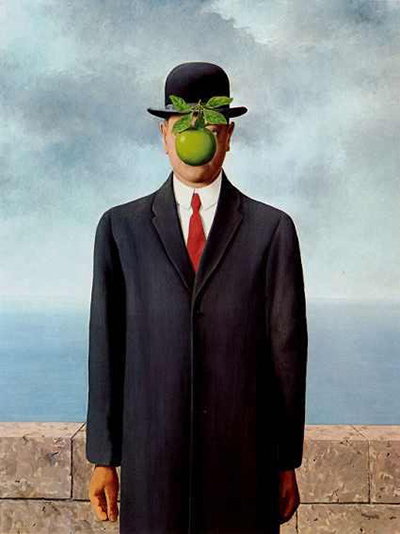
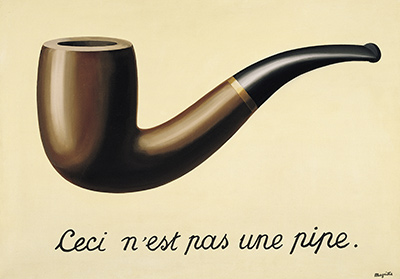
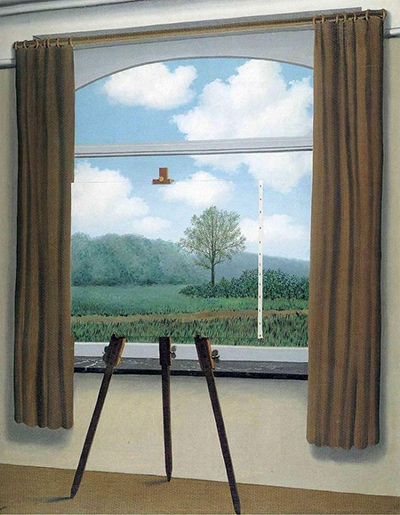
That is why his technique often seems deliberately neutral. The surface does not distract from the proposition. In The Treachery of Images, the pipe must be readable as a pipe-like image at once; otherwise the caption loses force. In The Son of Man, the apple must feel ordinary enough to make its position extraordinary. In The Human Condition, the painted canvas inside the painting must align plausibly with the view behind it. [5]
Magritte's technique is therefore a discipline of legibility. He paints objects so the viewer can identify them quickly, then uses placement, title, scale or context to disturb that identification. [5] [8]
Oil Paint and the Smooth Surface
Many of Magritte's major works are oil paintings on canvas. He used the medium not for bravura texture, but for control. The paint surface is usually restrained, with smooth passages, even modelling and relatively contained transitions between forms. This gives the images their hard, declarative quality. [5]
The smoothness does not mean the paintings are mechanical. It means that Magritte suppresses the drama of making in favour of the drama of seeing. The viewer is not invited to dwell first on the movement of the brush. Instead, the viewer is invited to accept the object, then realise that the object's relationship to the rest of the image is impossible. [5]
This technique suits his philosophical interests. Visible brushwork can remind the viewer that a painting is an expressive handmade surface. Magritte often wants another kind of awareness: the recognition that even a convincing image is still an image. [5]
Drawing, Edges and Placement
Magritte's drawing is usually clean and functional. Objects are given firm silhouettes, readable contours and stable positions within the composition. Even when the scene is irrational, the parts are not vague. A pipe, apple, hat, eye, window, train or curtain can usually be identified without effort. [5]
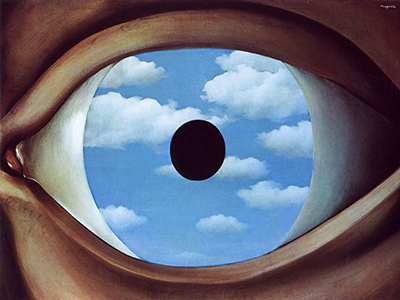
Edges matter in Magritte because they control the relationship between things. The apple in The Son of Man has to sit with uncanny precision in front of the face. The eye in The False Mirror must contain the sky clearly enough for the viewer to understand both eye and sky at once. The easel in The Human Condition has to confuse painting and view while still making the trick legible. [5]
His technique is often less about modelling forms in depth than about making the border between things intellectually active. Where does the image end and the world begin? Where does the face stop and the object begin? Where does the word attach to the thing it names? [5]
Composition and Scale
Magritte's compositions often begin from stable, familiar arrangements. A room has walls and a floor. A figure stands upright. A window opens onto a landscape. A street recedes into space. Once this ordinary framework is established, a single disruption changes everything. [5]
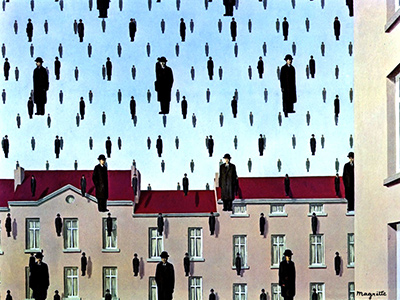
Scale is one of his most effective technical tools. In The Listening Room, the apple becomes enormous while remaining visually ordinary. In Personal Values, domestic objects grow until they dominate the bedroom. In Golconde, men in bowler hats are repeated across an urban scene like falling or floating units. [5] [7]
The technique is not simply to enlarge objects, but to keep enough spatial order around them that the enlargement feels calmly impossible. If every part of the painting were distorted, the viewer would accept the scene as fantasy. Magritte normally keeps most elements stable so that one altered relation carries the whole conceptual weight. [5]
Colour and Light
Magritte's colour is usually direct and controlled. He often uses clear blues, clean skies, dark suits, pale walls, red accents and naturalistic object colour. The effect is not flamboyant colourism, but visual certainty. The viewer knows what is sky, coat, apple, wall, curtain or pipe. [5]
Light in Magritte is similarly restrained. It clarifies rather than dramatizes. In many paintings, forms are lit evenly enough to be understood as objects. The lighting rarely dissolves things into atmosphere. It makes them available for contradiction. [5]
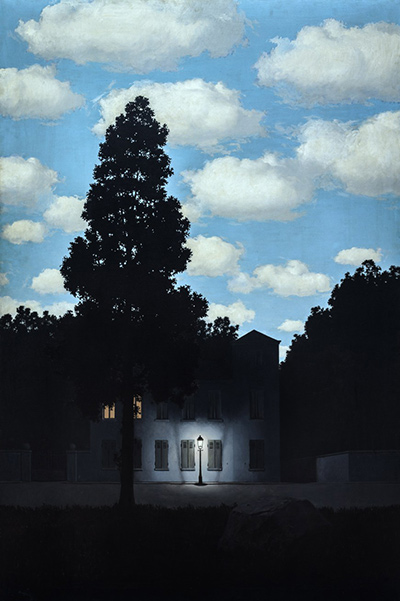
The Empire of Light is a major exception and also a perfect example. The painting depends on a technical split between nocturnal street and daytime sky. Magritte does not make the contradiction messy. He paints each half with convincing calm, then lets the impossible coexistence do the work. [5]
Titles as Part of the Technique
Magritte's titles are not afterthoughts. They are part of the completed mechanism of the work. A title can intensify uncertainty, redirect attention or refuse explanation. The Human Condition, The False Mirror, The Treachery of Images and Time Transfixed all change how the image is read without solving it. [5] [6]
This means that Magritte's technique extends beyond brush and canvas. The final artwork often consists of image plus title plus the viewer's attempt to reconcile them. The title may sound philosophical or poetic, but it rarely acts like a simple label. It opens another gap. [5]
The same is true when words appear inside the image. The phrase in The Treachery of Images is painted as part of the composition. It has visual form, placement and rhythm. It is not only language; it is also an object in the picture. [5]
Repetition, Versions and Variations
Magritte frequently returned to motifs and compositions. Apples, bowler-hatted men, windows, curtains, skies, stones and pipes appear in multiple works. This repetition was a technical and conceptual method. It allowed him to test how the same object behaved under different conditions. [5]
An apple can block a face, fill a room or become the subject of a sentence that denies it in This is Not an Apple. A sky can occupy an eye, sit above a nocturnal street or appear inside a silhouette. A bowler-hatted man can be an individual, a self-image, a crowd, an anonymous type or a repeating sign. [5]
Versions and variations also matter commercially and practically. Magritte worked within a real art market, responded to patrons and repeated successful visual problems. The repetition should not be dismissed as copying. In his work, repetition is often the way an idea becomes exact. [5]
Commercial Design and Visual Clarity
Before he could live fully from painting, Magritte worked in commercial design and advertising. That background is useful when thinking about technique. His images often have the immediate clarity of a poster or advertisement, but the message refuses to behave like advertising. [5]
Commercial design rewards legibility, memorable silhouettes, crisp objects and efficient communication. Magritte used those strengths against themselves. The image catches the eye quickly, but instead of delivering a product or slogan, it creates doubt. [5]
This helps explain why his paintings remain powerful in reproduction. A Magritte image can often be recognised from a small thumbnail because the arrangement is so clear. The apple in front of the face, the pipe above the words, the eye filled with sky, the train from the fireplace: each is visually concise. [5]
Materials, Reuse and Conservation Evidence
Technical evidence should be used carefully. For many Magritte paintings, public discussion focuses on image and meaning rather than detailed pigment or conservation data. It is safer to describe the visible technique and cite known media than to invent studio procedures. [5]
One important technical case is La pose enchantée, a large 1927 work later found in fragments beneath other Magritte paintings. Technical imaging and scholarly research showed that the lost composition had been cut and reused as supports for later works. This evidence is valuable because it reminds us that Magritte's practice was practical as well as philosophical. [5] [9]
The case also guards against a romantic idea of effortless creation. Magritte's clean surfaces can make the works seem inevitable, but the studio process included labour, adjustment, financial pressure and material decisions. [5]
Technique in Key Paintings
-
1. The Treachery of Images
The pipe and inscription must both be legible. If either were unclear, the image-word contradiction would weaken. -
2. The Human Condition
The canvas within the picture must almost continue the scene behind it, making the viewer question the boundary between representation and view. -
3. The Son of Man
The apple hides the face without erasing the body, turning portrait technique into anti-portrait technique. -
4. The False Mirror
The eye is still an eye, but the iris becomes a sky. The technique holds both identities in tension. -
5. The Empire of Light
Night and day are painted as distinct, believable conditions that occupy the same image.
FAQs
Magritte most often used controlled representational painting, especially oil on canvas, with smooth surfaces, clear drawing and careful placement of ordinary objects in impossible relationships. [5]
He painted many objects in a clear, recognisable manner, but not to produce ordinary realism. The realistic handling makes the impossible relationship more convincing and more disturbing. [5]
The smooth surface keeps attention on the image's idea rather than on expressive brushwork. It helps the contradiction appear calm and factual. [5]
Magritte was involved with photography and film, and photographic clarity is relevant to his visual world, but individual claims about photographic sources should be made only when a source supports them. [5]
Repetition allowed Magritte to test the same object in different conceptual situations. The repeated motif becomes a tool, not simply a recycled image. [5]
Yes, but his skill is often deliberately understated. His achievement lies in making clear images whose calm surfaces carry precise contradictions. [5]
References
- MoMA, "René Magritte", View source.
- Royal Museums of Fine Arts of Belgium, "Magritte Museum", View source.
- René Magritte Museum, "Welcome to the René Magritte Museum", View source.
- Anne Umland, ed., Magritte: The Mystery of the Ordinary, 1926-1938, Museum of Modern Art, 2013.
- David Sylvester, Sarah Whitfield and Michael Raeburn, René Magritte: Catalogue Raisonné, London: Menil Foundation / Philip Wilson, 1992-1997.
- Harry Torczyner, Magritte: Ideas and Images, New York: Harry N. Abrams, 1977.
- Suzi Gablik, Magritte, London: Thames & Hudson, 1970.
- Patricia Allmer, René Magritte: Beyond Painting, Manchester: Manchester University Press, 2009.
- Catherine Defeyt, Elodie Herens, Frederik Leen, Francisca Vandepitte and David Strivay, "Discovery and multi-analytical study of the last missing quarter from René Magritte's La pose enchantée", Heritage Science, 2018.