 by Tom Gurney
Tom Gurney BSc (Hons) is an art history expert with over 20 years experience
Published on June 19, 2020 / Updated on July 5, 2026
Email: tomgurney1@gmail.com / Phone: +44 7429 011000
Personal Values by Rene Magritte
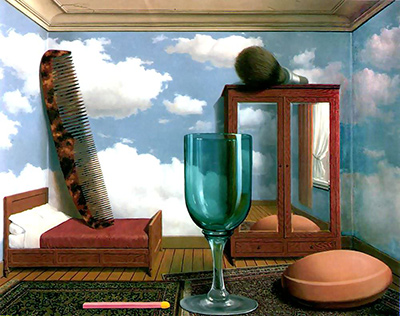
Personal Values is one of Rene Magritte's most concentrated images of ordinary things made strange. A bedroom contains a bed, rugs, a mirrored armoire and familiar personal objects, but the objects have lost any normal sense of scale. A comb towers over the bed. A goblet stands like a column. A match, shaving brush and bar of soap become too large for their domestic roles. [1]
SFMOMA records the painting as Les valeurs personnelles (Personal Values), made in 1952, oil on canvas, measuring 31 1/2 x 39 3/8 inches. The museum acquired it in 1998 through a purchase made possible by a gift of Phyllis C. Wattis. [1]
The painting matters because it does not invent exotic fantasy. It uses the things of a room and changes their relationships. Magritte makes the private objects of grooming, drinking and sleeping lose their normal functions, then surrounds them with walls that look like sky. [5]
At a Glance
- Artist: Rene Magritte [3]
- Title: Les valeurs personnelles (Personal Values) [1]
- Date: 1952 [1]
- Medium: oil on canvas [1]
- Dimensions: 31 1/2 x 39 3/8 in. (80.0 x 100.1 cm) [1]
- Collection: San Francisco Museum of Modern Art [1]
- Date acquired: 1998 [1]
- Status: not on view at the time the SFMOMA page was accessed [1]
Contents
- Why this painting matters
- Museum perspective
- Historical background
- Visual description
- Looking carefully
- Meaning and interpretation
- Comparison works
Why This Painting Matters
Personal Values matters because it turns a bedroom into a philosophical problem. The room should be a stable interior, a place of private order. Instead, it becomes a place where every proportion is wrong and the walls behave like open air. [7]
The painting also shows Magritte's difference from more theatrical Surrealism. He did not need melting forms or dream monsters. He could make a comb, a match, a goblet, soap and a shaving brush feel uncanny by changing only their scale and setting. [6]
Museum Perspective
SFMOMA's interpretation gives the page its best evidence-first centre. The museum stresses that Magritte was interested in familiar objects and the relationships between them. Rather than inventing visions, he described objects so that ordinary concepts no longer comfortably attached to them. [1]
The museum also notes that the room reverses inside and outside. Bedroom walls normally enclose. Here, the walls become a skyscape. The viewer is indoors and outdoors at once, or perhaps inside a room whose walls have been erased by painted sky. [1]
Historical Background
Magritte painted Personal Values in 1952, during the mature postwar period when many of his most memorable images became simpler, clearer and more iconic. This was the same year as The Listening Room, another painting in which an everyday object becomes impossible through scale. [4]
The painting's early reception was not calm. SFMOMA records that Magritte's dealer Alexander Iolas reacted strongly against it. Magritte's reply is important because it shows that the disturbance was intentional. The objects had lost their ordinary social character and become, in his phrase, useless luxury. [1]
Visual Description
The painting shows a bedroom with the front wall removed, almost like a dollhouse. At the left is a bed. At the right is a mirrored armoire. Rugs lie on the floor. These pieces of furniture still correspond to the room's proportions. [2]
The personal objects do not. A huge tortoise-shell comb leans against the wall and nearly reaches the ceiling. An oversized pink match lies on the floor. A green goblet rises in the centre. A shaving brush sits on the armoire, and a large oval bar of soap occupies the lower right corner. [2]
The walls are covered with blue sky and white clouds. This is not a landscape seen through a window. It is the room itself behaving like sky. [1]
Looking Carefully
Begin with the comb. It is ordinary in type but absurd in scale. It leans on the bed like a structural object rather than a grooming tool. That change is the key to the painting: function has not disappeared, but proportion has made function unusable. [2]
Then look at the mirror on the armoire. It reflects a window and curtains, giving the room another layer of interior space. Magritte uses the mirror to complicate the room rather than clarify it. [2]
Finally, look at the walls. If the walls are painted like sky, then they are still walls. If they are actual sky, then the room has no stable enclosure. The painting keeps both possibilities active. [7]
Things You Might Miss
- The objects are not randomly enlarged. They are personal objects: comb, match, goblet, shaving brush and soap. The title asks what personal value means when private possessions lose their practical scale. [5]
- The match is easy to pass over, but SFMOMA's audio commentary singles it out as especially charged. Its colour and placement make it small compared with the comb, yet huge compared with an ordinary match. [2]
- The furniture remains comparatively normal. That contrast matters. The room is not universally distorted; the personal objects are the ones that have become impossible. [1]
Technique and Composition
Magritte's technique is deliberately clear. The painting does not dissolve into dream atmosphere. Each object is legible. The strange effect comes from the relationship among objects, not from unclear painting. [6]
The composition is built from a box-like room and a set of oversized props. The flat wall planes, floor and ceiling create a stable container, while the sky imagery dissolves that stability. The room is both a container and an opening. [7]
Meaning and Interpretation
The strongest interpretation begins with scale and social meaning. Magritte takes things associated with personal care or private habit and makes them too large to use. The comb no longer combs hair; the soap no longer fits the hand; the goblet no longer belongs to the body. [5]
That is why a moralising reading about alcohol or social decline is too narrow. The painting is not a sermon about bad habits. It is a visual experiment in how objects lose their usual meanings when their relationships change. [1]
Magritte's own remarks, as recorded by SFMOMA, support this evidence-first reading. He wanted the objects to lose their social character. The painting is less about condemning luxury than about making everyday possessions suddenly useless, monumental and strange. [1]
Title Analysis
The title Personal Values is dry and quietly ironic. These are personal things, but the values attached to them have shifted. They are no longer small, useful possessions. They have become presences that dominate the room. [5]
The French title, Les valeurs personnelles, carries the same ambiguity. It may refer to private belongings, personal priorities or the values that society attaches to objects. Magritte does not choose one meaning. He lets the title hover over the room. [4]
Museum Moment
SFMOMA's record gives the painting a concrete museum identity: acquired in 1998, held in the San Francisco Museum of Modern Art collection, and not on view when the page was accessed. That status is useful because it reminds readers that a famous painting may not always be visible in the galleries. [1]
SFMOMA's audio material also helps a viewer slow down. The transcript describes the painting almost object by object, which is the right way to look at it. Personal Values rewards inventory: the more carefully each item is identified, the stranger the room becomes. [2]
Comparison Works
The Listening Room is the closest comparison. In both paintings, a familiar object becomes too large for an interior. The Listening Room gives one apple command of a room; Personal Values multiplies the effect across several objects. [4]
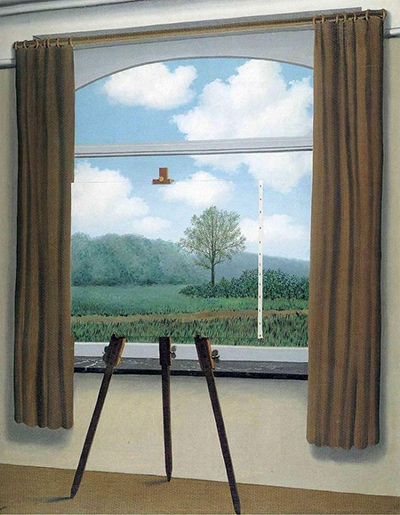
The Human Condition is useful because both paintings confuse inside and outside. In The Human Condition, the window and canvas disrupt the view. In Personal Values, the walls themselves become sky. [7]
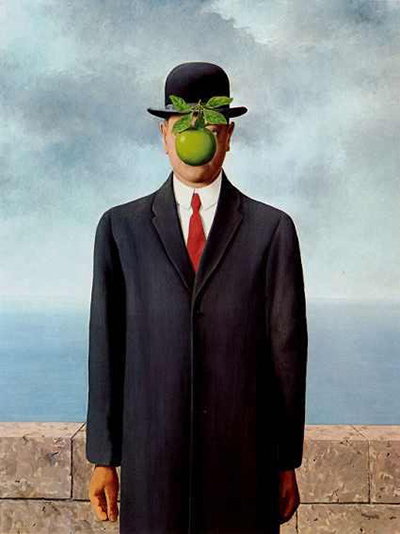
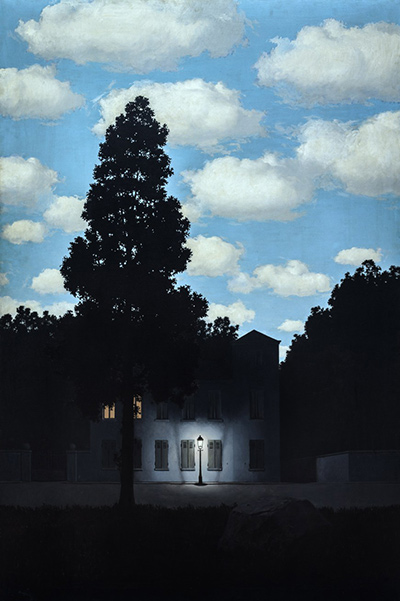
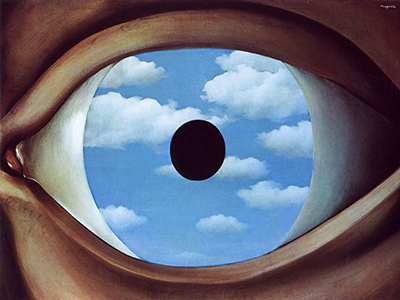
The Son of Man and The Empire of Light also belong nearby. One uses an apple to interrupt a face; the other uses daylight to interrupt night. In each case, Magritte keeps the image clear while making one basic relationship impossible. [6]
Reception and Influence
Personal Values has had a long afterlife because it is both domestic and impossible. Viewers recognise the objects quickly, but their scale makes the room impossible to inhabit. [1]
The painting also influenced later artists interested in enlarged everyday objects. A New Yorker profile of Vija Celmins notes that her oversized comb sculpture was a deliberate echo of the comb in Magritte's Personal Values. [8]
Timeline
- 1952 - Magritte paints Personal Values. [1]
- 1952 - Magritte also makes The Listening Room, another major scale-based image. [4]
- 1998 - SFMOMA acquires Personal Values. [1]
FAQs
Personal Values is in the collection of the San Francisco Museum of Modern Art. [1]
It shows a bedroom with sky-covered walls and oversized everyday objects including a comb, match, goblet, shaving brush and soap. [2]
Magritte painted it in 1952. [1]
The strongest reading is about scale, object relations and the loss of ordinary function. Magritte makes personal objects strange by changing their size and context. [5]
SFMOMA listed it as not on view when the object page was accessed. [1]
References
- SFMOMA, "Rene Magritte, Les valeurs personnelles (Personal Values), 1952," accessed July 4, 2026, https://www.sfmoma.org/artwork/98.562/.
- SFMOMA audio transcript, "Magritte's room of illusions," on the SFMOMA object page for Personal Values, accessed July 4, 2026.
- Museum of Modern Art, "Rene Magritte," artist record, accessed July 4, 2026, https://www.moma.org/artists/3692-rene-magritte.
- David Sylvester and Sarah Whitfield, eds., Rene Magritte: Catalogue Raisonne, Houston and London: Menil Foundation / Philip Wilson, 1993.
- Harry Torczyner, Magritte: Ideas and Images, New York: Harry N. Abrams, 1977.
- Suzi Gablik, Magritte, London: Thames & Hudson, 1970.
- Patricia Allmer, Rene Magritte: Beyond Painting, Manchester: Manchester University Press, 2009.
- Peter Schjeldahl, "Vija Celmins's Surface Matters," The New Yorker, August 26, 2019, https://www.newyorker.com/magazine/2019/09/02/vija-celmins-surface-matters.