 by Tom Gurney
Tom Gurney BSc (Hons) is an art history expert with over 20 years experience
Published on June 19, 2020 / Updated on July 5, 2026
Email: tomgurney1@gmail.com / Phone: +44 7429 011000
Time Transfixed by Rene Magritte
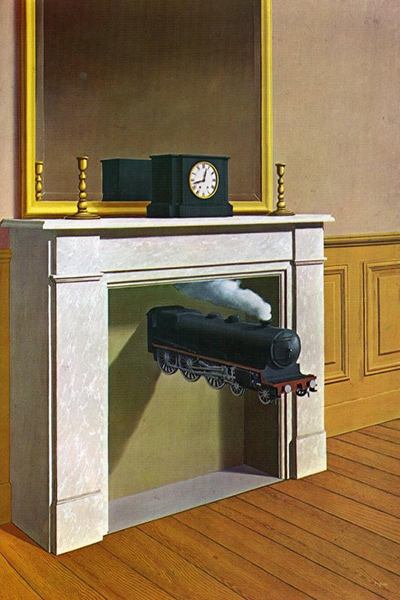
Time Transfixed is one of Rene Magritte's most startling interiors. A polished fireplace stands in a quiet room. Above it are a clock, candlesticks and a mirror. Then, from inside the fireplace, a small black locomotive drives forward, trailing smoke as if the chimney were a railway tunnel. [1]
The Art Institute of Chicago records the official title as La duree poignardee (Time Transfixed), painted in 1938. The museum identifies the work as oil on canvas, 147 x 98.7 cm, in the Joseph Winterbotham Collection, accession number 1970.426. [1]
The painting is famous because it makes an impossible scene look composed and exact. Nothing is painted wildly. The room is orderly, the mantel is symmetrical and the train is precise. The shock comes from the calm joining of two incompatible worlds: domestic fireplace and industrial locomotive. [1]
At a Glance
- Artist: Rene Magritte [7]
- Official title: La duree poignardee (Time Transfixed) [1]
- Date: 1938 [1]
- Medium: oil on canvas [1]
- Dimensions: 147 x 98.7 cm (57 7/8 x 38 7/8 in.) [1]
- Collection: Art Institute of Chicago [2]
- Accession number: 1970.426 [1]
- On view: Gallery 396, Art Institute of Chicago [1]
Contents
- Why this painting matters
- Museum perspective
- Historical background
- Visual description
- Looking carefully
- Meaning and interpretation
- Provenance
- Comparison works
Why This Painting Matters
Time Transfixed matters because it is one of Magritte's cleanest demonstrations of poetic collision. He does not dissolve the world into dream mist. He keeps the objects recognisable and lets their relationship do the impossible work. [3]
The painting also belongs to the important Edward James context. James was one of Surrealism's great patrons, and Magritte produced several works connected to him. Time Transfixed and Not to Be Reproduced are especially useful as a pair because both place an impossible event in a refined domestic interior. [4]
Museum Perspective
The Art Institute's commentary gives the page its evidence-first centre. It explains that Magritte was trying to draw out "poetic secrets" by combining images in a way that would suggest a third, unseen thing in the viewer's mind. [1]
In this painting, the two key objects are the train and the fireplace. The museum notes that they are highly different objects: one industrial, one domestic. Their bridge is smoke. Locomotive smoke and chimney smoke belong to different worlds, but Magritte makes them meet in a single impossible opening. [1]
Museum Moment
In the Art Institute galleries, the painting's scale matters. At 147 x 98.7 cm, it is large enough for the fireplace to feel close to human scale, yet the locomotive remains strangely compressed. That imbalance is not a technical weakness; it is part of the image's logic. The room feels stable, while the train feels both forceful and trapped. [1]
The museum's current display information places the painting in Gallery 396, where it belongs to the Art Institute's account of modern art and Surrealism. Seeing it in a museum also clarifies the surface calm. Reproductions tend to emphasise the absurdity of the train; the original also emphasises the stillness of the room. [1]
Historical Background
Magritte painted Time Transfixed in 1938, at the end point of the period often treated as his great early maturity. By then he had refined a method based on clarity, familiar objects and conceptual disturbance. He could make a pipe, an apple, a window, a mirror or a train behave in a way that turned ordinary seeing into a problem. [3]
The painting was sold by the artist to Edward James by July 12, 1939, according to the Art Institute provenance. James's role matters because the painting was not only an isolated studio invention. It belonged to a network of Surrealist patronage, collecting and installation in which domestic space itself became a stage for paradox. [1]
The Edward James connection also helps explain why the painting feels theatrical without becoming a stage set. James's interiors were already places where Surrealism could enter domestic life. Magritte's image takes that idea literally: the impossible event arrives through the fireplace, one of the most conventional symbols of home. [4]
Visual Description
The room is spare and controlled. A white fireplace rises against a panelled wall. On the mantel sit a clock and two candlesticks. A mirror above the mantel reflects the clock and objects below, but the reflection does not calm the scene. It makes the fireplace feel even more like a formal stage. [1]
From the fireplace opening comes the locomotive. It is too small for a real train and too solid to be a toy. Its smoke rises into the chimney, which gives the impossible image a surprising logic. The train is absurd, but the smoke knows where to go. [1]
Looking Carefully
Look first at the mantel clock. The English title invites the viewer to think about time, but the clock is not the only timekeeper in the painting. The train also carries time: schedules, speed, modernity and movement. Magritte sets both forms of time in a room where nothing appears to move. [5]
Then look at the fireplace. A fireplace is already a kind of controlled passage for heat and smoke. By turning it into a tunnel, Magritte does not choose a random place for the locomotive. He selects an object that can almost justify the intrusion. [1]
The mirror is equally important. It reflects the room, but it does not reflect the train in any simple theatrical way. The scene remains internally strange instead of becoming a trick image. [6]
Things You Might Miss
- The title is often translated as Time Transfixed, but the French La duree poignardee is more violent and more precise. It suggests duration pierced or stabbed, not merely time stopped. [5]
- The train is not simply a symbol of modern life invading the home. The museum's smoke connection is stronger because it explains how Magritte makes unlike objects become poetically related. [1]
- The room is not chaotic. Its order is part of the shock. A messy room with a train in it would be fantasy clutter. A perfectly arranged room with a train in it is Magritte. [3]
Technique and Composition
The composition is vertical and architectural. The fireplace, mirror and mantel form a stacked structure, while the train cuts forward horizontally from the hearth. This cross-direction gives the painting its force: the room rises calmly; the train thrusts outward. [6]
Magritte's finish is restrained. The locomotive is detailed enough to be convincing, while the fireplace and mirror are simplified enough to feel almost ceremonial. The limited palette of whites, greys, blacks and warm wood tones helps the impossible event feel sober rather than theatrical. [1]
Meaning and Interpretation
The safest interpretation begins with relation, not symbolism. Magritte is not saying that trains always mean progress or that fireplaces always mean domestic comfort. He is asking what happens when two ordinary things are joined by a hidden resemblance. [5]
The painting's mystery comes from a near-rational link. Train smoke and chimney smoke make sense together, but trains and fireplaces do not. That is the mechanism: the mind finds a connection and an impossibility at the same time. [1]
This is why the painting remains fresher than a simple dream image. It does not ask the viewer to believe in fantasy. It asks the viewer to notice how the real world can become strange when familiar categories are crossed with precision. [3]
Title Analysis
The English title Time Transfixed is elegant, but it softens the French. La duree poignardee carries the sense of duration stabbed. That makes the locomotive more pointed: it appears to pierce the quiet room from the depth of the fireplace. [5]
The clock above the mantel gives the title a visible anchor, but it does not exhaust the title. The whole scene is about movement interrupted, time made still and speed trapped inside a painting. The train seems to rush forward, yet it is permanently held in place. [6]
Provenance and Collection Context
The Art Institute provenance is clear. The painting remained with Magritte until it was sold to Edward James in London by July 12, 1939. It later appeared at Sotheby Parke Bernet in New York on October 28, 1970, lot 50, where it was acquired by the Art Institute of Chicago. [1]
The painting is now part of the Joseph Winterbotham Collection and is among the Art Institute's major Surrealist icons. The museum lists it as on view in Gallery 396. [1]
Exhibition History
The Art Institute record gives a long exhibition history. Selected highlights include Brussels in 1939, MoMA's Rene Magritte exhibition of 1965-66, the Tate Gallery's 1969 Magritte exhibition, the 1992-93 Magritte retrospective, MoMA's Magritte: The Mystery of the Ordinary in 2013-14, and Surrealism Beyond Borders at the Metropolitan Museum of Art and Tate Modern in 2021-22. [1]
This exhibition history shows how firmly Time Transfixed sits inside the international Magritte canon. It is not merely a popular image; it is repeatedly used by major museums to explain the logic of Surrealism and Magritte's particular version of it. [3]
The exhibition record is especially useful because it shows the painting moving between different stories about Magritte. It appears in monographic Magritte exhibitions, in railway and modernity contexts, and in broader Surrealism surveys. Each setting brings out a different aspect of the work, but the central structure remains the same: a familiar object made strange through a precise displacement. [1]
Comparison Works
Not to Be Reproduced is the most important comparison because it also belongs to the Edward James orbit and uses a domestic interior to make an impossible visual event feel calm. In that painting, a mirror refuses to reverse the figure. In Time Transfixed, a fireplace becomes a tunnel. [4]
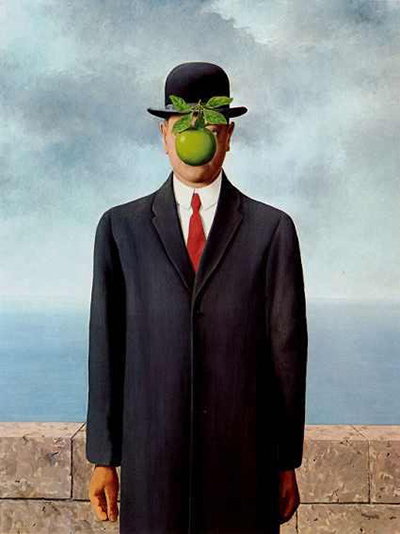
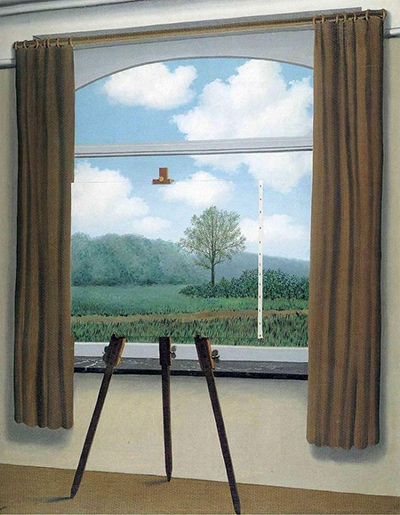
The Human Condition is another useful comparison because both works make interior space unstable. The Human Condition confuses window and canvas. Time Transfixed confuses hearth and railway passage. [3]
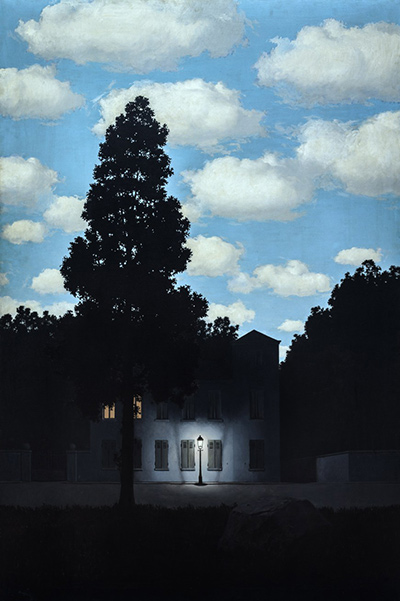
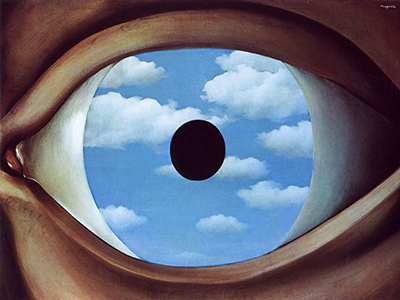
The Empire of Light and The False Mirror show related methods. Each painting keeps the objects plain and lets one altered relation transform the whole image. [6]
Reception and Influence
Time Transfixed has become one of Magritte's most reproduced images because the contradiction is immediate and unforgettable. The painting does not require specialist knowledge to register its shock. A train does not belong in a fireplace. [3]
Its longer influence comes from the precision of that shock. Many later images place unexpected objects in rooms, but Magritte's painting feels more durable because the connection is not random. Smoke gives the impossible scene a logic that almost works. [1]
Timeline
- 1938 - Magritte paints La duree poignardee (Time Transfixed). [1]
- 1939 - The painting is sold to Edward James by July 12, 1939. [1]
- 1970 - The Art Institute of Chicago acquires the painting at Sotheby Parke Bernet, New York. [1]
- 2013-14 - The painting appears in Magritte: The Mystery of the Ordinary, 1926-1938. [3]
FAQs
Time Transfixed is in the Art Institute of Chicago. [1]
It shows a locomotive emerging from a fireplace in a quiet interior with a clock, candlesticks and mirror above the mantel. [1]
Edward James bought the painting from Magritte by July 12, 1939, and the Art Institute acquired it in 1970. [1]
La duree poignardee can be understood as duration stabbed or ongoing time stabbed, which is sharper than the English title Time Transfixed. [5]
The fireplace matters because it links domestic space with smoke. Magritte uses that link to make the locomotive's impossible arrival feel poetically plausible. [1]
References
- Art Institute of Chicago API/object record, "La duree poignardee (Time Transfixed)," accessed July 4, 2026, https://api.artic.edu/api/v1/artworks/34181.
- Art Institute of Chicago, "Time Transfixed," public object page, accessed July 4, 2026, https://www.artic.edu/artworks/34181/time-transfixed.
- Anne Umland, ed., Magritte: The Mystery of the Ordinary, 1926-1938, New York: Museum of Modern Art, 2013.
- David Sylvester and Sarah Whitfield, eds., Rene Magritte: Catalogue Raisonne, Houston and London: Menil Foundation / Philip Wilson, 1993.
- Harry Torczyner, Magritte: Ideas and Images, New York: Harry N. Abrams, 1977.
- Patricia Allmer, Rene Magritte: Beyond Painting, Manchester: Manchester University Press, 2009.
- Museum of Modern Art, "Rene Magritte," artist record, accessed July 4, 2026, https://www.moma.org/artists/3692-rene-magritte.