 by Tom Gurney
Tom Gurney BSc (Hons) is an art history expert with over 20 years experience
Published on July 5, 2026 / Updated on July 5, 2026
Email: tomgurney1@gmail.com / Phone: +44 7429 011000
René Magritte Style: How He Made the Ordinary Strange
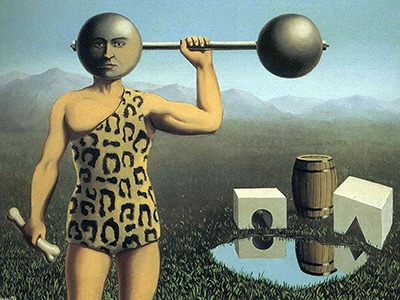
René Magritte's style is one of the most recognisable in twentieth-century art because it does something very difficult: it makes the impossible look calm. His paintings rarely depend on expressive brushwork, violent distortion or spectacular fantasy. Instead, they present ordinary things with a cool, almost literal clarity, then alter one relationship so quietly that the entire image becomes unstable. [1]
A pipe is shown with the statement that it is not a pipe. A green apple hides a man's face. A daylight sky appears above a night-time street. A train emerges from a fireplace. A canvas on an easel seems to replace the view behind it. A mirror refuses to reflect the person standing in front of it. Nothing in these images looks hurried or chaotic, yet each one asks the viewer to reconsider what seeing, naming and recognising actually mean. [1]
That restraint is the centre of Magritte's art. He was a Surrealist, but not a Surrealist in the most flamboyant sense. His mature work does not usually look like a dream spilling across the canvas. It looks more like a carefully staged visual proposition. The objects are familiar, the paint surface is smooth, the lighting is legible and the composition is often direct. [1]
To understand René Magritte's style is to see that his paintings do not simply show strange things. They make ordinary seeing strange. [1] [2]
At a Glance
- Artist: René Magritte
- Movement: Surrealism
- Mature style: Precise, representational and conceptually disruptive
- Common motifs: Apples, pipes, bowler hats, hidden faces, skies and windows
- Core idea: Ordinary objects become strange when expected relationships change
Contents
- What Defines Magritte's Style
- Belgian Surrealism
- Ordinary Objects Made Strange
- Clarity, Flatness and Restraint
- Words, Images and Titles
- Hidden Faces and Anonymous Men
- Apples, Skies, Windows and Repetition
- Style Across His Career
- Magritte and Dalí
- How to Recognise a Magritte
What Defines Magritte's Style
Magritte's mature style can be defined as precise representational painting used to disturb ordinary thought. The paintings usually begin with familiar things: a room, a pipe, a man in a suit, a window, a curtain, a sky, an apple, a mirror, a landscape. These objects are painted clearly enough to be named at once. Magritte wants the viewer to recognise them quickly, because recognition is the ground on which the later disturbance takes place. [8]
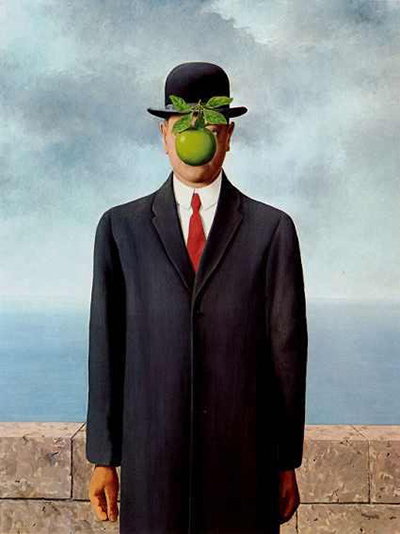
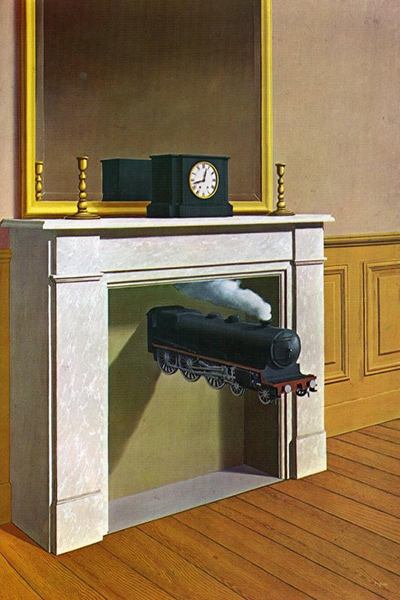
The disturbance is rarely complicated at first glance. In The Son of Man, the apple is not monstrous. It is simply in the wrong position, floating in front of the man's face. In The Listening Room, the apple is not transformed; it is too large for the room. In Time Transfixed, the locomotive is not impossible in itself, but impossible as an object emerging from a fireplace. Magritte's art often works by keeping most of reality intact while altering one crucial relation. [8]
This gives his paintings their distinctive tension. They are easy to enter and difficult to leave. Viewers can describe what they see in a sentence, but the sentence immediately exposes the problem. A man is visible, except the face is hidden. A pipe is visible, except the caption denies it. A landscape is visible, except the picture inside the picture makes the outside world uncertain. [8]
Magritte's style is also unusually clean. He was not interested in making brushwork the hero of the painting. The surface is often smooth, the contours legible and the modelling restrained. This visual plainness matters. If the paintings were technically chaotic, the mystery might feel like a matter of expression. Because they are calm, the mystery feels conceptual. [8]
The Key to Magritte's Style
Magritte usually changes one relationship, not the whole world. The result is an image that looks clear until the viewer notices that clarity has become the problem. [8]
Belgian Surrealism
Magritte belonged to Surrealism, but his relationship to the movement was shaped by Belgium as much as by Paris. The Brussels circle around Magritte, Paul Nougé, E. L. T. Mesens, Louis Scutenaire and others developed a form of Surrealism that was often cooler, more linguistic and more deadpan than the dream-spectacle associated with some French and Spanish Surrealist painting. [4] [3]
This context helps explain why Magritte's art so often feels like a visual argument. Belgian Surrealism valued wit, contradiction, language, misdirection and the subversion of everyday bourgeois normality. Rather than making the unconscious erupt in painterly chaos, Magritte often made the normal world expose its own instability. [4]
His Paris years from 1927 to 1930 were important, but he did not simply become a Parisian Surrealist. He remained attached to Brussels, to ordinary interiors, to middle-class clothing, to the language of advertisements and shop-window clarity, and to the understated theatricality of everyday life. The result was a Surrealism that could be severe and funny at the same time. [4]
A Magritte painting often looks polite before it becomes unsettling. A man in a bowler hat stands upright. A room is tidy. A seascape is calm. A pipe is drawn with the clarity of a catalogue illustration. Then the image breaks the contract of normal seeing. [4]
Ordinary Objects Made Strange
The phrase most often used to describe Magritte's method is the transformation of the ordinary into the strange. That phrase is accurate, but it needs care. Magritte does not usually make objects strange by changing their appearance. He makes them strange by changing their situation. [4]
An apple remains an apple. A pipe remains a pipe-like image. A hat remains a hat. A curtain remains a curtain. The shock comes from placement, scale, substitution, concealment or contradiction. The familiar object is not destroyed; it is made unreliable. [4]
This is why Magritte's paintings are so good at slowing the viewer down. In many Surrealist works, the strange element announces itself immediately as fantasy. In Magritte, the strange element often arrives through the stubborn ordinariness of the object. The apple in The Son of Man is painted plainly enough to be almost dull, but it blocks the one area of the painting that a viewer most wants to see. [4]
Magritte's ordinary objects also resist symbolic closure. It is tempting to translate every apple into temptation, every bird into freedom, every covered face into trauma and every cloudy sky into transcendence. Sometimes those associations may be relevant, but Magritte's style works best when the object is allowed to remain stubbornly itself. [4] [9]
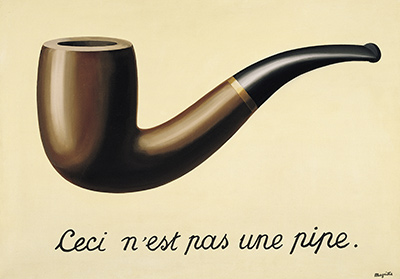
The same is true of The Treachery of Images. The painting does not need an obscure object. It needs an object so recognisable that the caption can attack recognition directly. The viewer knows what the image depicts, but the words insist on a distinction between the object and its representation. [4]
Clarity, Flatness and Restraint
Magritte's style depends on clarity. His paintings are usually composed so that the central idea can be grasped quickly. The viewer sees the contradiction before needing to analyse painterly handling. This has sometimes led people to underestimate his art as merely illustrative, but the directness is part of the intelligence. [4]
The paintings often use frontal arrangements, simple silhouettes and clean separations between objects. Figures stand still. Rooms are quiet. Skies are open. Edges are legible. Colour is controlled rather than extravagant. Even when the subject is impossible, the painting behaves as if it were reporting a fact. [4]
This deadpan tone is one of Magritte's greatest inventions. He rarely tells the viewer how emotionally to respond. The image does not scream. It waits. That waiting quality gives the work its humour and unease. A locomotive from a fireplace in Time Transfixed is absurd, but it is painted with such composure that the absurdity becomes more unsettling. [4] [6]
The restraint also distinguishes Magritte from painters who make dream imagery feel fluid or delirious. Magritte's art is often closer to a diagram than a hallucination, but a diagram whose logic has been poisoned. The viewer is invited to understand, then prevented from completing that understanding. [4]
Words, Images and Titles
Magritte's style cannot be separated from language. He repeatedly explored the unstable relationship between words, images and things. The most famous example is The Treachery of Images, where a carefully painted pipe appears above the phrase Ceci n'est pas une pipe. The sentence is not a trick in the simple sense. It is true: the painting is not a pipe, but a representation of one. [4] [5]
The force of the work comes from the conflict between visual recognition and linguistic correction. The eye says pipe. The words say not pipe. The mind has to hold both at once. That tension became central to Magritte's reputation because it exposes a problem present in all images. A picture can resemble something without being that thing. A name can point to something without becoming the thing named. [4]
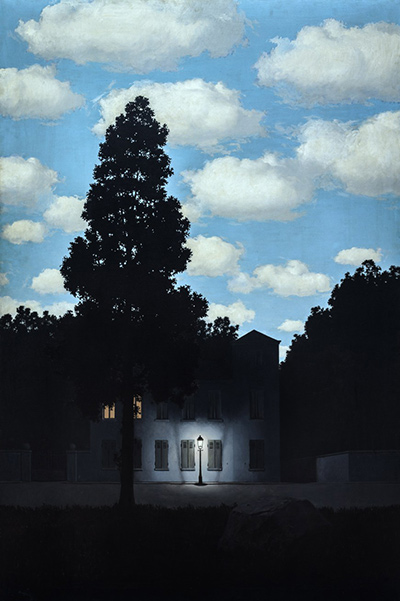
Magritte's titles often work in a related way. They rarely explain the picture in a straightforward manner. Instead, they add another level of displacement. Titles such as The Human Condition, The False Mirror, The Empire of Light and Time Transfixed do not solve the image; they sharpen its uncertainty. [4]
This is important for readers approaching Magritte for the first time. His titles should not be treated as captions that decode the painting. They are part of the artwork's machinery. [4]
Hidden Faces and Anonymous Men
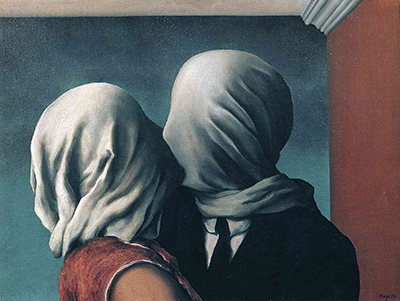
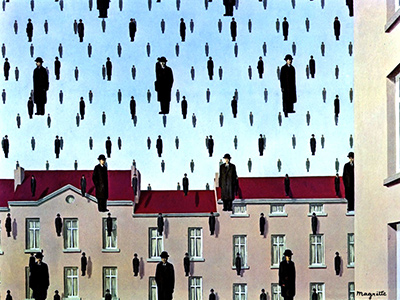
One of Magritte's most persistent visual strategies is to withhold the face. Sometimes the face is covered with cloth, as in Les Amants. Sometimes it is blocked by an apple, as in The Son of Man. Sometimes the figure is turned away, multiplied or made anonymous by formal dress, as in Man in a Bowler Hat and Golconde. [4]
Faces matter because portraiture usually promises access. A face gives the viewer identity, emotion, social presence and psychological clues. Magritte repeatedly interrupts that promise. He does not remove the person entirely. He lets the viewer know that a person is there, then blocks the route by which the person would normally be known. [4]
The bowler-hatted man is central to this effect. The hat and suit suggest bourgeois respectability, modern urban life and social conformity. The figure may resemble Magritte himself, but it also resists individuality. It can be a self-image, an everyman, a clerk, a witness, a mask or a repeating unit. [4]
The hidden face also warns against easy biography. Many viewers connect covered faces with the death of Magritte's mother, but responsible interpretation should be cautious. The paintings are not simply coded confessions. They are formal and conceptual investigations into visibility, identity and concealment. [4]
Apples, Skies, Windows and Repetition
Magritte repeated motifs throughout his career: apples, skies, birds, curtains, stones, bowler hats, pipes, rooms, windows, mirrors and framed pictures. Repetition in his work is not a weakness. It is a method. By returning to the same objects, he could test new relationships between them. [4] [7]
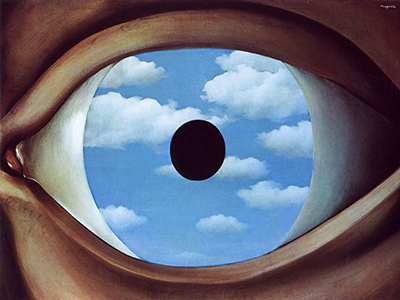
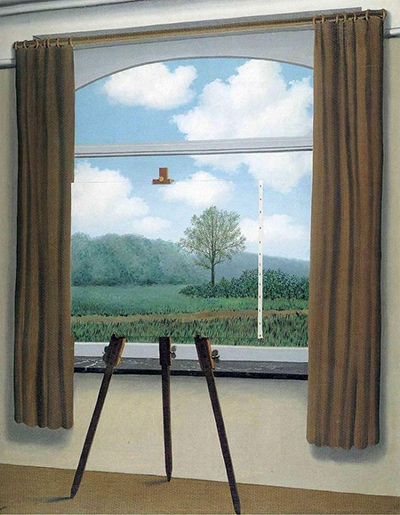
The apple can hide a face in The Son of Man, fill a room in The Listening Room or become the subject of a naming problem in This is Not an Apple. The sky can occupy the iris of an eye in The False Mirror, hover above a nocturnal street in The Empire of Light or appear inside a cut-out silhouette. A window can open onto a view, frame a deception or become confused with a painting in The Human Condition. [4]
These repetitions create a visual vocabulary. Once a viewer knows several Magritte paintings, each new work begins to echo the others. The apple is not only an apple; it recalls other apples. The bowler hat is not only a hat; it belongs to a population of repeated men. The cloudy sky is not only weather; it is one of Magritte's favourite ways to make space feel both open and artificial. [4]
Repetition also helps explain why Magritte's art is so memorable. His motifs behave almost like words in a private language. They can be rearranged into new visual sentences. [4]
Style Across His Career
- 1898 — René Magritte is born in Lessines, Belgium. [4]
- 1922-1926 — Commercial design and advertising work sharpen his clean, legible handling of objects. [4]
- 1926 — The Lost Jockey marks a decisive move toward Surrealism. [4]
- 1927-1930 — Magritte lives near Paris and engages with Surrealist circles while remaining distinct from Parisian Surrealism. [4]
- 1928-1938 — Many of the central devices of his mature style develop: covered faces, word-image tensions, interiors, frames, mirrors and impossible substitutions. [4]
- 1943-1948 — The Renoir and Vache periods test brighter, rougher and more provocative alternatives to his classic style. [4]
- 1950s-1960s — Recurring motifs become increasingly iconic in works such as The Listening Room, The Empire of Light and The Son of Man. [4]
The late 1920s and 1930s were especially important. During this period Magritte produced many of the works that established his language of displacement, obstruction and contradiction, including The Treachery of Images, The Lovers, The False Mirror, The Human Condition, The Menaced Assassin, The Red Model, Not to Be Reproduced and Time Transfixed. [4]
By the 1950s and 1960s, Magritte's motifs had become increasingly iconic. His later style could be almost poster-like in its clarity while remaining conceptually unresolved. [4]
Magritte and Dalí
Magritte is often grouped with Salvador Dalí because both artists are central to Surrealism, but their styles operate very differently. Dalí often gives the viewer spectacle: melting forms, heightened illusionism, theatrical landscapes and a sense of dream imagery made extravagantly visible. Magritte is usually quieter. [8]
A Dalí painting often announces its virtuosity and strangeness together. A Magritte painting often suppresses drama so that the thought becomes sharper. The viewer is not swept into a dream world so much as returned to the ordinary world with confidence damaged. [8]
This difference matters because it helps readers understand why Magritte's art can seem simple at first. His restraint is not a lack of imagination. It is the condition that allows the contradiction to feel exact. If The Treachery of Images were painted as a wild hallucination, its point about representation would be weaker. If The Son of Man were full of dramatic distortion, the apple would not feel so calmly obstructive. [8]
Magritte's Surrealism is therefore less about escape from reality than about suspicion toward reality's apparent order. He does not need to invent a completely new world. He only needs to adjust this one. [8]
How to Recognise a Magritte
A useful way to recognise Magritte's style is to ask what ordinary expectation has been interrupted. Do not begin by searching for a hidden symbolic dictionary. Begin by naming what is visible, then ask what relationship has changed. [4]
-
1. Name the ordinary object first
Is it an apple, pipe, hat, window, mirror, curtain, room, stone, bird or sky? -
2. Find the altered relationship
Is the object too large, in the wrong place, blocking a face, contradicting a word or behaving against expectation? -
3. Notice what the change does to seeing
Does it frustrate recognition, confuse inside and outside, challenge naming or make identity unavailable? -
4. Avoid rushing to fixed symbols
Magritte's objects work through context. Their meaning changes from painting to painting.
This approach connects naturally with the broader question of how to read Magritte more generally. Once the altered relationship is identified, interpretation becomes more grounded. The viewer can then ask what the altered relationship does to identity, language, space, desire, representation or certainty. [4]
That is the enduring power of his style. It teaches viewers that seeing is not passive. To look at Magritte is to discover how much the mind expects from the world before the world has said anything at all. [4]
FAQs
René Magritte's art style is usually called Surrealism, more specifically Belgian Surrealism. His mature style is precise, representational and conceptually disruptive, using ordinary objects in unexpected relationships. [1]
Magritte is generally cooler, flatter and more restrained than Dalí. Dalí often uses theatrical illusion and dreamlike spectacle, while Magritte tends to make ordinary objects look calm and logical before revealing that their relationship is impossible. [1]
Magritte used ordinary objects because they allowed him to disturb familiar expectations. A pipe, apple, hat or window is easy to recognise, so any contradiction involving it becomes immediately clear. [1]
His recurring motifs include apples, pipes, bowler hats, hidden faces, curtains, mirrors, windows, cloudy skies, birds, stones and domestic interiors. [1]
They can carry symbolic associations, but they should not be reduced to fixed symbols. Magritte's objects usually work through placement, contradiction and context rather than one-to-one symbolic meaning. [1]
Hidden faces allow Magritte to explore identity, concealment and the viewer's desire to recognise another person. The face is present as an expectation, but blocked as information. [1]
References
- MoMA, "René Magritte", View source.
- Royal Museums of Fine Arts of Belgium, "Magritte Museum", View source.
- René Magritte Museum, "Welcome to the René Magritte Museum", View source.
- Anne Umland, ed., Magritte: The Mystery of the Ordinary, 1926-1938, Museum of Modern Art, 2013.
- Harry Torczyner, Magritte: Ideas and Images, New York: Harry N. Abrams, 1977.
- David Sylvester, Magritte: The Silence of the World, Houston: Menil Foundation, 1992.
- David Sylvester, Sarah Whitfield and Michael Raeburn, René Magritte: Catalogue Raisonné, London: Menil Foundation / Philip Wilson, 1992-1997.
- Suzi Gablik, Magritte, London: Thames & Hudson, 1970.
- Patricia Allmer, René Magritte: Beyond Painting, Manchester: Manchester University Press, 2009.