 by Tom Gurney
Tom Gurney BSc (Hons) is an art history expert with over 20 years experience
Published on June 19, 2020June 19, 2020 / Updated on July 6, 2026
Email: tomgurney1@gmail.com / Phone: +44 7429 011000
Not to Be Reproduced by Rene Magritte
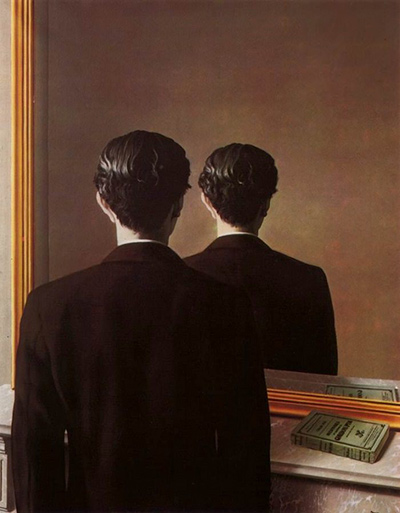
Not to Be Reproduced is one of Rene Magritte's sharpest mirror paintings. A man stands before a mirror. We expect the mirror to reveal his face. Instead, it gives us the back of his head again. [3]
The painting is usually identified as a 1937 oil portrait of Edward James, the British Surrealist patron who commissioned several works from Magritte. It is held by Museum Boijmans Van Beuningen in Rotterdam. [1] [4]
The shock is precise. The book on the mantelpiece reflects normally, but the man does not. Magritte changes only the rule he needs to change, which makes the impossible event feel colder and more exact. [6]
At a Glance
- Artist: Rene Magritte [7]
- Title: Not to Be Reproduced
- French title: La reproduction interdite [3]
- Date: 1937 [3]
- Medium: oil on canvas [3]
- Collection: Museum Boijmans Van Beuningen, Rotterdam [1]
- Subject: Edward James [4]
- Key object: Poe's The Narrative of Arthur Gordon Pym of Nantucket in French edition [4]
Contents
- Why this painting matters
- Museum and collection context
- Historical background
- Visual description
- Looking carefully
- Meaning and interpretation
- Comparison works
Why This Painting Matters
Not to Be Reproduced matters because it turns the mirror, a device of recognition, into a device of refusal. Mirrors usually promise access to the self. Here, the mirror repeats concealment. [6]
The painting is also central to the Edward James group. Alongside The Pleasure Principle and Time Transfixed, it shows Magritte working inside a patron's world of interiors, portraits and staged paradoxes. [4]
Museum and Collection Context
The painting is associated with Museum Boijmans Van Beuningen in Rotterdam, one of the major European collections holding Magritte's work. The official object reference was not fully retrievable in this environment, so this page treats the Boijmans collection fact together with the catalogue raisonne and other scholarly references. [1] [3]
That caution matters because the painting is often reproduced and discussed online. The strongest reading should not depend on internet folklore. It should begin with what the image visibly does: the mirror disobeys only for the human figure. [6]
Museum Moment
Seen as a museum object, the painting depends on a very controlled delay. The viewer first recognises a conventional portrait arrangement: figure, mantel, mirror, book and interior. Only after that recognition does the mirror's refusal become clear. Magritte needs the room to look credible before the impossible rule can register. [6]
This delay is one reason the painting should not be reduced to a spooky effect. Its force is intellectual and visual at once. The mirror behaves correctly for the book, so the viewer cannot dismiss the scene as a simple fantasy. The contradiction is targeted, and that makes it more exacting. [4]
Video Guide
This selected video from Shawn Grenier | The Canvas offers useful visual context before the detailed analysis continues.
Historical Background
Magritte painted Not to Be Reproduced in 1937, during his connection with Edward James. James was not merely a collector but an active Surrealist patron whose domestic spaces became settings for impossible images. [4]
This portrait is strange because it withholds the face of its subject. A portrait normally promises recognition. Magritte gives the patron's body, clothes and position, but removes the identifying frontal view that a mirror should provide. [6]
Visual Description
The painting shows a man in a dark jacket standing before a mantel and mirror. He is seen from behind. His hair, shoulders and collar are carefully described. The space is quiet and controlled. [3]
In the mirror, the viewer expects to see his face. Instead, the reflection shows the same back view. The mirror repeats the refusal. On the mantel, however, a book is reflected correctly. This detail proves that the mirror is not generally broken; it fails only at the human figure. [4]
Looking Carefully
Begin with the book. It is easy to miss because the human anomaly dominates the painting, but the book is crucial. Its correct reflection shows that Magritte is not simply painting a fantasy mirror. He is changing one relationship within an otherwise orderly scene. [4]
Then look at the posture. Edward James stands calmly, as if nothing unusual has happened. The painting's uncanniness comes from that calm. The figure does not react to his own missing face. [6]
Finally, notice the frame of the mirror. It acts like a second painting inside the painting. What should reveal identity becomes a picture of concealment. [5]
Things You Might Miss
- The title does not simply describe reproduction in the mechanical sense. It also points to failure: the mirror is forbidden to reproduce the sitter as expected. [5]
- The painting is not faceless because the head is absent. The head is present twice, but only from behind. [6]
- The Poe book is not decorative trivia. Poe's fiction often plays with unreliable narration, enclosed spaces and uncertain identity. [4]
Poe and the Book
The book on the mantel is usually identified as a French edition of Edgar Allan Poe's The Narrative of Arthur Gordon Pym of Nantucket. That detail is more than a literary Easter egg. Poe's novel is itself bound up with narration, identity, uncertainty and the unstable border between fact and fiction. [4]
In the painting, the book is also the control case. It reflects normally. The viewer therefore has two systems in one image: a book that obeys reflection and a human figure who does not. Magritte makes the inanimate object more reliable than the portrait subject. [6]
Technique and Composition
The technique is controlled and sober. The jacket, hair, mirror and mantel are painted in a realist manner. This realism is what makes the mirror anomaly so effective. [3]
The composition is almost symmetrical, but not comforting. The viewer, the sitter and the mirror create a closed circuit. We look at a man looking at an image that refuses to look back. [6]
Meaning and Interpretation
The strongest interpretation is about identity and representation. The mirror should offer self-knowledge. Instead, it reproduces the same unknowability already visible to the viewer. [5]
The painting also asks what a portrait can do. A portrait without a face should fail, yet this one succeeds precisely because it makes absence its subject. Edward James is represented through the impossibility of seeing him. [4]
It is tempting to call the painting sinister or frightening, but those are responses rather than evidence. The firmer point is that Magritte turns recognition into repetition and reflection into concealment. [6]
Title Analysis
La reproduction interdite means reproduction forbidden or not to be reproduced. The title is wonderfully double. It refers to an image that refuses normal reflection, but also to the reproduction of identity in art. [5]
The title also suits Magritte's broader suspicion of images. A picture is never the thing itself. Here, even a mirror, the most automatic of images, fails to deliver the expected truth. [5]
Provenance and Patron Context
Edward James is central to the painting's meaning. He commissioned and collected major Surrealist works, and Magritte produced several important paintings connected to him. [4]
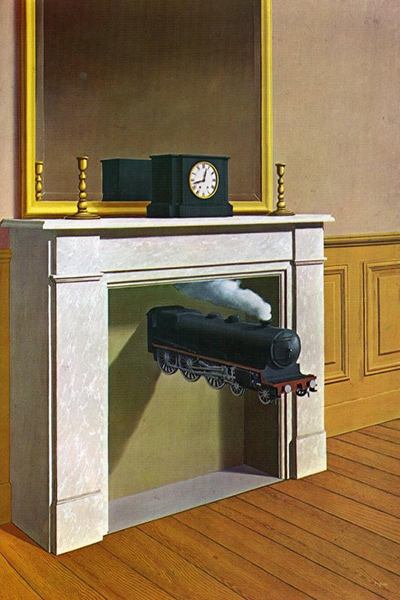
Time Transfixed, completed the following year, belongs to the same world of refined interiors and impossible events. In one painting, the fireplace admits a train. In Not to Be Reproduced, the mirror refuses a face. [2]
The Edward James context sharpens the portrait problem. James wanted and supported Surrealist art that altered domestic experience. Yet Magritte's portrait refuses the usual reward of patronage: the sitter's recognisable face. The painting gives James a place in the image while denying the frontal identity that portraiture conventionally supplies. [4]
Comparison Works
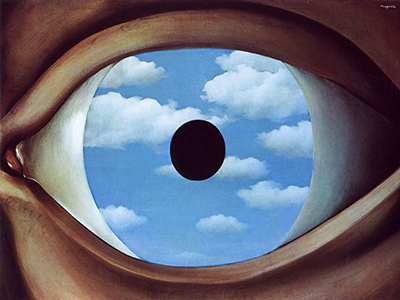
The False Mirror is the closest conceptual comparison because both paintings make sight unreliable. In The False Mirror, the eye becomes sky. In Not to Be Reproduced, the mirror becomes a machine of concealment. [6]
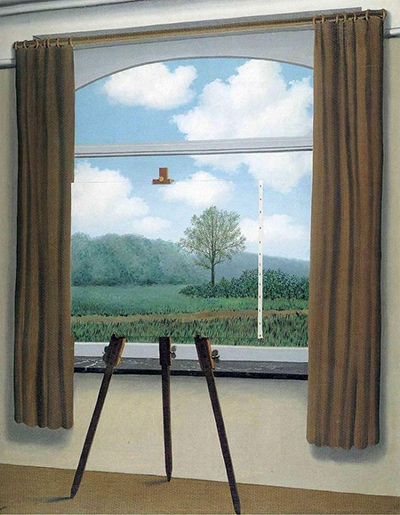
Time Transfixed is important because of Edward James and domestic space. The Human Condition is useful because it also tests what an image does inside a room. [3]
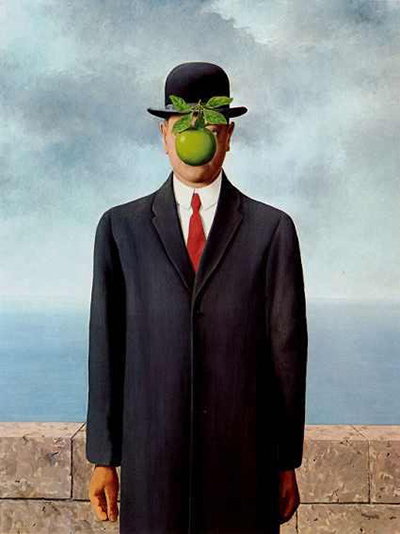
The Son of Man provides a later echo. There, an apple hides the face from outside. In Not to Be Reproduced, the mirror itself withholds the face. [6]
Reception and Influence
The painting has had a strong afterlife because its central device is instantly understandable. Anyone knows what a mirror should do, so anyone can feel the disturbance when it refuses. [6]
Later visual culture often uses the repeated back-view as a shorthand for split identity or alienation. But Magritte's painting is more precise than a generic identity crisis. It gives the viewer a rule and then violates it in one exact place. [5]
Timeline
- 1937 - Magritte paints Not to Be Reproduced. [3]
- 1937 - The work belongs to Magritte's Edward James portrait context. [4]
- 1938 - Magritte completes Time Transfixed, another major Edward James-related interior. [2]
FAQs
It is held by Museum Boijmans Van Beuningen in Rotterdam. [1]
The figure is generally identified as Edward James, Magritte's British Surrealist patron. [4]
Magritte makes the mirror fail only for the human figure, turning reflection into concealment. [6]
The book is a French edition of Edgar Allan Poe's The Narrative of Arthur Gordon Pym of Nantucket. [4]
Both works are linked to Edward James and both introduce an impossible event into a controlled interior. [2]
References
- Museum Boijmans Van Beuningen, Rene Magritte object/artist reference for La reproduction interdite / Not to Be Reproduced, current/archived object reference identified but not fetchable in this environment.
- Art Institute of Chicago API/object record, "La duree poignardee (Time Transfixed)," accessed July 4, 2026, https://api.artic.edu/api/v1/artworks/34181.
- David Sylvester and Sarah Whitfield, eds., Rene Magritte: Catalogue Raisonne, Houston and London: Menil Foundation / Philip Wilson, 1993.
- Richard Calvocoressi, Magritte, London: Phaidon, 1984.
- Harry Torczyner, Magritte: Ideas and Images, New York: Harry N. Abrams, 1977.
- Patricia Allmer, Rene Magritte: Beyond Painting, Manchester: Manchester University Press, 2009.
- Museum of Modern Art, "Rene Magritte," artist record, accessed July 4, 2026, https://www.moma.org/artists/3692-rene-magritte.