
Good Faith
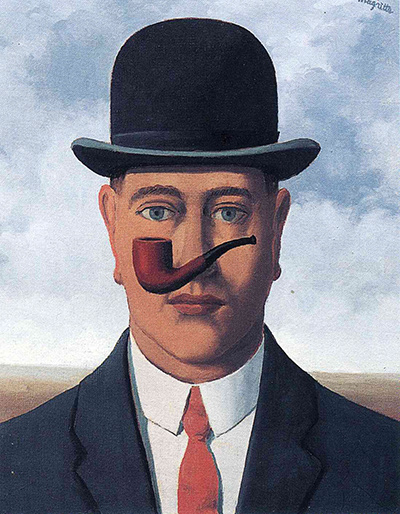
A man in a dark suit and bowler hat looks directly towards us. His white collar and red tie give him the appearance of someone dressed for a formal portrait. Across the middle of his face, however, a brown pipe hangs in the air. Its bowl covers part of one cheek, while the curved stem crosses the nose without entering his mouth.
René Magritte's Good Faith, or La bonne foi, is an oil painting catalogued in a private collection. The Art Gallery of New South Wales dated it 1965 in its 2024 exhibition booklet. An earlier Belgian museum publication gave the range 1964–65. Both records identify the same pipe-and-bowler composition reproduced here. [1] [2]
At a Glance
Contents
The expectations of a portrait
The composition initially offers several familiar cues. A head and shoulders occupy the centre, the face turns towards the viewer, and the clothing establishes a relatively orderly appearance. The man's eyes are visible, so we can meet his gaze despite the object crossing his features.
This visibility matters. The pipe interrupts a portrait that remains recognisable around it. We can still follow the brows, the outline of the ears and the closed mouth. The unusual element does not remove all the information that makes the image readable as a human likeness.
The resulting encounter is divided. The eyes suggest the possibility of direct contact, while the pipe places a conspicuous obstacle below them. Looking at the face means repeatedly accounting for that object. The picture gives us enough of an ordinary portrait to make its departure from the convention especially clear.
A pipe in the wrong position
The pipe is not being smoked. There is no hand holding it, its stem is displaced from the lips, and the mouth remains visible below. An object normally associated with a particular bodily action has been placed where that action cannot explain it.
Its bowl and stem are nevertheless carefully legible. The rounded brown bowl has a dark opening at the top; the narrower black stem extends across the face with a pronounced curve. The contrast between these parts helps identify the object quickly, even though its position is extraordinary.
Follow the pipe's movement from left to right. Its curve cuts across the comparatively upright organisation of hat, nose and tie. The face supplies a background against which that curve becomes emphatic. Instead of functioning as an accessory held beside a sitter, the pipe establishes its own route through the centre of the image.
What remains visible
The eyes sit above the main interruption. Their pale colour and darker outlines give them a presence distinct from the surrounding skin. The pipe passes close enough to make their continued visibility feel deliberate: the picture obstructs the face selectively rather than covering it completely.
Below, the lips create another point of stability. Their horizontal line is smaller and quieter than the shape of the pipe. Because we can see that the mouth is closed, we cannot comfortably complete the scene by imagining an ordinary smoking gesture hidden behind the object.
The picture therefore makes absence and presence work together. Part of the nose is concealed, but its expected position remains easy to infer from the features around it. What is hidden does not become an empty area. We continue to imagine the face behind the pipe while recognising the painted object in front.
Hat, collar and tie
The bowler forms a large dark mass above the face. Its rounded crown has a clearer, more compact outline than the loosely gathered clouds behind it. The brim extends sideways, establishing a broad horizontal accent near the top of the head.
Below the face, the white collar and red tie organise another set of shapes. The tie draws attention down the centre, while the darker lapels open around it. Their arrangement gives the upper body a structure that can be grasped almost as quickly as the pipe.
These ordinary items of clothing contribute to the painting's restraint. There is no elaborate costume explaining an extraordinary character. The man appears conventionally dressed, and his posture offers little outward drama. That composed appearance makes the pipe's unsupported position more insistent, because the surrounding portrait provides no equally conspicuous disturbance to absorb it.
A narrow horizon behind the head
The background is divided between a cloudy sky and a much narrower band of ground. The horizon remains low beside the shoulders, leaving most of the space behind the hat and face open. There is no detailed interior furnishing to establish a social occasion for the portrait.
This reduced setting strengthens the central encounter. The clouds supply softer edges and changes in tone, contrasting with the cap, collar and pipe. The landscape does not develop into a second scene that competes for attention; it allows the figure's outline to remain prominent.
Look especially at the meeting of hat and sky. The dark boundary is immediately readable, while the atmosphere beyond it is less sharply divided. The man's silhouette appears stable within this softer setting. The pipe's impossibility emerges inside that stability rather than from a wholesale collapse of the painted world.
Which date and which object?
The recent exhibition label identifies Good Faith as 1965, oil on canvas, in a private collection. The Belgian Federal Science Policy publication Science Connection reproduced it in 2016 with the slightly broader date 1964–65. The difference is worth retaining when the painting is discussed, rather than turning a range into a falsely exact claim. [1] [2]
These are records of the painting, not dimensions or edition details for a later print bearing the same image. A reproduction can preserve the pipe-and-face arrangement while belonging to a different physical object. The medium and collection statements used here follow the institutional descriptions of the oil painting.
The likeness also remains unnamed in those records. A bowler hat and formal suit may invite associations with Magritte, but resemblance and familiar clothing do not establish a confirmed self-portrait. The useful starting point is the depicted figure and the way the pipe changes our access to his face.
Good faith and an unsettled image
The title introduces an idea of sincerity or trust into a scene that frustrates an ordinary explanation. The man's appearance is composed, and the objects are readily recognisable. Yet recognising them does not settle the question of how they belong together.
That tension does not require a single hidden message assigned to every detail. The image already gives us a substantial problem to consider: a clearly painted pipe occupies an impossible position in a clearly painted portrait. The face remains accessible enough to invite attention, while the object makes that attention repeatedly conscious of its own limits.
Return to the space between the eyes and mouth. It is a small part of the composition, but the displaced pipe changes the whole encounter. Hat, clothing, sky and gaze continue to promise familiarity. Good Faith lets that familiarity persist while making its central arrangement impossible to take for granted.
Selected Magritte paintings
Nine individually sourced Magritte works. Date and medium labels distinguish the 1926 Dawn of Cayenne oil, 1948 Memory gouache and 1960 Heartstrings canvas from other versions. This is a selected directory, not a complete catalogue.
| Name | Date | Medium |
|---|---|---|
| Dawn of Cayenne — 1926 oil | 1926 | Oil painting 1926 oil identified in later-version catalogue. |
| The Double Secret | 1927 | Oil on canvas Catalogue record. |
| Act of Violence | 1932 | Oil on canvas Museum object record. |
| Memory — 1948 gouache | 1948 | Gouache on paper Catalogue record. |
| The Invisible World | 1954 | Oil on canvas Catalogue record. |
| Clear Ideas — dated 1955 | 1955; possible 1958 execution | Oil on canvas Catalogue record. |
| Heartstrings | 1960 | Oil on canvas Auction object record. |
| Good Faith | 1965; earlier record 1964–65 | Oil on canvas Exhibition label, p. 111. |
| The Blank Signature | 1965 | Oil on canvas Catalogue record. |
Frequently Asked Questions
The stem does not enter his mouth. The pipe hangs across the face, and the closed lips remain visible below it.
Discussion
Look closely at the objects, their boundaries and the setting around them.
Reader Insights
How does the visibility of the eyes change your response to the obstructed face?
Which line gives the pipe its strongest contrast with the portrait?
What does the restrained setting contribute to the image's strangeness?
Join the Conversation
Share a detail, comparison or question about Good Faith below.
References
- Art Gallery of New South Wales, Magritte, large-print exhibition booklet (2024), p. 111: Good faith / La bonne foi, 1965, oil on canvas, private collection. View source.Splash image: Good Faith (La bonne foi), 1965 in the 2024 exhibition label; 1964–65 in the earlier Belgian publication. Oil on canvas; catalogued in a private collection.
- Belgian Federal Science Policy Office, Science Connection 52 (November–December 2016), Royal Museums' Magritte Museum article and facing reproduction, pp. 16–17. Caption identifies La Bonne Foi, 1964–1965, oil on canvas, private collection. View source.