
Clear Ideas
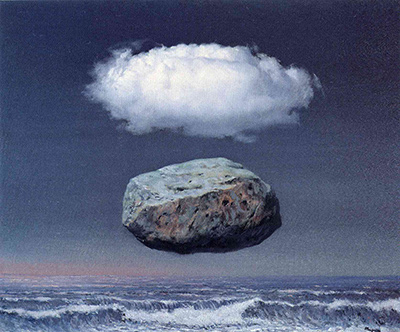
A large stone hangs above the sea. A white cloud floats higher in the same dark sky, and a narrow band of light separates the water from the air. The stone has the weight and texture of something that ought to fall, yet nothing supports it and nothing in the picture announces its descent. René Magritte gives an impossible arrangement the stillness of an ordinary view.
This Clear Ideas, or Les idées claires, is the oil painting catalogued by Christie's as 50 × 60 centimetres, signed and dated 1955. Its catalogue raisonné number is Sylvester III 885. The date written on the painting and a later scholarly proposal about its execution need to be distinguished. [1]
At a Glance
Three stone motifs
Contents
A cloud and a stone
The cloud and rock occupy separate horizontal bands. The cloud is broader, softer at its edges and much lighter in colour. The rock below has a more compact outline, with a pale upper surface and darker underside. Their resemblance as isolated forms becomes evident because they have been placed one above the other.
They are also very different kinds of things. We readily accept a cloud in the air, while the unsupported rock contradicts our expectations about weight. Magritte gives them a shared setting without making that difference disappear. The cloud seems stranger as we compare it with the stone, and the stone becomes temporarily plausible through its relation to the cloud.
The interval between them is important. They neither touch nor combine into a single fantastic object. The dark air remains visible as a gap, allowing us to recognise two separate forms and then reconsider the relation that the composition establishes between them.
The space beneath the rock
Another gap separates the rock from the water. It is small enough to make the distance feel consequential, but clear enough to remove any doubt that the stone is unsupported. The horizon passes behind it, giving us a measure of its position within the seascape.
The water does not supply an event that would explain the arrangement. There is no visible splash or disturbance directly beneath the rock. Instead, the foreground waves carry their own repeated movement across the bottom of the picture. The suspended stone remains detached from that rhythm.
This contrast is part of the painting's peculiar quiet. Waves suggest activity, yet the principal object seems held outside ordinary movement. We can imagine the possibility of falling because we recognise the stone's apparent weight. The picture itself withholds the next moment.
Making weight visible
The rock is described through changes of tone and surface. Its upper plane catches more light, while darker passages turn beneath it. Small variations across the grey-green stone suggest irregularities rather than the smooth finish of a manufactured object.
Those details make the contradiction more effective. A vague floating shape might be easy to accept as an invented creature or an abstract form. Here we recognise a familiar material and retain our expectations about it. Magritte's careful description gives the impossible arrangement something solid to work against.
The rock also occupies a substantial part of the canvas. It is large enough to hold attention, but it does not fill the entire view. The surrounding sky allows its outline to remain conspicuous. We can move around it with our eyes even though we cannot supply a convincing physical explanation for its presence.
Sky, sea and scale
The foreground water is more visibly patterned than the distant horizon. Pale crests cross darker passages, creating a succession of horizontal movements. As the sea recedes, those differences become less distinct, and the thin horizon establishes a quieter boundary.
Above it, the sky holds both the cloud and the rock within a continuous field. The cloud's bright centre and softer underside give it a rounded presence of its own. It is not merely an empty background against which the stone can perform its impossibility.
The absence of a boat, person or shoreline leaves the object's scale uncertain. We understand it as large through its relation to the view, but the picture does not give us a measuring figure. Its apparent monumentality depends on composition and expectation as much as on any imagined number of metres.
The date on the painting
Christie's records the reverse as bearing the title and the date 1955. Its essay also reports David Sylvester's suggestion that Magritte may have painted the work in 1958 and deliberately given it an earlier date, possibly in relation to his dealer contract. That remains a qualified scholarly proposal, not a reason to erase the inscribed year. [1]
For a viewer, the distinction keeps two useful facts together. The painting presents itself with a particular date, and its place among related works has prompted further research. A catalogue can record an inscription while also discussing uncertainty about the circumstances in which it was made.
That uncertainty does not alter what we can examine in the composition. The cloud, boulder and sea remain available to close looking. Their arrangement also places the work within Magritte's sustained interest in stones and the unexpected conditions under which they might appear.
Stones in Magritte's later work
The Menil Collection's account of Magritte's late paintings identifies stones as a recurring subject. It discusses the improbable presence of large rocks alongside a related transformation: familiar things represented as if made entirely of stone. These are different ways of making an ordinary material unsettling. [2]
The later Castle of the Pyrenees offers a particularly useful comparison. The Israel Museum dates that work 1959 and describes its massive boulder floating over the sea with a castle above it. The added building changes the encounter, giving the rock an architectural burden as well as its own apparent weight. [3]
In Clear Ideas, the arrangement is more spare. A cloud, a rock and moving water are enough to sustain the contradiction. Its economy encourages repeated comparison rather than a search through many separate narrative details.
What the title contributes
The title does not identify a depicted object in the way that “cloud” or “boulder” would. It introduces a phrase associated with thought into an image that remains materially clear and logically difficult. We can recognise what has been painted while remaining uncertain how its parts should coexist.
That difference is more productive than a fixed code in which every object stands for one private feeling. The rock need not become a specific obstacle in Magritte's life, nor the cloud a universal sign of mental freedom. Those possibilities would add a story that the painting does not establish.
Its most persistent effect comes from the simple comparison already before us. The cloud belongs in the air; the stone seems equally composed there; the water continues below. Clear Ideas allows clear recognition to coexist with an unresolved relationship, making the act of looking both straightforward and difficult to bring to an end.
Selected Magritte works
Five separately documented Magritte works. This selected directory distinguishes the 1948 Memory gouache from paintings sharing its title; it is not a complete catalogue. Each record links to its individual source.
| Name | Date | Medium |
|---|---|---|
| The Double Secret | 1927 | Oil on canvas Catalogue record. |
| Memory — 1948 gouache | 1948 | Gouache on paper Catalogue record. |
| The Invisible World | 1954 | Oil on canvas Catalogue record. |
| Clear Ideas — dated 1955 | 1955; possible 1958 execution | Oil on canvas Catalogue record. |
| The Blank Signature | 1965 | Oil on canvas Catalogue record. |
Frequently Asked Questions
It is dated 1955. Christie's reports Sylvester's proposal of possible 1958 execution; the later year is not presented as certain. [1]
No. The Israel Museum's 1959 work adds a castle above its floating rock. [3]
Discussion
Compare the cloud, the rock and the moving water.
Reader Insights
How does the cloud change your response to the floating stone?
What does the gap above the sea contribute to the picture?
Which details make the rock seem heavy despite its position?
Join the Conversation
Share a detail, comparison or question about Clear Ideas below.
References
- Christie's, René Magritte, Les idées claires, 2006 sale catalogue. Object details, reverse inscription, Sylvester III 885 and qualified execution-date discussion. View source.Splash image: Clear Ideas, 1955 (inscribed); possible 1958 execution. Oil on canvas, 50 × 60 cm. Private collection, as catalogued in 2006; Sylvester III 885.
- The Menil Collection, Memories of a Voyage: The Late Work of René Magritte, 2014 gallery guide. Recurring stones and petrification in the late work. View source.
- The Israel Museum, Drifting with Magritte: Castles in the Air, 2022 exhibition interpretation. The separate 1959 Castle of the Pyrenees and the stone motif. View source.