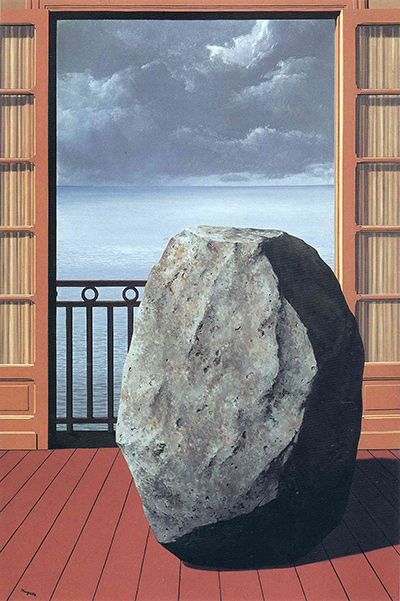


The Invisible World
A large boulder stands on red floorboards before an open pair of glass doors. Beyond the balcony railing lie a pale sea and a grey, clouded sky. Everything is recognisable, but the stone occupies a place where its size, weight and proximity feel difficult to accommodate. The view is open, and our access to it is obstructed at the same time.
René Magritte painted The Invisible World, or Le monde invisible, in 1954. The Menil Collection's canvas, inventory V 615, measures 195.6 × 131.1 centimetres. Its identity and dimensions are recorded in the Art Gallery of New South Wales's 2024 exhibition resource. The tall format gives the boulder an almost bodily presence within the room. [1]
At a Glance
A stone on the floor and a stone in the air
Contents
A stone inside a room
The stone dominates the foreground without filling the entire canvas. Its broad pale face turns towards the viewer, while a darker side curves away to the right. A smaller upper plane completes the impression of a solid, irregular object. We can understand its volume even though its situation remains strange.
Small marks across the surface suggest mottling and roughness. These details distinguish the boulder from the smoother architecture around it. The rock belongs to another kind of environment, yet Magritte describes it with enough care to make it feel insistently present on the floor.
Its placement also creates an encounter at close range. We do not look down upon it from a remote viewpoint. It rises into the doorway and interrupts the view beyond, making the room's foreground a place that has to be negotiated by the eye.
The doors and the balcony
The paired doors supply a measured architectural frame. Their straight edges and repeated glass divisions contrast with the stone's uneven contour. The open centre promises a route towards the balcony and the sea, while the rock makes that route appear restricted.
The railing provides another set of repeated shapes. Its vertical bars and circular ornaments establish a regular pattern behind the stone. Where that pattern disappears, the boulder's silhouette becomes particularly clear. We can infer the continuation of the railing without seeing it all.
This relationship gives the rock a convincing position in space. It stands in front of the balcony, within the room, and in contact with the floor. The picture does not make every spatial rule uncertain. It establishes enough ordinary relationships for the extraordinary occupation of the foreground to become unavoidable.
Floorboards and shadow
The floorboards lead towards the opening. Their narrow divisions create directions through the room, but the stone interrupts their continuity. We see the boards around its base and imagine them continuing beneath it. The support that the boulder seems to receive is part of its apparent weight.
A dark shadow spreads towards the right. It helps separate the stone from the floor and makes the meeting between them more emphatic. The lighter front of the boulder and its darker side create a further turn between what faces us and what recedes.
These painted relationships can suggest a particular light, but they do not establish an unseen door or the route by which the rock entered. The image supplies an arrangement to examine, not a sequence of practical events. Its stillness leaves the circumstances of arrival unresolved.
A distant sea
Behind the confined foreground, the sea offers a broad horizontal opening. Its pale surface is comparatively quiet, especially beside the more sharply defined architecture and mottled stone. The horizon gives that distance a clear boundary without furnishing a specific, identifiable coastal location.
The clouds gather more heavily in the sky above. Their changing light and dark forms provide a different kind of mass from the boulder's compact solidity. Both sky and stone occupy substantial areas of the picture, but their apparent materials invite different expectations.
The distant view remains attractive even while it is partly blocked. We can look around the stone towards the water and then return to the object nearest us. Magritte makes the boulder a conspicuous obstruction without allowing it to erase the landscape completely.
Why scale matters
The picture's effect depends on the relation between the rock and the room. A pebble on the floor would be easy to overlook. This boulder reaches far into the opening and seems difficult to move, making the architecture look less accommodating than it first appears.
At the same time, the doors remain ordinary in their proportions. Magritte does not need to turn them into fantastic architecture. Their familiarity gives us a basis for judging the stone's inconvenient scale and the way it changes the use of the surrounding space.
The tall canvas strengthens that presence. The stone rises from near the bottom towards the middle of the view, while the open doorway carries the eye upwards into the sky. We experience a conflict between the heavy foreground and the more expansive space above and beyond it.
Stones and the later paintings
The Menil Collection's 2014 gallery guide describes stones as a recurring concern in Magritte's late work. It places The Invisible World among images in which large rocks occupy improbable situations, alongside paintings that transform familiar objects and entire scenes into stone. [2]
Those approaches are related, but their effects differ. A familiar object represented as petrified changes its apparent substance. The boulder here remains recognisably a boulder; the disturbance lies in where it stands and how it relates to the room and view around it.
This distinction makes the picture more specific than a general example of something strange. Its material is ordinary, its volume legible and much of its space coherent. The problem emerges from the combination. The painting allows a familiar thing to become unfamiliar without dissolving its recognisable identity.
What is invisible?
The title poses a question beside a scene filled with visible things. Stone, doors, floor, railing, water and clouds can all be named. Naming them, however, does not explain the relation that makes their coexistence so unsettling.
It is tempting to give the boulder a fixed hidden meaning: an obstacle, a private burden or something concealed in the mind. Such readings may describe a viewer's response, but the picture does not identify one personal story as its solution. Its visible construction gives the question a more sustained life.
The AGNSW resource places this work beside Magritte's reflections on painting as a means of creating poetic images from recognisable things. That context encourages attention to relationships within the image rather than treating each object as a substitute for a single explanatory word. [1]
The boulder remains a powerful final point of return. It both belongs to the space through its painted weight and disrupts that space through its placement. Beyond it, the sea continues. The Invisible World holds these experiences together, making an open view feel newly difficult to enter.
Selected Magritte works
Five separately documented Magritte works. This selected directory distinguishes the 1948 Memory gouache from paintings sharing its title; it is not a complete catalogue. Each record links to its individual source.
| Name | Date | Medium |
|---|---|---|
| The Double Secret | 1927 | Oil on canvas Catalogue record. |
| Memory — 1948 gouache | 1948 | Gouache on paper Catalogue record. |
| The Invisible World | 1954 | Oil on canvas Catalogue record. |
| Clear Ideas — dated 1955 | 1955; possible 1958 execution | Oil on canvas Catalogue record. |
| The Blank Signature | 1965 | Oil on canvas Catalogue record. |
Frequently Asked Questions
The canvas belongs to The Menil Collection in Houston, inventory V 615. [1]
In this composition the boulder meets the floor and casts a shadow. Its improbable placement within the room is central to the effect.
Discussion
Follow the rock’s relation to the doorway, floor and distant horizon.
Reader Insights
Which architectural details make the stone's scale most apparent?
How does the boulder change your experience of the distant sea?
Where does the painting make an impossible situation look convincing?
Join the Conversation
Share a detail, comparison or question about The Invisible World below.
References
- Art Gallery of New South Wales, Magritte: Learning resource, 2024, p. 24. Reproduction, title, 1954 date, medium, dimensions and Menil inventory V 615; accompanying artist statement. View source.Splash image: The Invisible World, 1954. Oil on canvas, 195.6 × 131.1 cm. The Menil Collection, Houston; V 615.
- The Menil Collection, Memories of a Voyage: The Late Work of René Magritte, 2014 gallery guide. Stones, improbable placement and petrification in the late work. View source.
- Christie’s, René Magritte, Les idées claires, 2006 sale catalogue. Separate dated-1955 painting and qualified later-execution proposal. View source.