

Dawn of Cayenne
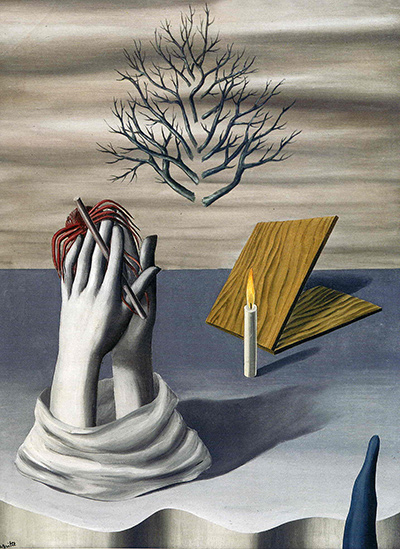
Pale hands rise from a fold of white material, their fingers brought together around a thin rigid rod. A red spider spreads over them. Behind, bare branches hang against a grey sky, while a candle burns beside two angled wooden planes. Long shadows connect these improbable things to a surface whose front edge undulates across the picture.
This is René Magritte's 1926 oil painting Dawn of Cayenne, or L'aube à Cayenne, catalogued as Sylvester I 118. Philippe Roberts-Jones reproduced it in the Royal Museums' 1968 bulletin. A separate, later gouache returns to the subject; its paper support, smaller dimensions and history belong to another object. [1] [2]
At a Glance
Date and version
Contents
Hands without a complete figure
The hands are the most immediately human forms, yet they do not lead upwards to a face or downwards to a fully described body. Their wrists emerge from the folded white material, giving the group a definite base while leaving its larger physical situation unexplained.
Their pose can suggest prayer, but the object held among the fingers and the spider complicate that association. The hands remain close together, concentrating attention on a narrow area. Their pale surfaces make the red legs and darker rod especially visible.
Look at the relation between the fingers and the cloth-like base. The upper forms are long and comparatively slender; the folds below gather into a broader mound. This gives the group a sculptural presence. It seems to stand before us as an object, even though we recognise its principal parts as belonging to a living body.
The red spider and the rigid rod
The spider introduces an active pattern across the otherwise restrained colour scheme. Its thin legs reach around and over the fingers, making several small contacts. Their repeated curves contrast with the straighter rod passing through the group.
The rod provides another direction for the eye to follow. It is relatively simple beside the many fingers and legs around it. Its rigidity gives the cluster an additional structure without explaining why these objects have been brought together.
These differences become more noticeable when viewed slowly. At first, the hands may dominate the recognition of the group. The red form then asserts itself, and the rod draws attention through the overlaps. The arrangement combines bodily familiarity with relationships that remain difficult to translate into a single action.
Branches suspended in the sky
The bare branches occupy the upper centre. They spread outwards and upwards without a trunk rooted in the surface below. Their separated lower sections make the apparent suspension more pronounced: the viewer can follow familiar branching forms while finding their expected continuity interrupted.
The group of branches also answers the hands visually. Both divide into long, narrowing extensions, and both occupy positions that make them look detached from a larger body. This resemblance is available to the eye without requiring the two forms to become literal equivalents.
Notice the spaces between the branches. The sky remains visible through them, so their shape is made partly by dark lines and partly by the intervals those lines enclose. The hands, by contrast, form a denser, paler cluster. Their related outlines therefore coexist with a striking difference in visual weight.
Candle and wooden planes
The burning candle introduces a small, concentrated brightness beside the hands. Its flame is slight compared with the width of the grey sky, yet it remains easy to find. The upright white body also gives the lower part of the composition a relatively simple vertical accent.
Behind it, two wooden planes meet at an angle. Their grain gives them a material identity distinct from skin, flame and branches. Their arrangement may recall open pages, but the visible surfaces retain the appearance of timber. The analogy makes their form easier to grasp without settling their function.
Together, candle and wood make a second cluster across from the hands. The two groups do not repeat one another exactly. Their different heights, surfaces and degrees of complexity establish a balance across the image, while the branches occupy the space above and between them.
Shadows and the uncertain surface
The shadows give the arrangement a degree of physical coherence. Even when the objects are difficult to explain, their darker extensions make them seem related to the same supporting surface. The pale hands and white candle acquire weight through their contrast with those darker areas.
The front edge of the surface creates a different uncertainty. Its wave-like contour does not resemble a simple rectangular tabletop. A darker vertical passage near the right edge adds another obstruction, reminding us that the lower setting is not fully described by ordinary still-life furniture.
Follow the shadows back towards the objects casting them. This is one of the painting's most persuasive routes into physical space. Then look upwards at the suspended branches, whose place remains harder to establish. The image combines convincing contacts with missing connections, allowing both conditions to persist within the same restrained setting.
Cayenne and the question of interpretation
Roberts-Jones associated the title and arrangement with Cayenne's prison context, bound hands and the possibility of liberation. His discussion is an interpretation of the painting's relationships, rather than a definitive list of symbols supplied by Magritte. The link between confinement and the hands is suggestive, but it should remain distinguishable from what the image directly shows. [1]
The title can therefore affect how we experience the still life without converting it into a literal view of a particular place. The grey sky, flame and isolated forms do not provide a detailed geographical setting. Their association is constructed through the image and its name, leaving room for an encounter that is more unsettling than a plainly illustrated narrative.
That openness is important to the picture's effect. The hands can seem devotional, restrained or exposed. The branches can appear broken or suspended. The candle offers a recognisable flame amid a setting that resists complete explanation. These possibilities arise from visible relationships, rather than from an obligation to give every object one permanent meaning.
The 1926 oil and the later gouache
Christie's catalogue for a 1957 gouache explicitly distinguishes it from the similarly titled 1926 oil, Sylvester I 118, shown in Magritte's 1927 Galerie Le Centaure exhibition. The later work revisits the arrangement on paper; it is not the canvas reproduced here. [2]
Returning to this earlier painting, the limited colour and sparse setting are especially striking. The red spider and yellowish flame punctuate broad areas of grey, blue and pale flesh. Each small colour accent helps connect attention to a particular object without supplying an answer to the whole arrangement.
The painting's power lies in that combination of economy and unresolved association. Hands, branches, candle and wood are given enough presence to be studied separately. Together, they establish a world in which physical clarity does not guarantee a clear explanation, and the gaps between things remain as compelling as the things themselves.
Selected Magritte paintings
Nine individually sourced Magritte works. Date and medium labels distinguish the 1926 Dawn of Cayenne oil, 1948 Memory gouache and 1960 Heartstrings canvas from other versions. This is a selected directory, not a complete catalogue.
| Name | Date | Medium |
|---|---|---|
| Dawn of Cayenne — 1926 oil | 1926 | Oil painting 1926 oil identified in later-version catalogue. |
| The Double Secret | 1927 | Oil on canvas Catalogue record. |
| Act of Violence | 1932 | Oil on canvas Museum object record. |
| Memory — 1948 gouache | 1948 | Gouache on paper Catalogue record. |
| The Invisible World | 1954 | Oil on canvas Catalogue record. |
| Clear Ideas — dated 1955 | 1955; possible 1958 execution | Oil on canvas Catalogue record. |
| Heartstrings | 1960 | Oil on canvas Auction object record. |
| Good Faith | 1965; earlier record 1964–65 | Oil on canvas Exhibition label, p. 111. |
| The Blank Signature | 1965 | Oil on canvas Catalogue record. |
Frequently Asked Questions
They are arranged in a way that can recall open pages, but their grain and surfaces look like timber. The resemblance is useful without requiring a fixed identification.
Discussion
Look closely at the objects, their boundaries and the setting around them.
Reader Insights
Which connection between the hands and branches seems most compelling?
How does the small flame change the balance of the grey setting?
Which shadows make the objects feel most physically present?
Join the Conversation
Share a detail, comparison or question about Dawn of Cayenne below.
References
- Philippe Roberts-Jones, “Les poèmes visibles de René Magritte”, Royal Museums of Fine Arts of Belgium, Bulletin (1968), p. 66. Reproduction, 1926 date and attributed interpretation. View source.Splash image: Dawn of Cayenne (L’aube à Cayenne), 1926. The oil painting, Sylvester I 118, reproduced in the 1968 Royal Museums bulletin; distinct from the 1957 gouache.
- Christie's, L'aube à Cayenne, lot 453, separate 1957 gouache. Catalogue essay identifies the 1926 oil as Sylvester I 118 and records its 1927 exhibition. View source.