
Heartstrings
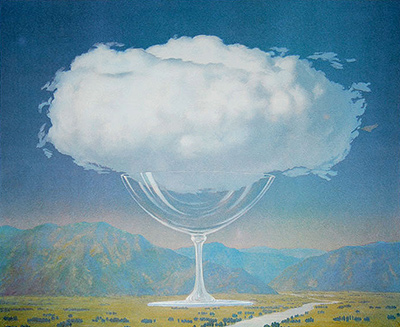
A transparent, wide-bowled glass stands above a green plain, rising in front of distant mountains. An enormous white cloud hovers over its rim. The landscape supplies a convincing sense of distance, yet the glass and cloud make that distance difficult to measure: a familiar vessel has acquired the scale of a monument.
René Magritte's Heartstrings, or La corde sensible, is a 1960 oil on canvas measuring 114 × 146 centimetres, catalogued as Sylvester III 915. Christie's offered it in 2017. [1]
At a Glance
Date and version
Heartstrings
1960 [1]Contents
A glass larger than the landscape
The glass occupies the centre of the composition. Its stem rises from a broad foot on the plain, while its open bowl spreads across the mountains behind. The vessel's familiar proportions make it easy to identify, but its relation to the surrounding land prevents us from treating it as an ordinary tabletop object.
The distant trees are especially useful for judging the discrepancy. They appear as small dark groups distributed across the green ground. Against them, the base of the glass becomes immense. The painting offers these recognisable features of landscape while making one object disturb the scale they would normally establish.
Try looking first at the valley and then at the glass. The change in attention produces a change in the scene's apparent dimensions. We can imagine a vast vessel standing in a real landscape, or experience the land as something miniaturised around a familiar form. The image keeps both readings available without giving either a final measurement.
The cloud and the rim
The cloud is broader than the bowl beneath it. Its outer edge breaks into small projections and softer passages, contrasting with the smooth curve of the glass. The lower part approaches the opening closely enough to suggest a relationship between container and contents, while its upper mass retains the appearance of weather.
That relation remains deliberately difficult to settle. The cloud might seem to have gathered above the glass, to be rising from it, or to be resting where a drink would ordinarily be. These are possible ways of reading the arrangement. The still image does not show a process of filling, evaporation or descent taking place.
Notice the narrow area where the bowl's outline crosses the cloud's lower boundary. A very small interval connects two otherwise enormous forms. Much of the painting's tension gathers there. The eye follows the glass upwards expecting an intelligible opening, then encounters a mass that both answers and exceeds that expectation.
Transparency and opacity
The glass is described through relatively slight changes in colour and light. Thin bright lines establish the rim and edges, while curved reflections indicate the bowl's surface. Portions of the background remain visible through it, allowing the mountains and sky to continue across a form that is nevertheless recognisable as solid.
The cloud behaves differently. Its pale body interrupts the blue sky and presents a substantial visual mass. Its softer edges do not make it less prominent. Beside the glass's delicate outlines, the cloud can appear surprisingly dense, even though we recognise it as something formed in the atmosphere.
This reversal of visual weight rewards sustained looking. The object that should be hard and graspable is almost absent in places; the thing associated with vapour occupies the scene emphatically. Magritte does not have to abandon recognisable appearances to create this effect. He brings their ordinary differences into an extraordinary relationship.
The stem, the foot and the ground
The stem narrows the vessel dramatically between bowl and base. Its slenderness makes the upper arrangement seem precarious, especially when viewed against the much wider cloud. The form is elegant, but its delicacy also draws attention to the improbability of the whole structure's apparent scale.
At the bottom, the foot returns to a broader horizontal shape. It establishes contact with the plain and gives the glass a definite place to stand. Without that contact, the vessel might read simply as another object floating against the sky. Its grounding makes the scene's physical contradiction more specific.
The river adds another route through the lower landscape. It passes among the small clusters of trees, leading attention away from the central glass and into the surrounding land. That lateral movement helps the plain remain more than a stage beneath the main motif. It gives the setting its own distances and patterns.
Mountains and open sky
The mountain range establishes a broad middle distance. Its slopes rise on either side of the stem, with differences in colour and tone suggesting successive ridges. Their uneven outlines contrast with the vessel's more controlled curves, while the bowl seems to span the landscape they organise.
Above, the blue sky gives the cloud room to expand. The image remains comparatively uncluttered, so the two main forms can be understood at once. Looking longer reveals the quieter work performed by changes in the mountains and the small divisions of the plain.
The apparent simplicity therefore depends on a carefully structured setting. Ground, middle distance and sky give the glass and cloud a world to disturb. Their clarity makes the strange encounter easy to remember, while the landscape keeps it from becoming a completely unlocated emblem.
A composition developed in 1960
The catalogue cites Magritte's 1960 Bosmans correspondence and reports that he found the glass appropriate to a cloud he wanted to paint. Their relationship belongs to the composition's documented development. [1]
Some older publications used 1955. The catalogue instead records 1960 on the canvas's reverse, supported by the correspondence. That distinction anchors this particular oil painting. [1]
It also directs attention back to the whole arrangement. The cloud is not simply an interchangeable patch of weather. Its size, lower edge and position over the bowl make it a specific partner for the vessel beneath.
The painting's recorded history
Christie's reports an initial gift to Georgette, followed by Renée Lachowsky's acquisition in 1962–64. Its 2017 catalogue records a private collection, without establishing the canvas's current location. [1]
The painting's scale is worth remembering alongside reproductions of it. At more than a metre high, the canvas gives considerable physical presence to an image centred on transparency and apparent lightness. The large support and the impossible vessel operate at different levels, but both contribute to the encounter.
Returning to the rim restores the central question. The glass looks capable of holding something, and the cloud seems positioned to answer that capacity. Their relationship is visually persuasive while remaining physically unresolved. Heartstrings sustains its interest through that combination of immediate recognition, altered scale and a meeting that feels precise without becoming fully explicable.
Selected Magritte paintings
Nine individually sourced Magritte works. Date and medium labels distinguish the 1926 Dawn of Cayenne oil, 1948 Memory gouache and 1960 Heartstrings canvas from other versions. This is a selected directory, not a complete catalogue.
| Name | Date | Medium |
|---|---|---|
| Dawn of Cayenne — 1926 oil | 1926 | Oil painting 1926 oil identified in later-version catalogue. |
| The Double Secret | 1927 | Oil on canvas Catalogue record. |
| Act of Violence | 1932 | Oil on canvas Museum object record. |
| Memory — 1948 gouache | 1948 | Gouache on paper Catalogue record. |
| The Invisible World | 1954 | Oil on canvas Catalogue record. |
| Clear Ideas — dated 1955 | 1955; possible 1958 execution | Oil on canvas Catalogue record. |
| Heartstrings | 1960 | Oil on canvas Auction object record. |
| Good Faith | 1965; earlier record 1964–65 | Oil on canvas Exhibition label, p. 111. |
| The Blank Signature | 1965 | Oil on canvas Catalogue record. |
Frequently Asked Questions
It hovers immediately above the opening. The arrangement suggests a relation to the vessel's contents, but does not establish a literal process of filling or evaporation.
The small trees, broad plain and distant mountains provide points of comparison around a familiar object whose base appears immense beside them.
Discussion
Look closely at the objects, their boundaries and the setting around them.
Reader Insights
Which landscape detail most strongly establishes the glass's extraordinary scale?
Does the cloud seem to rest, hover or rise above the rim?
How do transparency and opacity change the apparent weight of the two forms?
Join the Conversation
Share a detail, comparison or question about Heartstrings below.
References
- Christie's, René Magritte, La corde sensible, 2017, lot 110: object record, provenance and essay. View source.Splash image: Heartstrings (La corde sensible), 1960. Oil on canvas, 114 × 146 cm; Sylvester III 915. Private collection as recorded in the 2017 catalogue.