from Amazon
* As an Amazon Associate I earn from qualifying purchases.

Sheherazade
Two eyes and a pair of red lips look out from a network of pearls in René Magritte’s Sheherazade. Blue fabric sweeps down from the upper right, with pale sky and water visible beside it. Near the bottom, green leaves interrupt the horizontal lines of the shore. Some loops of pearls have a shape we can associate with a face. Others curl above the eyes or fall below the mouth and seem to follow the movement of the fabric and leaves.
This is Magritte’s 1947 gouache on paper portraying the Belgian artist Rachel Baes. The National Gallery of Victoria exhibited it under the title Portrait of Rachel Baes based on Sheherezade, on loan from the Collection Sisters ‘L’. The blue drapery, leafy foreground and placement of the features match the illustrated loan record and the details indexed for catalogue raisonné number 1224. The dating and medium are consistent across the records. The loan document lists 18 by 15 centimetres, while the catalogue index gives approximately 17 by 13. [1] [2] [3]
At a Glance
- Exhibited titlePortrait of Rachel Baes based on Sheherezade
- Date1947
- MediumGouache on paper
- Size18 × 15 cm in the National Gallery of Victoria loan record. The catalogue index gives approximately 17 × 13 cm.
- Catalogue numberSylvester IV 1224
Selected works
Popular Panorama
1926Sheherazade
1947The Fair Captive
1948 in the catalogue raisonnéHow the pearls make a face
The two eyes are close to the same height. Each has a round iris and a dark pupil, with a little reflected light. Warm colour marks the skin around the lids. The pearls hold these small areas together by making a distinct loop around each eye. At the outside corners the beads curve away from the lines of the lids. The effect is close to a pair of elaborately decorated frames through which a person can look. The eyes keep a human scale in relation to each other even as the beads begin to wander beyond the boundaries of a face.
Below them, the beads draw close around the place where we would look for a nose. Some of the intervening space still shows the colour of the sky or the fabric. There is enough of an outline to keep the two eyes and the mouth in a familiar relation. The skin around the lips is bounded by its own oval of pearls, and the bright red gives that small passage a weight out of proportion to its size. Looking there after following the pearls downwards makes the face seem to gather itself together again.
The lower loops are especially loose. Beads that might suggest a chin on a first look stretch down towards the plants. A short strand crosses in front of the water, and the network thins as it approaches the ground. The little white touches on the beads do much to make them look round. Their highlights repeat across the picture, making it possible to follow parts of the strings even in passages where the pale colours of the setting are almost as light as the pearls.
Fabric, water and foliage
The blue fabric enters the picture at an angle. It is broad near the top and its lower edge comes to a point at the right. There are strokes of white along its folds and fine reddish marks inside darker passages. Where the pearls run over the fabric their roundness stands out against the long, parallel strokes. The right eye sits over blue, while its partner has a much softer area of sky around it. Looking across the two eyes makes the change in background hard to miss, even though the gaze seems to come from a single face.
Watch: Understanding Magritte
Three complementary films introduce the artist, explore words and images, and examine a painting’s materials. These are broader Magritte comparisons, alongside the work discussed here.
René Magritte: Great Art Explained
An introduction to Magritte’s life, characteristic images and visual puzzles.
Watch on YouTubeThe water is picked out by fine horizontal lines. Through the open parts of the pearl design these lines continue behind the mouth and the narrow strings below it. The leaves near the bottom have stronger differences between light and shade. They rise at several angles, some curling far enough to reveal both sides. Their pointed edges give us another kind of outline to follow after the rows of round beads. Where leaves and pearls come together, some of the white highlights have the green of the plants close around them.
The landscape gives the picture a horizon and the plants establish a foreground. The blue fabric appears to hang somewhere between the sea and the viewer. The face occupies a large part of this space and follows its own boundaries. It remains easy to see from across a room because of the bright mouth and the direct gaze. Closer up, the picture is full of places where the eye passes straight through it to the surroundings.
Rachel Baes and the storyteller
Rachel Baes was a painter active in Belgian and French Surrealist circles. Valentine Pigeolet’s study reproduces the gouache and discusses it alongside Baes’s own career. In 1946 Paul Éluard helped arrange a showing of Baes’s work at the Galerie de Berri in Paris. André Breton later exhibited her at L’Étoile scellée. Her appearances in Magritte’s work included his amateur films, as the National Gallery of Victoria notes in its label for the gouache. In the picture, her eyes and mouth belong to a design that Magritte could adapt for other subjects and settings. [3] [4]
Magritte associated the pearl-woman with the storyteller of The Thousand and One Nights. In the framing tale, Sheherazade keeps the king waiting to hear how her stories end, prolonging her life. [7] The painter used the title for other arrangements of the motif. The 1950 oil shown at the Thyssen, for example, sets a face of smaller beads over a sandy coast with a metal sphere. The blue drapery and leafy foreground are features of the Baes portrait. The two works offer different settings for the same encounter with a gaze and a mouth. [5] [6]
In the Baes gouache, the mouth is closed. A painting named for a storyteller can make that detail stand out, especially after the eye has followed so many of the pearls towards the lips. The bright colour holds attention there for a moment. Then the lower loops lead away, and the gaze seems to draw the viewer back upwards. We can name the person Magritte portrayed and the figure who supplied the title. Looking closely at the way the beads frame the eyes shows how much of the likeness he entrusted to a very small area of painted skin. The rest of the picture gives that small area a setting that changes almost every time a strand of pearls crosses it.
Magritte artworks directory
| Name | Date | Medium |
|---|---|---|
| Memory of a Voyage | 1963 | Oil on canvas |
| The Blood of the World | 1927; also catalogued as 1926–27 | Oil on canvas |
| The Hunters at the Edge of Night | Paris, 1928 | Oil on canvas |
| The Empty Picture Frame (La saignée) | 1938–39 | Gouache on paper |
| The Glass House | 1939 | Gouache on paper |
| Oasis | 1926 in the illustrated Christie’s catalogue | Oil on canvas |
| Natural Encounters | 1945 | Oil on canvas |
| Attempting the Impossible | 1928 | Oil on canvas |
| On the Threshold of Liberty | 1930 | Oil on canvas |
| The Titanic Days | 1928 | Oil on canvas |
| The Voice of Space | 1931 | Oil on canvas |
| Unexpected Answer | 1932 in the museum catalogue, 1933 on the reverse | Oil on canvas |
| Elective Affinities | 1932 in MoMA’s checklist, also published as 1933 | Oil on canvas |
| The Human Condition II | 1935 | Oil on canvas |
| The Six Elements | 1929 | Oil on canvas |
| The Happy Donor | 1966 | Oil on canvas |
| Clairvoyance (Self Portrait) | Brussels, 1936 | Oil on canvas |
| Philosopher’s Lamp | 1936 | Oil on canvas |
| The Annunciation | Paris, 1930 | Oil on canvas |
| The Lost Jockey | Circa 1942 in the illustrated lot catalogue | Gouache on paper laid down on canvas |
| Homage to Mack Sennett | 1936 in the Thyssen catalogue | Oil on canvas |
| Discovery | 1927 | Oil on canvas |
| Collective Invention | 1935 in the later catalogue index | Oil on canvas |
| The Wonders of Nature | 1953 | Oil on canvas |
| The Balcony | Circa 1950, with 1950 inscribed on the reverse | Oil on canvas |
| The Pilgrim | 1966 | Oil on canvas |
| The Invention of Life | 1928 | Oil on canvas |
| The Therapist | 1941 | Gouache on paper |
| The Gradation of Fire | 1938 or 1939 in the catalogue index | Gouache on paper |
| A Friend of Order | 1964 | Oil on canvas |
| The Poetic World | 1939 in Hammacher’s illustrated monograph | Gouache |
| The Muscles of the Sky | Paris, 1927 | Oil on canvas |
| The Battle of the Argonne | 1959 | Oil on canvas |
| Meditation | 1936 | Oil on canvas |
| The Domain of Arnheim | 1962 | Oil on canvas |
| This Is Not an Apple | 1964 | Oil on Unilite |
| The Meaning of Night | Brussels, 1927 | Oil on canvas |
| The Pleasure Principle (Portrait of Edward James) | 1937 | Oil on canvas |
| Ready Made Bouquet | 1957 | Oil on canvas |
| Popular Panorama | 1926 | Oil on canvas |
| Memory of a Journey | 1955 in the Thyssen catalogue. Tentatively 1958 in the catalogue index. | Gouache on paper, as exhibited at the Thyssen |
| Sheherazade | 1947 | Gouache on paper |
| The Difficult Crossing | 1926 | Oil on canvas |
| The Fair Captive | 1948 in the catalogue raisonné | Oil on canvas |
| The Birth of the Idol | 1926 | Oil on canvas |
| Hegel’s Holiday | 1958 | Oil on canvas |
| Homesickness | 1941 | Oil on canvas |
| The Rape (Le Viol) | 1934 | Oil on canvas |
| The Art of Living | 1967 | Oil on canvas |
| Secret Life IV | 1928 | Oil on canvas |
| The Tomb of the Wrestlers | 1960 | Oil on canvas |
| Young Girl Eating a Bird (The Pleasure) | 1927 | Oil on canvas |
| The Central Story | 1928 | Oil on canvas |
| The Seducer | 1953 | Oil on canvas |
| The Telescope | 1963 | Oil on canvas |
| The Banquet | 1958 | Oil on canvas |
| The Empty Mask | 1928 | Oil on canvas |
| The Cultivation of Ideas | 1927 | Oil on canvas |
| The Enchanted Pose | 1927 | Oil on canvas |
| The Future of Statues | 1937 | Oil on plaster |
| The Return of the Flame | 1943 | Oil on canvas |
| The White Page | 1967 | Oil on canvas |
| The Large Family | 1963 | Oil on canvas |
| Black Magic | 1945 | Oil on canvas |
| Les Amants I | 1928 | Oil on canvas |
| Man in a Bowler Hat | 1964 | Oil on canvas |
| The Portrait | 1935 | Oil on canvas |
| The Sixteenth of September | 1956 | Oil on canvas |
| Heartstrings | 1960 | Oil on canvas |
| The Present | 1939; also dated 1938 or 1939 | Gouache on paper |
| Act of Violence | 1932 | Oil on canvas |
| Fashionable People | 1950, in the 2016 thesis caption | Medium unconfirmed · Attribution follows the published caption |
| The Representation | 1962 | Oil on canvas |
| Memory | 1948 | Gouache on paper |
| The Mysteries of the Horizon | 1955 | Oil on canvas |
| Portrait of Stephy Langui | 1961 | Oil on canvas |
| The Double Secret | 1927 | Oil on canvas |
| Every Day | 1966 | Oil on canvas |
| The Invisible World | 1954 | Oil on canvas |
| Dawn of Cayenne | 1926 | Oil painting |
| Clear Ideas | 1955 (inscribed); possible 1958 execution | Oil on canvas |
| The Face of Genius | 1926 / 1927 | Oil on canvas |
| Good Faith | 1965; earlier record 1964–65 | Oil on canvas |
| The Flash | 1959 | Gouache and pencil on paper |
| Perpetual Motion | 1935; earlier catalogue 1934 | Oil on canvas |
| Personal Values | 1952 | Oil on canvas |
| Not to Be Reproduced | 1937 | Oil on canvas |
| The Red Model | 1935 | Oil on canvas |
| The Menaced Assassin | 1927 | Oil on canvas |
| The Castle of the Pyrenees | 1959 | Oil on canvas |
| The Blank Signature | 1965 | Oil on canvas |
| The Listening Room | 1958 | Oil on canvas |
| Golconde | 1953 | Oil on canvas |
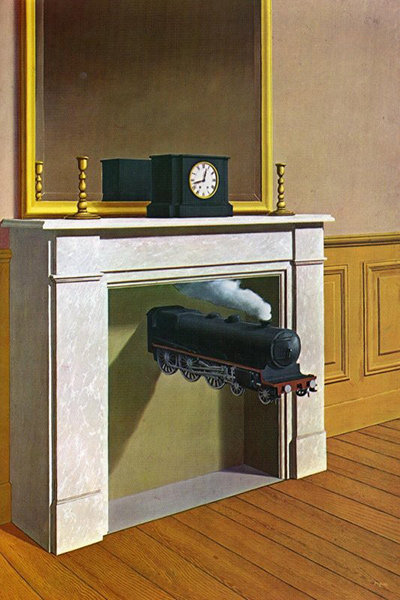
| Time Transfixed | 1938 | Oil on canvas |
| The Treachery of Images | 1929 | Oil on canvas |
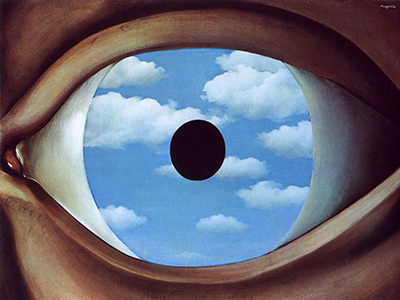
| The False Mirror | 1929 | Oil on canvas |
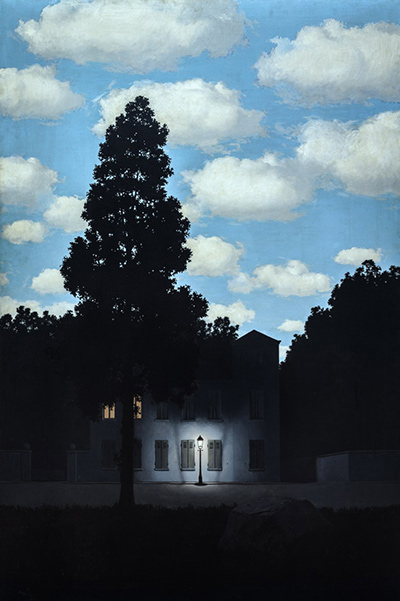
| The Empire of Light | 1953–54 | Oil on canvas |
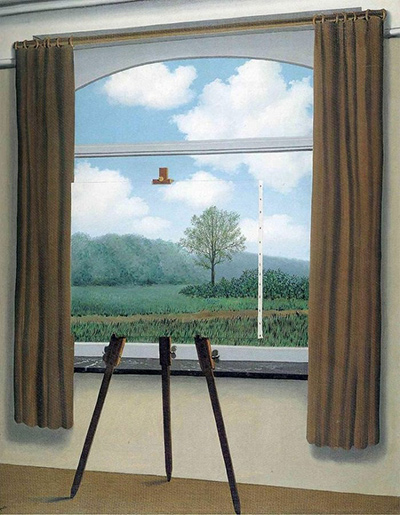
| The Human Condition | 1933 | Oil on canvas |
| Les Amants | 1928 | Oil on canvas |
| The Son of Man | 1964 | Oil on canvas |
Frequently Asked Questions
Rachel Baes, a Belgian Surrealist painter.
Discussion
Look closely and compare your reading with others.
Reader Insights
Where do the pearls do most to suggest the shape of a face?
What changes as your eye moves between the two sides of the blue fabric?
How does the title affect the attention you give the mouth?
Join the Conversation
Share a detail, comparison or question about Sheherazade below.
References
- National Gallery of Victoria. Magritte. Illustrated protected loans document, entry for Portrait of Rachel Baes based on Sheherezade. View source.
- Magritte. Toutes les œuvres, tous les thèmes. Catalogue raisonné and motif index, vol. IV, p. 82, no. 1224. View source.
- National Gallery of Victoria. Magritte. Large-print exhibition labels, p. 61. View source.
- Valentine Pigeolet. Rachel Baes (1912–1983) et les galeries bruxelloises. Reflets d’une carrière artistique. Koregos, 2017, fig. 1. View source.
- Royal Museums of Fine Arts of Belgium. Bulletin, 1968, nos. 1–2, pp. 74–75, with Magritte’s remarks on the title. View source.
- Museo Nacional Thyssen-Bornemisza. La máquina Magritte. Exhibition catalogue, 2021, cat. 58, CR 729. View source.
- Christie’s. Shéhérazade. Illustrated lot record for the 1947 oil, lot 5584763, with discussion of the framing tale. View source.