 by Tom Gurney
Tom Gurney BSc (Hons) is an art history expert with over 20 years experience
Published on July 2, 2026 / Updated on July 3, 2026
Email: tomgurney1@gmail.com / Phone: +44 7429 011000
How to Read a René Magritte Painting
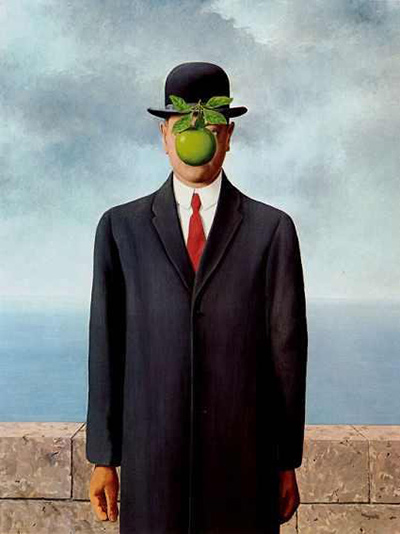
Start with a detail you can point to. In The Son of Man, pictured here, a green apple overlaps a man’s face. You can still see the hat above it, part of the face beside it and the collar below it. These are observations you can test by looking again. To say the man is hiding his identity is already an inference. It is one possible account of the scene, and it depends on what you think is happening between the face and the apple. Keeping those two kinds of statement distinct gives you a way into paintings that seem to invite an immediate explanation. [1]
At a Glance
- ApproachClose looking and visual inference
- Image shownThe Son of Man (1964)
Contents
Describe the ordinary arrangement
Begin with a short account of what would make sense in an ordinary scene. The figure in The Son of Man is upright and formally dressed. The hat, the coat and the parapet give us enough information to read the scene as a portrait made outdoors. You can then name what changes that reading. The apple sits directly over the area a portrait ordinarily asks us to study. If you follow the clear edges of the apple and the fragments of the face, you can see exactly how the painter has restricted what is available to look at. [1]
Try the same approach with The Banquet. The 1958 oil at the Art Institute of Chicago gives us trees, a terrace and the colour of a sunset. Each helps us locate ourselves. The terrace is close, the trees stand further away and the sky seems to stretch beyond them. Then look at the edge of the red disc. The leaves are interrupted wherever they meet it. That overlap puts the disc in front of the very trees we would expect to hide it. The ordinary setting matters because it establishes the order that the edge overturns. [2]
It often helps to state the change as simply as possible. An apple covers the place of a face. A sun covers part of a tree. Once the relationship is clear, you can ask how the rest of the image makes it work. In The Banquet, look back at the colour of the sky, which encourages you to place the sun in the distance even after its edge has given you evidence to the contrary. That one observation already gives you two grounded ways of reading the same disc.
Follow an edge through the picture
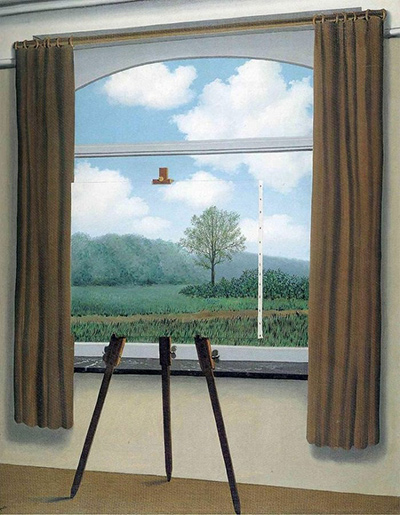
An overlap lets us see which of two things appears nearer. A second kind of edge can make one view look continuous with another. In the National Gallery of Art’s 1933 The Human Condition, a landscape painted on a canvas aligns with the landscape visible through the window behind it. Start where the sky and land seem to run across the join. Then look for the easel, the clip and the thin edge of the canvas. The National Gallery calls attention to these details because they allow the viewer to locate a second painting within the first. [3]
Watch: Understanding Magritte
Three complementary films introduce the artist, explore words and images, and examine a painting’s materials. These are broader Magritte comparisons, alongside the work discussed here.
René Magritte: Great Art Explained
An introduction to Magritte’s life, characteristic images and visual puzzles.
Watch on YouTubeNow consider what you inferred before finding the edge. You probably supplied a continuation of the landscape behind the easel, taking the canvas as a guide to what it conceals. The image itself lets us inspect the canvas and the view beside it. The patch of country supposedly hidden behind the canvas is something we construct from their alignment. This makes the picture a good exercise in noticing how much a viewer adds to a scene before stopping to check.
The Telescope offers a variation you can test the same way. Put your attention on the frame of the open right casement. The wooden edges describe a hinged panel at an angle to the wall, and the clouds remain visible across its glazed area. The dark strip opened up beside it supplies almost nothing to look into. As you move between the two bright panes, the edge of the open one tells you exactly where the scene ceases to behave like a view through an ordinary window. [4]
Treat words as part of what you see
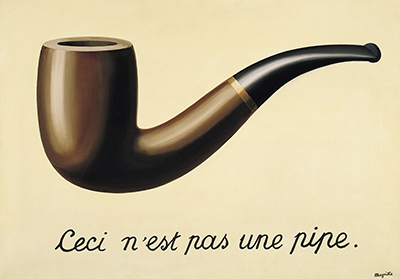
In LACMA’s 1929 The Treachery of Images, a carefully painted pipe sits above the French words Ceci n’est pas une pipe. Look at where the line is placed and how the lettering resembles a caption. That familiar arrangement encourages the reader to expect a label that names the object. Then ask what ceci, or this, might refer to. You can point at the painted shape and call it a pipe. You can also point at the same shape as an image on a canvas. The words make that change of reference part of the act of looking. [5]
A title can do something similar from outside the painted scene. It offers another way to approach the picture and may change which details seem significant. Try looking at the scene in The Banquet before and after reading its title. You can make a convincing account of the distance between the terrace and the trees in either case. The title may lead you to imagine people or an occasion beyond what the scene provides. Keep track of which parts of that reading came from the name and which can be traced to a visible feature.
Check your reading against the evidence
The Thyssen exhibition La máquina Magritte organised works around several recurring procedures, including framing and mimicry. The exhibition makes it possible to compare how a device changes from one painting to the next. Use that same approach on your own. Select two pictures with a window or two with a covered face. In each picture, look for the smallest visible detail that allows you to tell where one surface ends and another begins. You may find that the two paintings use a similar subject to produce quite different experiences. [6]
Finish by putting one observation and one inference into words. Give the inference a visible reason, then look for a second detail that might change it. If your explanation of the sunset depends on where the sun sits, the contour of the trees is a better place to test it than a general association with the colour red. The aim is to leave the picture with a reading you can show to another person and a detail both of you can return to.
Magritte artworks directory
| Name | Date | Medium |
|---|---|---|
| Memory of a Voyage | 1963 | Oil on canvas |
| The Blood of the World | 1927; also catalogued as 1926–27 | Oil on canvas |
| The Hunters at the Edge of Night | Paris, 1928 | Oil on canvas |
| The Empty Picture Frame (La saignée) | 1938–39 | Gouache on paper |
| The Glass House | 1939 | Gouache on paper |
| Oasis | 1926 in the illustrated Christie’s catalogue | Oil on canvas |
| Natural Encounters | 1945 | Oil on canvas |
| Attempting the Impossible | 1928 | Oil on canvas |
| On the Threshold of Liberty | 1930 | Oil on canvas |
| The Titanic Days | 1928 | Oil on canvas |
| The Voice of Space | 1931 | Oil on canvas |
| Unexpected Answer | 1932 in the museum catalogue, 1933 on the reverse | Oil on canvas |
| Elective Affinities | 1932 in MoMA’s checklist, also published as 1933 | Oil on canvas |
| The Human Condition II | 1935 | Oil on canvas |
| The Six Elements | 1929 | Oil on canvas |
| The Happy Donor | 1966 | Oil on canvas |
| Clairvoyance (Self Portrait) | Brussels, 1936 | Oil on canvas |
| Philosopher’s Lamp | 1936 | Oil on canvas |
| The Annunciation | Paris, 1930 | Oil on canvas |
| The Lost Jockey | Circa 1942 in the illustrated lot catalogue | Gouache on paper laid down on canvas |
| Homage to Mack Sennett | 1936 in the Thyssen catalogue | Oil on canvas |
| Discovery | 1927 | Oil on canvas |
| Collective Invention | 1935 in the later catalogue index | Oil on canvas |
| The Wonders of Nature | 1953 | Oil on canvas |
| The Balcony | Circa 1950, with 1950 inscribed on the reverse | Oil on canvas |
| The Pilgrim | 1966 | Oil on canvas |
| The Invention of Life | 1928 | Oil on canvas |
| The Therapist | 1941 | Gouache on paper |
| The Gradation of Fire | 1938 or 1939 in the catalogue index | Gouache on paper |
| A Friend of Order | 1964 | Oil on canvas |
| The Poetic World | 1939 in Hammacher’s illustrated monograph | Gouache |
| The Muscles of the Sky | Paris, 1927 | Oil on canvas |
| The Battle of the Argonne | 1959 | Oil on canvas |
| Meditation | 1936 | Oil on canvas |
| The Domain of Arnheim | 1962 | Oil on canvas |
| This Is Not an Apple | 1964 | Oil on Unilite |
| The Meaning of Night | Brussels, 1927 | Oil on canvas |
| The Pleasure Principle (Portrait of Edward James) | 1937 | Oil on canvas |
| Ready Made Bouquet | 1957 | Oil on canvas |
| Popular Panorama | 1926 | Oil on canvas |
| Memory of a Journey | 1955 in the Thyssen catalogue. Tentatively 1958 in the catalogue index. | Gouache on paper, as exhibited at the Thyssen |
| Sheherazade | 1947 | Gouache on paper |
| The Difficult Crossing | 1926 | Oil on canvas |
| The Fair Captive | 1948 in the catalogue raisonné | Oil on canvas |
| The Birth of the Idol | 1926 | Oil on canvas |
| Hegel’s Holiday | 1958 | Oil on canvas |
| Homesickness | 1941 | Oil on canvas |
| The Rape (Le Viol) | 1934 | Oil on canvas |
| The Art of Living | 1967 | Oil on canvas |
| Secret Life IV | 1928 | Oil on canvas |
| The Tomb of the Wrestlers | 1960 | Oil on canvas |
| Young Girl Eating a Bird (The Pleasure) | 1927 | Oil on canvas |
| The Central Story | 1928 | Oil on canvas |
| The Seducer | 1953 | Oil on canvas |
| The Telescope | 1963 | Oil on canvas |
| The Banquet | 1958 | Oil on canvas |
| The Empty Mask | 1928 | Oil on canvas |
| The Cultivation of Ideas | 1927 | Oil on canvas |
| The Enchanted Pose | 1927 | Oil on canvas |
| The Future of Statues | 1937 | Oil on plaster |
| The Return of the Flame | 1943 | Oil on canvas |
| The White Page | 1967 | Oil on canvas |
| The Large Family | 1963 | Oil on canvas |
| Black Magic | 1945 | Oil on canvas |
| Les Amants I | 1928 | Oil on canvas |
| Man in a Bowler Hat | 1964 | Oil on canvas |
| The Portrait | 1935 | Oil on canvas |
| The Sixteenth of September | 1956 | Oil on canvas |
| Heartstrings | 1960 | Oil on canvas |
| The Present | 1939; also dated 1938 or 1939 | Gouache on paper |
| Act of Violence | 1932 | Oil on canvas |
| Fashionable People | 1950, in the 2016 thesis caption | Medium unconfirmed · Attribution follows the published caption |
| The Representation | 1962 | Oil on canvas |
| Memory | 1948 | Gouache on paper |
| The Mysteries of the Horizon | 1955 | Oil on canvas |
| Portrait of Stephy Langui | 1961 | Oil on canvas |
| The Double Secret | 1927 | Oil on canvas |
| Every Day | 1966 | Oil on canvas |
| The Invisible World | 1954 | Oil on canvas |
| Dawn of Cayenne | 1926 | Oil painting |
| Clear Ideas | 1955 (inscribed); possible 1958 execution | Oil on canvas |
| The Face of Genius | 1926 / 1927 | Oil on canvas |
| Good Faith | 1965; earlier record 1964–65 | Oil on canvas |
| The Flash | 1959 | Gouache and pencil on paper |
| Perpetual Motion | 1935; earlier catalogue 1934 | Oil on canvas |
| Personal Values | 1952 | Oil on canvas |
| Not to Be Reproduced | 1937 | Oil on canvas |
| The Red Model | 1935 | Oil on canvas |
| The Menaced Assassin | 1927 | Oil on canvas |
| The Castle of the Pyrenees | 1959 | Oil on canvas |
| The Blank Signature | 1965 | Oil on canvas |
| The Listening Room | 1958 | Oil on canvas |
| Golconde | 1953 | Oil on canvas |
| Time Transfixed | 1938 | Oil on canvas |
| The Treachery of Images | 1929 | Oil on canvas |
| The False Mirror | 1929 | Oil on canvas |
| The Empire of Light | 1953–54 | Oil on canvas |
| The Human Condition | 1933 | Oil on canvas |
| Les Amants | 1928 | Oil on canvas |
| The Son of Man | 1964 | Oil on canvas |
Frequently Asked Questions
Describe one feature you can point to, then consider what it makes you infer.
Discussion
Look closely and compare your reading with others.
Reader Insights
Which detail would you show someone first to support your reading?
Where do two parts of a picture give you different evidence about depth?
How does your interpretation change when you read the title after looking at the image?
Join the Conversation
Share a detail, comparison or question about How to Read a René Magritte Painting below.
References
- Fondation Magritte. Notes on Le Fils de l’homme and the bowler-hatted figure. View source.
- Art Institute of Chicago. The Banquet, collection record and Dawn Ades’s catalogue entry. View source.
- National Gallery of Art, Washington. La condition humaine, collection record. View source.
- The Menil Collection. The Field-Glass (La lunette d’approche), collection record. View source.
- Los Angeles County Museum of Art. The Treachery of Images (This is Not a Pipe), collection record. View source.
- Museo Nacional Thyssen-Bornemisza. La máquina Magritte, exhibition and thematic sections. View source.