 by Tom Gurney
Tom Gurney BSc (Hons) is an art history expert with over 20 years experience
Published on June 19, 2020 / Updated on October 14, 2023
Email: tomgurney1@gmail.com / Phone: +44 7429 011000
Memory of a Voyage
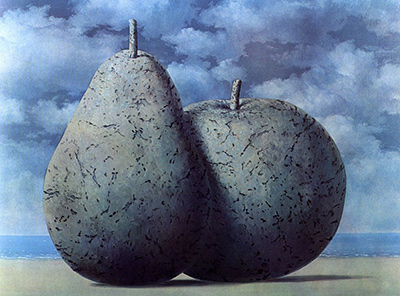
A pear and an apple rest on a beach. Their stalks are still intact, their rounded forms are easy to recognise, and the darkness where the two meet gives them the presence of objects we could walk around. Then the surfaces come into focus. They have the fissures and mottling of stone. Behind them, a band of sea runs almost the full width of the picture, low enough to make the fruit seem enormous. René Magritte sets this improbable still life in a landscape that gives it space, light and a place to cast its shadow.
This Memory of a Voyage, titled Souvenir de voyage on the reverse, is an oil on canvas from 1963. It measures 81 × 100 centimetres and is number 974 in the third volume of David Sylvester’s catalogue raisonné. Magritte used the French title for several compositions. The coastline and the two stone fruits identify the one shown here. [1]
At a Glance
- Original titleSouvenir de voyage
- Date1963
- MediumOil on canvas
- Size81 × 100 cm
- Catalogue numberSylvester III 974
Selected works
The Blood of the World
1927; also catalogued as 1926–27Contents
The weight of the fruit
Look first at the pear. It rises on the left to a little neck and a long stalk. The apple comes up behind it on the right. Its stem is shorter and appears lower in the picture, and the swell of its side brings the eye back down towards the sand. The overlapping forms are especially convincing where the pear’s curve interrupts the apple. The fruits have different silhouettes and a definite relation in space. One has to be in front of the other for that particular line to appear.
The change of material works across those differences. Cracks travel around the pear and pockmarks break up the apple. We are used to reading the surface of fruit for clues about what would happen if we handled it. The marks here suggest a hard surface that would resist the pressure of a thumb. Yet the thin stems look as delicate as the stems of harvested fruit. Magritte has put the suggestion of two weights and two textures into each form. We might imagine lifting a pear, then imagine how much it would weigh if it were a piece of stone.
The fruit looks monumental partly because of what surrounds it. Nothing in the foreground offers a conventional measure of size. A beach gives us a plane, while the strip of water and the clouds suggest a depth that carries on far behind the pair. One can read the fruits as large objects in that space or as small things seen very close. The effect of scale survives both readings. For as long as we are looking at the canvas, the fruits fill a large part of the visible world.
A still life at the water’s edge
Fruit on a tabletop receives whatever space the painter gives to the table. Here the coast opens the scene beyond the two objects. The sea forms a horizontal band behind them and continues where their outlines cut it off. The sand extends to either side. Their shadow runs across that ground and gives us a sense of light arriving from outside the frame. The landscape is doing much of the practical work of making the fruit believable.
Notice how little of that landscape Magritte needs. There is no person walking past and no boat by which to reckon the distance to the water. There is enough variation in the clouds to make the sky feel expansive, and enough calm in the meeting of shore and sea to keep the eye on the two shapes in front. The coast could accommodate all kinds of activity. Here, the central event is a pear and an apple standing together.
The title encourages a different kind of attention. A souvenir is something one brings away from an experience, often an object that fits in the hand and takes a place among other belongings. In this picture the objects seem too heavy to carry. Nor is there a recognisable landmark to tell us where the voyage led. The title asks us to consider what might survive of a place or an encounter when its ordinary details have fallen away.
Watch: Understanding Magritte
Three complementary films introduce the artist, explore words and images, and examine a painting’s materials. These are broader Magritte comparisons, alongside the work discussed here.
René Magritte: Great Art Explained
An introduction to Magritte’s life, characteristic images and visual puzzles.
Watch on YouTubeTwo shapes together
The dealer Margaret Krebs offered a more particular account of the pairing. According to her recollection, reported in the catalogue raisonné and discussed in the Christie’s essay, Magritte had seen a couple at the seaside. It is a reported memory of what prompted the work. The coast and the intimate placement of the fruits give us a way to understand why someone might associate the painting with two people. [1]
The resemblance remains a matter of posture and proximity. The pear is taller and the apple seems to sit partly in its shelter. There is no face, gesture or costume to turn either fruit into a named person. It is possible to see companionship simply in the small area where two unlike outlines touch. Move the apple the width of the pear to the right in your mind, and imagine what the open strip between them would do to the picture. They would still be two large stone fruits. It would take a different kind of attention to see them as a pair.
Other stone fruits and other voyages
In La Grande Table, an oil from around 1962–63, Magritte also places mineral fruit against an open landscape. The auction catalogue identifies it separately as number 964 and documents its exhibition alongside other Magritte works at Galerie Isy Brachot in 1968. Seeing it beside the larger 1963 canvas brings out how much remains at the painter’s disposal after he has chosen the fruit and given it the appearance of stone. The space around each form, the relation of one shape to the other and the distance to the horizon can all change. Repeating the subject lets us pay attention to decisions that a wholly different picture would make harder to isolate. [2]
A smaller Souvenir de voyage of about 1962–63, number 962, puts a solitary stone apple under a crescent moon. The fruit in that picture sits below another solid body that appears weightless to the eye. The gap between those objects is as important as the contact between the pear and apple in the larger painting. Here on the beach, the two fruits share a single patch of ground and the eye can take in their combined weight. [3]
The Museum of Modern Art’s Memory of a Voyage dates from 1955. [4] The work discussed on Memory of a Journey shows the Leaning Tower of Pisa and an enormous feather. Each has the French title Souvenir de voyage. The English titles often vary, so the date, material and composition are more useful when identifying a reproduction. The Pisa picture also makes an apt comparison in its own right. Both compositions let us picture something heavy, then leave us to reckon with what the rest of the scene implies about its weight. [5]
From Brussels to international exhibitions
The documented provenance begins with a gift from Magritte to Raoul Brunswyck in Brussels. Margaret Krebs subsequently acquired the canvas from Brunswyck, and it passed to another owner in 1982. These transfers are separate from its exhibition history, which shows the different company in which the painting was seen. After the Galerie Isy Brachot presentation in Brussels in 1968 and a tribute in Magritte’s birthplace, Lessines, in 1973, it was included in Painters of the Mind’s Eye in New York and Houston in 1974. It also went to Mexico City that year for a presentation of Ensor, Magritte and Delvaux. The 1978 Brussels retrospective took it into another survey of Magritte’s own work, which travelled to the Centre Pompidou in 1979. [1]
Placed in a retrospective, the work invites comparison with a long succession of Magritte’s transformations. Shown beside Ensor and Delvaux, it offers another point of entry into the exhibition’s account of Belgian art. The pair on the beach can sustain either setting. Its basic arrangement is available at a glance, and it grows less ordinary as the eye finds the precise evidence of overlapping shapes, stone surfaces, a low horizon and one continuous shadow.
Magritte artworks directory
| Name | Date | Medium |
|---|---|---|
| Memory of a Voyage | 1963 | Oil on canvas |
| The Blood of the World | 1927; also catalogued as 1926–27 | Oil on canvas |
| The Hunters at the Edge of Night | Paris, 1928 | Oil on canvas |
| The Empty Picture Frame (La saignée) | 1938–39 | Gouache on paper |
| The Glass House | 1939 | Gouache on paper |
| Oasis | 1926 in the illustrated Christie’s catalogue | Oil on canvas |
| Natural Encounters | 1945 | Oil on canvas |
| Attempting the Impossible | 1928 | Oil on canvas |
| On the Threshold of Liberty | 1930 | Oil on canvas |
| The Titanic Days | 1928 | Oil on canvas |
| The Voice of Space | 1931 | Oil on canvas |
| Unexpected Answer | 1932 in the museum catalogue, 1933 on the reverse | Oil on canvas |
| Elective Affinities | 1932 in MoMA’s checklist, also published as 1933 | Oil on canvas |
| The Human Condition II | 1935 | Oil on canvas |
| The Six Elements | 1929 | Oil on canvas |
| The Happy Donor | 1966 | Oil on canvas |
| Clairvoyance (Self Portrait) | Brussels, 1936 | Oil on canvas |
| Philosopher’s Lamp | 1936 | Oil on canvas |
| The Annunciation | Paris, 1930 | Oil on canvas |
| The Lost Jockey | Circa 1942 in the illustrated lot catalogue | Gouache on paper laid down on canvas |
| Homage to Mack Sennett | 1936 in the Thyssen catalogue | Oil on canvas |
| Discovery | 1927 | Oil on canvas |
| Collective Invention | 1935 in the later catalogue index | Oil on canvas |
| The Wonders of Nature | 1953 | Oil on canvas |
| The Balcony | Circa 1950, with 1950 inscribed on the reverse | Oil on canvas |
| The Pilgrim | 1966 | Oil on canvas |
| The Invention of Life | 1928 | Oil on canvas |
| The Therapist | 1941 | Gouache on paper |
| The Gradation of Fire | 1938 or 1939 in the catalogue index | Gouache on paper |
| A Friend of Order | 1964 | Oil on canvas |
| The Poetic World | 1939 in Hammacher’s illustrated monograph | Gouache |
| The Muscles of the Sky | Paris, 1927 | Oil on canvas |
| The Battle of the Argonne | 1959 | Oil on canvas |
| Meditation | 1936 | Oil on canvas |
| The Domain of Arnheim | 1962 | Oil on canvas |
| This Is Not an Apple | 1964 | Oil on Unilite |
| The Meaning of Night | Brussels, 1927 | Oil on canvas |
| The Pleasure Principle (Portrait of Edward James) | 1937 | Oil on canvas |
| Ready Made Bouquet | 1957 | Oil on canvas |
| Popular Panorama | 1926 | Oil on canvas |
| Memory of a Journey | 1955 in the Thyssen catalogue. Tentatively 1958 in the catalogue index. | Gouache on paper, as exhibited at the Thyssen |
| Sheherazade | 1947 | Gouache on paper |
| The Difficult Crossing | 1926 | Oil on canvas |
| The Fair Captive | 1948 in the catalogue raisonné | Oil on canvas |
| The Birth of the Idol | 1926 | Oil on canvas |
| Hegel’s Holiday | 1958 | Oil on canvas |
| Homesickness | 1941 | Oil on canvas |
| The Rape (Le Viol) | 1934 | Oil on canvas |
| The Art of Living | 1967 | Oil on canvas |
| Secret Life IV | 1928 | Oil on canvas |
| The Tomb of the Wrestlers | 1960 | Oil on canvas |
| Young Girl Eating a Bird (The Pleasure) | 1927 | Oil on canvas |
| The Central Story | 1928 | Oil on canvas |
| The Seducer | 1953 | Oil on canvas |
| The Telescope | 1963 | Oil on canvas |
| The Banquet | 1958 | Oil on canvas |
| The Empty Mask | 1928 | Oil on canvas |
| The Cultivation of Ideas | 1927 | Oil on canvas |
| The Enchanted Pose | 1927 | Oil on canvas |
| The Future of Statues | 1937 | Oil on plaster |
| The Return of the Flame | 1943 | Oil on canvas |
| The White Page | 1967 | Oil on canvas |
| The Large Family | 1963 | Oil on canvas |
| Black Magic | 1945 | Oil on canvas |
| Les Amants I | 1928 | Oil on canvas |
| Man in a Bowler Hat | 1964 | Oil on canvas |
| The Portrait | 1935 | Oil on canvas |
| The Sixteenth of September | 1956 | Oil on canvas |
| Heartstrings | 1960 | Oil on canvas |
| The Present | 1939; also dated 1938 or 1939 | Gouache on paper |
| Act of Violence | 1932 | Oil on canvas |
| Fashionable People | 1950, in the 2016 thesis caption | Medium unconfirmed · Attribution follows the published caption |
| The Representation | 1962 | Oil on canvas |
| Memory | 1948 | Gouache on paper |
| The Mysteries of the Horizon | 1955 | Oil on canvas |
| Portrait of Stephy Langui | 1961 | Oil on canvas |
| The Double Secret | 1927 | Oil on canvas |
| Every Day | 1966 | Oil on canvas |
| The Invisible World | 1954 | Oil on canvas |
| Dawn of Cayenne | 1926 | Oil painting |
| Clear Ideas | 1955 (inscribed); possible 1958 execution | Oil on canvas |
| The Face of Genius | 1926 / 1927 | Oil on canvas |
| Good Faith | 1965; earlier record 1964–65 | Oil on canvas |
| The Flash | 1959 | Gouache and pencil on paper |
| Perpetual Motion | 1935; earlier catalogue 1934 | Oil on canvas |
| Personal Values | 1952 | Oil on canvas |
| Not to Be Reproduced | 1937 | Oil on canvas |
| The Red Model | 1935 | Oil on canvas |
| The Menaced Assassin | 1927 | Oil on canvas |
| The Castle of the Pyrenees | 1959 | Oil on canvas |
| The Blank Signature | 1965 | Oil on canvas |
| The Listening Room | 1958 | Oil on canvas |
| Golconde | 1953 | Oil on canvas |
| Time Transfixed | 1938 | Oil on canvas |
| The Treachery of Images | 1929 | Oil on canvas |
| The False Mirror | 1929 | Oil on canvas |
| The Empire of Light | 1953–54 | Oil on canvas |
| The Human Condition | 1933 | Oil on canvas |
| Les Amants | 1928 | Oil on canvas |
| The Son of Man | 1964 | Oil on canvas |
Frequently Asked Questions
This is the 1963 oil on canvas with a pale stone pear and apple by the sea, listed as number 974 in the third volume of the catalogue raisonné.
MoMA’s work dates to 1955 and depicts a different composition. Magritte reused the French title Souvenir de voyage.
Discussion
Look closely and compare your reading with others.
Reader Insights
Where does the picture give you the strongest sense that the fruits are heavy?
What would change if the pear and apple stood farther apart?
How does an open coast change a subject usually associated with a tabletop?
Join the Conversation
Share a detail, comparison or question about Memory of a Voyage below.
References
- Christie’s, Souvenir de voyage, lot 5459983, details, provenance, exhibition chronology, lot essay and illustrated literature, including David Sylvester, ed., René Magritte: Catalogue raisonné, vol. III, 1993, p. 383, no. 974. View source.
- Sotheby’s, La Grande Table, lot 7, catalogue entry and exhibitions, with Sylvester vol. III, p. 374, no. 964. View source.
- Christie’s, Souvenir de voyage, lot 6380427, the smaller apple-and-moon canvas, with Sylvester vol. III, p. 373, no. 962. View source.
- The Museum of Modern Art, Memory of a Voyage, 1955, accession 607.1959. View source.
- Museo Nacional Thyssen-Bornemisza, La máquina Magritte, 2021, p. 162, on the Pérez Simón gouache. View source.