

Fashionable People
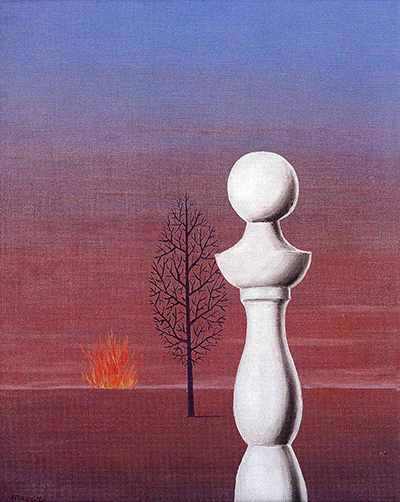
A large white form stands before a bare tree and a small fire. Its rounded head and narrowing body resemble a figure, but its smooth, turned contours suggest a manufactured object. Pink and blue bands stretch across the sky, while the ground remains almost empty. A few clearly separated things are enough to make the landscape feel inhabited and strangely still.
The composition is reproduced as Fashionable People, attributed to René Magritte and dated 1950, in Walmira Sodré Austríaco Moraes's 2016 doctoral thesis at UNESP. The illustrated example appears on printed page 458. That published caption supplies the title and date used here; it does not establish a French title, dimensions or present collection. [1]
At a Glance
Date of this work
Date in the published caption
1950 [1]Contents
A figure without a face
The white form occupies much of the right side. A rounded upper section rests above a narrow neck, a projecting shoulder-like curve and a longer body. Those relationships make it easy to imagine a person, even though there are no eyes, mouth or separate arms.
Its smooth surface encourages a different reading at the same time. The repeated swelling and narrowing could belong to an object shaped on a lathe. Rather than reproducing human anatomy, it offers a simplified sequence of curves that happens to suggest the proportions of a standing figure.
Look from the spherical top towards the broader middle section. Recognition develops through the relation between the parts, not through a single identifying feature. The form can seem human for a moment, then become an object again when attention returns to its polished outline and lack of expression.
Turned curves and the suggestion of a bilboquet
The form recalls a baluster or the turned components of a cup-and-ball toy, often called a bilboquet. That resemblance is more precise than simply calling it a mysterious statue: the narrow necks and rounded masses suggest a familiar kind of worked object.
Moraes discusses the pictured example among recurring bilboquet-like forms in Magritte's imagery. [1] The comparison helps describe what is visible without requiring us to identify the painted object as a functioning toy. No attached cord or complete game is shown.
The lower part continues beyond the bottom edge. This cropping matters because it withholds a complete base. A fully displayed pedestal might establish the object as a sculpture standing in a particular place. Here, the edge makes it feel close to us while leaving its full height and support partly outside the picture.
The tree's open structure
Behind the white form, a dark tree divides into many slender branches. Its bare silhouette is almost the opposite of the solid figure-like shape. We can see sky between the branches, whereas the white surface blocks what lies behind it.
The tree's vertical trunk creates a second upright presence. It is narrower and less massive, but its branching pattern gives it a distinct outline. The two forms therefore share a direction while differing in texture, density and apparent construction.
Try looking at the spaces within the tree rather than at its dark branches. The sky remains visible through its open network. Then compare the white object's uninterrupted body. The painting creates a strong relationship between a form built from lines and one presented as a continuous volume, without needing a crowded setting to make that difference clear.
A small fire near the horizon
At the left, pale orange and yellow flames rise from a low patch. They introduce a flickering shape into a scene otherwise dominated by stable contours. The flame tips are less regular than either the turned object or the tree's branching structure.
The fire also adds a concentrated warm accent. Its light colour links it loosely with the sky's pinker passages, but its sharply upward movement distinguishes it from the horizontal bands behind. It is small in area and still difficult to ignore.
There is no visible person tending the fire and no obvious building around it. The image does not explain what burns or why. That lack of narrative leaves the fire available as a visual event: a changing, luminous form set apart from the white object's composed stillness. A fixed symbolic meaning would go beyond what the scene itself establishes.
Sky and ground arranged in bands
The sky moves from cooler blue above towards pink and mauve nearer the horizon. Thin horizontal passages stretch across its lower area. These bands give the background an expansive rhythm that contrasts with the upright forms in front of it.
The ground is comparatively plain. Its muted colour supports the white figure and the tree without surrounding them with many identifying details. There are few clues to a specific location, and the scene's effect does not depend on recognising one.
The horizon sits low enough for the tree and white form to appear clearly against the sky. Their outlines can be compared across a broad, simple field. This arrangement makes the relations between objects more important than a detailed account of the terrain they occupy.
Light, shade and apparent material
Shading along the white form gives its curves a sense of volume. The darkened side makes the spherical top and projecting middle look rounded rather than flat. Light appears to move across a continuous, smooth surface.
That modelling contributes to the object's credibility without identifying its material conclusively. It could suggest painted wood, plaster or another pale worked substance, but the reproduction alone does not establish a technical description of what the imagined object is made from.
The tree and fire offer different kinds of visibility. The dark branches read through their outline; the flames through their brightness and irregular edges. Against them, the white form is understood through shaded volume. The composition brings together three distinct ways of making a thing recognisable within a painted landscape.
The plural title and the empty setting
Fashionable People introduces people in the plural, yet the image contains no ordinary group of human figures. The white form may suggest one standing presence, while the tree offers another upright silhouette. Their relation can feel social without becoming an identifiable meeting.
That is a possible response to the title, rather than a documented explanation from Magritte. The English caption gives us a prompt, but it does not settle whether the scene is comic, solemn or faintly threatening. The forms remain too spare to support a complete story about their identities.
The most productive way back into the picture is to compare its contrasts: smooth volume and open branches, pale solidity and small flames, upright shapes and horizontal sky. The published title and date identify the reproduction being discussed, while those visible relationships explain why it rewards attention. Its peculiar presence comes from how a few familiar kinds of form stand together in an otherwise quiet landscape.
Selected Magritte paintings
Seventeen selected Magritte compositions with individually cited records. Fashionable People uses the title and date of the reproduced academic caption; no physical-object catalogue identification is claimed for that entry.
Discussion
Compare the familiar objects with the spaces they appear to occupy.
Reader Insights
Which curve first makes the white object resemble a person?
How does the bare tree differ from the solid form beside it?
What does the small fire contribute to the scene's stillness?
Join the Conversation
Share a detail, comparison or question about Fashionable People below.
References
- Walmira Sodré Austríaco Moraes, Sob o domínio da metáfora: transposição de imagens poéticas (em) entre Edgar Allan Poe e René Magritte, doctoral thesis, UNESP/IBILCE (2016), pp. 156 and458: discussion of recurring forms and the illustrated composition captioned Fashionable People, René Magritte, 1950. View source.Splash image: Composition reproduced as Fashionable People, René Magritte, 1950, in Moraes’s 2016 UNESP thesis, p.458. The caption does not establish dimensions or a collection.