

The Face of Genius
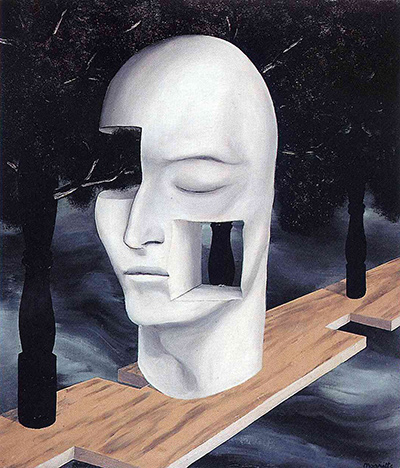
A pale, closed-eyed head rests on a narrow wooden platform. Rectangular gaps interrupt the face, allowing dark, tree-like forms to appear through it. The planks extend over an uncertain depth, while the head remains composed and still. What first resembles a solid cast becomes a structure with openings, edges and a view beyond its surface.
René Magritte's The Face of Genius, or Le visage du génie, belongs to the Musée d'Ixelles in Brussels, inventory MJ 31. It is oil on canvas, 75 × 65 centimetres. Institutional dates differ: the Art Gallery of New South Wales's 2024 exhibition labels give 1926, while the Thyssen's 2021 works list and the Ixelles website heading give 1927. [1] [2] [3]
At a Glance
Contents
A face that does not return our gaze
The closed eyes are central to the head's effect. They deny the usual encounter between a portrait and its viewer, leaving us to inspect a face that appears unaware of being seen. The mouth is similarly quiet, without a speaking gesture or an expression that would explain the surrounding scene.
The pale surface is modelled with enough shade to suggest projecting features. Forehead, nose, lips and chin remain legible even where the head is interrupted. Those familiar relationships make recognition immediate, before we have worked out how the different planes could fit together.
The Musée d'Ixelles identifies the represented object as Napoleon's death mask. [1] That identification gives the face a historical reference, but the painting does not supply a narrative of Napoleon's life or death. The cast-like appearance matters visually: an already still likeness has been made stranger by the spaces cut through it.
Looking at the rectangular gaps
The openings do not behave like injuries in flesh. Their straight edges make the head appear manufactured or assembled, despite the softly described human features. At these points, the surface becomes something like a wall with an aperture cut through it.
Each gap redirects attention from the face to what can be seen behind. A viewer may begin by following the continuous curve of the cheek or forehead, then find that the expected material is absent. The head's recognisability survives that interruption, even as its apparent construction becomes difficult to reconcile with an ordinary cast.
Try tracing the edge of an opening rather than concentrating on the features. The border gives the absent section a specific shape and position. We are not simply told that part of the face is missing; we can look through a defined space. That difference turns the likeness into a passage between foreground and background.
Trees that resemble turned objects
Behind and beside the head stand dark vertical forms. Their lower portions have rounded, turned profiles, while branch-like shapes spread above. They combine the upright presence of trees with the regular shaping of manufactured objects.
These forms differ from a freely growing woodland. Their constricted sections and swelling curves suggest things that have been worked into shape. The contrast is particularly strong against the smooth pale head: a human likeness and an artificial-looking grove share a scene whose components remain individually recognisable.
Where a vertical form appears through an opening, depth becomes especially important. We have to decide which edge belongs to the head and which belongs to the object beyond it. The dark colours make that task demanding, but the arrangement keeps enough separation for the cut-out structure to remain visible.
The narrow wooden support
The head rests on pale boards whose grain and colour distinguish them from both the white cast and the darker surroundings. The platform runs diagonally into the scene, providing one of its clearest directions of movement. The eye follows the planks away from the foreground towards an uncertain space beyond.
This support is much narrower than a room or stage floor. Its edges expose the surrounding depth rather than enclosing the head safely within an interior. The face's calm therefore contrasts with a setting that looks difficult to cross or inhabit.
The boards also make the head feel like an object placed somewhere. They supply a contact surface and an approximate scale, anchoring the likeness before the gaps destabilise it. Magritte gives us enough physical information to believe in the placement, while withholding the larger structure that would explain where the platform leads or what holds it up.
Light against an obscure setting
The head's pale colour concentrates attention near the centre of the composition. Its broad, smooth passages are easier to read than the dark branches and atmosphere around it. Light appears to clarify the face, but that clarity exposes the impossible apertures as well as the familiar features.
The surrounding darkness does more than provide contrast. It makes the depth behind the head difficult to measure. We can distinguish nearby forms and the directional pull of the planks without acquiring a complete map of the setting.
Look from the bright forehead towards a cut edge, then into the dark beyond. The transition changes the kind of information available. The surface offers a volume; the opening offers a route through that volume; the background resists a final explanation of the route's destination. The uncertainty develops through looking rather than through an illustrated story.
Solid likeness, open construction
A cast ordinarily preserves the outward shape of a face. Its surface stands in for the visible appearance of a person, while the material beneath it gives that likeness physical continuity. Here, the openings make those two functions come apart.
The features still offer a coherent face, but the structure supporting them no longer seems continuous. The painting lets us recognise a whole from incomplete parts, then directs us back towards the incompleteness. Recognition is successful without being sufficient.
One way to understand the effect is to compare the face with the surrounding tree-like objects. Each combines familiar characteristics in an arrangement that changes what kind of thing it appears to be. Neither becomes wholly abstract. Their strangeness depends on the persistence of things we can name: a likeness, a plank, a branch, an opening.
The title and the unresolved encounter
The Face of Genius gives unusual emphasis to the head, yet the closed eyes prevent an ordinary exchange of expressions. The title does not tell us what the figure is thinking, and the image supplies no visible act of inspiration. A quiet face occupies a scene full of structural uncertainty.
The institutional date difference places the painting within the same early phase of Magritte's work without requiring a false precision. More revealing than choosing between the two years is the particular organisation of this canvas: pale features, sharply bounded gaps, turned tree forms and a narrow route through darkness.
Return finally to the eyes. Their stillness has not changed, but the surrounding head may now seem less like a self-contained object. The openings allow other forms to enter its outline, while the platform connects it to a world beyond the portrait. The face remains recognisable, and its apparent completeness remains unsettled.
Selected Magritte paintings
Sixteen individually sourced Magritte works, distinguishing dates and media of particular objects. This selected directory is not a complete catalogue.
Discussion
Compare the familiar objects with the spaces they appear to occupy.
Reader Insights
Which rectangular opening most strongly changes your sense of the head as a solid object?
How does the narrow platform affect the stillness of the face?
Where do the tree-like forms seem natural, and where do they seem manufactured?
Join the Conversation
Share a detail, comparison or question about The Face of Genius below.
References
- Musée d'Ixelles, Le visage du génie: collection record MJ 31, materials, dimensions, date heading and identification of the represented death mask. View source.Splash image: The Face of Genius, oil on canvas, 75 × 65 cm. Musée d’Ixelles, MJ 31. Dated 1926 by AGNSW and 1927 in the Thyssen works list.
- Museo Nacional Thyssen-Bornemisza, The Magritte Machine: List of Works (2021), p. 6: reproduction and object metadata, dated 1927. View source.
- Art Gallery of New South Wales, Magritte: Large Print Labels (2024), p. 22: same collection and inventory, dated 1926. View source.