from Amazon
* As an Amazon Associate I earn from qualifying purchases.


Secret Life IV
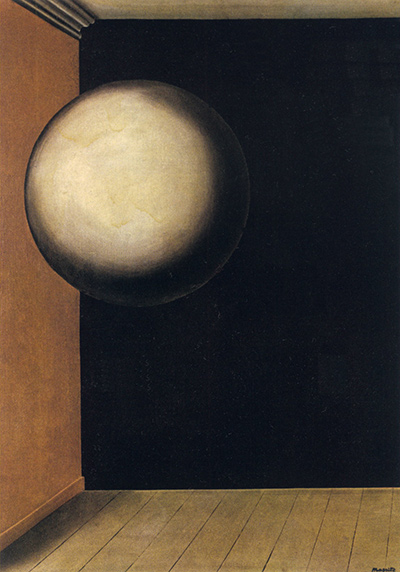
A large sphere hangs near the corner of a room in René Magritte’s Secret Life IV. It is pale on the side nearest the ochre wall and dark against the black surface behind it. A few boards and a strip of moulding establish the limits of the room. The sphere has no visible support, and it floats high enough for a wide stretch of wall to remain beneath it. Light makes its volume easy to recognise. The surrounding room makes it difficult to decide where that volume belongs.
Kunsthaus Zürich catalogues the painting as La Vie secrète, also known as The Secret Life. It is a 1928 oil on canvas measuring 73 by 54.5 centimetres, inventory 1973/0005 and catalogue raisonné number 290. The numeral IV is used in some accounts of the work, including scholarship on its London exhibition history. The Zürich record and its illustration identify the upright room with a single sphere. Cleveland owns a separate, horizontal oil from 1928 with the same French title. [1] [2] [3]
At a Glance
- Original titleLa Vie secrète
- Date1928
- MediumOil on canvas
- Size73 × 54.5 cm
- Catalogue numberSylvester I 290
- CollectionKunsthaus Zürich, 1973/0005
Selected works
Secret Life IV
1928A sphere in the corner
The brightest part of the sphere is a broad patch towards the left. It shades gradually through greys and browns into a dark curve at the bottom and right. Faint irregular marks remain visible in the light patch. They give it something of the character of a surface rather than an area of unmodulated colour. Around the dark side a fine boundary lets the eye continue following the circle against the black of the wall. Much of the impression of volume comes from the changes in tone inside that circle.
The sphere overlaps the upright join of the walls. Above it, the line is visible from the ceiling to the top of the sphere. Below it, the line begins again and runs down towards the floor. Because the sphere interrupts the join, it appears to sit somewhere in front of that corner. How far forward it sits is harder to establish. Its diameter takes up a large part of the canvas, but there is no smaller object nearby whose size would help us judge its distance. The corner gives an indication of depth without supplying a reliable scale.
The sphere is also high enough to leave the floor quite separate from it. There is no furniture under it and no cord appears in the narrow space above. If we follow the vertical at the left of the black wall all the way to the baseboard, the length of wall below the sphere becomes especially noticeable. The picture gives the sense of a heavy object in a room while leaving open how anything so substantial could occupy that position.
The boards and the black wall
The floor is a comparatively narrow strip along the bottom. The joints between the boards angle back towards the wall. They give the picture a direction away from us and make the upright surfaces easier to place. At the left a short length of baseboard follows the angle of the ochre wall. Where it reaches the corner, a nearly level line separates the darker rear surface from the light boards. The intersection is clear enough to read as architectural space even though we see very little of the room.
Watch: Understanding Magritte
Three complementary films introduce the artist, explore words and images, and examine a painting’s materials. These are broader Magritte comparisons, alongside the work discussed here.
René Magritte: Great Art Explained
An introduction to Magritte’s life, characteristic images and visual puzzles.
Watch on YouTubeAt the top, the moulding gives another view of that same corner. It retreats sharply along the ochre side before meeting the pale strip at the ceiling. The two cues are far apart. We can run our eyes down the left boundary and relate them to each other, or linger in the intervening space where the sphere blocks the line. The horizontal edges at top and bottom also leave a wide field of black on the right. The narrow outline of the sphere has a great deal of space in which to disappear and become visible again.
There is a similar economy in the light. The boards have a warm tone and the left wall is distinctly lighter than the rear. The sphere’s brightest patch catches some of that warmth, while its lower edge takes on the darkness of the larger surface behind it. Looking for a lamp or a window takes us back to the limits of the scene. The painting provides enough light to describe the objects and surfaces. The source lies beyond what the room reveals.
Other rooms and other spheres
Chiara Caputo identifies Secret Life IV among the paintings shown in Magritte’s first English solo exhibition, at the London Gallery in 1938. Her account places it alongside works such as The Red Model and The Key of Dreams. The Kunsthaus provenance also records the London Gallery and E. L. T. Mesens. The work was acquired by the Vereinigung Zürcher Kunstfreunde in 1973 and has been on loan to the Kunsthaus since that year. [1] [2]
The Cleveland painting opens the back of a room onto a wide expanse of blue sky and white cloud. A block on its floor supplies another object whose identity can be studied separately from the architecture. In the Zürich oil the rear surface is dark and the sphere rises well above the floor. Both pictures give us a room with enough detail to establish where we stand. What appears within it changes the kind of space we think we are entering. The French catalogue motif index distinguishes the two works as numbers 289 and 290. [1] [3] [4]
The Kunsthaus proposes an early painting by Giorgio Morandi as a possible source for the floating form in an enclosed room. Its account also raises a possible connection with Alberto Giacometti’s later Boule suspendue. Both suggestions are comparisons offered by the museum. They invite us to look at the amount of space left around the sphere and at how the strip of ceiling, corner and floor make its suspension visible. [1]
The later Art of Living also places a sphere above an interval of open space. Its face and the suit below provide a way to connect the round form to a person. In Secret Life IV, the room provides the scale and the light provides the sense of volume. As we keep looking, the basic shapes become more familiar. The relation between them stays hard to explain. [5]
Magritte artworks directory
| Name | Date | Medium |
|---|---|---|
| Memory of a Voyage | 1963 | Oil on canvas |
| The Blood of the World | 1927; also catalogued as 1926–27 | Oil on canvas |
| The Hunters at the Edge of Night | Paris, 1928 | Oil on canvas |
| The Empty Picture Frame (La saignée) | 1938–39 | Gouache on paper |
| The Glass House | 1939 | Gouache on paper |
| Oasis | 1926 in the illustrated Christie’s catalogue | Oil on canvas |
| Natural Encounters | 1945 | Oil on canvas |
| Attempting the Impossible | 1928 | Oil on canvas |
| On the Threshold of Liberty | 1930 | Oil on canvas |
| The Titanic Days | 1928 | Oil on canvas |
| The Voice of Space | 1931 | Oil on canvas |
| Unexpected Answer | 1932 in the museum catalogue, 1933 on the reverse | Oil on canvas |
| Elective Affinities | 1932 in MoMA’s checklist, also published as 1933 | Oil on canvas |
| The Human Condition II | 1935 | Oil on canvas |
| The Six Elements | 1929 | Oil on canvas |
| The Happy Donor | 1966 | Oil on canvas |
| Clairvoyance (Self Portrait) | Brussels, 1936 | Oil on canvas |
| Philosopher’s Lamp | 1936 | Oil on canvas |
| The Annunciation | Paris, 1930 | Oil on canvas |
| The Lost Jockey | Circa 1942 in the illustrated lot catalogue | Gouache on paper laid down on canvas |
| Homage to Mack Sennett | 1936 in the Thyssen catalogue | Oil on canvas |
| Discovery | 1927 | Oil on canvas |
| Collective Invention | 1935 in the later catalogue index | Oil on canvas |
| The Wonders of Nature | 1953 | Oil on canvas |
| The Balcony | Circa 1950, with 1950 inscribed on the reverse | Oil on canvas |
| The Pilgrim | 1966 | Oil on canvas |
| The Invention of Life | 1928 | Oil on canvas |
| The Therapist | 1941 | Gouache on paper |
| The Gradation of Fire | 1938 or 1939 in the catalogue index | Gouache on paper |
| A Friend of Order | 1964 | Oil on canvas |
| The Poetic World | 1939 in Hammacher’s illustrated monograph | Gouache |
| The Muscles of the Sky | Paris, 1927 | Oil on canvas |
| The Battle of the Argonne | 1959 | Oil on canvas |
| Meditation | 1936 | Oil on canvas |
| The Domain of Arnheim | 1962 | Oil on canvas |
| This Is Not an Apple | 1964 | Oil on Unilite |
| The Meaning of Night | Brussels, 1927 | Oil on canvas |
| The Pleasure Principle (Portrait of Edward James) | 1937 | Oil on canvas |
| Ready Made Bouquet | 1957 | Oil on canvas |
| Popular Panorama | 1926 | Oil on canvas |
| Memory of a Journey | 1955 in the Thyssen catalogue. Tentatively 1958 in the catalogue index. | Gouache on paper, as exhibited at the Thyssen |
| Sheherazade | 1947 | Gouache on paper |
| The Difficult Crossing | 1926 | Oil on canvas |
| The Fair Captive | 1948 in the catalogue raisonné | Oil on canvas |
| The Birth of the Idol | 1926 | Oil on canvas |
| Hegel’s Holiday | 1958 | Oil on canvas |
| Homesickness | 1941 | Oil on canvas |
| The Rape (Le Viol) | 1934 | Oil on canvas |
| The Art of Living | 1967 | Oil on canvas |
| Secret Life IV | 1928 | Oil on canvas |
| The Tomb of the Wrestlers | 1960 | Oil on canvas |
| Young Girl Eating a Bird (The Pleasure) | 1927 | Oil on canvas |
| The Central Story | 1928 | Oil on canvas |
| The Seducer | 1953 | Oil on canvas |
| The Telescope | 1963 | Oil on canvas |
| The Banquet | 1958 | Oil on canvas |
| The Empty Mask | 1928 | Oil on canvas |
| The Cultivation of Ideas | 1927 | Oil on canvas |
| The Enchanted Pose | 1927 | Oil on canvas |
| The Future of Statues | 1937 | Oil on plaster |
| The Return of the Flame | 1943 | Oil on canvas |
| The White Page | 1967 | Oil on canvas |
| The Large Family | 1963 | Oil on canvas |
| Black Magic | 1945 | Oil on canvas |
| Les Amants I | 1928 | Oil on canvas |
| Man in a Bowler Hat | 1964 | Oil on canvas |
| The Portrait | 1935 | Oil on canvas |
| The Sixteenth of September | 1956 | Oil on canvas |
| Heartstrings | 1960 | Oil on canvas |
| The Present | 1939; also dated 1938 or 1939 | Gouache on paper |
| Act of Violence | 1932 | Oil on canvas |
| Fashionable People | 1950, in the 2016 thesis caption | Medium unconfirmed · Attribution follows the published caption |
| The Representation | 1962 | Oil on canvas |
| Memory | 1948 | Gouache on paper |
| The Mysteries of the Horizon | 1955 | Oil on canvas |
| Portrait of Stephy Langui | 1961 | Oil on canvas |
| The Double Secret | 1927 | Oil on canvas |
| Every Day | 1966 | Oil on canvas |
| The Invisible World | 1954 | Oil on canvas |
| Dawn of Cayenne | 1926 | Oil painting |
| Clear Ideas | 1955 (inscribed); possible 1958 execution | Oil on canvas |
| The Face of Genius | 1926 / 1927 | Oil on canvas |
| Good Faith | 1965; earlier record 1964–65 | Oil on canvas |
| The Flash | 1959 | Gouache and pencil on paper |
| Perpetual Motion | 1935; earlier catalogue 1934 | Oil on canvas |
| Personal Values | 1952 | Oil on canvas |
| Not to Be Reproduced | 1937 | Oil on canvas |
| The Red Model | 1935 | Oil on canvas |
| The Menaced Assassin | 1927 | Oil on canvas |
| The Castle of the Pyrenees | 1959 | Oil on canvas |
| The Blank Signature | 1965 | Oil on canvas |
| The Listening Room | 1958 | Oil on canvas |
| Golconde | 1953 | Oil on canvas |
| Time Transfixed | 1938 | Oil on canvas |
| The Treachery of Images | 1929 | Oil on canvas |
| The False Mirror | 1929 | Oil on canvas |
| The Empire of Light | 1953–54 | Oil on canvas |
| The Human Condition | 1933 | Oil on canvas |
| Les Amants | 1928 | Oil on canvas |
| The Son of Man | 1964 | Oil on canvas |
Frequently Asked Questions
The upright Zürich oil with a single sphere suspended near a corner.
Discussion
Look closely and compare your reading with others.
Reader Insights
Which edge gives the clearest indication that the sphere is in front of the corner?
Where does the sphere’s outline become hardest to follow?
How does Cleveland’s open view of the sky change the effect of its room?
Join the Conversation
Share a detail, comparison or question about Secret Life IV below.
References
- Kunsthaus Zürich. La Vie secrète, 1928. Illustrated collection and provenance record, inv. 1973/0005, Sylvester I 290. View source.
- Chiara Caputo. Automatism and Psychoanalysis in the Pages of the London Bulletin (1938–1940). Dada/Surrealism, discussion of the London Magritte exhibition. View source.
- The Cleveland Museum of Art. The Secret Life, 1928. Illustrated collection record, 1992.298. View source.
- Magritte. Toutes les œuvres, tous les thèmes. Catalogue raisonné and motif index, vol. I, pp. 321–322, nos. 289 and 290. View source.
- Christie’s. Illustrated lot record for a related 1967 pencil drawing, lot 4954779, fig. 1 illustrating L’Art de vivre. View source.