by Tom Gurney
Tom Gurney BSc (Hons) is an art history expert with over 20 years experience
Published on June 19, 2020 / Updated on October 2, 2026
Email: tomgurney1@gmail.com / Phone: +44 7429 011000
Cardinal Bandinello Sauli, His Secretary, and Two Geographers by Sebastiano del Piombo: Introduction
Four men occupy a shallow green room around a table. Cardinal Bandinello Sauli sits at the left, dressed in red and white, with one hand on the table and the other holding what may be gloves. A man leans close to him at the edge of the picture. Two others stand beyond the table, near an open book of maps. A bell, a patterned carpet, rings, a painted fly and a signed paper slip all compete for attention.
Sebastiano del Piombo's Cardinal Bandinello Sauli, His Secretary, and Two Geographers is a portrait about authority under observation. The National Gallery of Art dates it to 1516, when Sauli was near the height of his influence in Rome. It is signed and dated, painted on panel, and now belongs to the Samuel H. Kress Collection in Washington. The NGA describes it as one of the earliest Italian group portraits, a careful phrase that should be preserved: the painting is exceptional without needing to become an absolute first.[1]
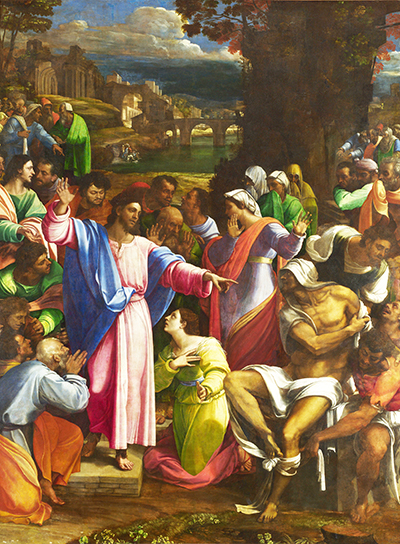
The picture belongs to Sebastiano's Roman years, after his move from Venice and before the great Raising of Lazarus made his collaboration with Michelangelo and rivalry with Raphael newly public. Here the drama is quieter. Four men, a table and a few objects become enough to stage status, intellectual work and pictorial deception.
At a Glance
- Current titleCardinal Bandinello Sauli, His Secretary, and Two Geographers
- ArtistSebastiano del Piombo
- Date1516
- MediumOil on panel
- Dimensions121.8 x 150.4 cm
- CollectionNational Gallery of Art, Washington
- Accession number1961.9.37
- Credit lineSamuel H. Kress Collection
- InscriptionSigned and dated on an illusionistic paper slip
Contents
- Introduction
- Sauli in Rome, 1516 and 1517
- Four people, one table
- Map, bell, carpet, rings and gloves
- The fly and the signed paper
- Venetian colour and Roman form
- Provenance and reception
- How to look at the portrait
Sauli in Rome, 1516 and 1517
Bandinello Sauli came from a Genoese family and rose within the politics of the Roman church. Pope Julius II elevated him to the rank of cardinal in 1511. By 1516, when Sebastiano painted the portrait, Sauli was powerful enough to commission or possess an ambitious group image from one of Rome's most sought-after painters.[1]
The following year changed his position dramatically. The NGA records that Sauli was imprisoned in 1517 for plotting against Pope Leo X. That fact gives the portrait sharp historical tension, but it should not be read backward as prophecy. The men do not know their future because we do. Their expressions, gestures and objects belong first to the moment of 1516.[1]
This restraint matters because group portraits invite narrative. A later fall from power can make every shadow look ominous and every glance seem suspicious. Sebastiano does not need that hindsight to make the painting compelling. The composition already turns authority into something watched, approached, handled and interrupted.
Sauli sits apart while also anchoring the group. He occupies the narrow end of the table, dressed in cardinal red, his body angled across the picture. The secretary leans close to his right shoulder, while the two geographers stand across the table in a more active exchange. The arrangement creates hierarchy without making the other men secondary decorations.
Within Sebastiano's biography, the picture belongs to the period in which Venetian colour and Roman monumentality came together in portraiture. Treccani and the NGA both stress that Sebastiano became a highly valued portraitist in Rome. Sauli's portrait shows why: he could make status visible without freezing the sitter into ceremony.[2]
It also shows how portraiture could carry public risk. A cardinal's image did not simply preserve private likeness. It could advertise access, learning, office and proximity to papal politics. In 1516, those qualities made Sauli impressive; after 1517, the same qualities could be read under the shadow of failed ambition. The painting therefore sits at a charged historical threshold, but the responsible interpretation keeps the two moments distinct.
Four people, one table
The table is the painting's real stage. It separates and connects the figures, holding the map book, bell, carpet and Sauli's resting hand. The group does not face us in a row. Instead, Sebastiano arranges them around a compressed workspace, so that looking becomes a form of social negotiation.
Sauli dominates by position, clothing and stillness. The red cap and cape identify his rank immediately, while the white robe expands his body across the chair. His eyes turn outward, meeting the viewer directly. He is not absorbed in the map book. He is the person around whom the conversation and service take place.
The man at the far left leans toward him, almost entering Sauli's personal space. The fingers of one hand rest on his own chest, while the other barely touches the chair. The gesture can suggest deference, speech or interruption, but the NGA's cautious title identifies him only as the secretary. The safest reading leaves him unnamed unless a cited authority supports a specific identification.
The two men to the right are defined by their relation to the map manuscript. One rests a hand on the open book, while the other raises a finger, as if making a point. They are geographers by role and attribute, not by individually named biography. Their position gives the painting intellectual movement: the table is not only a surface of wealth but a place where knowledge is being consulted.
This is what makes the group portrait modern in feeling. The men share a space of work and rank rather than a purely dynastic or devotional setting. Sauli remains central, but the painting shows his authority as something supported by papers, tools, attendants and experts.
The shallow space helps this effect. The green backdrop presses the figures forward, giving them little room to retreat. Everyone is close to the table, close to Sauli and close to the viewer. That compression turns the painting into a controlled encounter rather than a broad narrative scene.
Map, bell, carpet, rings and gloves
The open manuscript with maps gives the right side of the painting its subject of knowledge. Geography is not presented as abstract decoration. It is a practical discipline, something consulted by men close to power. In early sixteenth-century Rome, maps, diplomacy, church politics and worldly administration could be closely connected.
The bell near Sauli's hand introduces another kind of authority. It is small but potent: an object that summons service, interrupts discussion or marks command. Its place on the table near the cardinal makes office physical. Sauli does not have to speak for power to be felt; the bell is a tool of presence.
The carpet performs a different function. It brings colour, cost and texture into the foreground, showing Sebastiano's Venetian command of rich surface. At the same time, it turns the table into a ceremonial platform. The objects do not sit on plain furniture but on a patterned field that makes the whole encounter visually charged.
Sauli's rings and possible gloves also matter. Rings mark status, office and touch. Gloves can suggest rank, ceremony and the controlled handling of the world. These details should not be forced into a fixed symbolic code, but they help the viewer understand how Sebastiano makes authority material. Power appears through cloth, metal, gesture and proximity.
The table objects are therefore not still-life filler. They coordinate the painting's themes: learning, command, wealth, service and illusion. They also slow the viewer down. To understand the portrait, we must look not only at faces but at what hands touch and what objects sit within reach.
The map book is especially important because it gives the geographers a task. Without it, the two men on the right might become anonymous companions in a portrait of rank. With it, they become participants in a practical inquiry. The painting suggests that Sauli's world is not only ceremonial but informational: status depends on documents, spatial knowledge and expert interpretation.
The bell and rings then return that world of information to command. Knowledge may be open on the table, but authority still belongs to the cardinal. Sebastiano's composition keeps both facts visible at once.
The fly and the signed paper
The small fly on Sauli's knee is one of the painting's most memorable details. It appears at first like a dark speck, then resolves into a tiny trompe-l'oeil insect painted as if it has landed on the surface. The detail is witty, but not trivial. It makes the viewer aware of the painting as a made object and of Sebastiano's ability to deceive the eye.[1]
The signed and dated paper slip at the front of the table works in a related way. The inscription appears as if written on a piece of paper attached to the painted surface. The signature is not merely administrative. It becomes another illusion, another test of where painted representation ends and the viewer's world begins.
These details are especially appropriate in a portrait about knowledge and authority. The geographers read the world through maps; the viewer reads the painting through surfaces; Sebastiano invites both kinds of interpretation and then complicates them. If a fly can seem to sit on Sauli's knee, then the painting can make power feel immediate while reminding us that it is constructed.
The fly should not be overloaded with invented symbolism. It can suggest decay, vanity, sharp observation or artistic display in different traditions, but the secure point here is pictorial: Sebastiano placed a deceptive detail in a portrait of a powerful man and his intellectual circle. The result is a controlled game between realism and artifice.
That game also explains why the work later appeared in an exhibition on trompe-l'oeil painting under the title Cardinal Bandinello Sauli and Three Companions. The painting's identity as a group portrait and its identity as an illusionistic display are not separate. The fly and paper slip help make the social scene more acute.[3]
Venetian colour and Roman form
Sebastiano was born in Venice and carried a colour-led formation into Rome. The NGA notes the painting's resonant reds, greens, whites and blacks as part of that Venetian inheritance. The deep green background presses close to the figures, while Sauli's red and white clothing makes rank visible through colour before any object is read.[2]
At the same time, the figures have Roman weight. They are life-sized, solid and clear. The scene does not dissolve into atmospheric ambiguity like an early Venetian poetic panel. It is built from large bodies, controlled gestures and a shallow but forceful space. The NGA connects this solidity to the impact of Michelangelo, who befriended Sebastiano after his arrival in Rome.[2]
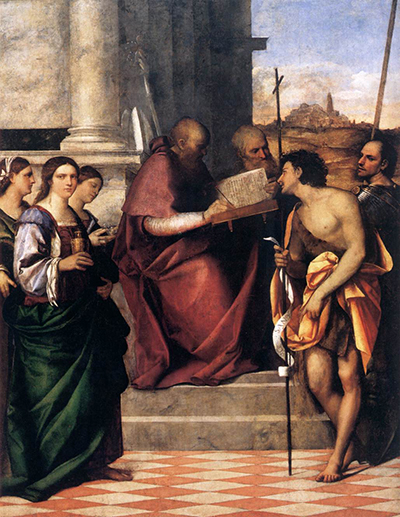
This combination is central to Sebastiano's art. In the San Giovanni Crisostomo Altarpiece, he had already tested monumental sacred presence within a Venetian church. In Sauli's portrait, he transfers that seriousness to secular and ecclesiastical status. Colour gives the painting richness; structure gives it command.
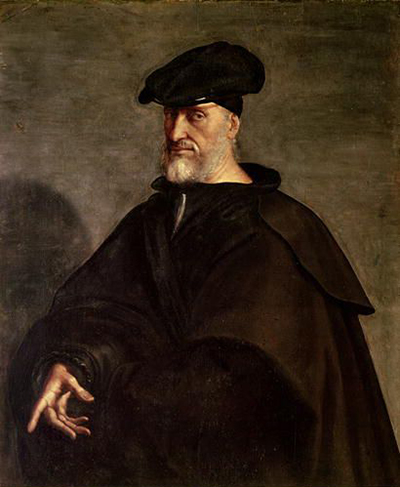
The comparison with Portrait of Ferry Carondelet with His Secretaries is useful because both portraits organise powerful men through attendants, documents and controlled space. The comparison with Portrait of Andrea Doria will later show a different strategy: one dominant public figure rather than a compact group around a table. Sauli's portrait stands between individual portraiture and institutional scene.
Provenance and reception
The NGA's provenance begins with the Palazzo Giacomo Balbi in Genoa by 1780. By 1854 the painting was with Henry Labouchere, first Baron Taunton, at Quantock Lodge in Somerset, and probably remained with his widow and then descendants into the early twentieth century. By 1920 it was with Henry George Charles Lascelles, later sixth Earl of Harewood, and then passed by inheritance to his son at Harewood House. It was sold in 1949 to the Samuel H. Kress Foundation and given to the National Gallery of Art in 1961.[4]
This history matters because the painting's modern identity developed through changing collections and titles. In 1870 it was exhibited at the Royal Academy as The Medici Family. In the twentieth century, the NGA bibliography records titles and studies that increasingly treated it as a portrait group by Sebastiano. The current title gives Sauli his proper centrality while preserving caution around the other men.
The painting's bibliography also shows why it should not be treated as a simple likeness. Scholars have studied its prophecy, portraiture, iconography, illusionism and relationship to Sebastiano's Roman career. The NGA bibliography includes major catalogue entries and the 2008 Sebastiano exhibition catalogue, which records the work with specific catalogue pages even though it was not in that exhibition.[4]
Its reception therefore follows the painting's own complexity. It is a portrait, a group scene, a display of objects, a lesson in illusion and a statement of Roman ecclesiastical status. Each category explains part of it; none is enough alone.
The Kress history also matters for its modern visibility. Many Italian Renaissance works in American museums came through the Kress Foundation, and this painting entered the NGA as part of that broader collecting history. Its current public identity therefore joins two stories: a Roman portrait made in 1516 for a powerful cardinal, and a twentieth-century museum object whose provenance and scholarship have gradually clarified the group around him.
How to look at the portrait
Begin with Sauli's face, because Sebastiano makes that unavoidable. Then move to the secretary leaning in from the left, whose closeness changes the cardinal's stillness into a social situation. Cross the table to the geographers and the map book. Their exchange gives the portrait its intellectual direction.
Notice also how little open space Sebastiano allows. The room is not described as a large interior, and the background does not invite the eye into a landscape or architectural setting. That restraint keeps attention on the human arrangement. The green wall, the crowded table and the bodies pressed near the picture plane make the portrait feel almost audible, as if the viewer has arrived in the middle of a discussion. This is why the painting works both as likeness and as scene. Sauli's rank is stable, but the atmosphere around him is active: someone leans in, someone points, someone reads, and the painter asks us to judge what kind of authority is being performed.
Then return to the objects. The bell sits near command. The rings and gloves mark status and touch. The carpet creates a costly surface for work. The fly and signed paper test the boundary between painted thing and real thing. Sebastiano turns every detail into evidence of how power is staged.
The painting matters within Sebastiano's paintings because it shows the Roman portrait at full intellectual pressure. It is neither a simple image of a cardinal nor a generic office scene. It is a concentrated account of a man at the centre of service, knowledge, rank and illusion, painted just before history changed the meaning of his power.
Discussion
This portrait rewards close looking at the social space around Cardinal Sauli: the table, the map book, the bell, the fly and the men whose roles are safer than their names.
Use the prompts below to keep the current NGA title, the 1516 moment and the later 1517 political history in balance.
Reader Insights
How does the table make Sauli's authority depend on other people, objects and forms of expertise?
Which detail changes the mood most for you: the bell, the map book, the rings, the gloves, the carpet or the fly?
How much should Sauli's imprisonment in 1517 affect the way we read a portrait signed and dated in 1516?
Join the Conversation
Share your reading of Sebastiano del Piombo's portrait of Cardinal Bandinello Sauli below.
References
- National Gallery of Art, Washington, Sebastiano del Piombo, Cardinal Bandinello Sauli, His Secretary, and Two Geographers, 1961.9.37, object record, visual description, title, date, medium, dimensions, accession, credit line and object overview.
- National Gallery of Art, Washington, Sebastiano del Piombo artist record; Michele Di Monte, “Luciani, Sebastiano, detto Sebastiano del Piombo”, Dizionario Biografico degli Italiani, vol. 66 (2006).
- National Gallery of Art, Washington, exhibition history for Cardinal Bandinello Sauli, His Secretary, and Two Geographers, including Deceptions and Illusions: Five Centuries of Trompe l'Oeil Painting, 2002-03.
- National Gallery of Art, Washington, artwork history, provenance, exhibition history and bibliography for 1961.9.37, including Palazzo Giacomo Balbi, Labouchere, Lascelles/Harewood, Samuel H. Kress Foundation and NGA ownership sequence.