 by Tom Gurney
Tom Gurney BSc (Hons) is an art history expert with over 20 years experience
Published on June 19, 2020 / Updated on October 2, 2026
Email: tomgurney1@gmail.com / Phone: +44 7429 011000
The San Giovanni Crisostomo Altarpiece by Sebastiano del Piombo: Introduction
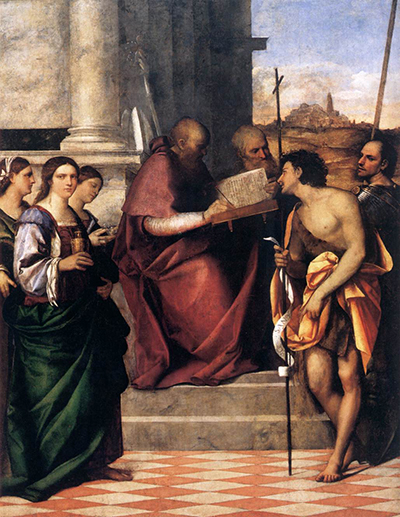
Sebastiano del Piombo's altarpiece for San Giovanni Crisostomo in Venice is still bound to the church for which it was made. Saint John Chrysostom sits reading in an ordered architectural space, surrounded by Saint John the Baptist, Saint Paul, Saint Liberale, Saint Mary Magdalene, Saint Catherine and Saint Cecilia. The painting is not arranged as a simple throne scene. It is a gathering in which reading, listening, standing and looking all matter.
Painted about 1510-11, just before Sebastiano left Venice for Rome, the altarpiece is one of the key works of his early career. It belongs to the same moment as Judith (or Salome?) and the unfinished Judgement of Solomon, but it has a different public function. This was not a portable poetic panel or an unfinished narrative canvas. It was a high altarpiece for a Venetian church, made to organise devotion in a real architectural setting.[1]
The work is important because it shows Sebastiano already thinking beyond inherited formulas. He keeps the Venetian command of colour, atmosphere and sacred presence associated with Giovanni Bellini and Giorgione, yet he gives the scene a stronger architectural order and a more monumental physical weight. The result helps explain why his move to Rome in 1511 was not a break from immaturity, but the next step for a painter already capable of large invention.[2]
At a Glance
- Common titleSan Giovanni Crisostomo Altarpiece
- Catalogue subjectSaint John Chrysostom with saints
- ArtistSebastiano del Piombo
- DateAbout 1510-11
- MediumOil on canvas
- Current locationChurch of San Giovanni Crisostomo, Venice
- National catalogue ID0500193993
- Saints named in the catalogueJohn Chrysostom, John the Baptist, Paul, Liberale, Mary Magdalene, Catherine and Cecilia
Contents
- Introduction
- A commission for a rebuilt Venetian church
- Seven saints and the act of reading
- Architecture and a new kind of sacred conversation
- Colour, light and Venetian formation
- Date, attribution and the Giorgione question
- Survival, influence and looking in place
A commission for a rebuilt Venetian church
San Giovanni Crisostomo stands in Cannaregio, near the dense mercantile and parish life of early sixteenth-century Venice. The church had recently been rebuilt and redecorated, and Di Monte identifies the parish priest Alvise Talenti as a likely guiding figure in the altarpiece's execution. That setting matters. Sebastiano was not making an isolated devotional painting; he was contributing to a renewed church interior whose architecture, liturgy and family memory shaped the work.[2]
The commission is linked to Caterina Contarini and her husband Niccolo Morosini. The safest account is deliberately restrained: the painting was associated with their testamentary intentions for the high altar, but it was executed after both had died. The evidence supports a Contarini-Morosini commission context and Talenti's probable supervision; it does not require a public paraphrase of testamentary wording unless a specialist edition is being quoted directly.
That restraint keeps the patronage from becoming more certain than the sources allow. The evidence supports an altarpiece emerging from a specific Venetian church, a family commission and a programme of renewal, without requiring a personal devotional motive for the patrons, exact reconstructed instructions or a claim that Talenti designed every visual detail.
The in-situ character is still essential. Many Renaissance altarpieces have been removed from their first locations and reframed by museums. This one remains connected to the place named in its catalogue record. That survival changes how it should be understood: the painting belongs to an altar, a church interior, a parish history and a Venetian urban setting, not only to Sebastiano's biography.
It also changes the meaning of scale. A high altarpiece is not designed for the same kind of encounter as a small cabinet picture. The viewer approaches it through the church, across a distance and within the sightlines of the altar. Sebastiano therefore had to solve a public problem: how to make individual saints legible while keeping the whole composition stable enough to hold its place in worship.
The commission came at a decisive moment for the painter. In the same years he was producing compact works of striking psychological ambiguity, but this altarpiece required a broader and more institutional language. It had to answer family memory, parish setting and high-altar visibility at once. That is why it matters within Sebastiano's biography: before Rome gave him major papal and international commissions, Venice had already given him a demanding public test.
Seven saints and the act of reading
The national catalogue lists seven holy figures: Saint John Chrysostom, Saint John the Baptist, Saint Paul, Saint Liberale, Saint Mary Magdalene, Saint Catherine and Saint Cecilia. That enumeration gives the safest basic cast unless a later specialist iconographic study is being used for a narrower historical argument.[1]
John Chrysostom is the central figure, but he does not dominate in the ordinary way of an enthroned altarpiece. He is absorbed in reading or writing, turned partly in profile, and placed within the architectural space rather than raised into an isolated heavenly hierarchy. His authority is intellectual and spiritual before it is ceremonial.
This emphasis fits his identity. John Chrysostom was one of the great preachers and theologians of the early Church, remembered for eloquence, biblical interpretation and pastoral force. Sebastiano does not need to show him performing a miracle or receiving a crown. The book is enough. Reading becomes the action around which the sacred gathering coheres.
The surrounding saints extend the altarpiece's field of meaning. John the Baptist carries prophetic force and points towards Christ's coming. Paul brings apostolic authority and doctrinal gravity. Mary Magdalene, Catherine and Cecilia bring different forms of female sanctity: penitence, learning, martyrdom, music and devotion. Saint Liberale gives the group a regional and civic dimension within the Venetian world.
Sebastiano's achievement is to keep these figures distinct without making them compete. The saints do not act out separate stories. They share a constructed sacred space, each contributing a different kind of presence. The painting asks the viewer to move slowly among identities, attributes and gestures, rather than to read one dramatic episode from left to right.
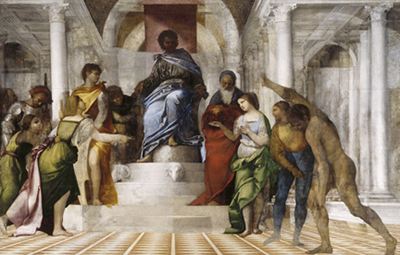
That slow movement is important because the altarpiece is not a narrative in the manner of The Judgement of Solomon. Nothing dramatic is about to happen. No execution, miracle or argument propels the figures into action. The energy lies in attention: Chrysostom attends to the book, the saints attend to one another and to the sacred space, and the viewer is asked to join that attentiveness.
The catalogue's saint list also helps prevent the image from being reduced to an attractive group of figures. Each saint carries a different historical and devotional register. John the Baptist and Paul pull the work towards Scripture and apostolic authority. Mary Magdalene, Catherine and Cecilia offer forms of sanctity that would have been familiar to Venetian devotion but are not interchangeable. The painting's unity depends on difference held in order.
Architecture and a new kind of sacred conversation
The altarpiece is a form of sacra conversazione, a sacred conversation in which saints from different times gather around a holy centre. Sebastiano's version is unusual because the centre is not the Virgin and Child, and because the figures are bound together by architecture as much as by devotional symmetry.
Steps, pavement and columns create a staged setting. The space feels measured and public, almost like a small sacred theatre. This order gives the saints weight. They stand or sit as bodies occupying a shared environment, not as labels arranged against a flat gold or decorative ground.
The same architectural intelligence appears in the unfinished Judgement of Solomon, where the National Gallery has drawn attention to Sebastiano's use of pavement, steps, colonnades and large-scale building forms to organise narrative authority. In the San Giovanni Crisostomo Altarpiece, the architecture is less expansive, but the principle is related: space is not backdrop. It structures meaning.[3]
John Chrysostom's seated position also changes the hierarchy. A conventional altarpiece might place the principal holy figure frontally and high above the others. Sebastiano lets Chrysostom's intellectual act make him central. He is not louder than the saints around him; he is more concentrated. The surrounding figures become witnesses to reading, contemplation and sacred learning.
This architectural order helps explain why Di Monte describes the altarpiece as a decisive stage in Venetian altarpiece development. Sebastiano gives the picture greater volume and structural clarity without abandoning Venetian colour. The scene has more bodily and spatial firmness than an older devotional panel, yet it remains atmospheric rather than dry.
The pavement is especially important. It gives the figures a shared ground and makes their positions readable across the width of the painting. The columns then provide a vertical counterpoint, setting human presence against a durable architectural frame. Together they create a sacred place that feels constructed rather than merely imagined.
This is where Sebastiano's early ambition becomes visible. He was not simply placing saints before a pleasant background. He was testing how architecture could make devotional presence more persuasive. The painting does not need a crowded story because the space itself gives the saints a public and intellectual seriousness.
Colour, light and Venetian formation
Sebastiano was formed in Venice, where colour and light were not secondary effects but the substance of painting. Di Monte treats an early connection with Giovanni Bellini as credible, while warning that the claimed relationship with Giorgione is harder to document as a formal apprenticeship. That distinction matters for this altarpiece.[2]
Bellini's legacy can be felt in the gravity of sacred presence and the use of colour to give devotion warmth and dignity. Giorgione's example matters for atmosphere, tonal softness and poetic inwardness. But the San Giovanni Crisostomo Altarpiece is not reducible to either older name. It is an early Sebastiano work because it makes those inheritances more monumental and architecturally forceful.
Colour binds the saints to one another. Drapery, flesh, stone and shadow create a rhythm across the surface, allowing the eye to pass from one figure to another without losing the central stillness of Chrysostom. The painting's light does not turn the scene into spectacle. It supports a slow reading of bodies and surfaces.
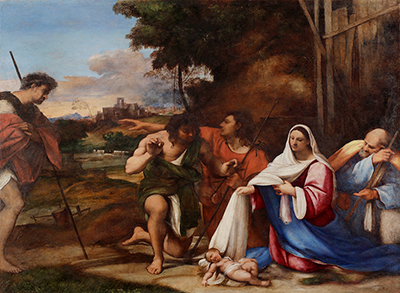
The comparison with The Adoration of the Shepherds is useful. Both works stand near the Venice-to-Rome threshold, and both combine Venetian atmosphere with larger, more weighty figure design. The altarpiece, however, is more architectural and more public. It shows Sebastiano testing how far Venetian colour could be brought into a disciplined sacred structure.
The comparison with Judith (or Salome?) is different but just as revealing. In that panel, a single young woman and a severed head carry the pressure of interpretation. In San Giovanni Crisostomo, interpretation is distributed across a holy assembly. Sebastiano could compress meaning into one face, or spread it across several figures bound by architecture. Both solutions belong to the same late Venetian intelligence.
Date, attribution and the Giorgione question
The date needs careful handling. The national catalogue's broad 1500-1510 range is useful as a catalogue bracket, while Di Monte places the work after the deaths of the patrons and not before May 1510, in the period immediately before Sebastiano's departure for Rome in spring 1511. About 1510-11 is therefore the most responsible working chronology.[1][2]
The Giorgione question belongs to the painting's reception and early style, not to its current attribution. Sebastiano's early works were close enough to Giorgione's world that older writers and viewers could connect them. But the current national catalogue attributes the San Giovanni Crisostomo Altarpiece to Sebastiano del Piombo, and Di Monte describes modern criticism as recognising it as the most important work of his Venetian phase.[1][2]
This distinction avoids two errors. The first is to erase Giorgione's importance from Sebastiano's formation. The second is to make Giorgione a present rival for authorship every time a Venetian quality appears. The painting's atmosphere, colour and inwardness explain why Giorgione matters; its architectural structure, saintly organisation and career position explain why it belongs to Sebastiano.
The same balance is needed when looking forward to Rome. The altarpiece should not be treated as a work already transformed by Michelangelo. It precedes that relationship. Its monumentality comes from Sebastiano's own late Venetian development, not from an imported Roman design. That makes the painting more important, not less: it shows what he brought with him before Rome changed him.
Survival, influence and looking in place
Because the painting remains in San Giovanni Crisostomo, it still asks to be understood in relation to place. An in-situ altarpiece is experienced differently from a museum picture. Its scale, height, altar setting and surrounding architecture affect what a viewer sees. The continuing church location should be described as historical survival, not as a promise of perfect access, lighting or uninterrupted viewing.
The painting's influence is best stated cautiously. Di Monte calls it a decisive stage in the typology of the Venetian altarpiece, and that is a strong claim from a specialist biography. The work's importance lies in its combination of architecture, figure volume, sacred conversation and Venetian light. Those elements help bridge older Bellinian altarpiece traditions and the more physically commanding painting of the early sixteenth century.[2]
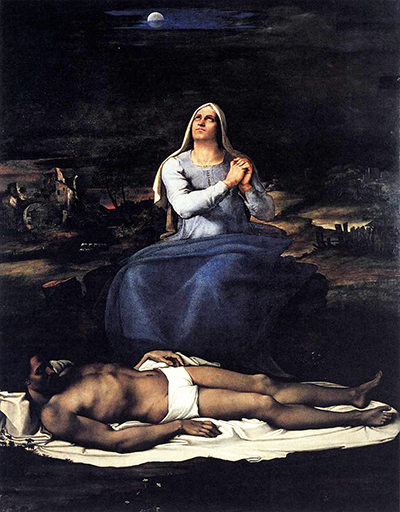
Within Sebastiano's paintings, the San Giovanni Crisostomo Altarpiece is a foundation work. Judith (or Salome?) concentrates ambiguity in a single half-length figure. The Judgement of Solomon expands architectural thinking into a complex, unfinished narrative. The Viterbo Pieta later transforms sacred painting through darkness, landscape and Michelangelo's presence. The altarpiece stands before all of those Roman developments as proof that Sebastiano's ambition was already public, architectural and devotional.
Look first at John Chrysostom's book. Then look at the saints around him, not as a crowd but as a set of presences gathered by that act of reading. Finally, follow the pavement and columns that make the space coherent. The painting's subject is not only a group of saints. It is a model of sacred authority shaped through text, architecture, colour and place.
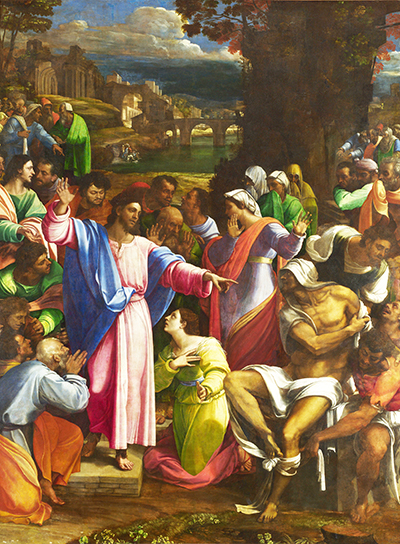
That final point explains why the altarpiece should not be treated as a minor prelude. Its importance is quieter than the later Raising of Lazarus, but it is fundamental. Sebastiano learned how to give sacred figures weight without sacrificing atmosphere, and how to make a church painting feel intellectually composed rather than merely decorative. Rome would change the scale of his opportunities; this altarpiece shows the Venetian foundation from which those opportunities became possible.
Discussion
The San Giovanni Crisostomo Altarpiece is a good test of how place, patronage and attribution history change the way an altarpiece is read.
Use the prompts below to keep the church setting, named saints and Venice-to-Rome chronology in view without turning careful caveats into certainty.
Reader Insights
How does knowing that the altarpiece remains tied to San Giovanni Crisostomo change the scale and purpose of the painting?
What does John Chrysostom's book do for the whole gathering of saints?
Where does the painting look Venetian, and where does it anticipate the more monumental ambitions of Sebastiano's Roman career?
Join the Conversation
Share your reading of Sebastiano del Piombo's San Giovanni Crisostomo Altarpiece below.
References
- Catalogo generale dei Beni Culturali, “Santi,” catalogue code 0500193993, current catalogue record for Sebastiano del Piombo's altarpiece in the Church of San Giovanni Crisostomo, Venice, including subject, named saints, medium, current location and metadata licence.
- Michele Di Monte, “Luciani, Sebastiano, detto Sebastiano del Piombo”, Dizionario Biografico degli Italiani, vol. 66 (2006), especially the early Venetian chronology, Bellini/Giorgione caution, Contarini-Morosini commission context, Alvise Talenti role and assessment of the San Giovanni Crisostomo Altarpiece.
- Amanda Lillie, “Sebastiano del Piombo, ‘The Judgement of Solomon’”, in Building the Picture: Architecture in Italian Renaissance Painting (London: National Gallery, 2014), for Sebastiano's early architectural vocabulary in the related Judgement of Solomon.