



 by Tom Gurney
Tom Gurney BSc (Hons) is an art history expert with over 20 years experience
Published on June 19, 2020 / Updated on November 3, 2026
Email: tomgurney1@gmail.com / Phone: +44 7429 011000
Behemoth and Leviathan by William Blake: Introduction
A huge animal stands over a coiled sea monster, both enclosed within a rounded world. Above them, a long arm reaches down from a gathering of human and heavenly figures, its finger pointing towards the enclosure. William Blake’s Behemoth and Leviathan turns the last great descriptions of creation in the Book of Job into a crowded encounter between different kinds of life. The two creatures dominate the picture, yet the finger descending towards them belongs to a power beyond their enclosure. [1]
This is the fifteenth numbered engraving in Blake’s Illustrations of the Book of Job. Its main inscription draws attention to Behemoth as a creature made alongside Job. The wording establishes a relationship before the reader has decided what kind of animal this extraordinary body resembles. The man looking down and the beast looking towards us belong to the same creation. Their different strengths become part of the answer Job receives after his long struggle to understand suffering. [1] [2]
At a Glance
- SequenceJob engraving 15 [1]
- SettingLate in God’s address to Job [2]
- Suite issueCompleted suite available March 1826 [1]
This work across William Blake’s career
Gothic art and antiquarian study
Apprenticeship, 1772–1779 [3]Poetical Sketches
1783 [4]The Marriage of Heaven and Hell
Offered in the 1793 prospectus [6]Night Thoughts
Published selection, 1797 [8]The Ghost of a Flea
c.1819–1820 [10]Job engravings
Agreement 1823; issue 1826 [11]Dante illustrations
1824–1827 [12]Behemoth and Leviathan (current article)
Suite issued 1826; later printings vary [1]Contents
- A world beneath the witnesses
- The weight of Behemoth
- Leviathan’s coils and open mouth
- Why God shows Job the creatures
- Clouds around the argument
- Nature, war and the globe
- A design and its printed impressions
- Annotated details
A world beneath the witnesses
The globe fills most of the lower picture. Inside it, a narrow strip of land supports Behemoth, while the sea below contains Leviathan’s curling body. Trees rise behind the land animal, reeds stand at the left, and foam follows the sea creature’s movement around the bottom. Blake provides enough habitat to separate the two domains, then packs their inhabitants so tightly that each seems close to exceeding its allotted space. [1]
Above the globe, Job and his wife crouch together on the left of the descending arm. His forearms cross his chest, while her head bends towards him. The friends cluster on the other side. Their bent backs and lowered faces make the act of looking feel physically demanding. These people occupy a much smaller portion of the picture than the creatures they are being shown. Their familiar bodies now help us measure an unfamiliar scale. [1]
Two tall angels flank the gathering, their hands held near their faces. Long wings and streaming robes frame the scene, while stars punctuate the dark space behind the central divine figure. His pale halo separates his head from that darkness. One arm extends across a broad cloud; the other reaches down between the witnesses, ending in the pointing finger immediately above the globe. Looking follows a route through the picture, from his face to his hand and then into the animals’ world. [1]
The gesture has a useful counterpart in Job Rebuked by his Friends, where hands converge on the sufferer. Here the witnesses’ attention is redirected outwards. The pointing hand introduces something beyond the human argument. It is also remarkably empty: it carries no weapon, rope or instrument for mastering the enormous bodies below. Its action is to show them. [1]
The weight of Behemoth
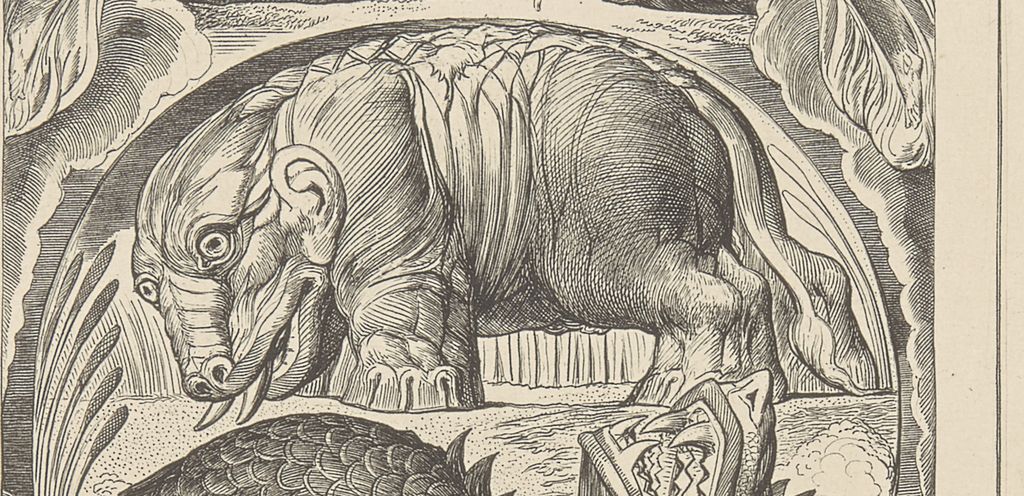
Behemoth’s broad flank bulges towards the right edge of the globe. Deep folds descend from its shoulders; short, heavy legs bear the body close to the ground. The lowered head turns towards us, making its staring eyes conspicuous. Large curved ears and projecting tusk-like forms give the face a mixture of recognisable animal features and deliberate strangeness. A thin tail drops beside the powerful hindquarters. [1]
Blake makes the animal’s mass through closely organised lines. Curves follow the rounded belly and haunch, while deeper darks gather under the body and within the folds of its hide. Its feet have blunt, upright edges against the narrow ground. The beast appears planted, almost architectural, especially beside the vertical tree trunks behind it. Its strength is expressed through the capacity to stand and occupy space. [1]
The biblical description begins with a surprisingly ordinary action: Behemoth eats grass like an ox. God then directs Job towards its muscular belly, mighty bones and sinews. Mountains supply its food; trees and reeds shelter it; a river does not alarm it. These passages place overwhelming strength within an inhabited landscape. The animal has needs and a dwelling, even while its body exceeds Job’s ability to command it. [2]
Tate’s catalogue connects Behemoth with the traditional hippopotamus identification. That tradition helps explain why readers have sought a large river-dwelling animal behind the words, but Blake’s particular creature resists a single zoological label. Its tusk-like projections, curled ear and heavily folded hide must be looked at together. The engraving makes a biblical body vivid through that combination of forms, giving its strength a particular appearance while preserving its strangeness. [1] [2]
Leviathan’s coils and open mouth
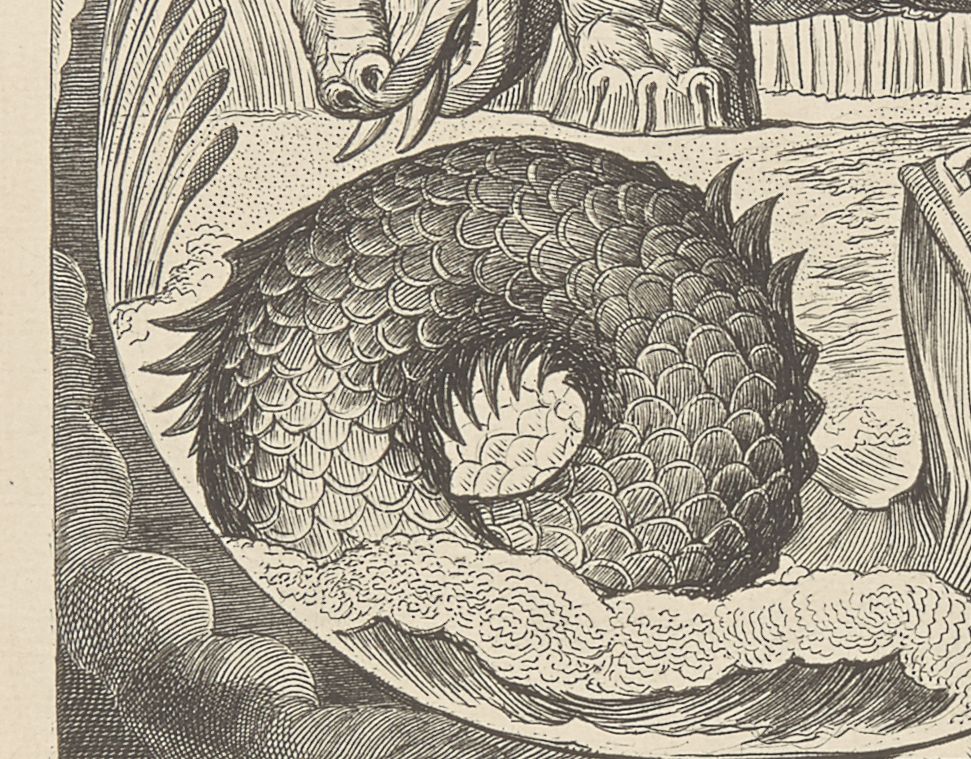
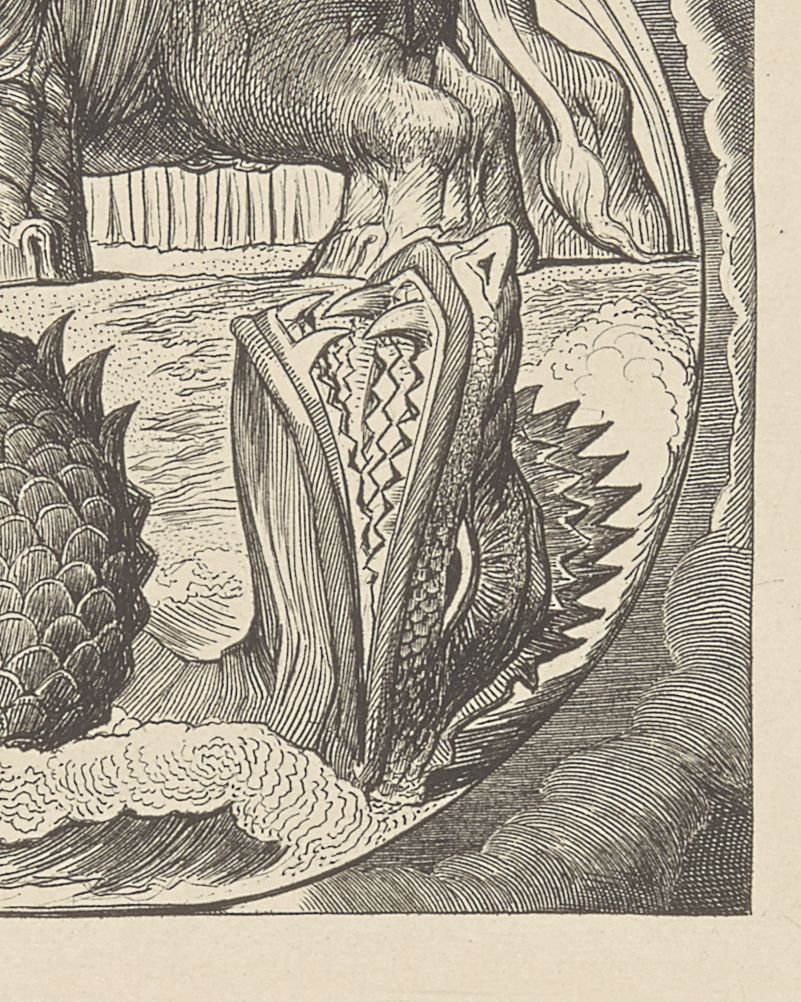
Leviathan has an entirely different construction. The lower body loops into a dense coil on the left, leaving a small opening within it. Rows of overlapping scales turn around that opening, changing direction with the curve. Pointed spines project from the outer contour. Where Behemoth’s skin hangs in long folds, Leviathan’s surface is articulated into hundreds of small defensive units. [1]
On the right, its neck rises almost vertically into open jaws. Long, pointed teeth line the mouth; fine parallel grooves extend along the stretched throat. The head comes close to the land above, creating a tense meeting between the upright mouth and Behemoth’s planted hind leg. Along the bottom, waves and foam continue the sweep of the coil. The enclosure contains weight and movement in two sharply different forms. [1]
Job 41 repeatedly asks whether a person could capture, trade or domesticate this creature. Could Job pull it out with a hook, make it a servant or give it to the household as a plaything? These questions turn familiar human relationships with animals into absurd possibilities. Fishing, ownership, commerce and amusement all fail before a being that cannot be handled on those terms. [2]
The chapter’s attention to scales is especially close to Blake’s visible invention. The biblical plates of armour fit so tightly that air cannot pass between them. Swords, spears and arrows are then imagined failing against the body. Engraved scale follows engraved scale around the coil, giving that resistance a patient, almost tactile form. The reader can trace the surface much more easily than any imagined hunter could penetrate it. [1] [2]
The text also describes sparks, smoke and burning breath. Blake’s open mouth makes room for that terrifying poetic description, while the surrounding sea answers the passage in which Leviathan makes the deep boil and leaves a shining wake. In the monochrome engraving, tooth, throat, foam and scale carry the encounter. Its mouth opens towards the upper world, while the coiled body remains within its own turbulent habitat. [1] [2]
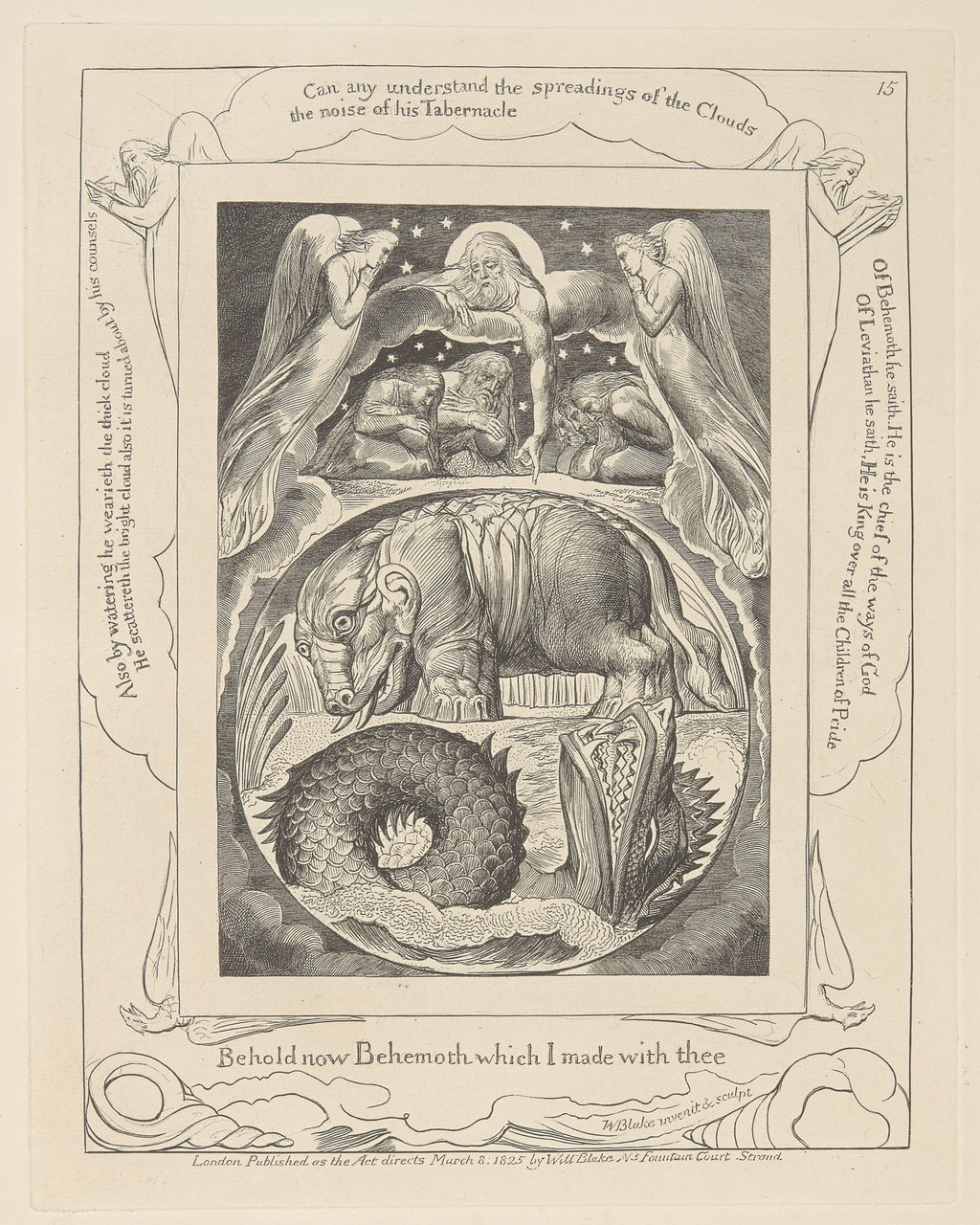
Behemoth and Leviathan. Yale Center for British Art, B1978.43.1517, identified impression dated 1826. The engraved 1825 publication line is a separate date.
Annotated Details from Behemoth and Leviathan: Two Creatures in One Globe
These details show the Yale Center for British Art’s 1826 impression, B1978.43.1517. Follow the pointing hand down to the two creatures, then compare their bodies and engraved textures.
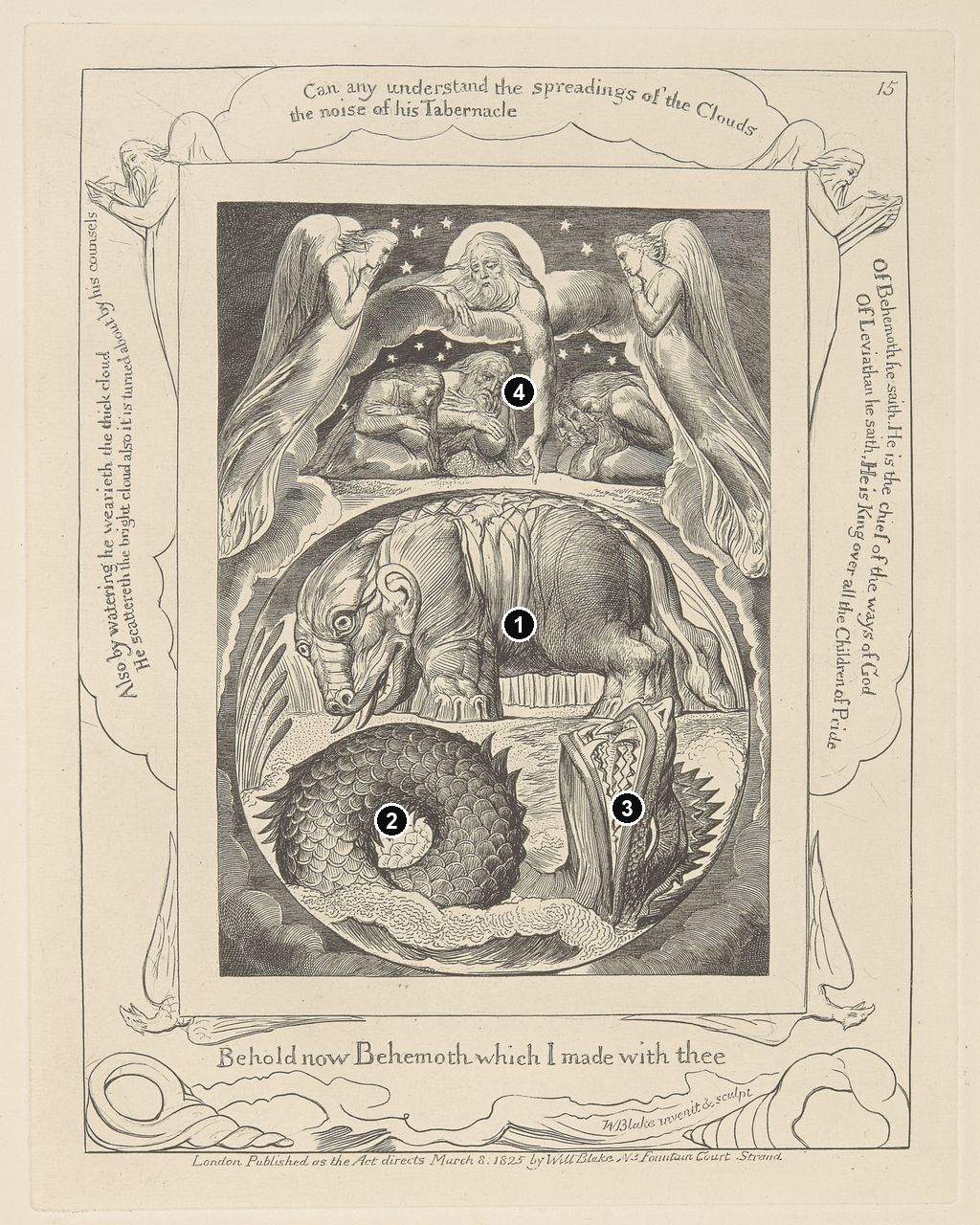
Details from BEHEMOTH AND LEVIATHAN: TWO CREATURES IN ONE GLOBE
The details retain the original engraved lines and paper tone of this impression.
The land creature
A broad animal fills the upper part of the circular opening. Its sturdy legs and rounded body stand above the tightly coiled creature below.
Coils and scales
Rows of small scales follow the twisting lower body. Repeated curves make the coil feel compressed within the circular boundary.
The open jaws
The lower creature opens its jaws at the right. Teeth, curling forms and dark engraved strokes sharpen the contrast with the heavier animal above.
The pointing hand
The figure above points down towards the creatures. The hand connects the upper group of figures with the circular world beneath them.
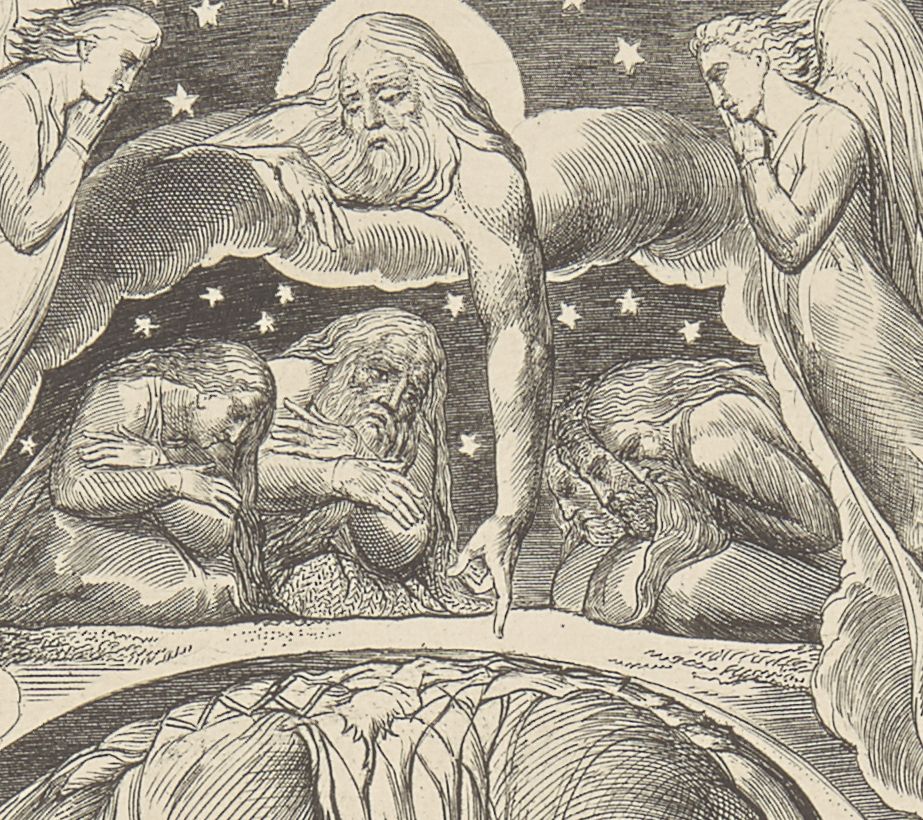
Image: Yale Center for British Art, B1978.43.1517. Numbered overview and detail crops from the collection’s original image. Collection record · CC0 1.0
Why God shows Job the creatures
Behemoth and Leviathan arrive late in the biblical divine address. God has already questioned Job about the earth’s foundations, the limits of the sea, the stars and the coming of daylight. Rain falls in wilderness where nobody lives. Wild animals bear their young, range beyond the city and refuse the work people might want them to do. Creation extends beyond human knowledge and usefulness long before the two enormous creatures appear. [2]
That context makes the engraving more than a display of frightening animals. The globe gathers forms of life whose existence has its own dimensions, appetites and powers. Job can look at them, but he cannot reduce them to the scale of his household or the terms of his dispute. Blake places him outside their enclosure, receiving a view of a world in which human concerns no longer fill the whole field. [1] [2]
Chapter 40 also gives the address an explicitly moral pressure. Before describing Behemoth, God asks whether Job can abase the proud, bring down the wicked and save himself by his own right hand. Leviathan’s description ends with its kingship over the children of pride. These passages connect overwhelming physical strength with questions of judgement and mastery. The scene asks who can comprehend and govern such powers, as well as who can survive them. [2]
Job’s response begins before the animals are described. At the opening of chapter 40 he falls silent and places his hand upon his mouth. After the divine speeches, in chapter 42, he acknowledges having spoken about things beyond his understanding and distinguishes his earlier hearing from his present seeing. Blake’s bowed witnesses give a bodily form to this altered relationship with knowledge. They are being brought into an experience that their previous argument could not provide. [2]
This change does not vindicate every accusation made against Job. The same final chapter rebukes the friends for speaking wrongly about God and asks for Job’s intercession on their behalf. Humility before creation and condemnation of the sufferer are different judgements within the biblical story. Keeping them distinct preserves the force of Blake’s scene: an expansion of vision can answer human certainty without making cruelty wise. [2]
Watch: William Blake’s world and working methods
Choose an introduction to Blake, a printing demonstration, or a discussion of his radical ideas.
William Blake: Poet, Artist & Visionary - a genius of early Romanticism in England
An introduction to Blake’s art, poetry and imaginative world.
Watch on YouTubeClouds around the argument
The right margin names both creatures through their biblical distinctions: Behemoth’s pre-eminence among God’s works and Leviathan’s rule over pride. The other inscriptions move towards weather. Above the central picture, words about the spreading clouds and the sound of God’s tabernacle occupy an outlined bank of cloud. Down the left, further words describe thick and bright clouds moving under divine counsel. [1] [2]
Those weather passages come from Elihu’s speech in Job 36 and 37, before God answers from the whirlwind. The top inscription corresponds to Job 36:29; the left combines wording from 37:11–12. Blake brings them beside the creatures described later, joining different stages of the biblical address on one printed page. Clouds become an environment for the vision and a subject of questioning in their own right. [2]
There is a striking difference between the cloud held by the divine figure and the clouds drawn around the writing. In the central scene, dense shading gives the great horizontal form a rounded weight. Outside it, a few slender lines leave most of the paper open. Two lightly drawn human figures bend around the upper corners, while elongated bodies descend along the sides. The border has its own inhabitants and motions, inviting the eye to move between the compact vision and its surrounding words. [1]
Penelope Minney gives the cloud passages particular importance in her study of Blake’s Job illustrations. She reads darkness and cloud as conditions of divine vision, and the great creatures as necessary counterparts within creation. Her argument directs attention to the source of what Job sees: the darkness surrounding the revelation need not make it false or empty. The monsters remain within the vision he has been given. [13]
Nature, war and the globe
Other readings place greater emphasis on the enclosure beneath the witnesses. Martin Butlin’s Tate catalogue reports Bo Lindberg’s interpretation of the globe as Hell and of its rounded form as a challenge to scientific cosmology. Tate’s later display label also presents a reading in which the beasts express the hopelessness of material nature and expose limitations in Job’s faith. These arguments give the globe a spiritual meaning extending beyond its visible division into land and sea. [1]
The separation between the observers and the globe gives such arguments a concrete starting point. The witnesses occupy a starry region above the bounded land and sea. Yet the principal inscription simultaneously insists on a common maker for Job and Behemoth. The image therefore holds separation and relationship together. Its geometry can suggest the limits of material existence while its words require the viewer to consider the beasts as fellow creatures. [1] [2]
Blake uses their names differently and explicitly in Jerusalem, plate 91. There, the Spectre constructs vast structures from the heavens and forms Leviathan and Behemoth as war by sea and land. The passage belongs to a struggle involving Los, demonstration, pride and the transformation of the Spectre. It confirms that the monsters could carry a political and destructive meaning in Blake’s imagination. It also provides a distinct literary setting, with its own actors and actions. [14]
Tate connects that war imagery with Blake’s separate pictures of Nelson and Pitt. The association adds a history of national power to the monsters’ possible meanings. In the Job engraving, the biblical act of showing the creatures remains decisive. The pointed finger, the enclosed habitats and the attentive witnesses give the page a structure that cannot be replaced by a pair of symbolic definitions. [1] [2]
A design and its printed impressions
The engraving bears the number 15 at the upper right and a publication formula dated 8 March 1825 below the image. Tate’s shared catalogue distinguishes that inscribed date from the completed suite’s availability in March 1826. Linnell had commissioned a second watercolour set in 1821, before making the engraving agreement in 1823. The printed suite eventually comprised twenty-one numbered illustrations and a title plate. These related undertakings have different media and histories; the engraved border belongs to this printed page’s argument. The broader sequence is explored in Illustrations of the Book of Job. [1]
Tate’s particular sheet, A00026, is catalogued as a line engraving on paper, dated 1825 and reprinted in 1874. Butlin identifies Tate’s set as apparently belonging to the later printing made under Linnell. The Yale Center for British Art holds a separately identified impression, B1978.43.1517, dated 1826 in its official digital record. Both preserve this composition; their individual printing histories remain separate. [1] [15]
Following the lines across the creatures reveals why the medium matters. Behemoth’s flank turns through long curves; Leviathan’s coil turns through repeated scales. The jaws open through a narrow pattern of teeth, while the human witnesses fold their arms and bodies above. Enormous powers and small gestures become legible through the same engraved discipline. The divine finger brings them into one encounter, asking Job—and the viewer—to attend to a creation whose detail exceeds a quick judgement. [1] [2]
Works and designs directory
Browse separate works, impressions and book components. Dates distinguish versions; six Tate copies after Blake are labelled. These records are not a complete catalogue of unique designs.
| Name | Date | Medium |
|---|---|---|
| A Figure Standing in a Gothic Apse, perhaps the Empress Maud. Verso: Detailed Drawings for ‘The Empress Maud in Bed’ | c.1819 | Pencil drawing |
| A Rolling Stone Is Ever Bare of Moss, from Thornton's "Pastorals of Virgil" | 1821 | Wood engraving |
| A Title Page for The Grave | 1806 | Watercolour |
| A Vision of the Last Judgment | 1808 | Watercolour |
| A Vision: The Inspiration of the Poet (Elisha in the Chamber on the Wall) | c.1819–20? | Watercolour |
| Adam and the Beasts, Frontispiece to Hayley's "Ballads" | June 1, 1802 | Engraving |
| Age Teaching Youth | c.1785–90 | Watercolour |
| Alfred and the Neat-Herd’s Wife (after Henry Fuseli) | 1797, published 1798 | Etching and engraving |
| An Allegory of the Bible. Verso: The Shins of an Écorché Male Figure | c.1780–5, ?c.1780 | Watercolour |
| Angel of the Divine Presence Bringing Eve to Adam (The Creation of Eve: "And She Shall be Called Woman) (recto); Sketch for the same (verso) | ca. 1803 | Watercolour |
| Angel of the Revelation (Book of Revelation, chapter 10) | ca. 1803–5 | Watercolour |
| Antaeus setting down Dante and Virgil in the Last Circle of Hell | 1824–1827 | Watercolour |
| Bathsheba at the Bath | c.1799–1800 | Tempera |
| Beatrice Addressing Dante from the Car | 1824–7 | Watercolour |
| Behemoth and Leviathan | 1825–26 | Engraving |
| Behemoth and Leviathan | 1825, reprinted 1874 | Engraving |
| Behemoth and Leviathan | 1826 | Engraving |
| Blasted Trees and Flattened Crops, from Thornton's "Pastorals of Virgil" | 1821 | Wood engraving |
| Boy Returning Joyfully, with Plough and Oxen, from Thornton's "Pastorals of Virgil" | 1821 | Wood engraving |
| Boy Returning Joyfully, with Plough and Oxen, from Thornton's "Pastorals of Virgil" | 1821 | Wood engraving |
| Catherine Blake. Verso: A Man’s Head and Other Drawings | c.1805 | Pencil drawing |
| Cerberus | 1824–7 | Watercolour |
| Cerberus (second version) | 1824–1827 | Watercolour |
| Chaucer’s Canterbury Pilgrims | 1810, reprinted before 1881 | Engraving |
| Christ Appearing to His Disciples After the Resurrection | c.1795 | Colour print |
| Christ Appearing to the Apostles after the Resurrection | c.1795 | Watercolour |
| Christ Blessing the Little Children | 1799 | Tempera |
| Christ in the Carpenter’s Shop: The Humility of the Saviour (after William Blake) | Date not stated | Watercolour |
| Ciampolo the Barrator Tormented by the Devils | 1826–7, reprinted 1892 | Engraving |
| Ciampolo the Barrator Tormented by the Devils | 1826–7, reprinted 1968 | Engraving |
| Circle of Theives: Agnello Brunelleschi Attacked By a Six-Footed Serpent | ca. 1825–27 | Engraving |
| Clarence's Dream (Shakespeare, Richard III, Act 1, Scene 4) | 1774 | Etching and engraving |
| Colinet Mocked by Two Boys, from Thornton's "Pastorals of Virgil" | 1821 | Wood engraving |
| Colinet Rests by a Stream at Night | c.1821, printed 1830 | Wood engraving |
| Colinet Rests by a Stream at Night | 1821, reprinted 1977 | Wood engraving |
| Colinet with his Shepherd’s Pipe, Mocked by Two Boys | c.1821, printed 1830 | Wood engraving |
| Colinet with his Shepherd’s Pipe, Mocked by Two Boys | 1821, reprinted 1977 | Wood engraving |
| Colinet's Journey, Milestone Marked 'LXII Miles to London', from Thornton's "Pastorals of Virgil" | 1821 | Wood engraving |
| Colinet's Journey: Milestone Marked 'LXII Miles to London', from Thornton's "Pastorals of Virgil" | 1821 | Wood engraving |
| Colinet’s Fond Desire Strange Lands to Know | 1821, reprinted 1977 | Wood engraving |
| Colinet’s ‘Fond Desire Strange Lands to Know’ | c.1821, printed 1830 | Wood engraving |
| Composition Sketch for ‘The Fall of the Rebel Angels’? Verso: Standing Figure with Flaming Hair | ?c.1805–10 | Pencil drawing |
| Composition Sketch, Possibly a Subject from Dante. Verso: A Man Standing over a Figure Reclining on a Bed | ?1824–7, ?c.1800–10 | Pencil drawing |
| Composition Sketch. Verso: Standing Figure Holding a Spear | ?c.1805–10 | Pencil drawing |
| Dante and Virgil Approaching the Angel Who Guards the Entrance of Purgatory | 1824–7 | Watercolour |
| Dante and Virgil Penetrating the Forest | 1824–7 | Watercolour |
| Dante in the Empyrean, Drinking at the River of Light | 1824–7 | Watercolour |
| Dante running from the Three Beasts | 1824–1827 | Watercolour |
| Dante Striking against Bocca Degli Abati | 1826–7, reprinted 1892 | Engraving |
| Dante Striking Against Bocca degli Abati | 1826–7, reprinted 1968 | Engraving |
| David Delivered out of Many Waters | c.1805 | Watercolour |
| David Delivered out of Many Waters (after William Blake) | Date not stated | Watercolour |
| Detailed Drawings for ‘A Figure Standing in a Gothic Apse’ | 1819 | Pencil drawing |
| Elohim Creating Adam | 1795–c.1805 | Colour print |
| Enoch | 1806–7 | Lithograph |
| Epitome of James Hervey’s ‘Meditations among the Tombs’ | c.1820–5 | Watercolour |
| Europe. A Prophecy; Frontispiece | ca. 1820 | Relief etching |
| Evening | c.1820/1825 | Watercolour |
| Every Man also Gave him a Piece of Money | 1825, reprinted 1874 | Engraving |
| Every Man also Gave him a Piece of Money. Verso: God the Father with Attendant Angels | c.1821–3 | Watercolour |
| Every One also Gave Him a Piece of Money | 1826 | Engraving |
| Fertilization of Egypt, from Erasmus Darwin's "The Botanic Garden" | 1791 | Engraving |
| First Book of Urizen pl. 10 | 1796, c.1818 | Etching |
| First Book of Urizen pl. 11 | 1796, c.1818 | Etching |
| First Book of Urizen pl. 15 | 1796, c.1818 | Etching |
| First Book of Urizen pl. 17 | 1796, c.1818 | Etching |
| First Book of Urizen pl. 21 | 1796, c.1818 | Etching |
| First Book of Urizen pl. 6 | 1796, c.1818 | Etching |
| Frontispiece to Jerusalem, the Emanation of the Great Albion | [ca. 1804–20] (?) | Engraving |
| Frontispiece to ‘Visions of the Daughters of Albion’ | c.1795 | Relief etching |
| Frontispiece: Thenot and Colinet | c.1821, printed 1830 | Wood engraving |
| George Cumberland's Message Card | 1827 | Engraving |
| God Judging Adam | ca. 1795 | Relief etching |
| God Judging Adam | 1795 | Relief etching |
| Hiding of Moses, from "Remember Me!, or a Pocket Companion" | 1825 | Engraving |
| Homer and the Ancient Poets | 1824–7 | Watercolour |
| Illustration 1 to Milton’s On the Morning of Christ’s Nativity: The Descent of Peace | c.1814–1816 | Watercolour |
| Illustration 1 to Milton’s Paradise Lost: Satan Calling Up His Legions | 1807 | Watercolour |
| Job accepting Charity | 1825–26 | Engraving |
| Job and his Daughters | 1825–26 | Engraving |
| Job and his Daughters | 1825, reprinted 1874 | Engraving |
| Job and His Daughters | 1826 | Engraving |
| Job and His Family | 1825–26 | Engraving |
| Job and his Family | Reprinted 1874; engraved 1828 date is an error | Engraving |
| Job and His Family | 1826 | Engraving |
| Job and his Family Restored to Prosperity | 1825, reprinted 1874 | Engraving |
| Job and his Wife restored to Prosperity | 1825–26 | Engraving |
| Job rebuked by his Friends | 1825–26 | Engraving |
| Job Rebuked by his Friends | 1825, reprinted 1874 | Engraving |
| Job Rebuked by His Friends | 1826 | Engraving |
| Job's Comforters | 1825–26 | Engraving |
| Job's Comforters | 1826 | Engraving |
| Job's Despair | 1825–26 | Engraving |
| Job's Evil Dreams | 1825–26 | Engraving |
| Job's Evil Dreams | 1826 | Engraving |
| Job's Sacrifice | 1825–26 | Engraving |
| Job's Sons and Daughters Overwhelmed by Satan | 1826 | Engraving |
| Job, his Wife and his Friends: The Complaint of Job. Verso: Job’s Wife and Eight Other Sketches | c.1785 | Watercolour |
| Job’s Comforters | 1825, reprinted 1874 | Engraving |
| Job’s Despair | 1825, reprinted 1874 | Engraving |
| Job’s Evil Dreams | 1825, reprinted 1874 | Engraving |
| Job’s Sacrifice | 1825, reprinted 1874 | Engraving |
| Job’s Sons and Daughters Overwhelmed by Satan | 1825, reprinted 1874 | Engraving |
| John Linnell | 1825 | Pencil drawing |
| Joseph of Arimathea Preaching to the Britons | c.1794/1796 | Relief etching |
| Judas Betrays Him | c.1803–5 | Watercolour |
| King John Absolved by Pandulph (after Henry Fuseli) | 1797, published 1798 | Etching and engraving |
| Lamech and his Two Wives | 1795 | Colour print |
| Landscape near Felpham | c.1800 | Watercolour |
| Lear and Cordelia in Prison | c.1779 | Watercolour |
| Los and Orc | c.1792–3 | Watercolour |
| Lower Half of a Woman Playing a Harp. Verso: Seraphim and Other Drawings | c.1785, c.?1807 | Pencil drawing |
| Menalcus Watching Women Dance, from Thornton's "Pastorals of Virgil" | 1821 | Wood engraving |
| Menalcus Watching Women Dance, from Thornton's "Pastorals of Virgil" | 1821 | Wood engraving |
| Moses Indignant at the Golden Calf | c.1799–1800 | Tempera |
| Nebuchadnezzar | 1795–c.1805 | Colour print |
| Newton | 1795–c.1805 | Colour print |
| Oberon, Titania and Puck with Fairies Dancing | c.1786 | Watercolour |
| Pity | ca. 1795 | Relief etching |
| Pity | c.1795 | Colour print |
| Plate 2 of ‘Urizen’: ‘Teach these Souls to Fly’ | ?1796 | Relief etching |
| Plate 3 of ‘Urizen’: Oh! Flames of Furious Desires’ (after William Blake) | Date not stated | Watercolour |
| Plate 4 of ‘Visions of the Daughters of Albion’ | c.1795 | Relief etching |
| Plutus | 1824–7 | Watercolour |
| Preliminary Sketch for ‘Christ Girding Himself with Strength’. Verso: Standing Figure with One Arm Raised | c.1805, c.1805–10 | Pencil drawing |
| Preludium. "The shadowy daughter of Urthona stood before red Orc..." (Plate 3) | 1793 | Relief etching |
| Queen Elizabeth and Essex (after Henry Fuseli) | 1797, published 1798 | Engraving |
| Sabrina's Silvery Flood, from Thornton's "Pastorals of Virgil" | 1821 | Wood engraving |
| Sabrina's Silvery Flood, from Thornton's "Pastorals of Virgil" | 1821 | Wood engraving |
| Sabrina’s Silvery Flood | c.1821, printed 1830 | Wood engraving |
| Sabrina’s Silvery Flood | 1821, reprinted 1977 | Wood engraving |
| Satan Before the Throne of God | 1825–26 | Engraving |
| Satan before the Throne of God | 1825, reprinted 1874 | Engraving |
| Satan before the Throne of God | 1826 | Engraving |
| Satan calling up his Legions | c.1800–05 | Tempera |
| Satan Exulting over Eve | c.1795 | Colour print |
| Satan Going Forth from the Presence of the Lord, and Job’s Charity | 1825, reprinted 1874 | Engraving |
| Satan Going Forth fron the Presence of the Lord | 1825–26 | Engraving |
| Satan in his Original Glory: ‘Thou wast Perfect till Iniquity was Found in Thee’ | c.1805 | Watercolour |
| Satan Smiting Job with Boils | 1825–26 | Engraving |
| Satan Smiting Job with Sore Boils | 1825, reprinted 1874 | Engraving |
| Satan Smiting Job with Sore Boils | c.1826 | Tempera |
| Satan Smiting Job with Sore Boils | 1826 | Engraving |
| Shepherd Chases Away a Wolf, from Thornton's "Pastorals of Virgil" | 1821 | Wood engraving |
| Shepherd Chases Away a Wolf, from Thornton's "Pastorals of Virgil" | 1821 | Wood engraving |
| Sketch for the Title-Page of the Engraved Illustrations to the Book of Job | c.1823/1826 | Pencil drawing |
| Sketch for ‘The Four and Twenty Elders Casting their Crowns before the Divine Throne’. Verso: Standing Figure with Arms at his Side | c.1803, c.1805–10 | Pencil drawing |
| Sketch for ‘Tiriel Supporting the Dying Myratana’. Verso: Sketch for ‘Tiriel Supporting the Dying Myratana’ | c.1786–9 | Pencil drawing |
| Songs of Experience: A Little Boy Lost | [1794] printed ca. 1825 | Relief etching |
| Songs of Experience: A Little Girl Lost | [1794] printed ca. 1825 | Relief etching |
| Songs of Experience: A Poison Tree | [1794] printed ca. 1825 | Relief etching |
| Songs of Experience: Earth's Answer | [1794] printed ca. 1825 | Relief etching |
| Songs of Experience: Frontispiece | [1794] printed ca. 1825 | Relief etching |
| Songs of Experience: Holy Thursday | [1794] printed ca. 1825 | Relief etching |
| Songs of Experience: Infant Sorrow | [1794] printed ca. 1825 | Relief etching |
| Songs of Experience: Introduction | [1794] printed ca. 1825 | Relief etching |
| Songs of Experience: London | [1794] printed ca. 1825 | Relief etching |
| Songs of Experience: My Pretty Rose Tree, Ah! Sun-Flower, The Lilly | [1794] printed ca. 1825 | Relief etching |
| Songs of Experience: Nurses Song | [1794] printed ca. 1825 | Relief etching |
| Songs of Experience: The Angel | [1794] printed ca. 1825 | Relief etching |
| Songs of Experience: The Chimney Sweeper | [1794] printed ca. 1825 | Relief etching |
| Songs of Experience: The Clod & the Pebble | [1794] printed ca. 1825 | Relief etching |
| Songs of Experience: The Fly | [1794] printed ca. 1825 | Relief etching |
| Songs of Experience: The Garden of Love | [1794] printed ca. 1825 | Relief etching |
| Songs of Experience: The Human Abstract | [1794] printed ca. 1825 | Relief etching |
| Songs of Experience: The Little Girl Found (second plate) | [1789] printed ca. 1825 | Relief etching |
| Songs of Experience: The Little Girl Lost | [1789] printed ca. 1825 | Relief etching |
| Songs of Experience: The Little Girl Lost (second plate); The Little Girl Found | [1789] printed ca. 1825 | Relief etching |
| Songs of Experience: The Little Vagabond | [1794] printed ca. 1825 | Relief etching |
| Songs of Experience: The School Boy | [1789] printed ca. 1825 | Relief etching |
| Songs of Experience: The Sick Rose | [1794] printed ca. 1825 | Relief etching |
| Songs of Experience: The Tyger | [1794] printed ca. 1825 | Relief etching |
| Songs of Experience: The Voice of the Ancient Bard | [1789] printed ca. 1825 | Relief etching |
| Songs of Experience: Title-page | [1794] printed ca. 1825 | Relief etching |
| Songs of Experience: To Tirzah | [1794] printed ca. 1825 | Relief etching |
| Songs of Innocence and of Experience, Shewing the Two Contrary States of the Human Soul: Combined Title-page | [1789–94] printed ca. 1825 | Relief etching |
| Songs of Innocence and of Experience: Infant Sorrow | 1794, reprinted 1831 or later | Relief etching |
| Songs of Innocence: A Cradle Song | [1789] printed ca. 1825 | Relief etching |
| Songs of Innocence: A Cradle Song (second plate) | [1789] printed ca. 1825 | Relief etching |
| Songs of Innocence: A Dream | [1794] printed ca. 1825 | Relief etching |
| Songs of Innocence: Frontispiece | [1789] printed ca. 1825 | Relief etching |
| Songs of Innocence: Holy Thursday | [1789] printed ca. 1825 | Relief etching |
| Songs of Innocence: Infant Joy | [1789] printed ca. 1825 | Relief etching |
| Songs of Innocence: Introduction | [1789] printed ca. 1825 | Relief etching |
| Songs of Innocence: Laughing Song | [1789] printed ca. 1825 | Relief etching |
| Songs of Innocence: Little Boy Lost | [1789] printed ca. 1825 | Relief etching |
| Songs of Innocence: Night | [1789] printed ca. 1825 | Relief etching |
| Songs of Innocence: Night (second plate) | [1789] printed ca. 1825 | Relief etching |
| Songs of Innocence: Nurse's Song | [1789] printed ca. 1825 | Relief etching |
| Songs of Innocence: On Anothers Sorrow | [1789] printed ca. 1825 | Relief etching |
| Songs of Innocence: Spring | [1789] printed ca. 1825 | Relief etching |
| Songs of Innocence: Spring (second plate) | [1789] printed ca. 1825 | Relief etching |
| Songs of Innocence: The Blossom | [1789] printed ca. 1825 | Relief etching |
| Songs of Innocence: The Chimney Sweeper | [1789] printed ca. 1825 | Relief etching |
| Songs of Innocence: The Divine Image | [1789] printed ca. 1825 | Relief etching |
| Songs of Innocence: The Ecchoing Green | [1789] printed ca. 1825 | Relief etching |
| Songs of Innocence: The Ecchoing Green (second plate) | [1789] printed ca. 1825 | Relief etching |
| Songs of Innocence: The Lamb | [1789] printed ca. 1825 | Relief etching |
| Songs of Innocence: The Little Black Boy | [1789] printed ca. 1825 | Relief etching |
| Songs of Innocence: The Little Black Boy (second plate) | [1789] printed ca. 1825 | Relief etching |
| Songs of Innocence: The Little Boy Found | [1789] printed ca. 1825 | Relief etching |
| Songs of Innocence: The Shepherd | [1789] printed ca. 1825 | Relief etching |
| Songs of Innocence: Title Page | [1789] printed ca. 1825 | Relief etching |
| St Christopher, Copy from an Engraving? Verso:Part of a Face: Copy from a Plaster Cast: a Daughter of Niobe? | ?c.1779–80 | Pencil drawing |
| The Agony in the Garden | c.1799–1800 | Tempera |
| The Angel Appearing to Zacharias | 1799–1800 | Tempera |
| The Ascent of the Mountain of Purgatory | 1824–7 | Watercolour |
| The Baffled Devils Fighting | 1826–7, reprinted 1892 | Engraving |
| The Baffled Devils Fighting | 1826–7, reprinted 1968 | Engraving |
| The Bard, from Gray | ?1809 | Tempera |
| The Beggar's Opera, Act III | July 1, 1790 | Etching and engraving |
| The Beggar's Opera, Act III | July 1, 1790 | Engraving |
| The Beggar's Opera, Act III | 1790 | Engraving |
| The Blasphemer | c.1800 | Watercolour |
| The Blighted Corn | c.1821, printed 1830 | Wood engraving |
| The Blighted Corn | 1821, reprinted 1977 | Wood engraving |
| The Body of Abel Found by Adam and Eve | c.1826 | Tempera |
| The Body of Christ Borne to the Tomb | c.1799–1800 | Tempera |
| The Book of Job: Title Page | 1825 | Engraving |
| The Book of Thel pl. 6 | 1796, c.1818 | Etching |
| The Circle of Corrupt Officials: The Devils Mauling Each Other | ca. 1825–27 | Engraving |
| The Circle of Corrupt Officials: The Devils Tormenting Ciampolo | ca. 1825–27 | Engraving |
| The Circle of the Lustful: Francesca da Rimini (‘The Whirlwind of Lovers’) | 1826–7, reprinted 1892 | Engraving |
| The Circle of the Lustful: Francesca da Rimini (‘The Whirlwind of Lovers’) | 1826–7, reprinted 1968 | Engraving |
| The Circle of the Lustful: Paolo and Francesca | ca. 1825–27 | Engraving |
| The Circle of the Thieves; Buoso Donati Attacked by the Serpent | ca. 1825–27 | Engraving |
| The Circle of Traitors: Dante's Foot Striking Bocca degli Abbate | ca. 1825–27 | Engraving |
| The Complaint and the Consolation; or, Night Thoughts | 1797 | Etching and engraving |
| The Creation | 1825–26 | Engraving |
| The Crucifixion | c.1825–7 | Pencil drawing |
| The Crucifixion: ‘Behold Thy Mother’ | c.1805 | Watercolour |
| The Dance of Albion (Glad Day) | c.1803/1810 | Engraving |
| The Death of Lucretia, from Allen's "New and Impartial Roman History" | 1797 | Engraving |
| The Death of Saint Joseph | 1803 | Watercolour |
| The Death of the Virgin | 1803 | Watercolour |
| The Descent of Peace [recto] | c.1815 | Pencil drawing |
| The Destruction of Job's Sons | 1825–26 | Engraving |
| The Devils, with Dante and Virgil by the Side of the Pool | 1824–7 | Watercolour |
| The Entombment | c.1805 | Watercolour |
| The Fall of Rosamond (after Thomas Stothard) | 1783 | Etching and engraving |
| The Fall of Satan | 1825–26 | Engraving |
| The Fall of Satan | 1825, reprinted 1874 | Engraving |
| The Fall of Satan | 1826 | Engraving |
| The Four and Twenty Elders Casting their Crowns before the Divine Throne | c.1803–5 | Watercolour |
| The Ghost of a Flea | c.1819–20 | Tempera |
| The Good and Evil Angels | 1795–?c.1805 | Colour print |
| The Good Farmer, Probably the Parable of the Wheat and the Tares. Verso: Rough Sketch of Two or Three Figures in a Landscape | c.1780–5 | Watercolour |
| The Great Red Dragon and the Beast from the Sea | c.1805 | Watercolour |
| The Great Red Dragon and the Woman Clothed with the Sun | c.1805 | Watercolour |
| The Head of the Ghost of a Flea. Verso: A Profile and a Reduced Drawing of Milton’s First Wife | c.1819 | Pencil drawing |
| The Hermit’s Dog, from William Hayley’s "Ballads" | 1805 | Etching and engraving |
| The Hiding of Moses | 1824 | Engraving |
| The House of Death | 1795–c.1805 | Colour print |
| The House of Death | c.1790 | Watercolour |
| The Hypocrites with Caiaphas. Verso: Sketch of a Stooping Figure | 1824–7 | Watercolour |
| The Inscription over the Gate | 1824–7 | Watercolour |
| The Laborious Passage along the Rocks | 1824–7 | Watercolour |
| The Last Trumpet (recto); Two studies of a right eye, a profile of an open-mouthed young man, the head of an eagle, and the head of a lion (verso) | 1780–85 | Pencil drawing |
| The Lord Answering Job out of the Whirlwind | 1825–26 | Engraving |
| The Lord Answering Job out of the Whirlwind | 1825, reprinted 1874 | Engraving |
| The Man Who Taught Blake Painting in his Dreams (counterproof) (after William Blake) | after c.1819–20 | Pencil drawing |
| The Marriage of Heaven and Hell pl. 16 | 1796, c.1818 | Etching |
| The Messengers tell Job of his Misfortunes | 1825–26 | Engraving |
| The Messengers tell Job of his Misfortunes | 1825, reprinted 1874 | Engraving |
| The Night of Enitharmon’s Joy (formerly called ‘Hecate’) | c.1795 | Colour print |
| The Parable of the Wise and Foolish Virgins | ca. 1799–1800 | Watercolour |
| The Parable of the Wise and Foolish Virgins (after William Blake) | Date not stated | Watercolour |
| The Pastorals of Virgil, with a Course of English Reading, Adapted for Schools, Vol. I | 1821 | Wood engraving |
| The Penance of Jane Shore in St Paul’s Church | c.1793 | Watercolour |
| The Pit of Disease: The Falsifiers | 1826–7, reprinted 1892 | Engraving |
| The Pit of Disease: The Falsifiers | 1824–7 | Watercolour |
| The Pit of Disease: The Falsifiers | 1826–7, reprinted 1968 | Engraving |
| The Primaeval Giants Sunk in the Soil | 1824–7 | Watercolour |
| The Punishment of the Thieves | 1824–7 | Watercolour |
| The Raising of Lazarus (after William Blake) | Date not stated | Watercolour |
| The Rest on the Flight into Egypt (The Repose of the Holy Family in Egypt) | 1806 | Watercolour |
| The River of Life | c.1805 | Watercolour |
| The Rock Sculptured with the Recovery of the Ark and the Annunciation | 1824–7 | Watercolour |
| The Serpent Attacking Buoso Donati | 1826–7, reprinted 1892 | Engraving |
| The Serpent Attacking Buoso Donati | 1826–7, reprinted 1968 | Engraving |
| The Serpent Attacking Buoso Donati. Verso: A Man with a Transparent Hood (?) over his Head | 1824–7 | Watercolour |
| The Simoniac Pope | 1824–7 | Watercolour |
| The Six-Footed Serpent Attacking Agnolo Brunelleschi | 1826–7, reprinted 1892 | Engraving |
| The Six-Footed Serpent Attacking Agnolo Brunelleschi | 1826–7, reprinted 1968 | Engraving |
| The Soul Hovering over the Body Reluctantly Parting with Life | c.1805 | Pencil drawing |
| The Spiritual Form of Nelson Guiding Leviathan | c.1805–9 | Tempera |
| The Spiritual Form of Pitt Guiding Behemoth | ?1805 | Tempera |
| The Sun at His Eastern Gate | c.1816–1820 | Watercolour |
| The Temple of Mirth, after Thomas Stothard | 1784 | Engraving |
| The Temptation and Fall of Eve | 1807 | Watercolour |
| The Temptation and Fall of Eve (Illustration to Milton’s Paradise Lost) | 1808 | Watercolour |
| The Thieves and Serpents | 1824–1827 | Watercolour |
| The Vision of Christ | 1825, reprinted 1874 | Engraving |
| The Vision of Eliphaz | 1825–26 | Engraving |
| The Vision of Eliphaz | 1825, reprinted 1874 | Engraving |
| The Vision of God | 1825–26 | Engraving |
| The Wood of the Self-Murderers: The Harpies and the Suicides | 1824–7 | Watercolour |
| The Wrath of Elihu | 1825–26 | Engraving |
| The Wrath of Elihu | 1825, reprinted 1874 | Engraving |
| Thenot and Colinet | 1821, reprinted 1977 | Wood engraving |
| Thenot and Colinet at Supper | c.1821, printed 1830 | Wood engraving |
| Thenot and Colinet at Supper | 1821, reprinted 1977 | Wood engraving |
| Thenot and Colinet Converse Seated between Two Trees | c.1821, printed 1830 | Wood engraving |
| Thenot and Colinet Converse Seated between Two Trees | 1821, reprinted 1977 | Wood engraving |
| Thenot and Colinet Eat Their Evening Meal, from Thornton's "Pastorals of Virgil" | 1821 | Wood engraving |
| Thenot and Colinet Folding their Flocks together at Sunset | c.1821, printed 1830 | Wood engraving |
| Thenot and Colinet Folding their Flocks together at Sunset | 1821, reprinted 1977 | Wood engraving |
| Thenot and Colinet Lead Their Flocks Together, from Thornton's "Pastorals of Virgil" | 1821 | Wood engraving |
| Thenot and Colinet Lead Their Flocks Together, from Thornton's "Pastorals of Virgil" | 1821 | Wood engraving |
| Thenot Remonstrates with Colinet | c.1821, printed 1830 | Wood engraving |
| Thenot Remonstrates with Colinet | 1821, reprinted 1977 | Wood engraving |
| Thenot Remonstrates With Colinet, from Thornton's "Pastorals of Virgil" | 1821 | Wood engraving |
| Thenot Remonstrates With Colinet, from Thornton's "Pastorals of Virgil" | 1821 | Wood engraving |
| Thenot Remonstrates with Colinet, Lightfoot in the Background, from Thornton's "Pastorals of Virgil" | 1821 | Wood engraving |
| Thenot Remonstrates with Colinet: Lightfoot in the Distance | 1821, reprinted 1977 | Wood engraving |
| Thenot Remonstrates with Colinet; Lightfoot in the Distance | c.1821, printed 1830 | Wood engraving |
| Thenot Under a Fruit Tree, from Thornton's "Pastorals of Virgil" | 1821 | Wood engraving |
| Thenot, with Colinet Waving his Arms in Sorrow | c.1821, printed 1830 | Wood engraving |
| Thenot, with Colinet Waving his Arms in Sorrow | 1821, reprinted 1977 | Wood engraving |
| Title Page: Illustrations of the Book of Job | 1825–26 | Engraving |
| Title-Page of ‘The Book of Job’ | 1825, reprinted 1874 | Engraving |
| Tornado–Zeus Battling Typhon, from Erasmus Darwin's "Botanic Garden" | August 1, 1795 | Engraving |
| Tornado–Zeus Battling Typhon, from Erasmus Darwin's "The Botanic Garden" | August 1, 1795 | Engraving |
| Two Figures in a Decorative Border | c.1790 | Pencil drawing |
| Unyok'd Heifers, Loitering Homeward (Return of the Shepherd), from Thornton's "Pastorals of Virgil" | 1821 | Wood engraving |
| Virgil Girding Dante’s Brow with a Rush | 1824–7 | Watercolour |
| Wat Tyler and the Tax-Gatherer (after Henry Fuseli) | 1797, published 1798 | Etching and engraving |
| When the Morning Stars Sang Together | 1825, reprinted 1874 | Engraving |
| When the Morning Stars Sang Together | 1826 | Engraving |
| Winged Figure Flying Through Clouds, from Bell's "Poets" | 1790 | Etching and engraving |
| Winter | c.1820–5 | Tempera |
| ‘A Rolling Stone is ever Bare of Moss’ | c.1821, printed 1830 | Wood engraving |
| ‘A Rolling Stone is ever Bare of Moss’ | 1821, reprinted 1977 | Wood engraving |
| ‘And Unyok’d Heifers, Loitering Homeward, Low’ | c.1821, printed 1830 | Wood engraving |
| ‘And Unyok’d Heifers, Loitering Homewards, Low’ | 1821, reprinted 1977 | Wood engraving |
| ‘Europe’: Fragment of Pages 3 and 4 | 1794–c.1830–5 | Relief etching |
| ‘For him Our Yearly Wakes and Feasts We Hold’ | c.1821, printed 1830 | Wood engraving |
| ‘For him Our Yearly Wakes and Feasts We Hold’ | 1821, reprinted 1977 | Wood engraving |
| ‘Nor Fox, nor Wolf, nor Rat among our Sheep’ | c.1821, printed 1830 | Wood engraving |
| ‘Nor Fox, nor Wolf, nor Rat among our Sheep’ | 1821, reprinted 1977 | Wood engraving |
| ‘Songs of Innocence and of Experience’: ‘Infant Sorrow’ | 1794, reprinted 1831 or later | Relief etching |
| ‘Songs of Innocence and of Experience’: ‘Spring’ | 1794, reprinted 1831 or later | Relief etching |
| ‘Songs of Innocence’: Title-Page | 1789, reprinted 1831 or later | Relief etching |
| ‘Songs of Innocence’: Title-Page | 1789, reprinted 1831 or later | Relief etching |
| ‘With Songs the Jovial Hinds Return from Plow’ | c.1821, printed 1830 | Wood engraving |
| ‘With Songs the Jovial Hinds Return from Plow’ | 1821, reprinted 1977 | Wood engraving |
Frequently Asked Questions
Butlin reports Lindberg’s Hell and cosmological interpretation, while Tate’s later label offers another spiritual reading. [1]
The catalogue distinguishes the publication formula from the suite’s completion in 1826 and the histories of its separate impressions. [1]
Discussion
Look again at the images and ideas explored in Behemoth and Leviathan by William Blake. These editorial prompts invite your observations.
Reader Insights
The globe separates land from sea, yet packs both creatures close to their allotted edges. Habitat and bodily excess meet.
Behemoth’s hanging folds contrast with Leviathan’s overlapping scales. Different line rhythms build different defences and weights.
Creation already exceeds human knowledge and usefulness before these beasts appear. The divine address enlarges the world around Job’s dispute.
Join the Conversation
Share a detail, comparison or question about Behemoth and Leviathan by William Blake below.
References
- Tate / Martin Butlin. William Blake, Behemoth and Leviathan, A00026. Current object fields; September 1998 display caption; complete individual and shared-series catalogue entry from William Blake 1757–1827, Tate Gallery Collections V (London: Tate Gallery, 1990). Official object image consulted. Lindberg’s globe interpretation is consulted through Butlin, rather than through Lindberg’s book. View the record and image View source.
- The Holy Bible, King James Version. Job, chapters 36–41 complete and 42:1–10, especially 36:29; 37:11–12; 38:26–27; 40:3–24; 41:1–34. Primary speakers, divine-address context and engraved inscriptions compared directly. Project Gutenberg, ebook 10. Read the primary text View source.
- Society of Antiquaries of London. “William Blake's drawings of Westminster Abbey,” collection highlight, apprenticeship and antiquarian drawings. View source.
- The Morgan Library & Museum. “175. Poetical Sketches,” 1783, copy X, PML 61487, William Blake's World. View source.
- William Blake. Songs of Innocence and of Experience , title pages; “Introduction,” “The Lamb,” both “The Chimney Sweeper” poems, “The Tyger” and “London,” Erdman digital transcription, Arizona State University. View source.
- William Blake. To the Public , prospectus dated 10 October 1793, E692–693. David V. Erdman edition, electronic transcription. View source.
- Tate; Martin Butlin. Newton , 1795/c.1805, N05058, collection record and catalogue entry in William Blake 1757–1827 , Tate Gallery Collections V (London: Tate Gallery, 1990). View source.
- Sir John Soane's Museum. Edward Young, The Complaint, and the Consolation; or, Night Thoughts (London: R. Noble for R. Edwards, 1797), library reference 3653, collection catalogue. View source.
- William Blake. Exhibition advertisements, conditions of sale and A Descriptive Catalogue , 1809, especially preface and nos. I–V, IX and XI–XVI, E527–550. David V. Erdman edition, electronic transcription. View source.
- Tate; Martin Butlin. The Ghost of a Flea , c.1819–20, N05889, collection record and catalogue entry in William Blake 1757–1827 , Tate Gallery Collections V (1990), including discussion of Varley and Cunningham's testimony. View source.
- Tate; Martin Butlin. Job and his Family , A00012, catalogue introduction to Illustrations to the Book of Job: Engravings , in William Blake 1757–1827 , Tate Gallery Collections V (1990), agreement, publication and textual borders. View source.
- Tate; Martin Butlin. Dante and Virgil Penetrating the Forest , 1824–27, N03351, collection record, 2023 display caption and catalogue entry in William Blake 1757–1827 , Tate Gallery Collections V (1990). View source.
- Penelope Minney. Job’s Gethsemane: Tradition and Imagination in William Blake’s Illustrations for the Book of Job, M.Litt. thesis, University of Durham (1997), printed pp.92–94, 149–150 and 177–178. Used especially for the engraved cloud inscriptions, darkness and creatures within divine vision on p.150. Earlier watercolour commentary kept distinct from the engraving. Read the thesis View source.
- William Blake / David V. Erdman, editor. Jerusalem, plate 91, complete plate consulted, particularly lines 32–46, E251–252, in The Complete Poetry and Prose of William Blake, revised edition. ASU Libraries transcription, chapter 4. Read Blake’s text View source.
- Yale Center for British Art. William Blake, Behemoth and Leviathan, B1978.43.1517, Paul Mellon Collection, object 2447. Complete official IIIF manifest, dated 1826; native plate-area image, overview and four details consulted as a separately identified comparison. Read the digital record View source.


