 by Tom Gurney
Tom Gurney BSc (Hons) is an art history expert with over 20 years experience
Published on June 19, 2020 / Updated on November 3, 2026
Email: tomgurney1@gmail.com / Phone: +44 7429 011000
The Marriage of Heaven and Hell by William Blake: Introduction
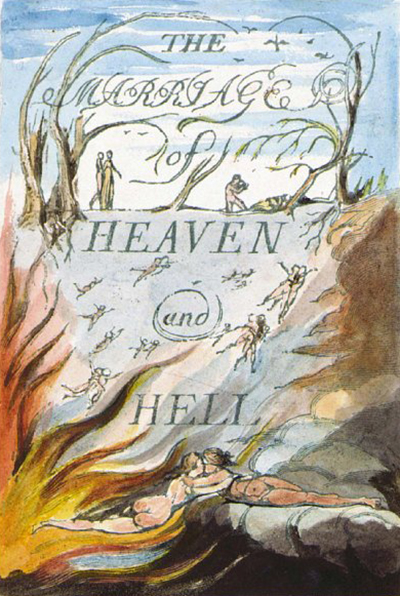
William Blake’s The Marriage of Heaven and Hell begins by making its reader look beneath the ground. In copy A’s title page, a pale upper landscape gives way to a much larger space of blue, fire and moving bodies, with an embracing pair at its base. The meeting promised by the title is already physical. [1]
That invitation to change position runs through the whole book. Blake brings a traveller into Hell, seats biblical prophets at dinner, gives a devil the task of interpreting Christ and takes an angel on an alarming journey through his own convictions. Short sayings interrupt sustained arguments; a printing house turns into a place of dragons and eagles. The reader keeps moving between a proposition, its speaker and the circumstances that make it persuasive. [1]
The work’s twenty-seven plates combine writing and pictures in an illuminated book. Its early making is conventionally dated around 1790–93; surviving copies also have later printing and finishing histories. Reading its complete sequence and comparing particular copies reveals the movement and tension behind its famous quotations. [1][2]
At a Glance
- FormsProverbs, arguments and narrated encounters [3]
- Main opening comparisonCopy A title page [1]
- Satirical contextSwedenborg and religious authority [4]
Contents
- Entering a world turned upside down
- The Devil’s account of body and energy
- How the Proverbs of Hell work
- Poets, priests and a dinner with the prophets
- Cleansing perception and making a book
- The prolific, the devourer and a dangerous guide
- Swedenborg, Christ and the second angel
- The Song of Liberty and the pressure of its ending
- Reading a particular copy
- A book that could grow through making
Entering a world turned upside down
Emanuel Swedenborg was a Swedish religious visionary whose writings included a treatise on Heaven and Hell. Blake’s satire addresses someone whose ideas he had taken seriously: William and Catherine Blake attended the New Jerusalem Church’s first General Conference in April 1789. As Viscomi stresses, their signatures establish attendance, without proving membership of the church or their presence throughout its five days. The book emerges from engagement with a religious movement whose development also involved disputed forms of worship and authority. [5]
The title page establishes a division and immediately unsettles its proportions. In copy A, the light upper landscape supports fine trunks and branches that also curl around the lettering. The lower field is turbulent: small figures move diagonally through it, and the embracing bodies at its base stretch almost across the page. Heaven and Hell occupy this same descending design. Colour helps the eye distinguish regions, while branches, roots, bodies and flame keep them connected. The page offers an encounter across boundaries before the prose begins to debate them. [1]
The verse called The Argument then tells a miniature history of displacement. A just man follows a dangerous course through the valley of death; roses, bees, water and red clay suggest life emerging where it seemed impossible. A villain takes possession of the perilous paths and drives the just man into barrenness. The relation between outward manner and justice changes with that dispossession: the serpent acquires an appearance of humility, while the just man rages among lions. [1]
The distinction matters throughout the book. A mild voice can belong to an usurper; anger can answer an injury. Blake makes the reader ask what has happened before deciding what a gesture means. The return of Rintrah’s roaring and the burdened clouds at the poem’s end encloses the account in gathering pressure. The storm continues beyond the explanation, preparing an atmosphere in which apparently secure moral names will be challenged. [1]
The next plate announces a new heaven and mocks Swedenborg as an angel left at a tomb. That opening mixes religious proclamation with the impatience of someone who thinks a predecessor has mistaken a preliminary stage for the destination. Its thirty-three years since the new heaven point to 1790 when counted from Swedenborg’s announced spiritual transformation in 1757. Viscomi connects that reckoning with Blake’s own birth year and the age of Christ: the passage makes chronological calculation carry an audacious claim to renewed inspiration. [5] Blake quickly turns to the opposed forces through which human life proceeds: attraction and repulsion, reason and energy, love and hate. His statement that “Without Contraries is no progression” introduces an activity that the rest of the book repeatedly stages. [1]
The same paragraph distinguishes these forces from the moral labels assigned to them. What the religious call good is passive obedience to reason; what they call evil is activity springing from energy. The qualification about who does the naming is decisive. The final equation of Heaven with good and Hell with evil belongs to an account of a particular classification. The reader has already seen how a classification based on meekness or rage can protect the wrong person. [1]
The Devil’s account of body and energy
A new heading gives the next plate to the Devil. Its arrangement resembles a compact catechism: three errors attributed to sacred codes are answered by three contrary truths. The errors separate body from soul, assign evil energy to the body and good reason to the soul, and threaten eternal punishment for following that energy. The replies redefine the body as a portion of soul perceived through the senses and give energy the central place in living existence. [1]
Reason remains present in this account as a boundary or circumference. The imagery describes a relation between the force of life and the form that bounds it; it gives the reader something more exact to consider than a general command to abandon thought. The senses, too, become points of entry into soul. A religious scheme that treated bodily experience as a contaminant is being challenged from within the very vocabulary of spiritual life. [1]
The heading asks us to hear a voice whose concentrated assertions will be tried in later scenes of desire, interpretation and imaginative production. Its polemical force comes from the position the speaker occupies in the preceding plate’s moral geography. The Devil answers the religious classification of his energies by offering a different account of what those energies are. [1]
The following discussion turns to the restraint of desire. Blake describes a process in which inhibited desire gradually loses force until reason governs what remains of it. He then retells the struggle in Paradise Lost through opposed accounts of who fell and who usurped power. The names of Messiah and Satan shift according to the party telling the story. We are watching an interpretation reverse the moral assignments of another interpretation. [1]
Milton enters this dispute as a poet whose imaginative freedom appears greater when he writes devils and Hell than when he writes God and angels. The notorious judgement that Milton belonged to the Devil’s party without knowing it makes poetic achievement exceed an author’s declared allegiance. Within this passage, the claim concerns the energy released by writing and the constraints imposed by an authorised picture of heaven. Treating it as a declaration that every act associated with Satan is admirable would discard the argument that produces it. [1]
Blake’s narrator then visits the fires of Hell for pleasure. Angels would interpret the same enjoyment as torment and insanity. This is the first explicit travel lesson in the book: a description of a place can disclose the assumptions of the observer. Before collecting the proverbs, the narrator announces his purpose as a kind of comparison between nations. The sayings will reveal the character of infernal wisdom through its own forms of expression. [1]
On returning, he sees a devil writing on rock with corrosive fire. The message asks whether a bird might be an immense world of delight closed off by the observer’s senses. An ordinary creature becomes the occasion for questioning the scale of what can be known. The senses that the earlier Devil called the inlets of soul can also participate in limitation. Their present reach is open to challenge, and the written question tries to enlarge it. [1]
How the Proverbs of Hell work
The Proverbs of Hell change the reader’s pace. Their brevity encourages an immediate response, while their succession keeps any one response provisional. Farming, hunting, bodily appetite, tools, birds, rivers, palaces and prisons supply a world of tangible comparisons. The sayings repeatedly ask what happens when an energy is allowed to develop, when a capacity is restricted or when a living process is mistaken for a fixed possession. [1]
The opening sequence joins learning to time and action: planting, harvesting and enjoying belong to different seasons. Elsewhere, the path of excess leads towards wisdom, and desire without action breeds pestilence. These sayings do not all describe the same tempo. Some urge experiment; others recognise the season appropriate to an act. Reading them together brings out a recurring interest in the difference between fruitful movement and arrested life. [1]
Their creatures resist being reduced to a single scale of merit. An eagle wastes time learning from a crow; an apple tree needs no advice from a beech about how to grow, nor a lion from a horse about how to hunt. A proverb about a bird flying too high adds the qualification that its flight must be made with its own wings. Capacity belongs to the being that exercises it. This makes the later warning against applying one law to lion and ox feel prepared by the reader’s encounter with different kinds of life. [1]
Blake also unsettles familiar relations between virtue and vice. The prison is built from the stones of law; the brothel from the bricks of religion. These aphorisms suggest that institutions can help produce the conditions they claim to regulate. Their architectural materials give that accusation an abrupt solidity. Another saying places the act of setting someone else before oneself at the height of sublimity. The infernal collection includes generosity as well as defiance. Its energy extends beyond selfish appetite. [1]
Some sayings deliberately make the reader recoil. The comparison that prefers the murder of an infant to the nursing of unacted desires is horrifying. Its murderous disproportion belongs to the violence of the rhetorical provocation; it supplies no practical moral guidance. A reader who turns every proverb into a rule would be doing precisely what the book’s many forms make difficult: replacing judgement about an utterance with obedience to its wording. The extremity remains disturbing even when its assault on repression is recognised. [1]
The closing movement brings limits back into the experience of reading. Enough and excess become difficult to distinguish without having encountered both. That concluding pressure extends to the collection itself. It gives the reader an abundance of compact statements, including statements that strain against one another, and leaves the work of discrimination active. The pleasure lies partly in their verbal snap, partly in the thought that begins when the snap has passed. [1]
Poets, priests and a dinner with the prophets
After the proverbs, a short account of ancient poets gives imagination a history of being appropriated. Poets animate the things they perceive and assign divine names to them. A priesthood subsequently detaches those mental deities from their objects, builds systems around them and gains power over others. The concluding reminder that deities reside in the human breast returns attention to the creative activity from which the system arose. This is Blake’s polemical miniature history, with its own chosen sequence of creation, abstraction and domination. [1]
The change from poets to priests repeats the Argument’s pattern of an originator displaced by an inheritor. It also extends the book’s interest in interpretation. A name that once expressed a living encounter can become something administered as an external authority. The book’s own forceful sayings now sit beside a warning about what happens when poetic expression hardens into a system. The warning addresses the possible fate of its language as well as the behaviour of its enemies. [1]
At dinner with Isaiah and Ezekiel, the narrator questions the prophets about how they knew that God had spoken to them. The domestic setting makes an immense question conversational. Isaiah denies seeing or hearing God through finite bodily perception, yet describes his senses discovering infinity in everything. His certainty is connected to honest indignation and the act of writing, with its consequences left unprotected. The prophet’s authority is being reimagined as an intensity of perception and expression. [1]
The narrator asks whether firm conviction can make something true, prompting a reply about its power to move mountains and the present incapacity for such conviction. The exchange lets a reader feel both the audacity and the difficulty of prophetic persuasion. Certainty has creative force, but the question that summoned the answer remains available. Dialogue gives the claim an exposed surface that a solitary maxim would lack. [1]
Ezekiel then links the history of nations and religious authority to the Poetic Genius. His account of one nation making its god pre-eminent is spoken within Blake’s invented conversation. It requires that frame: its generalisations about peoples and religions are the rhetoric of a speaker explaining power, rather than an independent history of religious development. The prophets’ strange bodily acts are likewise discussed as provocations against convention and the desire for an easy conscience. Dinner becomes another scene in which a respectable explanation must confront the discomfort on which it rests. [1]
Cleansing perception and making a book
The next announcement promises that creation will appear infinite and holy when its present finite and corrupt appearance is consumed. Its vocabulary of fire and apocalypse leads into a strikingly practical declaration about printing. Blake will attack the separation of body and soul through an infernal method whose corrosives remove apparent surfaces and disclose what was hidden. The familiar sentence about cleansing the doors of perception belongs inside this account of altered appearance and artistic action. [1]
The passage gives the artist a task. Human beings have shut themselves into a cavern and narrowed what they can see. An improvement in sensual enjoyment is linked to the transformation of the world’s appearance; making and encountering the illuminated book enters the same process. The reader holding a printed page meets a work that claims the power to change the conditions under which a page, a body or a world is perceived. This is a particularly intimate kind of artistic ambition. [1]
The printing house in Hell makes that ambition visible through six chambers. A Dragon-Man clears a cave’s mouth while dragons hollow it. A viper winds around its rock and cave, adding materials of ornament. An eagle with wings and feathers of air makes the interior infinite, and eaglelike workers build palaces in cliffs. Lions melt metals into living fluids. Unnamed forms cast metals into an expanse. Finally, men receive what becomes books and arrange them in libraries. The procession moves from resistant matter through animal and elemental labour into the recognisable world of readers. [1]
Joseph Viscomi relates the first five chambers to preparing copper, writing and drawing, etching, inking and printing. That interpretation makes the fantasy answer to a printer’s sequence without exhausting its imagery. The final chamber adds circulation and reception: the book enters a library, where further activity depends on someone opening it. The relation between the person making and the person reading is part of the passage’s account of how knowledge moves between generations. [1][6]
The transformations preserve the body’s importance. Hollowing, winding, flying, melting and casting are actions performed upon or through matter. A page capable of opening imaginative space emerges through work on a physical surface. The six chambers also refuse the isolation of a single masterful gesture. Their creatures perform distinct tasks in succession, giving the imagined transmission of knowledge the duration and variety of a workshop. The narrator’s tour lets us accompany those changes rather than merely admire a finished object. [1]
Watch: William Blake’s world and working methods
Choose an introduction to Blake, a printing demonstration, or a discussion of his radical ideas.
William Blake: Poet, Artist & Visionary - a genius of early Romanticism in England
An introduction to Blake’s art, poetry and imaginative world.
Watch on YouTubeThe prolific, the devourer and a dangerous guide
The next passage enlarges the dispute into a relation between producers and those who consume what they produce. Giants are described as the causes of the sensual world’s life and activity, though the weak and cunning imagine them chained. The account distinguishes the whole of an energy from the portion another person can seize or measure. Its imagery asks how a dependent power comes to picture itself as the master of its source. [1]
The relation is more difficult than a simple division into admirable makers and useless consumers. The devourer gives the prolific something upon which its energies can be exercised, yet the text insists that the two classes should remain enemies. A reconciliation that abolished their opposition would destroy existence. Religion is accused of trying to achieve that reconciliation, and Christ is invoked as a bringer of division. The book’s marriage therefore cannot mean a peaceful settlement in which contrary forces cease to act. [1]
An angel now offers the narrator a warning about his eternal fate. Their route passes through a stable, a church, a vault, a mill and a cave until they hang above an appalling abyss. The accumulated descents give the angel’s claim an environment. Monstrous life, threatening fire and the emergence of Leviathan turn an abstract judgement into a spectacle designed to terrify the person being judged. The angel’s authority depends partly on making this vision seem like the inevitable truth of the narrator’s future. [1]
When the angel withdraws, the narrator finds himself beside a pleasant river in moonlight, hearing a harper. He attributes the previous terror to his guide’s metaphysics. The reversal changes the apparent cause of what has been seen. The guide who claimed to reveal a fate may have imposed a set of assumptions upon the scene. Fixed opinion, associated with stagnant water and the breeding of mental reptiles, becomes the danger exposed by the journey. [1]
The narrator retaliates by taking the angel on a journey of his own. He forces him towards the sun, past the planets and into a void, using Swedenborg’s books as part of the extraordinary transport. Another church appears; an opened Bible becomes a pit containing chained apes and baboons. Stronger creatures seize and consume weaker ones with gestures that grotesquely mingle affection and destruction. The narrator’s vision turns the civilised order claimed by his opponent into a place of predation. [1]
This episode also complicates the narrator’s victory. His method includes coercion, and the angel accuses him of imposing a fantasy. The answer admits mutual imposition before declaring that “Opposition is true Friendship.” The exchange does not make the two speakers equally persuasive in a satire so vigorously weighted against the angel. It does leave the reader responsible for assessing how a vision is produced and how it treats the person compelled to share it. The narrator’s counter-demonstration carries a violence of its own. [1]
Swedenborg, Christ and the second angel
The attack on Swedenborg becomes explicit after the journey. Blake mocks a claim to exclusive wisdom through the image of a monkey displaying its tail as if it exceeded every other animal. He argues that Swedenborg’s conversations were confined to angels and that his books repeat received religious errors. The criticism is a performance of satirical judgement within The Marriage. Its extravagant absolutes should remain attached to Blake’s attack, rather than serving as a neutral account of the whole of Swedenborg’s writing. [1]
A further memorable fancy supplies a different kind of encounter. A devil in flame tells an angel on a cloud that worship means honouring the gifts of other people according to their genius. The angel insists upon the supremacy of the one God manifested in Christ and upon Christ’s sanction of the commandments. The devil answers by reading Christ’s actions as repeated departures from the rules supposedly defining his virtue. The dispute turns upon what counts as an adequate way to read a revered life. [1]
The devil’s argument has the daring and selectivity of an advocate’s case. He presses incidents involving Sabbath observance, wealth, judgement and forgiveness into a defence of action from impulse. The reader is being shown an infernal interpretation of scripture, with the energy of its challenge exposed. It differs from a systematic commentary that would weigh every passage evenly. The dramatic point is the possibility that devotion to Christ’s example can overturn the codification imposed upon it. [1]
This angel responds by entering the fire. He rises as Elijah and becomes a devil, then a friend of the narrator who reads the Bible with him in its infernal sense. The change gives the book an encounter that ends in conversion, distinct from the earlier guide’s resentful accusation. Religious reading becomes a shared activity capable of changing the reader’s position. The promised Bible of Hell extends that possibility beyond the immediate scene, while the final warning about one law for lion and ox makes the cost of uniformity explicit. [1]
The Song of Liberty and the pressure of its ending
A Song of Liberty changes the scale again. Its numbered movements begin with the groaning of an Eternal Female and the birth of fiery terror. The action spreads across a world addressed through places and peoples: Albion, America, France, Spain and Rome enter an urgent prophetic present. A starry king tries to cast the newborn power away. The antagonism between an established ruler and emergent energy becomes cosmic struggle. [1]
The song’s movement joins emancipation to a collision with authority. The king’s fall, his subsequent law-bearing appearance and the fiery child’s destruction of the law make political and religious power act through bodies. A declaration that empire has ended follows the breaking of stony commands. These are events proclaimed in visionary song, with all its urgency and imaginative compression. They do not supply a literal report that the historical empires addressed by the poem had ceased to exist. [1]
Its reach also has troubling limits. Among the peoples it summons, the song uses an antisemitic association between Jews and counting gold, and a racist description of the African forehead. Those stereotypes remain in a work proclaiming liberation. A responsible reading must allow the emancipatory ambition and the prejudice of the address to be visible together. The poem’s imagined universality does not prevent its language from participating in demeaning historical representations of particular people. [1]
The concluding chorus attacks priestly repression and the sanctification of denied desire. Its final affirmation, “For every thing that lives is Holy,” carries the book back towards the life whose energy its earlier voices defended. Coming after violent conflict, satirical exposure and conversion, the sentence has been earned through a difficult sequence. It also leaves a demanding measure against which to read the treatment of living beings within that sequence, including the stereotypes of the song itself. [1]
Reading a particular copy
The book’s visual sequence deserves the same attention as its words. Small reproductions of copy I in Viscomi’s essay show how text and design exchange positions: the figures beneath the proverbs on plate 10 gather below the writing, while plate 11 places its scene above the text. On plate 15, an eagle and serpent occupy the lower design; on plate 20, the huge coiling creature beneath the text brings the narrated abyss into the visible page. These are distinct arrangements through which the reader enters and leaves an argument. [6]
Copy I’s frames are especially useful for understanding an apparent change between books. Viscomi argues that cave borders visible in later copies were already present in the copper and had been wiped free of ink in earlier printings. What looks like a newly added graphic enclosure can therefore result from a different treatment during printing. A claim about a design’s revision requires attention to the impression and to the way its edges reached the paper. [6]
The Morgan Library’s copy C makes the distinction between plates and leaves concrete. Its catalogue describes twenty-seven plates on fifteen leaves, with the title and Argument on rectos alone and the remaining text occupying both sides of leaves. The record identifies bluish-green printing ink with additional watercolour. A count of twenty-seven printed plates therefore does not imply a book containing twenty-seven separate paper leaves, nor does the presence of colour tell us by itself how each colour was applied. [6]
The Morgan’s copy F belongs to a different printing history. Its exhibition label identifies plate 3 as printed around 1794 and explains the colour-printed background through pigments applied to the shallowly etched plate. The 1790 date entered in ink on that plate is consequently distinct from the date of its printing. Composition, etching, printing, hand colouring and binding or assembly describe different operations; evidence about one cannot automatically date them all. [7]
In their 2016 announcement of copy A, the Blake Archive’s editors described nine complete surviving copies. That is a dated editorial statement, rather than a newly verified census. Their account places A among the early printings and identifies later colour-printed and larger-paper books. It also records a change of order in copy G: plates 15 and 14 precede plates 12–13. For that reader, the printing house and the cleansing of perception come before dinner with the prophets. The altered adjacency creates a different route between the book’s accounts of making and inspiration. [1]
Copy I provides another reminder that a book’s date can outlive its first invention. The Archive’s 2016 account places its printing in 1827; the Fitzwilliam Museum’s catalogue gives the broader production date of on or after 1825. Those descriptions have different degrees of precision, while both place this copy late in Blake’s life. The coloured appearance reproduced in an illustration should belong to that identified copy, rather than being treated as a universal colour scheme for The Marriage. [1][5]
A book that could grow through making
The order in which a reader encounters the plates is also distinct from the proposed order of their production. In his study of the book’s evolution, Viscomi uses lettering and the reconstruction of copper sheets to argue that plates 21–24 preceded the rest. He proposes an initial anti-Swedenborgian pamphlet that developed into a larger work through successive additions, arguing for its execution within 1790. This is an attributed reconstruction of a making process, with uncertainties in the placing of particular plates, rather than a surviving complete draft that proves Blake’s initial plan. [8]
The proposal helps a reader recognise the force of the book’s separate units. The attack on Swedenborg, the angel’s conversion and the announcement of a future infernal Bible can form an ending; new material can alter what that ending answers. An illuminated page holds writing and design together, but a series of such pages can still be enlarged and rearranged. The book’s discontinuities acquire a material history alongside the experience of encountering them in sequence. [1][8]
Reading the whole work lets its recurring images carry thought across those discontinuities. A proverb’s animal returns as the beneficiary or victim of a law. The cave changes from a place of restriction to a workshop and a site of visionary encounter. Fire can terrify a spectator, sustain a devil or receive a convert. Each recurrence asks who is looking, what is being done and what has changed since the image last appeared. [1]
Begin with the full sequence, allowing the proverbs to interrupt the prose and the fancies to test its assertions. Then return to one named copy and follow the designed pages. The Marriage of Heaven and Hell makes its arguments through the activity of reading: accepting a guide, mistrusting him, laughing at a claim, meeting a resistant image and revising an opinion. Its continuing invitation is to take part in that movement with the same alertness that its speakers demand from one another. [1]
Works and designs directory
Browse separate works, impressions and book components. Dates distinguish versions; six Tate copies after Blake are labelled. These records are not a complete catalogue of unique designs.
| Name | Date | Medium |
|---|---|---|
| A Figure Standing in a Gothic Apse, perhaps the Empress Maud. Verso: Detailed Drawings for ‘The Empress Maud in Bed’ | c.1819 | Pencil drawing |
| A Rolling Stone Is Ever Bare of Moss, from Thornton's "Pastorals of Virgil" | 1821 | Wood engraving |
| A Title Page for The Grave | 1806 | Watercolour |
| A Vision of the Last Judgment | 1808 | Watercolour |
| A Vision: The Inspiration of the Poet (Elisha in the Chamber on the Wall) | c.1819–20? | Watercolour |
| Adam and the Beasts, Frontispiece to Hayley's "Ballads" | June 1, 1802 | Engraving |
| Age Teaching Youth | c.1785–90 | Watercolour |
| Alfred and the Neat-Herd’s Wife (after Henry Fuseli) | 1797, published 1798 | Etching and engraving |
| An Allegory of the Bible. Verso: The Shins of an Écorché Male Figure | c.1780–5, ?c.1780 | Watercolour |
| Angel of the Divine Presence Bringing Eve to Adam (The Creation of Eve: "And She Shall be Called Woman) (recto); Sketch for the same (verso) | ca. 1803 | Watercolour |
| Angel of the Revelation (Book of Revelation, chapter 10) | ca. 1803–5 | Watercolour |
| Antaeus setting down Dante and Virgil in the Last Circle of Hell | 1824–1827 | Watercolour |
| Bathsheba at the Bath | c.1799–1800 | Tempera |
| Beatrice Addressing Dante from the Car | 1824–7 | Watercolour |
| Behemoth and Leviathan | 1825–26 | Engraving |
| Behemoth and Leviathan | 1825, reprinted 1874 | Engraving |
| Behemoth and Leviathan | 1826 | Engraving |
| Blasted Trees and Flattened Crops, from Thornton's "Pastorals of Virgil" | 1821 | Wood engraving |
| Boy Returning Joyfully, with Plough and Oxen, from Thornton's "Pastorals of Virgil" | 1821 | Wood engraving |
| Boy Returning Joyfully, with Plough and Oxen, from Thornton's "Pastorals of Virgil" | 1821 | Wood engraving |
| Catherine Blake. Verso: A Man’s Head and Other Drawings | c.1805 | Pencil drawing |
| Cerberus | 1824–7 | Watercolour |
| Cerberus (second version) | 1824–1827 | Watercolour |
| Chaucer’s Canterbury Pilgrims | 1810, reprinted before 1881 | Engraving |
| Christ Appearing to His Disciples After the Resurrection | c.1795 | Colour print |
| Christ Appearing to the Apostles after the Resurrection | c.1795 | Watercolour |
| Christ Blessing the Little Children | 1799 | Tempera |
| Christ in the Carpenter’s Shop: The Humility of the Saviour (after William Blake) | Date not stated | Watercolour |
| Ciampolo the Barrator Tormented by the Devils | 1826–7, reprinted 1892 | Engraving |
| Ciampolo the Barrator Tormented by the Devils | 1826–7, reprinted 1968 | Engraving |
| Circle of Theives: Agnello Brunelleschi Attacked By a Six-Footed Serpent | ca. 1825–27 | Engraving |
| Clarence's Dream (Shakespeare, Richard III, Act 1, Scene 4) | 1774 | Etching and engraving |
| Colinet Mocked by Two Boys, from Thornton's "Pastorals of Virgil" | 1821 | Wood engraving |
| Colinet Rests by a Stream at Night | c.1821, printed 1830 | Wood engraving |
| Colinet Rests by a Stream at Night | 1821, reprinted 1977 | Wood engraving |
| Colinet with his Shepherd’s Pipe, Mocked by Two Boys | c.1821, printed 1830 | Wood engraving |
| Colinet with his Shepherd’s Pipe, Mocked by Two Boys | 1821, reprinted 1977 | Wood engraving |
| Colinet's Journey, Milestone Marked 'LXII Miles to London', from Thornton's "Pastorals of Virgil" | 1821 | Wood engraving |
| Colinet's Journey: Milestone Marked 'LXII Miles to London', from Thornton's "Pastorals of Virgil" | 1821 | Wood engraving |
| Colinet’s Fond Desire Strange Lands to Know | 1821, reprinted 1977 | Wood engraving |
| Colinet’s ‘Fond Desire Strange Lands to Know’ | c.1821, printed 1830 | Wood engraving |
| Composition Sketch for ‘The Fall of the Rebel Angels’? Verso: Standing Figure with Flaming Hair | ?c.1805–10 | Pencil drawing |
| Composition Sketch, Possibly a Subject from Dante. Verso: A Man Standing over a Figure Reclining on a Bed | ?1824–7, ?c.1800–10 | Pencil drawing |
| Composition Sketch. Verso: Standing Figure Holding a Spear | ?c.1805–10 | Pencil drawing |
| Dante and Virgil Approaching the Angel Who Guards the Entrance of Purgatory | 1824–7 | Watercolour |
| Dante and Virgil Penetrating the Forest | 1824–7 | Watercolour |
| Dante in the Empyrean, Drinking at the River of Light | 1824–7 | Watercolour |
| Dante running from the Three Beasts | 1824–1827 | Watercolour |
| Dante Striking against Bocca Degli Abati | 1826–7, reprinted 1892 | Engraving |
| Dante Striking Against Bocca degli Abati | 1826–7, reprinted 1968 | Engraving |
| David Delivered out of Many Waters | c.1805 | Watercolour |
| David Delivered out of Many Waters (after William Blake) | Date not stated | Watercolour |
| Detailed Drawings for ‘A Figure Standing in a Gothic Apse’ | 1819 | Pencil drawing |
| Elohim Creating Adam | 1795–c.1805 | Colour print |
| Enoch | 1806–7 | Lithograph |
| Epitome of James Hervey’s ‘Meditations among the Tombs’ | c.1820–5 | Watercolour |
| Europe. A Prophecy; Frontispiece | ca. 1820 | Relief etching |
| Evening | c.1820/1825 | Watercolour |
| Every Man also Gave him a Piece of Money | 1825, reprinted 1874 | Engraving |
| Every Man also Gave him a Piece of Money. Verso: God the Father with Attendant Angels | c.1821–3 | Watercolour |
| Every One also Gave Him a Piece of Money | 1826 | Engraving |
| Fertilization of Egypt, from Erasmus Darwin's "The Botanic Garden" | 1791 | Engraving |
| First Book of Urizen pl. 10 | 1796, c.1818 | Etching |
| First Book of Urizen pl. 11 | 1796, c.1818 | Etching |
| First Book of Urizen pl. 15 | 1796, c.1818 | Etching |
| First Book of Urizen pl. 17 | 1796, c.1818 | Etching |
| First Book of Urizen pl. 21 | 1796, c.1818 | Etching |
| First Book of Urizen pl. 6 | 1796, c.1818 | Etching |
| Frontispiece to Jerusalem, the Emanation of the Great Albion | [ca. 1804–20] (?) | Engraving |
| Frontispiece to ‘Visions of the Daughters of Albion’ | c.1795 | Relief etching |
| Frontispiece: Thenot and Colinet | c.1821, printed 1830 | Wood engraving |
| George Cumberland's Message Card | 1827 | Engraving |
| God Judging Adam | ca. 1795 | Relief etching |
| God Judging Adam | 1795 | Relief etching |
| Hiding of Moses, from "Remember Me!, or a Pocket Companion" | 1825 | Engraving |
| Homer and the Ancient Poets | 1824–7 | Watercolour |
| Illustration 1 to Milton’s On the Morning of Christ’s Nativity: The Descent of Peace | c.1814–1816 | Watercolour |
| Illustration 1 to Milton’s Paradise Lost: Satan Calling Up His Legions | 1807 | Watercolour |
| Job accepting Charity | 1825–26 | Engraving |
| Job and his Daughters | 1825–26 | Engraving |
| Job and his Daughters | 1825, reprinted 1874 | Engraving |
| Job and His Daughters | 1826 | Engraving |
| Job and His Family | 1825–26 | Engraving |
| Job and his Family | Reprinted 1874; engraved 1828 date is an error | Engraving |
| Job and His Family | 1826 | Engraving |
| Job and his Family Restored to Prosperity | 1825, reprinted 1874 | Engraving |
| Job and his Wife restored to Prosperity | 1825–26 | Engraving |
| Job rebuked by his Friends | 1825–26 | Engraving |
| Job Rebuked by his Friends | 1825, reprinted 1874 | Engraving |
| Job Rebuked by His Friends | 1826 | Engraving |
| Job's Comforters | 1825–26 | Engraving |
| Job's Comforters | 1826 | Engraving |
| Job's Despair | 1825–26 | Engraving |
| Job's Evil Dreams | 1825–26 | Engraving |
| Job's Evil Dreams | 1826 | Engraving |
| Job's Sacrifice | 1825–26 | Engraving |
| Job's Sons and Daughters Overwhelmed by Satan | 1826 | Engraving |
| Job, his Wife and his Friends: The Complaint of Job. Verso: Job’s Wife and Eight Other Sketches | c.1785 | Watercolour |
| Job’s Comforters | 1825, reprinted 1874 | Engraving |
| Job’s Despair | 1825, reprinted 1874 | Engraving |
| Job’s Evil Dreams | 1825, reprinted 1874 | Engraving |
| Job’s Sacrifice | 1825, reprinted 1874 | Engraving |
| Job’s Sons and Daughters Overwhelmed by Satan | 1825, reprinted 1874 | Engraving |
| John Linnell | 1825 | Pencil drawing |
| Joseph of Arimathea Preaching to the Britons | c.1794/1796 | Relief etching |
| Judas Betrays Him | c.1803–5 | Watercolour |
| King John Absolved by Pandulph (after Henry Fuseli) | 1797, published 1798 | Etching and engraving |
| Lamech and his Two Wives | 1795 | Colour print |
| Landscape near Felpham | c.1800 | Watercolour |
| Lear and Cordelia in Prison | c.1779 | Watercolour |
| Los and Orc | c.1792–3 | Watercolour |
| Lower Half of a Woman Playing a Harp. Verso: Seraphim and Other Drawings | c.1785, c.?1807 | Pencil drawing |
| Menalcus Watching Women Dance, from Thornton's "Pastorals of Virgil" | 1821 | Wood engraving |
| Menalcus Watching Women Dance, from Thornton's "Pastorals of Virgil" | 1821 | Wood engraving |
| Moses Indignant at the Golden Calf | c.1799–1800 | Tempera |
| Nebuchadnezzar | 1795–c.1805 | Colour print |
| Newton | 1795–c.1805 | Colour print |
| Oberon, Titania and Puck with Fairies Dancing | c.1786 | Watercolour |
| Pity | ca. 1795 | Relief etching |
| Pity | c.1795 | Colour print |
| Plate 2 of ‘Urizen’: ‘Teach these Souls to Fly’ | ?1796 | Relief etching |
| Plate 3 of ‘Urizen’: Oh! Flames of Furious Desires’ (after William Blake) | Date not stated | Watercolour |
| Plate 4 of ‘Visions of the Daughters of Albion’ | c.1795 | Relief etching |
| Plutus | 1824–7 | Watercolour |
| Preliminary Sketch for ‘Christ Girding Himself with Strength’. Verso: Standing Figure with One Arm Raised | c.1805, c.1805–10 | Pencil drawing |
| Preludium. "The shadowy daughter of Urthona stood before red Orc..." (Plate 3) | 1793 | Relief etching |
| Queen Elizabeth and Essex (after Henry Fuseli) | 1797, published 1798 | Engraving |
| Sabrina's Silvery Flood, from Thornton's "Pastorals of Virgil" | 1821 | Wood engraving |
| Sabrina's Silvery Flood, from Thornton's "Pastorals of Virgil" | 1821 | Wood engraving |
| Sabrina’s Silvery Flood | c.1821, printed 1830 | Wood engraving |
| Sabrina’s Silvery Flood | 1821, reprinted 1977 | Wood engraving |
| Satan Before the Throne of God | 1825–26 | Engraving |
| Satan before the Throne of God | 1825, reprinted 1874 | Engraving |
| Satan before the Throne of God | 1826 | Engraving |
| Satan calling up his Legions | c.1800–05 | Tempera |
| Satan Exulting over Eve | c.1795 | Colour print |
| Satan Going Forth from the Presence of the Lord, and Job’s Charity | 1825, reprinted 1874 | Engraving |
| Satan Going Forth fron the Presence of the Lord | 1825–26 | Engraving |
| Satan in his Original Glory: ‘Thou wast Perfect till Iniquity was Found in Thee’ | c.1805 | Watercolour |
| Satan Smiting Job with Boils | 1825–26 | Engraving |
| Satan Smiting Job with Sore Boils | 1825, reprinted 1874 | Engraving |
| Satan Smiting Job with Sore Boils | c.1826 | Tempera |
| Satan Smiting Job with Sore Boils | 1826 | Engraving |
| Shepherd Chases Away a Wolf, from Thornton's "Pastorals of Virgil" | 1821 | Wood engraving |
| Shepherd Chases Away a Wolf, from Thornton's "Pastorals of Virgil" | 1821 | Wood engraving |
| Sketch for the Title-Page of the Engraved Illustrations to the Book of Job | c.1823/1826 | Pencil drawing |
| Sketch for ‘The Four and Twenty Elders Casting their Crowns before the Divine Throne’. Verso: Standing Figure with Arms at his Side | c.1803, c.1805–10 | Pencil drawing |
| Sketch for ‘Tiriel Supporting the Dying Myratana’. Verso: Sketch for ‘Tiriel Supporting the Dying Myratana’ | c.1786–9 | Pencil drawing |
| Songs of Experience: A Little Boy Lost | [1794] printed ca. 1825 | Relief etching |
| Songs of Experience: A Little Girl Lost | [1794] printed ca. 1825 | Relief etching |
| Songs of Experience: A Poison Tree | [1794] printed ca. 1825 | Relief etching |
| Songs of Experience: Earth's Answer | [1794] printed ca. 1825 | Relief etching |
| Songs of Experience: Frontispiece | [1794] printed ca. 1825 | Relief etching |
| Songs of Experience: Holy Thursday | [1794] printed ca. 1825 | Relief etching |
| Songs of Experience: Infant Sorrow | [1794] printed ca. 1825 | Relief etching |
| Songs of Experience: Introduction | [1794] printed ca. 1825 | Relief etching |
| Songs of Experience: London | [1794] printed ca. 1825 | Relief etching |
| Songs of Experience: My Pretty Rose Tree, Ah! Sun-Flower, The Lilly | [1794] printed ca. 1825 | Relief etching |
| Songs of Experience: Nurses Song | [1794] printed ca. 1825 | Relief etching |
| Songs of Experience: The Angel | [1794] printed ca. 1825 | Relief etching |
| Songs of Experience: The Chimney Sweeper | [1794] printed ca. 1825 | Relief etching |
| Songs of Experience: The Clod & the Pebble | [1794] printed ca. 1825 | Relief etching |
| Songs of Experience: The Fly | [1794] printed ca. 1825 | Relief etching |
| Songs of Experience: The Garden of Love | [1794] printed ca. 1825 | Relief etching |
| Songs of Experience: The Human Abstract | [1794] printed ca. 1825 | Relief etching |
| Songs of Experience: The Little Girl Found (second plate) | [1789] printed ca. 1825 | Relief etching |
| Songs of Experience: The Little Girl Lost | [1789] printed ca. 1825 | Relief etching |
| Songs of Experience: The Little Girl Lost (second plate); The Little Girl Found | [1789] printed ca. 1825 | Relief etching |
| Songs of Experience: The Little Vagabond | [1794] printed ca. 1825 | Relief etching |
| Songs of Experience: The School Boy | [1789] printed ca. 1825 | Relief etching |
| Songs of Experience: The Sick Rose | [1794] printed ca. 1825 | Relief etching |
| Songs of Experience: The Tyger | [1794] printed ca. 1825 | Relief etching |
| Songs of Experience: The Voice of the Ancient Bard | [1789] printed ca. 1825 | Relief etching |
| Songs of Experience: Title-page | [1794] printed ca. 1825 | Relief etching |
| Songs of Experience: To Tirzah | [1794] printed ca. 1825 | Relief etching |
| Songs of Innocence and of Experience, Shewing the Two Contrary States of the Human Soul: Combined Title-page | [1789–94] printed ca. 1825 | Relief etching |
| Songs of Innocence and of Experience: Infant Sorrow | 1794, reprinted 1831 or later | Relief etching |
| Songs of Innocence: A Cradle Song | [1789] printed ca. 1825 | Relief etching |
| Songs of Innocence: A Cradle Song (second plate) | [1789] printed ca. 1825 | Relief etching |
| Songs of Innocence: A Dream | [1794] printed ca. 1825 | Relief etching |
| Songs of Innocence: Frontispiece | [1789] printed ca. 1825 | Relief etching |
| Songs of Innocence: Holy Thursday | [1789] printed ca. 1825 | Relief etching |
| Songs of Innocence: Infant Joy | [1789] printed ca. 1825 | Relief etching |
| Songs of Innocence: Introduction | [1789] printed ca. 1825 | Relief etching |
| Songs of Innocence: Laughing Song | [1789] printed ca. 1825 | Relief etching |
| Songs of Innocence: Little Boy Lost | [1789] printed ca. 1825 | Relief etching |
| Songs of Innocence: Night | [1789] printed ca. 1825 | Relief etching |
| Songs of Innocence: Night (second plate) | [1789] printed ca. 1825 | Relief etching |
| Songs of Innocence: Nurse's Song | [1789] printed ca. 1825 | Relief etching |
| Songs of Innocence: On Anothers Sorrow | [1789] printed ca. 1825 | Relief etching |
| Songs of Innocence: Spring | [1789] printed ca. 1825 | Relief etching |
| Songs of Innocence: Spring (second plate) | [1789] printed ca. 1825 | Relief etching |
| Songs of Innocence: The Blossom | [1789] printed ca. 1825 | Relief etching |
| Songs of Innocence: The Chimney Sweeper | [1789] printed ca. 1825 | Relief etching |
| Songs of Innocence: The Divine Image | [1789] printed ca. 1825 | Relief etching |
| Songs of Innocence: The Ecchoing Green | [1789] printed ca. 1825 | Relief etching |
| Songs of Innocence: The Ecchoing Green (second plate) | [1789] printed ca. 1825 | Relief etching |
| Songs of Innocence: The Lamb | [1789] printed ca. 1825 | Relief etching |
| Songs of Innocence: The Little Black Boy | [1789] printed ca. 1825 | Relief etching |
| Songs of Innocence: The Little Black Boy (second plate) | [1789] printed ca. 1825 | Relief etching |
| Songs of Innocence: The Little Boy Found | [1789] printed ca. 1825 | Relief etching |
| Songs of Innocence: The Shepherd | [1789] printed ca. 1825 | Relief etching |
| Songs of Innocence: Title Page | [1789] printed ca. 1825 | Relief etching |
| St Christopher, Copy from an Engraving? Verso:Part of a Face: Copy from a Plaster Cast: a Daughter of Niobe? | ?c.1779–80 | Pencil drawing |
| The Agony in the Garden | c.1799–1800 | Tempera |
| The Angel Appearing to Zacharias | 1799–1800 | Tempera |
| The Ascent of the Mountain of Purgatory | 1824–7 | Watercolour |
| The Baffled Devils Fighting | 1826–7, reprinted 1892 | Engraving |
| The Baffled Devils Fighting | 1826–7, reprinted 1968 | Engraving |
| The Bard, from Gray | ?1809 | Tempera |
| The Beggar's Opera, Act III | July 1, 1790 | Etching and engraving |
| The Beggar's Opera, Act III | July 1, 1790 | Engraving |
| The Beggar's Opera, Act III | 1790 | Engraving |
| The Blasphemer | c.1800 | Watercolour |
| The Blighted Corn | c.1821, printed 1830 | Wood engraving |
| The Blighted Corn | 1821, reprinted 1977 | Wood engraving |
| The Body of Abel Found by Adam and Eve | c.1826 | Tempera |
| The Body of Christ Borne to the Tomb | c.1799–1800 | Tempera |
| The Book of Job: Title Page | 1825 | Engraving |
| The Book of Thel pl. 6 | 1796, c.1818 | Etching |
| The Circle of Corrupt Officials: The Devils Mauling Each Other | ca. 1825–27 | Engraving |
| The Circle of Corrupt Officials: The Devils Tormenting Ciampolo | ca. 1825–27 | Engraving |
| The Circle of the Lustful: Francesca da Rimini (‘The Whirlwind of Lovers’) | 1826–7, reprinted 1892 | Engraving |
| The Circle of the Lustful: Francesca da Rimini (‘The Whirlwind of Lovers’) | 1826–7, reprinted 1968 | Engraving |
| The Circle of the Lustful: Paolo and Francesca | ca. 1825–27 | Engraving |
| The Circle of the Thieves; Buoso Donati Attacked by the Serpent | ca. 1825–27 | Engraving |
| The Circle of Traitors: Dante's Foot Striking Bocca degli Abbate | ca. 1825–27 | Engraving |
| The Complaint and the Consolation; or, Night Thoughts | 1797 | Etching and engraving |
| The Creation | 1825–26 | Engraving |
| The Crucifixion | c.1825–7 | Pencil drawing |
| The Crucifixion: ‘Behold Thy Mother’ | c.1805 | Watercolour |
| The Dance of Albion (Glad Day) | c.1803/1810 | Engraving |
| The Death of Lucretia, from Allen's "New and Impartial Roman History" | 1797 | Engraving |
| The Death of Saint Joseph | 1803 | Watercolour |
| The Death of the Virgin | 1803 | Watercolour |
| The Descent of Peace [recto] | c.1815 | Pencil drawing |
| The Destruction of Job's Sons | 1825–26 | Engraving |
| The Devils, with Dante and Virgil by the Side of the Pool | 1824–7 | Watercolour |
| The Entombment | c.1805 | Watercolour |
| The Fall of Rosamond (after Thomas Stothard) | 1783 | Etching and engraving |
| The Fall of Satan | 1825–26 | Engraving |
| The Fall of Satan | 1825, reprinted 1874 | Engraving |
| The Fall of Satan | 1826 | Engraving |
| The Four and Twenty Elders Casting their Crowns before the Divine Throne | c.1803–5 | Watercolour |
| The Ghost of a Flea | c.1819–20 | Tempera |
| The Good and Evil Angels | 1795–?c.1805 | Colour print |
| The Good Farmer, Probably the Parable of the Wheat and the Tares. Verso: Rough Sketch of Two or Three Figures in a Landscape | c.1780–5 | Watercolour |
| The Great Red Dragon and the Beast from the Sea | c.1805 | Watercolour |
| The Great Red Dragon and the Woman Clothed with the Sun | c.1805 | Watercolour |
| The Head of the Ghost of a Flea. Verso: A Profile and a Reduced Drawing of Milton’s First Wife | c.1819 | Pencil drawing |
| The Hermit’s Dog, from William Hayley’s "Ballads" | 1805 | Etching and engraving |
| The Hiding of Moses | 1824 | Engraving |
| The House of Death | 1795–c.1805 | Colour print |
| The House of Death | c.1790 | Watercolour |
| The Hypocrites with Caiaphas. Verso: Sketch of a Stooping Figure | 1824–7 | Watercolour |
| The Inscription over the Gate | 1824–7 | Watercolour |
| The Laborious Passage along the Rocks | 1824–7 | Watercolour |
| The Last Trumpet (recto); Two studies of a right eye, a profile of an open-mouthed young man, the head of an eagle, and the head of a lion (verso) | 1780–85 | Pencil drawing |
| The Lord Answering Job out of the Whirlwind | 1825–26 | Engraving |
| The Lord Answering Job out of the Whirlwind | 1825, reprinted 1874 | Engraving |
| The Man Who Taught Blake Painting in his Dreams (counterproof) (after William Blake) | after c.1819–20 | Pencil drawing |
| The Marriage of Heaven and Hell pl. 16 | 1796, c.1818 | Etching |
| The Messengers tell Job of his Misfortunes | 1825–26 | Engraving |
| The Messengers tell Job of his Misfortunes | 1825, reprinted 1874 | Engraving |
| The Night of Enitharmon’s Joy (formerly called ‘Hecate’) | c.1795 | Colour print |
| The Parable of the Wise and Foolish Virgins | ca. 1799–1800 | Watercolour |
| The Parable of the Wise and Foolish Virgins (after William Blake) | Date not stated | Watercolour |
| The Pastorals of Virgil, with a Course of English Reading, Adapted for Schools, Vol. I | 1821 | Wood engraving |
| The Penance of Jane Shore in St Paul’s Church | c.1793 | Watercolour |
| The Pit of Disease: The Falsifiers | 1826–7, reprinted 1892 | Engraving |
| The Pit of Disease: The Falsifiers | 1824–7 | Watercolour |
| The Pit of Disease: The Falsifiers | 1826–7, reprinted 1968 | Engraving |
| The Primaeval Giants Sunk in the Soil | 1824–7 | Watercolour |
| The Punishment of the Thieves | 1824–7 | Watercolour |
| The Raising of Lazarus (after William Blake) | Date not stated | Watercolour |
| The Rest on the Flight into Egypt (The Repose of the Holy Family in Egypt) | 1806 | Watercolour |
| The River of Life | c.1805 | Watercolour |
| The Rock Sculptured with the Recovery of the Ark and the Annunciation | 1824–7 | Watercolour |
| The Serpent Attacking Buoso Donati | 1826–7, reprinted 1892 | Engraving |
| The Serpent Attacking Buoso Donati | 1826–7, reprinted 1968 | Engraving |
| The Serpent Attacking Buoso Donati. Verso: A Man with a Transparent Hood (?) over his Head | 1824–7 | Watercolour |
| The Simoniac Pope | 1824–7 | Watercolour |
| The Six-Footed Serpent Attacking Agnolo Brunelleschi | 1826–7, reprinted 1892 | Engraving |
| The Six-Footed Serpent Attacking Agnolo Brunelleschi | 1826–7, reprinted 1968 | Engraving |
| The Soul Hovering over the Body Reluctantly Parting with Life | c.1805 | Pencil drawing |
| The Spiritual Form of Nelson Guiding Leviathan | c.1805–9 | Tempera |
| The Spiritual Form of Pitt Guiding Behemoth | ?1805 | Tempera |
| The Sun at His Eastern Gate | c.1816–1820 | Watercolour |
| The Temple of Mirth, after Thomas Stothard | 1784 | Engraving |
| The Temptation and Fall of Eve | 1807 | Watercolour |
| The Temptation and Fall of Eve (Illustration to Milton’s Paradise Lost) | 1808 | Watercolour |
| The Thieves and Serpents | 1824–1827 | Watercolour |
| The Vision of Christ | 1825, reprinted 1874 | Engraving |
| The Vision of Eliphaz | 1825–26 | Engraving |
| The Vision of Eliphaz | 1825, reprinted 1874 | Engraving |
| The Vision of God | 1825–26 | Engraving |
| The Wood of the Self-Murderers: The Harpies and the Suicides | 1824–7 | Watercolour |
| The Wrath of Elihu | 1825–26 | Engraving |
| The Wrath of Elihu | 1825, reprinted 1874 | Engraving |
| Thenot and Colinet | 1821, reprinted 1977 | Wood engraving |
| Thenot and Colinet at Supper | c.1821, printed 1830 | Wood engraving |
| Thenot and Colinet at Supper | 1821, reprinted 1977 | Wood engraving |
| Thenot and Colinet Converse Seated between Two Trees | c.1821, printed 1830 | Wood engraving |
| Thenot and Colinet Converse Seated between Two Trees | 1821, reprinted 1977 | Wood engraving |
| Thenot and Colinet Eat Their Evening Meal, from Thornton's "Pastorals of Virgil" | 1821 | Wood engraving |
| Thenot and Colinet Folding their Flocks together at Sunset | c.1821, printed 1830 | Wood engraving |
| Thenot and Colinet Folding their Flocks together at Sunset | 1821, reprinted 1977 | Wood engraving |
| Thenot and Colinet Lead Their Flocks Together, from Thornton's "Pastorals of Virgil" | 1821 | Wood engraving |
| Thenot and Colinet Lead Their Flocks Together, from Thornton's "Pastorals of Virgil" | 1821 | Wood engraving |
| Thenot Remonstrates with Colinet | c.1821, printed 1830 | Wood engraving |
| Thenot Remonstrates with Colinet | 1821, reprinted 1977 | Wood engraving |
| Thenot Remonstrates With Colinet, from Thornton's "Pastorals of Virgil" | 1821 | Wood engraving |
| Thenot Remonstrates With Colinet, from Thornton's "Pastorals of Virgil" | 1821 | Wood engraving |
| Thenot Remonstrates with Colinet, Lightfoot in the Background, from Thornton's "Pastorals of Virgil" | 1821 | Wood engraving |
| Thenot Remonstrates with Colinet: Lightfoot in the Distance | 1821, reprinted 1977 | Wood engraving |
| Thenot Remonstrates with Colinet; Lightfoot in the Distance | c.1821, printed 1830 | Wood engraving |
| Thenot Under a Fruit Tree, from Thornton's "Pastorals of Virgil" | 1821 | Wood engraving |
| Thenot, with Colinet Waving his Arms in Sorrow | c.1821, printed 1830 | Wood engraving |
| Thenot, with Colinet Waving his Arms in Sorrow | 1821, reprinted 1977 | Wood engraving |
| Title Page: Illustrations of the Book of Job | 1825–26 | Engraving |
| Title-Page of ‘The Book of Job’ | 1825, reprinted 1874 | Engraving |
| Tornado–Zeus Battling Typhon, from Erasmus Darwin's "Botanic Garden" | August 1, 1795 | Engraving |
| Tornado–Zeus Battling Typhon, from Erasmus Darwin's "The Botanic Garden" | August 1, 1795 | Engraving |
| Two Figures in a Decorative Border | c.1790 | Pencil drawing |
| Unyok'd Heifers, Loitering Homeward (Return of the Shepherd), from Thornton's "Pastorals of Virgil" | 1821 | Wood engraving |
| Virgil Girding Dante’s Brow with a Rush | 1824–7 | Watercolour |
| Wat Tyler and the Tax-Gatherer (after Henry Fuseli) | 1797, published 1798 | Etching and engraving |
| When the Morning Stars Sang Together | 1825, reprinted 1874 | Engraving |
| When the Morning Stars Sang Together | 1826 | Engraving |
| Winged Figure Flying Through Clouds, from Bell's "Poets" | 1790 | Etching and engraving |
| Winter | c.1820–5 | Tempera |
| ‘A Rolling Stone is ever Bare of Moss’ | c.1821, printed 1830 | Wood engraving |
| ‘A Rolling Stone is ever Bare of Moss’ | 1821, reprinted 1977 | Wood engraving |
| ‘And Unyok’d Heifers, Loitering Homeward, Low’ | c.1821, printed 1830 | Wood engraving |
| ‘And Unyok’d Heifers, Loitering Homewards, Low’ | 1821, reprinted 1977 | Wood engraving |
| ‘Europe’: Fragment of Pages 3 and 4 | 1794–c.1830–5 | Relief etching |
| ‘For him Our Yearly Wakes and Feasts We Hold’ | c.1821, printed 1830 | Wood engraving |
| ‘For him Our Yearly Wakes and Feasts We Hold’ | 1821, reprinted 1977 | Wood engraving |
| ‘Nor Fox, nor Wolf, nor Rat among our Sheep’ | c.1821, printed 1830 | Wood engraving |
| ‘Nor Fox, nor Wolf, nor Rat among our Sheep’ | 1821, reprinted 1977 | Wood engraving |
| ‘Songs of Innocence and of Experience’: ‘Infant Sorrow’ | 1794, reprinted 1831 or later | Relief etching |
| ‘Songs of Innocence and of Experience’: ‘Spring’ | 1794, reprinted 1831 or later | Relief etching |
| ‘Songs of Innocence’: Title-Page | 1789, reprinted 1831 or later | Relief etching |
| ‘Songs of Innocence’: Title-Page | 1789, reprinted 1831 or later | Relief etching |
| ‘With Songs the Jovial Hinds Return from Plow’ | c.1821, printed 1830 | Wood engraving |
| ‘With Songs the Jovial Hinds Return from Plow’ | 1821, reprinted 1977 | Wood engraving |
Frequently Asked Questions
It is an illuminated book combining verse, argumentative prose, proverbs and visionary dialogues called memorable fancies. The Argument and A Song of Liberty are verse components within its larger changing structure. [3]
Plate 3 identifies opposed forces, including reason and energy, as necessary to human existence and progression. Later passages dramatise their relations and resist a reconciliation that would extinguish their activity. The term needs to be followed through the book’s encounters. [1]
They are provocative sayings presented as infernal wisdom. Their range includes generosity, appetite, excess and deliberately shocking exaggeration. Their setting and their tensions require judgement about each utterance. [1]
Discussion
Look again at the images and ideas explored in The Marriage of Heaven and Hell by William Blake. These editorial prompts invite your observations.
Reader Insights
The Devil’s heading changes how the argument is heard. Three contrary replies overturn a compact set of religious errors.
The proverbs invite quick responses, then make each response provisional by placing another saying beside it.
Corrosive printing becomes part of the book’s argument about perception. Removing a surface also becomes a way to disclose what was hidden.
Join the Conversation
Share a detail, comparison or question about The Marriage of Heaven and Hell by William Blake below.
References
- Morris Eaves, Robert N. Essick and Joseph Viscomi, editors, William Blake Archive. The Marriage of Heaven and Hell Copy A, 30 August 2016. Complete editorial announcement, including its dated copy census, printing chronology and copy G sequence; copy A title-page reproduction displayed with the announcement. Read the announcement · View the copy A title page View source 1. View source 2.
- Joseph Viscomi. The Evolution of William Blake’s The Marriage of Heaven and Hell, Huntington Library Quarterly 58.3–4 (1997), pp.281–344. Author-hosted Part I PDF, especially PDF pp.1–5 and 38–42 for dating, proposed growth and production sequence; original publication identified in its note *. Read the author’s PDF View source.
- William Blake. The Marriage of Heaven and Hell, complete plates 1–27, including The Argument, The Voice of the Devil, Proverbs of Hell, all memorable fancies and A Song of Liberty with its concluding chorus. David V. Erdman, ed., The Complete Poetry and Prose of William Blake, E33–45. Plate numbers in the text follow this transcription. Read the primary text View source.
- Joseph Viscomi. Lessons of Swedenborg: or, the Origin of Blake’s The Marriage of Heaven and Hell, in Robert Gleckner and Thomas Pfau, eds., Lessons of Romanticism (1998), pp.173–212. Author-hosted Part II PDF, especially PDF pp.1–7 and notes 8–11 on p.31 for Swedenborg, the Blakes’ conference attendance and the chronological allusion. Read the author’s PDF View source.
- The Fitzwilliam Museum. The Marriage of Heaven and Hell, copy I, P.4172-R, object record 118307: twenty-seven bound plates and production date on or after 1825. View the object record View source.
- The Morgan Library & Museum. The marriage of heaven and hell, copy C, PML 17559, catalogue record: twenty-seven plates on fifteen leaves; printing ink, watercolour, recto/verso arrangement and concluding song. View the catalogue record View source.
- The Morgan Library & Museum. The Marriage of Heaven and Hell, Plate 3, copy F, PML 63935, William Blake’s World exhibition label: printing around 1794, plate date and colour-printing explanation. Read the exhibition label View source.
- Joseph Viscomi. In the Caves of Heaven and Hell: Swedenborg and Printmaking in Blake’s Marriage, in Steve Clark and David Worrall, eds., Blake in the Nineties (1999), pp.27–60. Complete author-hosted Part III PDF; especially PDF pp.3–4 and note 3 on borders, pp.17–19 on printing chambers, and illustrations 1–3 and 5, identified as copy I plates 10, 11, 15 and 20. Read the illustrated author’s PDF View source.