


 by Tom Gurney
Tom Gurney BSc (Hons) is an art history expert with over 20 years experience
Published on June 19, 2020 / Updated on November 3, 2026
Email: tomgurney1@gmail.com / Phone: +44 7429 011000
William Blake’s Pastorals of Virgil: Introduction
A river turns through a dark landscape towards a little thatched house. Sheep graze beneath a tree; pale strokes open the water, the roof and the distant sky. In William Blake’s Sabrina’s Silvery Flood, a view scarcely wider than a few fingers seems to contain a whole remembered home. Its smallness invites an unusually intimate kind of looking. The landscape can be taken in at once, yet its winding spaces keep drawing the eye further inside. [1][2]
Blake made this image for Robert John Thornton’s The Pastorals of Virgil, with a Course of English Reading, Adapted for Schools, published in its third edition in 1821. The famous wood engravings illustrate an English poem by Ambrose Philips included in the book: a conversation between the shepherds Thenot and Colinet. Their subjects include unhappy travel, mockery, shelter, food and the possibility of being heard by a friend. Understanding that conversation brings these concentrated landscapes into focus. [2][3]
The series also has an unusually revealing material history. The wooden surfaces were divided and reduced before appearing in the schoolbook. They subsequently passed into John Linnell’s possession, supplied impressions to younger artists and their families, and eventually became the source for twentieth-century printings. A familiar composition can consequently survive in objects made many decades apart. The date 1821 identifies the book’s publication; the history of an individual sheet needs a closer description. [2][4]
At a Glance
- Immediate textPhilips’s second pastoral, Thenot and Colinet [2][5]
- Classical relationPhilips’s second pastoral imitates Virgil’s first eclogue [2][5]
- Printing history1937 electrotypes reproduced the blocks [2]
Contents
- A schoolbook with several makers
- Philips’s shepherds and Virgil’s first eclogue
- A landscape held in memory
- Cold ground, then a shared table
- How the pictures changed before publication
- Palmer and the life of the blocks
- Electrotypes, restrikes and close examination
A schoolbook with several makers
Thornton’s title states a practical ambition: to help pupils learn Latin. Eton College’s copy preserves the fuller promise of acquiring the language quickly, and its catalogue places Philips’s imitation in volume I, pages 13–18. The two-volume publication brought classical poetry together with English reading and explanatory material. Blake’s pictures belonged to a larger teaching arrangement in which images, modern poems and ancient texts could illuminate one another. [3]
John Linnell supplied the personal connection. Thornton was his doctor, and Tate’s catalogue describes the commission as coming through him. Blake had met Thornton in September 1818 and was working on the engravings by September 1820. These dates allow a clear account of the undertaking without forcing every stage into the publication year. The artist was already an experienced engraver, although engraving on wood opened a new field of work for him. [2]
It helps to distinguish Blake’s different contributions. Tate identifies seventeen wood engravings that he both designed and cut for Philips’s pastoral, including the larger frontispiece. Three further designs in that sequence were engraved by another hand. Seventeen therefore counts Blake’s own cut designs; it does not count every illustration associated with his invention, every preparatory drawing, or every picture in Thornton’s two volumes. [2]
His work for the book also extended beyond the pastoral landscapes. He engraved six copperplate subjects: five busts, representing Theocritus, Virgil, Augustus, Julius Caesar and Epicurus, and a group of medallion heads after antique coins. Another wood engraving, The Giant Polypheme, was cut by Byfield after Poussin. Its drawing has been credited to Blake, but Tate quotes Linnell’s journal recording that he himself began a Polypheme drawing on a woodblock for Thornton. That evidence calls for a qualified attribution of the drawing, even while the distinction between Poussin’s source and Byfield’s cutting remains useful. [2]
The different roles explain why totals of Blake illustrations can vary according to what is being counted. Designing a subject, adapting an earlier artist’s composition, cutting wood and engraving copper are distinct activities. Here the central achievement is a closely related group of small landscapes, but those landscapes entered a collaborative publication containing several kinds of illustration. Their extraordinary visual character becomes more apparent when their ordinary setting as book illustrations is kept in view. [2]
Thornton also had a positive theory of what illustrations could do. In the address to the 1821 edition, quoted by the scholar Mei-Ying Sung, he links pictures with easier learning, pleasure and the acquisition of ideas alongside words. Sung’s study asks readers to consider the publisher’s educational and practical aims as well as Blake’s art. This perspective helps explain the importance of a compact page containing clear images and captions. The schoolbook had its own intended reader and its own demands on the illustrations. [6]
Philips’s shepherds and Virgil’s first eclogue
The immediate literary source is Philips’s second pastoral, known through its speakers as Thenot and Colinet. Thornton presents it as an imitation of Virgil’s first eclogue. The numbering can cause confusion: Philips’s second pastoral responds to Virgil’s first. Nor does imitation mean a word-for-word translation. Philips takes a situation, a contrasting pair of speakers and a pastoral form, then develops them through English places, poetic ambition and personal disappointment. [2][5]
In Virgil’s poem, Meliboeus encounters Tityrus resting beneath a tree. Their circumstances are painfully unequal. Tityrus can remain at ease; Meliboeus must leave his native fields, driving his animals away. Conversation opens out into questions of Rome, freedom, protection and the loss of land. The invitation to stay the night offers brief hospitality within a world whose security has been broken. Samuel Palmer’s later English translation preserves the contrast between the restful speaker and the dispossessed traveller particularly clearly. [7]
Philips gives that contrast a different centre of gravity. Thenot finds the younger Colinet unhappy despite the surrounding signs of spring. Colinet answers that the birds’ pleasure cannot describe his own condition. Thenot’s cheerful old age and Colinet’s miserable youth make a visible landscape insufficient as a measure of human happiness. The field can be bright while a person feels abandoned. Blake’s sequence develops this discrepancy through changing skies, enclosed figures and places remembered or endured. [5]
The conversation needs time. Colinet worries that telling the full story will distract Thenot from his sheep and lambs. Thenot arranges for Lightfoot to tend them, while promising to look across the plain himself. Listening becomes something that has to be made possible within daily work. This practical exchange matters to the series: figures talking in the foreground and a flock or attendant further away belong to the same small social world. [5]
Colinet gradually reveals the causes of his misery. He left the banks of Sabrina, travelled towards Cam, and found hardship, exhaustion and hostile judgement. His desire to know other places was bound up with a desire for fame. The shepherd is also a singer whose work has been mocked. Pastoral language allows the poem to speak about artistic aspiration through a flock, a pipe and an exposed traveller. The setting carries the argument rather than merely supplying decoration around it. [5]
Menalcas offers another kind of relationship. Colinet hopes for recognition from him, and Thenot describes his power to protect the flock and reward rural song. The poem therefore places generous patronage beside malicious speech. Its emotional movement proceeds through several forms of dependence: the traveller needs a place to rest, the singer needs a sympathetic listener, and both need support that reaches beyond consoling advice. These relationships can be read in the poem without identifying every shepherd with a particular person in Blake’s life. [5]
The ending makes kindness tangible. Thenot offers to fold Colinet’s flock with his own, then proposes milk, cream, cheese, curd and stored fruit for supper. Shared food and a resting place answer the earlier cold and lonely night. Returning workers and homeward cattle complete the evening. Across the sequence, rural life contains both exposure and refuge; the comfort has force because the unhappiness has been allowed to unfold. [5]
A landscape held in memory
Sabrina’s Silvery Flood gives Colinet’s lost home a place within that emotional journey. The NGV impression, accession 1879-5, has an image only 3.3 by 7.3 centimetres. A group of sheep occupies the left foreground, while a small house stands beneath dense foliage at the right. Between them the river swings through the scene in a broad, bright curve, narrowing towards a distant opening. [1]
The house is sharply present: a steep roof, an upper window and a dark doorway. Its enclosure contrasts with the river’s movement. Blake gives the eye both somewhere to settle and a route to follow. The sheep bend into the ground; the roof leans towards its peak; branches and cut marks turn the surrounding darkness into living texture. Even the sky has direction, with closely set pale strokes moving across the upper left. [1]
Read beside Colinet’s speech, this is a landscape of attachment. The poem remembers the riverbank and the small dwelling he had made for himself. The picture gives that dwelling weight without enlarging it into a grand estate. Its intimacy helps us understand what absence costs. A little home can occupy more imaginative space than a distant destination, because it gathers together work, shelter and the life the speaker has left behind. [1][5]
The engraving also shows how little Blake needs to suggest distance. Broad black areas hold the ground together, while the pale river crosses them and turns away. A tree trunk interrupts the view near the centre. Beyond it, the small opening and remote slopes imply a landscape continuing outside the little rectangle. Enlargement makes the cuts easy to inspect, but the original scale is part of the effect: depth has been concentrated into a surface small enough to sit beside reading matter. [1]
Cold ground, then a shared table
The NGV’s Colinet Resting at Cambridge by Night, accession 1881-5, reverses the promise of the remembered dwelling. A seated figure leans against a tree at the right, his legs extended across the foreground. Water, buildings and a crescent moon recede to the left. He has reached a place, but he has no enclosing room within it. The trunk supports his back while leaving him exposed to the surrounding night. [8]
The composition offers a broad prospect to someone unable to enjoy its security. The distant built forms stand apart from the figure. Pale horizontal strokes move across the sky and water, carrying the eye away from his resting body. Their thin continuities make the world seem extensive, while his body remains pressed against one small portion of it. The contrast between an expansive view and an uncomfortable resting place gives the scene much of its quiet force. [8]
This particular impression has a subdued, unevenly legible surface. Some features emerge more strongly than others from the brownish sheet. This subdued appearance belongs to the NGV object; other impressions need separate examination. The composition nevertheless remains readable: the isolated figure, the tree, the nocturnal signs and the distance between body and buildings organise the image. Physical variation and pictorial invention can be considered together without confusing their causes. [8]
In Thenot and Colinet Sup Together, NGV 1884-5, the two shepherds face one another across a table. A central opening rises behind them, while long slanting strokes describe the overhead enclosure. Vessels and food fill the space between the seated figures. Outside, at the left, a crescent and small star remain visible. Night continues, but the relation between person and surroundings has changed. [9]
The table produces a sustained horizontal connection across the image. Thenot’s bearded head and the younger man’s face turn the conversation into an exchange with two visible participants. The broad centre is occupied by things to be shared. Food gives the scene a material fullness that answers the earlier image of a body resting against a tree. Shelter also becomes a designed shape: the roof gathers the figures beneath converging lines, while the supports hold the sides. [9]
The poem’s hospitality could have been conveyed by a single gesture of invitation. Blake gives it an interior, objects and duration. We can imagine the conversation continuing after the traveller has sat down. That reading grows from the shared table and the poem’s offered meal; it does not require the picture to settle every anxiety Colinet has expressed. His circumstances have been met with attention and a place to stay. [5][9]
These scenes provide a useful way into the whole group. Move between a remembered home, an exposed night and an evening meal. The changes concern how a person occupies a landscape as much as which rural objects appear within it. The larger Thenot and Colinet frontispiece introduces the two speakers, while the journey imagery follows Colinet’s movement through unfamiliar places. Within the sequence, each view gains force through the different conditions around it. [1][2][8][9]

Thenot and Colinet. Whole frontispiece composition; the physical legacy impression is unidentified.
Watch: William Blake’s world and working methods
Choose an introduction to Blake, a printing demonstration, or a discussion of his radical ideas.
William Blake: Poet, Artist & Visionary - a genius of early Romanticism in England
An introduction to Blake’s art, poetry and imaginative world.
Watch on YouTubeHow the pictures changed before publication
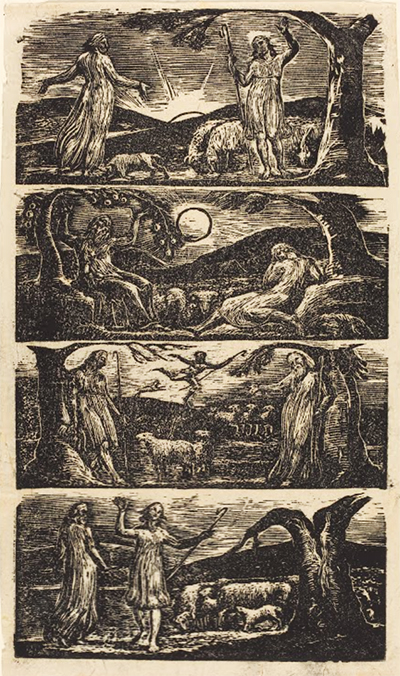
The surviving proofs preserve a format different from the familiar separate engravings. Except for the frontispiece, Blake cut designs in groups of four on a block. Impressions made before separation show their original relationship on the wooden surface. For Thornton’s book the designs were cut apart, then reduced around their edges so that captions could be accommodated with the pictures. A whole-block proof and an impression of a trimmed subject preserve different boundaries. [2]
This is more than a difference in the amount of blank paper around an image. Reduction of the printing surface removes part of the pictured area itself. When comparing an early proof and a reduced image, the edge deserves as much attention as a central figure. Branches, land or sky near that edge may belong to a fuller version of the composition. The separate little print was made possible through a physical alteration to the block. [2]
The published series also includes cutting by another engraver after Blake’s designs. Tate’s historical account connects the recutting with dissatisfaction about his work. Thornton’s own printed qualification offers firmer evidence of his unease: he describes the illustrations as displaying “less of art than genius”, while recording the admiration of eminent painters. The sentence introduces Blake through his previous achievements and simultaneously asks the reader to accept an unusual manner. [2]
The artist’s contributions to Night Thoughts and The Grave gave Thornton a way to identify him for readers. Yet the pastoral pictures had to succeed in a different context and at a different scale. The engraving guide explains the basic material distinction: these wood engravings produce pale passages by cutting material away from a surface that otherwise takes ink. Here that behaviour becomes the means of opening rivers, moonlit spaces, garments and roofs within dense darkness. [2]
Palmer and the life of the blocks
Samuel Palmer recognised something in these small images that the publisher’s reservation could scarcely describe. Tate reproduces his account of their secluded places and extraordinary light. He finds both solemn depth and brilliance in them, treating their atmosphere as an imaginative revelation. This is Palmer’s testimony, preserved in the later publication of his life and letters, rather than a neutral description of every surviving impression. It records the intensity with which another artist looked. [2]
Palmer’s response is particularly illuminating beside the scenes of shelter. A small house, the bend of a river or the space around a tree can seem inexhaustible when light makes it feel inwardly charged. Palmer’s admiration helps explain why these images mattered to the younger artists known as the Ancients. Their importance lay partly in what the pictures made possible: an intensely inhabited landscape could be created within the confines of a tiny printed image. Tate identifies Palmer and Edward Calvert as especially important recipients of that influence. [2]
Calvert’s own response held admiration and criticism together. As quoted in Louise Wilson’s account of the blocks’ history, he regarded the little illustrations as sometimes careless or incorrect, yet capable of deeply moving a sympathetic viewer. Wilson also cites Linnell’s diary through Raymond Lister’s study: Calvert brought impressions to Linnell on 8 September 1828. This supplies a dated episode of printing after Blake’s death, while leaving the printer of any unmarked individual sheet to be established separately. [10]
The survival of the blocks allowed admiration to become repeated contact with the work. Linnell bought them from Thornton on 16 September 1825 for two guineas. Later impressions were printed for him and for Calvert, while members of the Linnell family also tried printing some of the blocks. The wooden objects thus passed from a publisher’s illustration stock into an artistic circle where the images could be encountered as separate prints. [2]
Tate’s A00111–A00127 group belongs to that later life. Its catalogue proposes Calvert as the probable printer of the complete set, while the current frontispiece record places its printing around 1830. The qualification matters. Possession by Linnell and resemblance to other impressions provide a history to investigate, but the name Blake attached to the design does not identify the person who inked and printed every surviving sheet. [2]
The move out of the book changed the encounter as well. The pictures could now be studied apart from their captions and the surrounding lesson. That freedom makes their formal concentration especially apparent, although the poem remains valuable for understanding the sequence. Seeing them as separate works and reading them as illustrations are complementary experiences: one brings the marks close, the other restores the conversation and the changes of circumstance between images.
Electrotypes, restrikes and close examination
The twentieth-century printing history introduces another distinction. When Geoffrey Keynes prepared his 1937 publication, electrotypes were made from the surviving blocks and impressions printed from those metal duplicates. Such a print carries a design derived from the wooden original, but its immediate printing surface is the electrotype. The distinction is essential when a later reproduction is described as though it had come directly from Blake’s wood. [2]
In 1977, Iain Bain and David Chambers printed from the original woodblocks for the British Museum. Tate’s T02115–T02131 set comes from that undertaking: seventeen engravings on Japanese Hosho paper. The edition comprised 150 sets, with fifty additional frontispiece impressions. Tate reports that, despite damage and warping in the blocks, the printers brought out details and gradations absent from earlier printings and from the electrotypes. Later production could therefore disclose aspects of an old surface with fresh clarity. [4]
The dates describe different events. An early whole-block proof precedes the division and reduction of the designs. A schoolbook impression belongs to their publication setting. A separate nineteenth-century pull belongs to their continued use after the commission. A 1937 electrotype impression and a 1977 original-block restrike have different immediate matrices. Keeping those events distinct lets a comparison reveal something more specific than the simple passage from an early image to a late one. [2][4]
Conservation adds evidence that ordinary reproductions cannot supply. Louise Wilson’s examination distinguishes four paper types within the NGV group. She also identifies stray ink in the margins of Sabrina’s Silvery Flood and Thenot and Colinet Sup Together as evidence of difficulties printing thick blocks on a rolling press. This supports an account of printing conditions; it does not identify the press as Blake’s. Her explanations connect visible irregularities with particular physical processes while retaining limits on attribution. [10]
The NGV’s Unyoked Heifers Loitering Homeward, Low, accession 1886-5, makes that continuing material history especially visible. Its faintly printed scene has been strengthened with brown washes. The two animals and their attendant emerge with a softness quite different from the strong blacks of Sabrina. A small dark square remains in the lower left margin. Wilson discusses the square as a trace of another block and proposes that the faint pull may have served to remove residual ink during cleaning. The finishing hand remains uncertain. [10][11]
Look at the heifers’ bodies and the widening pale road beneath them. The brown modelling gives their flanks and legs a presence distinct from the scattered remnants of printed line around them. The object has become an encounter between a repeated design and later attention with a brush. Its interest lies in that particular surface and its unresolved history, alongside the composition’s place at the close of Philips’s pastoral. [5][11]
Two photographs of the Met’s 1821 volume make the book arrangement concrete. The leaves are headed as illustrations to the imitation of the first eclogue and marked to face pages 14 and 15. Four pictures run down each leaf, with brief speaker captions between them. On the second leaf, Sabrina appears below the shepherd driving away the wolf and above the journey scene. The broad view of a remembered home is therefore part of a changing succession of images encountered beside the poem. These photographs preserve the book setting that a collection of separate impressions cannot show. [12]
This is why the series rewards returning from an enlarged image to a named object and then to the book. Each encounter answers another question. The poem makes the changes between the scenes intelligible; the print lets the eye follow the concentrated landscape; the block and sheet preserve the work of making and remaking it. At the shared table, the long pastoral conversation ends in a practical gift. Across the wider group, Blake finds small spaces capable of holding a striking range of human need.
Works and designs directory
Browse separate works, impressions and book components. Dates distinguish versions; six Tate copies after Blake are labelled. These records are not a complete catalogue of unique designs.
| Name | Date | Medium |
|---|---|---|
| A Figure Standing in a Gothic Apse, perhaps the Empress Maud. Verso: Detailed Drawings for ‘The Empress Maud in Bed’ | c.1819 | Pencil drawing |
| A Rolling Stone Is Ever Bare of Moss, from Thornton's "Pastorals of Virgil" | 1821 | Wood engraving |
| A Title Page for The Grave | 1806 | Watercolour |
| A Vision of the Last Judgment | 1808 | Watercolour |
| A Vision: The Inspiration of the Poet (Elisha in the Chamber on the Wall) | c.1819–20? | Watercolour |
| Adam and the Beasts, Frontispiece to Hayley's "Ballads" | June 1, 1802 | Engraving |
| Age Teaching Youth | c.1785–90 | Watercolour |
| Alfred and the Neat-Herd’s Wife (after Henry Fuseli) | 1797, published 1798 | Etching and engraving |
| An Allegory of the Bible. Verso: The Shins of an Écorché Male Figure | c.1780–5, ?c.1780 | Watercolour |
| Angel of the Divine Presence Bringing Eve to Adam (The Creation of Eve: "And She Shall be Called Woman) (recto); Sketch for the same (verso) | ca. 1803 | Watercolour |
| Angel of the Revelation (Book of Revelation, chapter 10) | ca. 1803–5 | Watercolour |
| Antaeus setting down Dante and Virgil in the Last Circle of Hell | 1824–1827 | Watercolour |
| Bathsheba at the Bath | c.1799–1800 | Tempera |
| Beatrice Addressing Dante from the Car | 1824–7 | Watercolour |
| Behemoth and Leviathan | 1825–26 | Engraving |
| Behemoth and Leviathan | 1825, reprinted 1874 | Engraving |
| Behemoth and Leviathan | 1826 | Engraving |
| Blasted Trees and Flattened Crops, from Thornton's "Pastorals of Virgil" | 1821 | Wood engraving |
| Boy Returning Joyfully, with Plough and Oxen, from Thornton's "Pastorals of Virgil" | 1821 | Wood engraving |
| Boy Returning Joyfully, with Plough and Oxen, from Thornton's "Pastorals of Virgil" | 1821 | Wood engraving |
| Catherine Blake. Verso: A Man’s Head and Other Drawings | c.1805 | Pencil drawing |
| Cerberus | 1824–7 | Watercolour |
| Cerberus (second version) | 1824–1827 | Watercolour |
| Chaucer’s Canterbury Pilgrims | 1810, reprinted before 1881 | Engraving |
| Christ Appearing to His Disciples After the Resurrection | c.1795 | Colour print |
| Christ Appearing to the Apostles after the Resurrection | c.1795 | Watercolour |
| Christ Blessing the Little Children | 1799 | Tempera |
| Christ in the Carpenter’s Shop: The Humility of the Saviour (after William Blake) | Date not stated | Watercolour |
| Ciampolo the Barrator Tormented by the Devils | 1826–7, reprinted 1892 | Engraving |
| Ciampolo the Barrator Tormented by the Devils | 1826–7, reprinted 1968 | Engraving |
| Circle of Theives: Agnello Brunelleschi Attacked By a Six-Footed Serpent | ca. 1825–27 | Engraving |
| Clarence's Dream (Shakespeare, Richard III, Act 1, Scene 4) | 1774 | Etching and engraving |
| Colinet Mocked by Two Boys, from Thornton's "Pastorals of Virgil" | 1821 | Wood engraving |
| Colinet Rests by a Stream at Night | c.1821, printed 1830 | Wood engraving |
| Colinet Rests by a Stream at Night | 1821, reprinted 1977 | Wood engraving |
| Colinet with his Shepherd’s Pipe, Mocked by Two Boys | c.1821, printed 1830 | Wood engraving |
| Colinet with his Shepherd’s Pipe, Mocked by Two Boys | 1821, reprinted 1977 | Wood engraving |
| Colinet's Journey, Milestone Marked 'LXII Miles to London', from Thornton's "Pastorals of Virgil" | 1821 | Wood engraving |
| Colinet's Journey: Milestone Marked 'LXII Miles to London', from Thornton's "Pastorals of Virgil" | 1821 | Wood engraving |
| Colinet’s Fond Desire Strange Lands to Know | 1821, reprinted 1977 | Wood engraving |
| Colinet’s ‘Fond Desire Strange Lands to Know’ | c.1821, printed 1830 | Wood engraving |
| Composition Sketch for ‘The Fall of the Rebel Angels’? Verso: Standing Figure with Flaming Hair | ?c.1805–10 | Pencil drawing |
| Composition Sketch, Possibly a Subject from Dante. Verso: A Man Standing over a Figure Reclining on a Bed | ?1824–7, ?c.1800–10 | Pencil drawing |
| Composition Sketch. Verso: Standing Figure Holding a Spear | ?c.1805–10 | Pencil drawing |
| Dante and Virgil Approaching the Angel Who Guards the Entrance of Purgatory | 1824–7 | Watercolour |
| Dante and Virgil Penetrating the Forest | 1824–7 | Watercolour |
| Dante in the Empyrean, Drinking at the River of Light | 1824–7 | Watercolour |
| Dante running from the Three Beasts | 1824–1827 | Watercolour |
| Dante Striking against Bocca Degli Abati | 1826–7, reprinted 1892 | Engraving |
| Dante Striking Against Bocca degli Abati | 1826–7, reprinted 1968 | Engraving |
| David Delivered out of Many Waters | c.1805 | Watercolour |
| David Delivered out of Many Waters (after William Blake) | Date not stated | Watercolour |
| Detailed Drawings for ‘A Figure Standing in a Gothic Apse’ | 1819 | Pencil drawing |
| Elohim Creating Adam | 1795–c.1805 | Colour print |
| Enoch | 1806–7 | Lithograph |
| Epitome of James Hervey’s ‘Meditations among the Tombs’ | c.1820–5 | Watercolour |
| Europe. A Prophecy; Frontispiece | ca. 1820 | Relief etching |
| Evening | c.1820/1825 | Watercolour |
| Every Man also Gave him a Piece of Money | 1825, reprinted 1874 | Engraving |
| Every Man also Gave him a Piece of Money. Verso: God the Father with Attendant Angels | c.1821–3 | Watercolour |
| Every One also Gave Him a Piece of Money | 1826 | Engraving |
| Fertilization of Egypt, from Erasmus Darwin's "The Botanic Garden" | 1791 | Engraving |
| First Book of Urizen pl. 10 | 1796, c.1818 | Etching |
| First Book of Urizen pl. 11 | 1796, c.1818 | Etching |
| First Book of Urizen pl. 15 | 1796, c.1818 | Etching |
| First Book of Urizen pl. 17 | 1796, c.1818 | Etching |
| First Book of Urizen pl. 21 | 1796, c.1818 | Etching |
| First Book of Urizen pl. 6 | 1796, c.1818 | Etching |
| Frontispiece to Jerusalem, the Emanation of the Great Albion | [ca. 1804–20] (?) | Engraving |
| Frontispiece to ‘Visions of the Daughters of Albion’ | c.1795 | Relief etching |
| Frontispiece: Thenot and Colinet | c.1821, printed 1830 | Wood engraving |
| George Cumberland's Message Card | 1827 | Engraving |
| God Judging Adam | ca. 1795 | Relief etching |
| God Judging Adam | 1795 | Relief etching |
| Hiding of Moses, from "Remember Me!, or a Pocket Companion" | 1825 | Engraving |
| Homer and the Ancient Poets | 1824–7 | Watercolour |
| Illustration 1 to Milton’s On the Morning of Christ’s Nativity: The Descent of Peace | c.1814–1816 | Watercolour |
| Illustration 1 to Milton’s Paradise Lost: Satan Calling Up His Legions | 1807 | Watercolour |
| Job accepting Charity | 1825–26 | Engraving |
| Job and his Daughters | 1825–26 | Engraving |
| Job and his Daughters | 1825, reprinted 1874 | Engraving |
| Job and His Daughters | 1826 | Engraving |
| Job and His Family | 1825–26 | Engraving |
| Job and his Family | Reprinted 1874; engraved 1828 date is an error | Engraving |
| Job and His Family | 1826 | Engraving |
| Job and his Family Restored to Prosperity | 1825, reprinted 1874 | Engraving |
| Job and his Wife restored to Prosperity | 1825–26 | Engraving |
| Job rebuked by his Friends | 1825–26 | Engraving |
| Job Rebuked by his Friends | 1825, reprinted 1874 | Engraving |
| Job Rebuked by His Friends | 1826 | Engraving |
| Job's Comforters | 1825–26 | Engraving |
| Job's Comforters | 1826 | Engraving |
| Job's Despair | 1825–26 | Engraving |
| Job's Evil Dreams | 1825–26 | Engraving |
| Job's Evil Dreams | 1826 | Engraving |
| Job's Sacrifice | 1825–26 | Engraving |
| Job's Sons and Daughters Overwhelmed by Satan | 1826 | Engraving |
| Job, his Wife and his Friends: The Complaint of Job. Verso: Job’s Wife and Eight Other Sketches | c.1785 | Watercolour |
| Job’s Comforters | 1825, reprinted 1874 | Engraving |
| Job’s Despair | 1825, reprinted 1874 | Engraving |
| Job’s Evil Dreams | 1825, reprinted 1874 | Engraving |
| Job’s Sacrifice | 1825, reprinted 1874 | Engraving |
| Job’s Sons and Daughters Overwhelmed by Satan | 1825, reprinted 1874 | Engraving |
| John Linnell | 1825 | Pencil drawing |
| Joseph of Arimathea Preaching to the Britons | c.1794/1796 | Relief etching |
| Judas Betrays Him | c.1803–5 | Watercolour |
| King John Absolved by Pandulph (after Henry Fuseli) | 1797, published 1798 | Etching and engraving |
| Lamech and his Two Wives | 1795 | Colour print |
| Landscape near Felpham | c.1800 | Watercolour |
| Lear and Cordelia in Prison | c.1779 | Watercolour |
| Los and Orc | c.1792–3 | Watercolour |
| Lower Half of a Woman Playing a Harp. Verso: Seraphim and Other Drawings | c.1785, c.?1807 | Pencil drawing |
| Menalcus Watching Women Dance, from Thornton's "Pastorals of Virgil" | 1821 | Wood engraving |
| Menalcus Watching Women Dance, from Thornton's "Pastorals of Virgil" | 1821 | Wood engraving |
| Moses Indignant at the Golden Calf | c.1799–1800 | Tempera |
| Nebuchadnezzar | 1795–c.1805 | Colour print |
| Newton | 1795–c.1805 | Colour print |
| Oberon, Titania and Puck with Fairies Dancing | c.1786 | Watercolour |
| Pity | ca. 1795 | Relief etching |
| Pity | c.1795 | Colour print |
| Plate 2 of ‘Urizen’: ‘Teach these Souls to Fly’ | ?1796 | Relief etching |
| Plate 3 of ‘Urizen’: Oh! Flames of Furious Desires’ (after William Blake) | Date not stated | Watercolour |
| Plate 4 of ‘Visions of the Daughters of Albion’ | c.1795 | Relief etching |
| Plutus | 1824–7 | Watercolour |
| Preliminary Sketch for ‘Christ Girding Himself with Strength’. Verso: Standing Figure with One Arm Raised | c.1805, c.1805–10 | Pencil drawing |
| Preludium. "The shadowy daughter of Urthona stood before red Orc..." (Plate 3) | 1793 | Relief etching |
| Queen Elizabeth and Essex (after Henry Fuseli) | 1797, published 1798 | Engraving |
| Sabrina's Silvery Flood, from Thornton's "Pastorals of Virgil" | 1821 | Wood engraving |
| Sabrina's Silvery Flood, from Thornton's "Pastorals of Virgil" | 1821 | Wood engraving |
| Sabrina’s Silvery Flood | c.1821, printed 1830 | Wood engraving |
| Sabrina’s Silvery Flood | 1821, reprinted 1977 | Wood engraving |
| Satan Before the Throne of God | 1825–26 | Engraving |
| Satan before the Throne of God | 1825, reprinted 1874 | Engraving |
| Satan before the Throne of God | 1826 | Engraving |
| Satan calling up his Legions | c.1800–05 | Tempera |
| Satan Exulting over Eve | c.1795 | Colour print |
| Satan Going Forth from the Presence of the Lord, and Job’s Charity | 1825, reprinted 1874 | Engraving |
| Satan Going Forth fron the Presence of the Lord | 1825–26 | Engraving |
| Satan in his Original Glory: ‘Thou wast Perfect till Iniquity was Found in Thee’ | c.1805 | Watercolour |
| Satan Smiting Job with Boils | 1825–26 | Engraving |
| Satan Smiting Job with Sore Boils | 1825, reprinted 1874 | Engraving |
| Satan Smiting Job with Sore Boils | c.1826 | Tempera |
| Satan Smiting Job with Sore Boils | 1826 | Engraving |
| Shepherd Chases Away a Wolf, from Thornton's "Pastorals of Virgil" | 1821 | Wood engraving |
| Shepherd Chases Away a Wolf, from Thornton's "Pastorals of Virgil" | 1821 | Wood engraving |
| Sketch for the Title-Page of the Engraved Illustrations to the Book of Job | c.1823/1826 | Pencil drawing |
| Sketch for ‘The Four and Twenty Elders Casting their Crowns before the Divine Throne’. Verso: Standing Figure with Arms at his Side | c.1803, c.1805–10 | Pencil drawing |
| Sketch for ‘Tiriel Supporting the Dying Myratana’. Verso: Sketch for ‘Tiriel Supporting the Dying Myratana’ | c.1786–9 | Pencil drawing |
| Songs of Experience: A Little Boy Lost | [1794] printed ca. 1825 | Relief etching |
| Songs of Experience: A Little Girl Lost | [1794] printed ca. 1825 | Relief etching |
| Songs of Experience: A Poison Tree | [1794] printed ca. 1825 | Relief etching |
| Songs of Experience: Earth's Answer | [1794] printed ca. 1825 | Relief etching |
| Songs of Experience: Frontispiece | [1794] printed ca. 1825 | Relief etching |
| Songs of Experience: Holy Thursday | [1794] printed ca. 1825 | Relief etching |
| Songs of Experience: Infant Sorrow | [1794] printed ca. 1825 | Relief etching |
| Songs of Experience: Introduction | [1794] printed ca. 1825 | Relief etching |
| Songs of Experience: London | [1794] printed ca. 1825 | Relief etching |
| Songs of Experience: My Pretty Rose Tree, Ah! Sun-Flower, The Lilly | [1794] printed ca. 1825 | Relief etching |
| Songs of Experience: Nurses Song | [1794] printed ca. 1825 | Relief etching |
| Songs of Experience: The Angel | [1794] printed ca. 1825 | Relief etching |
| Songs of Experience: The Chimney Sweeper | [1794] printed ca. 1825 | Relief etching |
| Songs of Experience: The Clod & the Pebble | [1794] printed ca. 1825 | Relief etching |
| Songs of Experience: The Fly | [1794] printed ca. 1825 | Relief etching |
| Songs of Experience: The Garden of Love | [1794] printed ca. 1825 | Relief etching |
| Songs of Experience: The Human Abstract | [1794] printed ca. 1825 | Relief etching |
| Songs of Experience: The Little Girl Found (second plate) | [1789] printed ca. 1825 | Relief etching |
| Songs of Experience: The Little Girl Lost | [1789] printed ca. 1825 | Relief etching |
| Songs of Experience: The Little Girl Lost (second plate); The Little Girl Found | [1789] printed ca. 1825 | Relief etching |
| Songs of Experience: The Little Vagabond | [1794] printed ca. 1825 | Relief etching |
| Songs of Experience: The School Boy | [1789] printed ca. 1825 | Relief etching |
| Songs of Experience: The Sick Rose | [1794] printed ca. 1825 | Relief etching |
| Songs of Experience: The Tyger | [1794] printed ca. 1825 | Relief etching |
| Songs of Experience: The Voice of the Ancient Bard | [1789] printed ca. 1825 | Relief etching |
| Songs of Experience: Title-page | [1794] printed ca. 1825 | Relief etching |
| Songs of Experience: To Tirzah | [1794] printed ca. 1825 | Relief etching |
| Songs of Innocence and of Experience, Shewing the Two Contrary States of the Human Soul: Combined Title-page | [1789–94] printed ca. 1825 | Relief etching |
| Songs of Innocence and of Experience: Infant Sorrow | 1794, reprinted 1831 or later | Relief etching |
| Songs of Innocence: A Cradle Song | [1789] printed ca. 1825 | Relief etching |
| Songs of Innocence: A Cradle Song (second plate) | [1789] printed ca. 1825 | Relief etching |
| Songs of Innocence: A Dream | [1794] printed ca. 1825 | Relief etching |
| Songs of Innocence: Frontispiece | [1789] printed ca. 1825 | Relief etching |
| Songs of Innocence: Holy Thursday | [1789] printed ca. 1825 | Relief etching |
| Songs of Innocence: Infant Joy | [1789] printed ca. 1825 | Relief etching |
| Songs of Innocence: Introduction | [1789] printed ca. 1825 | Relief etching |
| Songs of Innocence: Laughing Song | [1789] printed ca. 1825 | Relief etching |
| Songs of Innocence: Little Boy Lost | [1789] printed ca. 1825 | Relief etching |
| Songs of Innocence: Night | [1789] printed ca. 1825 | Relief etching |
| Songs of Innocence: Night (second plate) | [1789] printed ca. 1825 | Relief etching |
| Songs of Innocence: Nurse's Song | [1789] printed ca. 1825 | Relief etching |
| Songs of Innocence: On Anothers Sorrow | [1789] printed ca. 1825 | Relief etching |
| Songs of Innocence: Spring | [1789] printed ca. 1825 | Relief etching |
| Songs of Innocence: Spring (second plate) | [1789] printed ca. 1825 | Relief etching |
| Songs of Innocence: The Blossom | [1789] printed ca. 1825 | Relief etching |
| Songs of Innocence: The Chimney Sweeper | [1789] printed ca. 1825 | Relief etching |
| Songs of Innocence: The Divine Image | [1789] printed ca. 1825 | Relief etching |
| Songs of Innocence: The Ecchoing Green | [1789] printed ca. 1825 | Relief etching |
| Songs of Innocence: The Ecchoing Green (second plate) | [1789] printed ca. 1825 | Relief etching |
| Songs of Innocence: The Lamb | [1789] printed ca. 1825 | Relief etching |
| Songs of Innocence: The Little Black Boy | [1789] printed ca. 1825 | Relief etching |
| Songs of Innocence: The Little Black Boy (second plate) | [1789] printed ca. 1825 | Relief etching |
| Songs of Innocence: The Little Boy Found | [1789] printed ca. 1825 | Relief etching |
| Songs of Innocence: The Shepherd | [1789] printed ca. 1825 | Relief etching |
| Songs of Innocence: Title Page | [1789] printed ca. 1825 | Relief etching |
| St Christopher, Copy from an Engraving? Verso:Part of a Face: Copy from a Plaster Cast: a Daughter of Niobe? | ?c.1779–80 | Pencil drawing |
| The Agony in the Garden | c.1799–1800 | Tempera |
| The Angel Appearing to Zacharias | 1799–1800 | Tempera |
| The Ascent of the Mountain of Purgatory | 1824–7 | Watercolour |
| The Baffled Devils Fighting | 1826–7, reprinted 1892 | Engraving |
| The Baffled Devils Fighting | 1826–7, reprinted 1968 | Engraving |
| The Bard, from Gray | ?1809 | Tempera |
| The Beggar's Opera, Act III | July 1, 1790 | Etching and engraving |
| The Beggar's Opera, Act III | July 1, 1790 | Engraving |
| The Beggar's Opera, Act III | 1790 | Engraving |
| The Blasphemer | c.1800 | Watercolour |
| The Blighted Corn | c.1821, printed 1830 | Wood engraving |
| The Blighted Corn | 1821, reprinted 1977 | Wood engraving |
| The Body of Abel Found by Adam and Eve | c.1826 | Tempera |
| The Body of Christ Borne to the Tomb | c.1799–1800 | Tempera |
| The Book of Job: Title Page | 1825 | Engraving |
| The Book of Thel pl. 6 | 1796, c.1818 | Etching |
| The Circle of Corrupt Officials: The Devils Mauling Each Other | ca. 1825–27 | Engraving |
| The Circle of Corrupt Officials: The Devils Tormenting Ciampolo | ca. 1825–27 | Engraving |
| The Circle of the Lustful: Francesca da Rimini (‘The Whirlwind of Lovers’) | 1826–7, reprinted 1892 | Engraving |
| The Circle of the Lustful: Francesca da Rimini (‘The Whirlwind of Lovers’) | 1826–7, reprinted 1968 | Engraving |
| The Circle of the Lustful: Paolo and Francesca | ca. 1825–27 | Engraving |
| The Circle of the Thieves; Buoso Donati Attacked by the Serpent | ca. 1825–27 | Engraving |
| The Circle of Traitors: Dante's Foot Striking Bocca degli Abbate | ca. 1825–27 | Engraving |
| The Complaint and the Consolation; or, Night Thoughts | 1797 | Etching and engraving |
| The Creation | 1825–26 | Engraving |
| The Crucifixion | c.1825–7 | Pencil drawing |
| The Crucifixion: ‘Behold Thy Mother’ | c.1805 | Watercolour |
| The Dance of Albion (Glad Day) | c.1803/1810 | Engraving |
| The Death of Lucretia, from Allen's "New and Impartial Roman History" | 1797 | Engraving |
| The Death of Saint Joseph | 1803 | Watercolour |
| The Death of the Virgin | 1803 | Watercolour |
| The Descent of Peace [recto] | c.1815 | Pencil drawing |
| The Destruction of Job's Sons | 1825–26 | Engraving |
| The Devils, with Dante and Virgil by the Side of the Pool | 1824–7 | Watercolour |
| The Entombment | c.1805 | Watercolour |
| The Fall of Rosamond (after Thomas Stothard) | 1783 | Etching and engraving |
| The Fall of Satan | 1825–26 | Engraving |
| The Fall of Satan | 1825, reprinted 1874 | Engraving |
| The Fall of Satan | 1826 | Engraving |
| The Four and Twenty Elders Casting their Crowns before the Divine Throne | c.1803–5 | Watercolour |
| The Ghost of a Flea | c.1819–20 | Tempera |
| The Good and Evil Angels | 1795–?c.1805 | Colour print |
| The Good Farmer, Probably the Parable of the Wheat and the Tares. Verso: Rough Sketch of Two or Three Figures in a Landscape | c.1780–5 | Watercolour |
| The Great Red Dragon and the Beast from the Sea | c.1805 | Watercolour |
| The Great Red Dragon and the Woman Clothed with the Sun | c.1805 | Watercolour |
| The Head of the Ghost of a Flea. Verso: A Profile and a Reduced Drawing of Milton’s First Wife | c.1819 | Pencil drawing |
| The Hermit’s Dog, from William Hayley’s "Ballads" | 1805 | Etching and engraving |
| The Hiding of Moses | 1824 | Engraving |
| The House of Death | 1795–c.1805 | Colour print |
| The House of Death | c.1790 | Watercolour |
| The Hypocrites with Caiaphas. Verso: Sketch of a Stooping Figure | 1824–7 | Watercolour |
| The Inscription over the Gate | 1824–7 | Watercolour |
| The Laborious Passage along the Rocks | 1824–7 | Watercolour |
| The Last Trumpet (recto); Two studies of a right eye, a profile of an open-mouthed young man, the head of an eagle, and the head of a lion (verso) | 1780–85 | Pencil drawing |
| The Lord Answering Job out of the Whirlwind | 1825–26 | Engraving |
| The Lord Answering Job out of the Whirlwind | 1825, reprinted 1874 | Engraving |
| The Man Who Taught Blake Painting in his Dreams (counterproof) (after William Blake) | after c.1819–20 | Pencil drawing |
| The Marriage of Heaven and Hell pl. 16 | 1796, c.1818 | Etching |
| The Messengers tell Job of his Misfortunes | 1825–26 | Engraving |
| The Messengers tell Job of his Misfortunes | 1825, reprinted 1874 | Engraving |
| The Night of Enitharmon’s Joy (formerly called ‘Hecate’) | c.1795 | Colour print |
| The Parable of the Wise and Foolish Virgins | ca. 1799–1800 | Watercolour |
| The Parable of the Wise and Foolish Virgins (after William Blake) | Date not stated | Watercolour |
| The Pastorals of Virgil, with a Course of English Reading, Adapted for Schools, Vol. I | 1821 | Wood engraving |
| The Penance of Jane Shore in St Paul’s Church | c.1793 | Watercolour |
| The Pit of Disease: The Falsifiers | 1826–7, reprinted 1892 | Engraving |
| The Pit of Disease: The Falsifiers | 1824–7 | Watercolour |
| The Pit of Disease: The Falsifiers | 1826–7, reprinted 1968 | Engraving |
| The Primaeval Giants Sunk in the Soil | 1824–7 | Watercolour |
| The Punishment of the Thieves | 1824–7 | Watercolour |
| The Raising of Lazarus (after William Blake) | Date not stated | Watercolour |
| The Rest on the Flight into Egypt (The Repose of the Holy Family in Egypt) | 1806 | Watercolour |
| The River of Life | c.1805 | Watercolour |
| The Rock Sculptured with the Recovery of the Ark and the Annunciation | 1824–7 | Watercolour |
| The Serpent Attacking Buoso Donati | 1826–7, reprinted 1892 | Engraving |
| The Serpent Attacking Buoso Donati | 1826–7, reprinted 1968 | Engraving |
| The Serpent Attacking Buoso Donati. Verso: A Man with a Transparent Hood (?) over his Head | 1824–7 | Watercolour |
| The Simoniac Pope | 1824–7 | Watercolour |
| The Six-Footed Serpent Attacking Agnolo Brunelleschi | 1826–7, reprinted 1892 | Engraving |
| The Six-Footed Serpent Attacking Agnolo Brunelleschi | 1826–7, reprinted 1968 | Engraving |
| The Soul Hovering over the Body Reluctantly Parting with Life | c.1805 | Pencil drawing |
| The Spiritual Form of Nelson Guiding Leviathan | c.1805–9 | Tempera |
| The Spiritual Form of Pitt Guiding Behemoth | ?1805 | Tempera |
| The Sun at His Eastern Gate | c.1816–1820 | Watercolour |
| The Temple of Mirth, after Thomas Stothard | 1784 | Engraving |
| The Temptation and Fall of Eve | 1807 | Watercolour |
| The Temptation and Fall of Eve (Illustration to Milton’s Paradise Lost) | 1808 | Watercolour |
| The Thieves and Serpents | 1824–1827 | Watercolour |
| The Vision of Christ | 1825, reprinted 1874 | Engraving |
| The Vision of Eliphaz | 1825–26 | Engraving |
| The Vision of Eliphaz | 1825, reprinted 1874 | Engraving |
| The Vision of God | 1825–26 | Engraving |
| The Wood of the Self-Murderers: The Harpies and the Suicides | 1824–7 | Watercolour |
| The Wrath of Elihu | 1825–26 | Engraving |
| The Wrath of Elihu | 1825, reprinted 1874 | Engraving |
| Thenot and Colinet | 1821, reprinted 1977 | Wood engraving |
| Thenot and Colinet at Supper | c.1821, printed 1830 | Wood engraving |
| Thenot and Colinet at Supper | 1821, reprinted 1977 | Wood engraving |
| Thenot and Colinet Converse Seated between Two Trees | c.1821, printed 1830 | Wood engraving |
| Thenot and Colinet Converse Seated between Two Trees | 1821, reprinted 1977 | Wood engraving |
| Thenot and Colinet Eat Their Evening Meal, from Thornton's "Pastorals of Virgil" | 1821 | Wood engraving |
| Thenot and Colinet Folding their Flocks together at Sunset | c.1821, printed 1830 | Wood engraving |
| Thenot and Colinet Folding their Flocks together at Sunset | 1821, reprinted 1977 | Wood engraving |
| Thenot and Colinet Lead Their Flocks Together, from Thornton's "Pastorals of Virgil" | 1821 | Wood engraving |
| Thenot and Colinet Lead Their Flocks Together, from Thornton's "Pastorals of Virgil" | 1821 | Wood engraving |
| Thenot Remonstrates with Colinet | c.1821, printed 1830 | Wood engraving |
| Thenot Remonstrates with Colinet | 1821, reprinted 1977 | Wood engraving |
| Thenot Remonstrates With Colinet, from Thornton's "Pastorals of Virgil" | 1821 | Wood engraving |
| Thenot Remonstrates With Colinet, from Thornton's "Pastorals of Virgil" | 1821 | Wood engraving |
| Thenot Remonstrates with Colinet, Lightfoot in the Background, from Thornton's "Pastorals of Virgil" | 1821 | Wood engraving |
| Thenot Remonstrates with Colinet: Lightfoot in the Distance | 1821, reprinted 1977 | Wood engraving |
| Thenot Remonstrates with Colinet; Lightfoot in the Distance | c.1821, printed 1830 | Wood engraving |
| Thenot Under a Fruit Tree, from Thornton's "Pastorals of Virgil" | 1821 | Wood engraving |
| Thenot, with Colinet Waving his Arms in Sorrow | c.1821, printed 1830 | Wood engraving |
| Thenot, with Colinet Waving his Arms in Sorrow | 1821, reprinted 1977 | Wood engraving |
| Title Page: Illustrations of the Book of Job | 1825–26 | Engraving |
| Title-Page of ‘The Book of Job’ | 1825, reprinted 1874 | Engraving |
| Tornado–Zeus Battling Typhon, from Erasmus Darwin's "Botanic Garden" | August 1, 1795 | Engraving |
| Tornado–Zeus Battling Typhon, from Erasmus Darwin's "The Botanic Garden" | August 1, 1795 | Engraving |
| Two Figures in a Decorative Border | c.1790 | Pencil drawing |
| Unyok'd Heifers, Loitering Homeward (Return of the Shepherd), from Thornton's "Pastorals of Virgil" | 1821 | Wood engraving |
| Virgil Girding Dante’s Brow with a Rush | 1824–7 | Watercolour |
| Wat Tyler and the Tax-Gatherer (after Henry Fuseli) | 1797, published 1798 | Etching and engraving |
| When the Morning Stars Sang Together | 1825, reprinted 1874 | Engraving |
| When the Morning Stars Sang Together | 1826 | Engraving |
| Winged Figure Flying Through Clouds, from Bell's "Poets" | 1790 | Etching and engraving |
| Winter | c.1820–5 | Tempera |
| ‘A Rolling Stone is ever Bare of Moss’ | c.1821, printed 1830 | Wood engraving |
| ‘A Rolling Stone is ever Bare of Moss’ | 1821, reprinted 1977 | Wood engraving |
| ‘And Unyok’d Heifers, Loitering Homeward, Low’ | c.1821, printed 1830 | Wood engraving |
| ‘And Unyok’d Heifers, Loitering Homewards, Low’ | 1821, reprinted 1977 | Wood engraving |
| ‘Europe’: Fragment of Pages 3 and 4 | 1794–c.1830–5 | Relief etching |
| ‘For him Our Yearly Wakes and Feasts We Hold’ | c.1821, printed 1830 | Wood engraving |
| ‘For him Our Yearly Wakes and Feasts We Hold’ | 1821, reprinted 1977 | Wood engraving |
| ‘Nor Fox, nor Wolf, nor Rat among our Sheep’ | c.1821, printed 1830 | Wood engraving |
| ‘Nor Fox, nor Wolf, nor Rat among our Sheep’ | 1821, reprinted 1977 | Wood engraving |
| ‘Songs of Innocence and of Experience’: ‘Infant Sorrow’ | 1794, reprinted 1831 or later | Relief etching |
| ‘Songs of Innocence and of Experience’: ‘Spring’ | 1794, reprinted 1831 or later | Relief etching |
| ‘Songs of Innocence’: Title-Page | 1789, reprinted 1831 or later | Relief etching |
| ‘Songs of Innocence’: Title-Page | 1789, reprinted 1831 or later | Relief etching |
| ‘With Songs the Jovial Hinds Return from Plow’ | c.1821, printed 1830 | Wood engraving |
| ‘With Songs the Jovial Hinds Return from Plow’ | 1821, reprinted 1977 | Wood engraving |
Frequently Asked Questions
They were printed from electrotypes made from the surviving blocks. The immediate printing surface was a metal duplicate. [2]
Discussion
Look again at the images and ideas explored in William Blake’s Pastorals of Virgil. These editorial prompts invite your observations.
Reader Insights
The remembered home fits inside a view only a few fingers wide. Its winding river keeps opening the small space.
Colinet’s tree offers support without shelter. His exposure changes the remembered dwelling’s promise.
Whole-block proofs preserve boundaries altered for the schoolbook. Cutting apart and trimming changed how each scene met its caption.
Join the Conversation
Share a detail, comparison or question about William Blake’s Pastorals of Virgil below.
References
- National Gallery of Victoria. William Blake, Sabrina’s Silvery Flood, 1879-5, catalogued 1820–21; object record and digital image. View the work. View source.
- Tate / Martin Butlin. Frontispiece: Thenot and Colinet, A00111, current object fields, display caption and full shared series history in William Blake 1757–1827, Tate Gallery Collections V (1990). Read the collection entry. View source.
- Eton College Collections. The Pastorals of Virgil, with a Course of English Reading, Adapted for Schools, third edition, two volumes, London, 1821, B39455, shelfmarks Ic6.1.07–Ic6.1.08. Edition, contents and location of Philips’s imitation. View the catalogue record. View source.
- Tate / Martin Butlin. Thenot and Colinet, T02115, current object fields and shared 1977 restrike history in William Blake 1757–1827 (1990). Read the collection entry. View source.
- Ambrose Philips. The Second Pastoral, in Pastorals (London: H. Hills, 1710); and Thenot and Colinet: An Eclogue, reprinted in William Blake: XVII Designs to Thornton’s Virgil (Portland, Maine: Thomas B. Mosher, 1899), pp.39–44. Mosher prints the later Philips text and explicitly corrects Thornton’s alterations; it is not a transcription of the 1821 schoolbook. Read the 1710 poem; read the 1899 volume. View source 1. View source 2.
- Mei-Ying Sung. “Teaching History or Retelling Ancient Stories with Pictures: William Blake and the School Version of Virgil”, The European Conference on Arts & Humanities 2017: Official Conference Proceedings, especially PDF pp.4–6 for Thornton’s educational addresses. Read the paper. View source.
- Virgil, translated by Samuel Palmer. “Tityrus: An Eclogue”, first eclogue, reprinted in William Blake: XVII Designs to Thornton’s Virgil (1899), pp.47–52. Read the volume. View source.
- National Gallery of Victoria. William Blake, Colinet Resting at Cambridge by Night, 1881-5, catalogued 1820–21; object metadata and digital image. View the work. View source.
- National Gallery of Victoria. William Blake, Thenot and Colinet Sup Together, 1884-5, catalogued 1820–21; object record and digital image. View the work. View source.
- Louise Wilson. “A Technical Examination of William Blake’s Virgil Wood Engravings”, National Gallery of Victoria, 30 June 2025; an earlier version appeared in Blake/An Illustrated Quarterly 56.2 (Fall 2022); and “William Blake and the NGV: The History of the Virgil Wood Engravings”, especially Calvert’s testimony and the dated 1828 printing. Read the conservation study; read the companion history. View source 1. View source 2.
- National Gallery of Victoria. William Blake, Unyoked Heifers Loitering Homeward, Low, 1886-5, catalogued 1820–21, wood engraving finished with brown watercolour; object metadata and digital image. View the work. View source.
- The Metropolitan Museum of Art. The Pastorals of Virgil, with a Course of English Reading, Adapted for Schools, volume I, 1821, 21.36.76; photographs MM1796 and MM1797, illustration leaves marked to face pages 14 and 15. View the book record. View source.


