



 by Tom Gurney
Tom Gurney BSc (Hons) is an art history expert with over 20 years experience
Published on June 19, 2020 / Updated on November 3, 2026
Email: tomgurney1@gmail.com / Phone: +44 7429 011000
Satan Before the Throne of God by William Blake: Introduction
A young man stretches across the centre of William Blake’s Satan Before the Throne of God, his arms lifted towards the seated figure above him. His body is powerful and graceful, carried within streams of flame. Beneath him, Job’s family gathers around books and unfolding scrolls. Above him, an elderly, bearded figure sits with a large volume open across his knees. The three levels occupy one continuous scene, bringing heavenly conversation close to domestic life. [1]
This is the second numbered engraving in Blake’s Illustrations of the Book of Job. Its familiar title directs attention towards the upper encounter, but the largest inscription below the picture concerns the family: “When the Almighty was yet with me, When my Children were about me”. These are Job’s words from chapter 29, remembering a happiness already lost. Blake puts that later voice beneath a household still intact. The engraving holds the approach of disaster and the future memory of this gathering together. [1][2]
At a Glance
- SequenceJob engraving 2 [1][2]
- Main captionJob 29, remembering the lost household [1][2]
- Suite issue1826, after the 1825 engraved imprint [1]
This work across William Blake’s career
Gothic art and antiquarian study
Apprenticeship, 1772–1779 [3]Poetical Sketches
1783 [4]The Marriage of Heaven and Hell
Offered in the 1793 prospectus [6]Night Thoughts
Published selection, 1797 [8]The Ghost of a Flea
c.1819–1820 [10]Job engravings
Agreement 1823; issue 1826 [11]Dante illustrations
1824–1827 [12]Satan Before the Throne of God (current article)
Suite issued 1826; later printings vary [13]Contents
- Three levels of looking
- Permission and the limits of the test
- The family remembered
- Faces carried within the flames
- A border of vision and presence
- Words added during engraving
- One composition, different sheets
- Annotated details
Three levels of looking
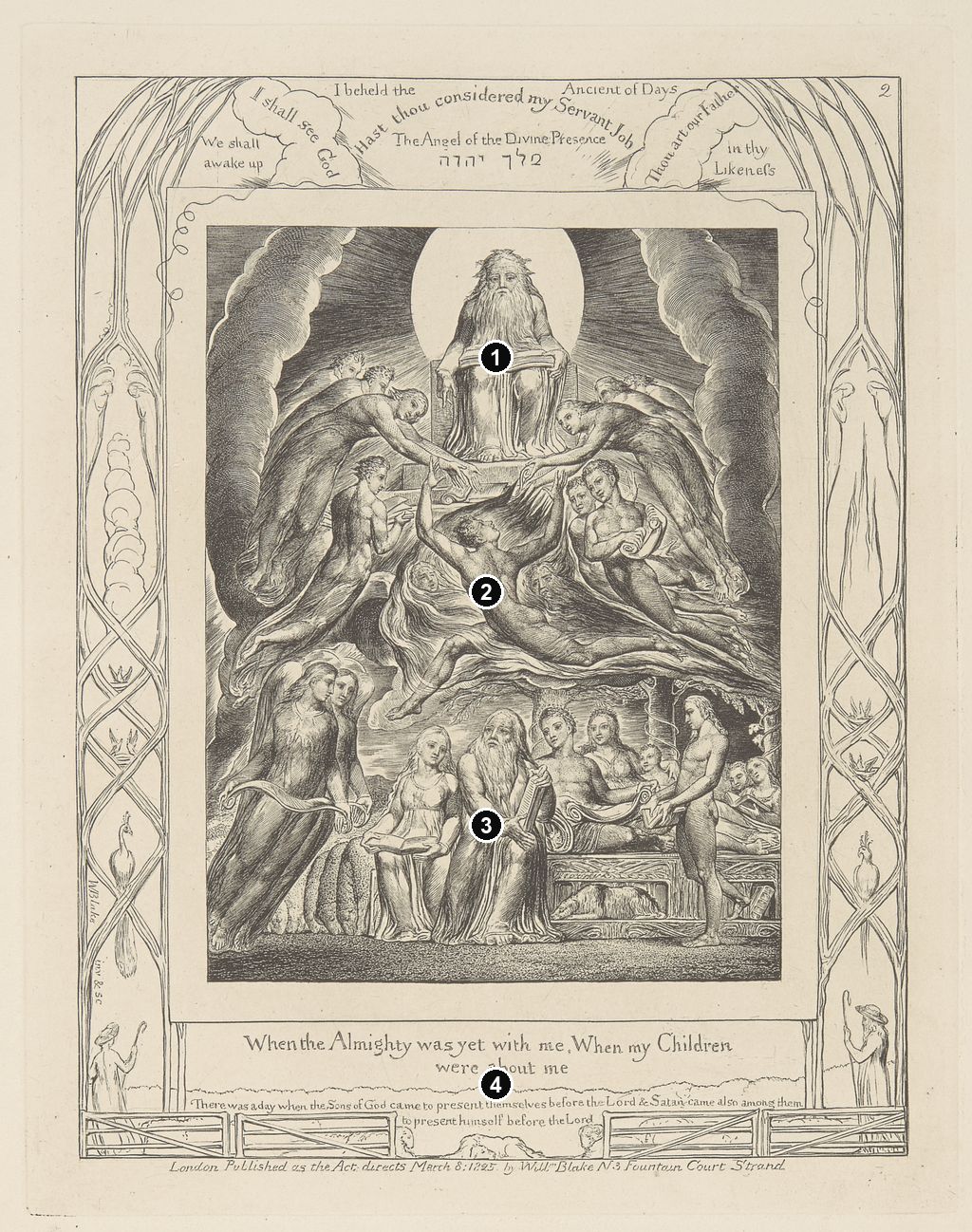
The throne occupies the central axis. A pale oval surrounds the seated figure’s head, while closely spaced lines radiate into the dark field around him. His long beard descends towards the open book. Below it, parallel folds of clothing continue the downward movement to his feet. The figure is remarkably still within a space whose surrounding forms seem to stream, bend and turn. Large columns of cloud enclose the upper scene at either side. [1]
The attendants introduce smaller movements around that stability. Two winged figures lean down and inwards from the throne, extending their hands towards the middle. Others carry books or scrolls. Their bent bodies, overlapping wings and flowing drapery give the heavenly gathering a structure of answering curves. The seated figure remains visible between them, with the book spread across his lap and one hand lowered beside the seat. Tate’s catalogue reads his gesture as pointing out Job to Satan. [1]
Satan cuts across this arrangement. His head turns upwards, his arms reach towards the throne and his legs extend along the lower sweep of flame. Blake gives him neither the bat wings nor the clawed extremities that might immediately identify a conventional devil. The youthful body belongs visually among the surrounding heavenly figures, while its sweeping posture makes it the scene’s most restless presence. The distinction is made through action and placement before it is made through ugliness. [1]
Below, the people occupy a much narrower space. Job sits close to his wife, supporting an upright book; her open volume lies across her knees. Young figures gather behind and beside them. At the left, two winged visitors incline towards the couple, one holding a long curling scroll. Further sheets unfold across the gathering on the right. Drapery and the carved couch give the group a low, continuous foundation, while a resting animal fits beneath the seat. The crowded intimacy of this level contrasts with the space given to Satan’s stretched limbs. [1]
Cloud, flame and the tree’s spreading forms connect the levels without making them comfortable neighbours. Satan passes immediately over the family. The people below can continue their gathering while the viewer sees what has entered the space above them. That unequal knowledge is one of the engraving’s strongest effects: we can look between causes and threatened lives, while Job remains within the household whose security is being discussed.
Permission and the limits of the test
In the first chapter of Job, the sons of God present themselves before the Lord, and Satan comes among them. Asked where he has been, Satan answers that he has been moving about the earth. God then draws attention to Job’s integrity. Satan challenges its motive: perhaps Job’s devotion depends on the protection, household and prosperity God has given him. Remove that protection, he argues, and Job will curse God. [2]
The encounter begins with praise of Job, not the discovery of an offence. That distinction matters when interpreting the catastrophe that follows. God permits Satan to exercise power over Job’s possessions while forbidding an attack on his person. The ensuing reports tell of raids, fire, dead servants and a great wind that brings down the house where the children are feasting. The chapter ends by affirming that Job has not sinned in his response. Its premise resists an easy equation between suffering and guilt. [2]
Blake’s picture gives the heavenly encounter a bodily force that the biblical dialogue leaves undescribed. Scripture supplies no pose for Satan’s presentation, no arrangement of attendants and no open book on the Lord’s knees. Blake makes the conversation visible through the contrast between seated authority and the airborne questioner. The calm family below supplies what is at stake in their exchange.
Chapter 2 repeats the meeting after Job has endured the first losses. God again affirms his integrity and explicitly describes his destruction as without cause. Satan now argues that bodily suffering will produce the curse that bereavement and dispossession have failed to elicit. A second permission allows him to attack Job’s body while preserving his life. He then afflicts Job with boils. These are successive permissions, with different limits; the family gathering in this second engraving belongs to the earlier moment before its destruction. [2]
The small inscription beneath the main caption also rewards comparison with both chapters. Its opening follows the first meeting, but its final words, about presenting himself before the Lord, occur in the fuller wording of the second. Tate identifies the passage with Job 1:6; Blake’s engraved sentence gathers wording found across the two accounts. The border invites reading between related moments even while the living household fixes the image’s place near the beginning. [1][2]
Satan’s presence in this court should therefore be understood through the particular story. He gains access, challenges Job’s motives and receives limited power. The scene does not depict a defeated rebel breaking into heaven, nor does Job describe a battle at this point. Blake’s later Fall of Satan gives expulsion a separate, invented place in the sequence. Here the disturbing event is that permission can coexist with the household’s apparently undiminished peace. [1][2]
The family remembered
The large lower caption changes the emotional time of the image. In chapter 29, Job longs for the months when God preserved him and light guided him through darkness. His children’s presence belongs to that recollection. By placing the words beneath this earlier gathering, Blake lets loss speak before the pictured people have suffered it. The caption is retrospective in its biblical setting, although the engraving returns us to the life it remembers. [2]
The rest of the chapter gives prosperity a substantial human meaning. Job recalls helping poor people, the fatherless and widows. He describes himself as a father to the poor and a defender of those who could not defend themselves. These are his claims within a speech about his former standing, but they show what he understands that standing to have involved. Household abundance and public responsibility belong together in his memory. [2]
This context prevents the family below from becoming merely a collection of possessions. The gathering includes attention, instruction and affection. Heads incline towards other heads; the winged visitors bring their scroll close to the seated couple; younger people share the couch and its immediate space. The books and sheets create occasions for exchange. Job’s upward face also connects the group to something beyond the volume he holds, though it does not establish that he sees the heavenly meeting.
Penelope Minney, discussing the earlier Butts watercolour of this composition, emphasises the ease of the family’s intercourse with angelic visitors. She challenges the influential assumption that books throughout Blake’s Job must mean restrictive law while scrolls invariably signify spiritual freedom. Her argument concerns the watercolours, whose absence of the engraved margins must be respected. It nevertheless provides a useful question for this print: what are these people actually doing with their books and sheets? [14]
The visible answer is more various than possession of a forbidden object. Some support a volume, others attend to a visitor or a neighbouring person. Above them, heavenly attendants also carry written forms, and the enthroned figure himself has a book. Repetition creates a relationship between the levels; it does not supply a simple code by which every volume condemns its holder. The engraving makes reading and understanding part of the same unsettled field as the question of Job’s faith. [1][14]
Tate also traces the lower arrangement, in reverse, to a much earlier watercolour in the Cincinnati Art Museum, dated about 1780–85. Its tentative title, Enoch Walked with God, competes with an identification as Job in prosperity. That uncertainty matters: the earlier sheet cannot be given a secure Job identity merely because its arrangement later served this subject. The catalogue’s comparison instead points to Blake’s continuing interest in a family gathered around an encounter between human and heavenly figures. [1]
Annotated Details from Satan before the Throne of God: Three Levels of Action
These details show the Yale Center for British Art’s 1826 impression, B1978.43.1504. Compare the seated figure above, the flying body between the groups and the family below.
Details from SATAN BEFORE THE THRONE OF GOD: THREE LEVELS OF ACTION
The details retain this impression’s engraved lines and paper tone.
The book on the throne
An open book lies across the seated figure’s knees. A pale oval frames his head while closely spaced rays extend into the darker space around him.
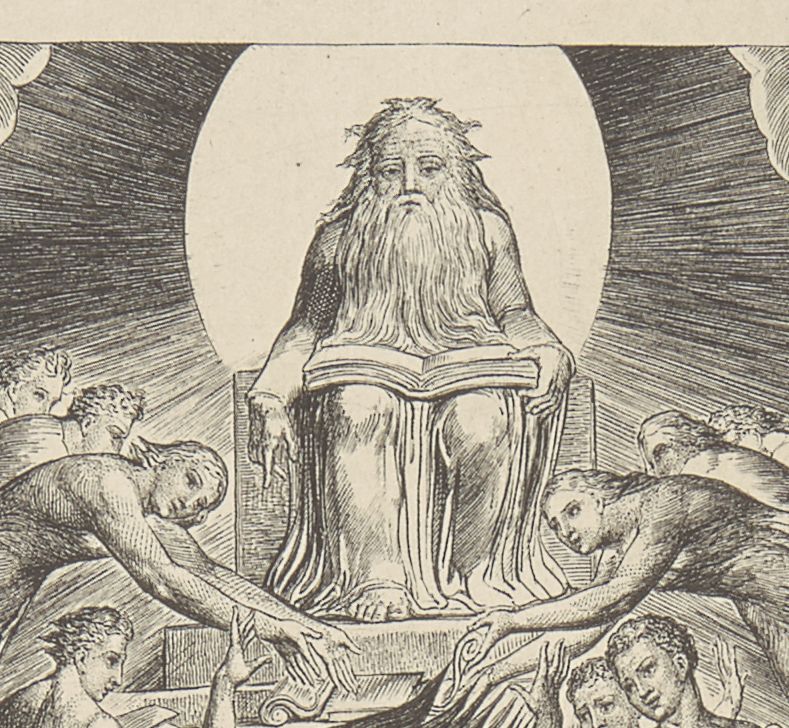
A body crossing the middle
The flying figure stretches both arms into the surrounding group. His reaching body crosses the scene between the throne and the family below.
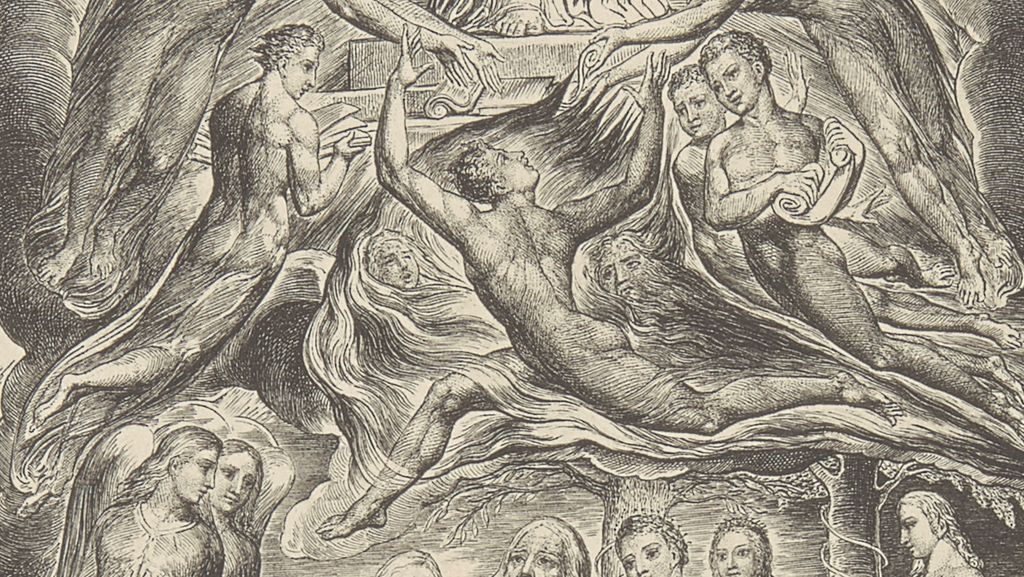
The family below
Open books draw attention to the hands of the lower group. Fingers, hair and layered garments distinguish the figures, while long curves connect them with the forms behind and above.
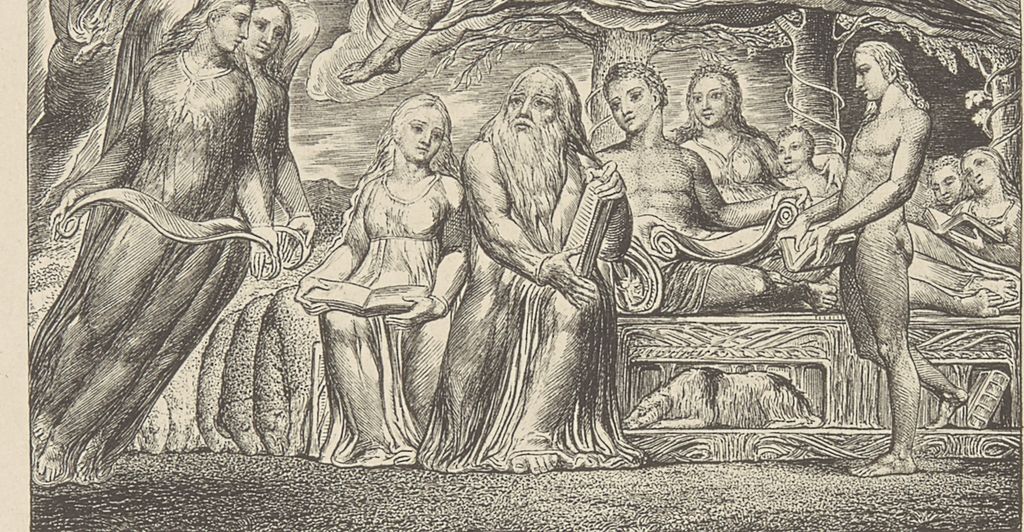
Letters beneath the picture
The lettering curves beneath the family scene. The lower border brings several lines of text into the same sheet as the pictured bodies.
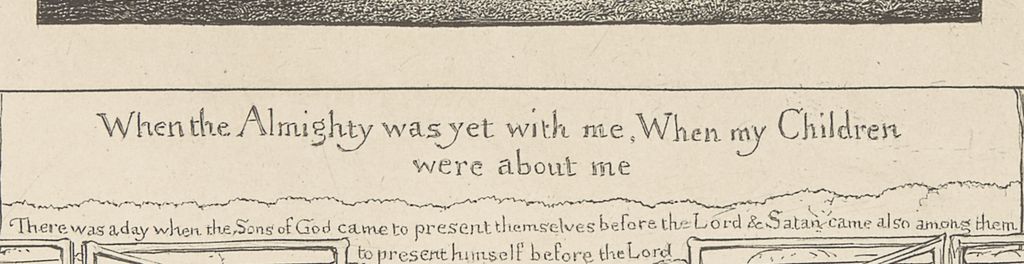
Image: Yale Center for British Art, B1978.43.1504. Numbered overview and detail crops from the collection’s original image. Collection record · CC0 1.0
Watch: William Blake’s world and working methods
Choose an introduction to Blake, a printing demonstration, or a discussion of his radical ideas.
William Blake: Poet, Artist & Visionary - a genius of early Romanticism in England
An introduction to Blake’s art, poetry and imaginative world.
Watch on YouTubeFaces carried within the flames
The likeness between the seated figure and Job is hard to miss. Both have long beards, prominent brows and books held close to the body. The difference in scale and height makes the resemblance more conspicuous: an aged figure presides above a household centred on another aged figure. Tate’s Martin Butlin catalogue explicitly observes the shared likeness, while drawing attention to the enthroned figure’s unusually pointed hair. [1]
The resemblance has encouraged interpretations in which the deity represents Job’s own conception of God. Minney reviews that established reading while considering alternatives in the earlier watercolours. Her discussion resists treating the heavenly figure’s identity as settled by his facial resemblance alone. The picture offers a relation between human and divine appearance; its meaning has been argued through the whole series, its versions and their inscriptions. [14]
There are more disturbing faces closer to Satan. Within the streaming forms beside his torso, two small heads emerge from the flames. Butlin identifies them as images of Job and his wife. This is a scholarly identification, supported by their relation to the lower couple and to the later sequence, rather than an identity supplied by a label beside each head. They appear as fiery likenesses while the living people remain seated below. [1]
That duplication makes Satan’s relation to the household peculiarly intimate. He travels with human appearances bound into the substance surrounding him. The forms do not establish that Job or his wife has literally joined him, and the main image carefully preserves the distinction between the small fiery heads and the complete bodies below. Later, plate sixteen returns to the motif during Satan’s fall. For this earlier scene, the essential effect is the uneasy proximity of threatened people and their likenesses within the threatening power. [1]
A border of vision and presence
Above the central rectangle, the words move through curved clouds and branching outlines. At the top, the Ancient of Days comes from Daniel’s seventh chapter. Daniel describes a dream of beasts, judgement and a heavenly throne, with white clothing, wool-like hair, fire and opened books. Blake condenses the scriptural wording to place this visionary authority over the encounter. The reference brings another biblical account of heavenly judgement into the reading of Job. [1][2]
The next curve carries God’s question about his servant Job. Nearby, the short statement “I shall see God” draws on Job 19:26. In that chapter, Job protests the harm done by his companions’ words and appeals for pity before declaring his confidence that he will behold God. The inscription therefore brings a later hope, voiced under pressure, over the still-prosperous family. Like the lower recollection, it makes the engraving contain more than the present episode. [1][2]
At the right, “Thou art our Father” recalls Isaiah 63:16 and 64:8. Those chapters move through recollection, complaint and appeal. Divine fatherhood is invoked amid affliction and desolation; it is not merely a statement that everything is well. At the outer upper edges, Blake divides an adaptation of Psalm 17:15, turning the psalmist’s awakening in God’s likeness into a shared future. The plural voice extends the hope across the page’s gathering. [1][2]
Psalm 17 itself is a prayer for a hearing and deliverance from oppressive enemies. Its closing likeness therefore follows danger and petition. Placed around a picture in which faces repeat across heaven, household and flame, the words give resemblance an additional spiritual possibility. Likeness can concern the hope of beholding and awakening, as well as the troubling duplication already visible in the picture. The border keeps those different relations in play. [2]
At the centre of the upper writing stands “The Angel of the Divine Presence”. Robert N. Essick points out that this exact phrase is absent from the Bible but derives from Isaiah 63:9, where the angel of God’s presence saves the afflicted. The surrounding passage recalls love, pity and redemption before turning to rebellion and conflict. Blake has drawn language of saving presence into a scene that initiates terrible suffering. Its position sharpens a question the picture cannot comfortably settle: how is the divine related to the pain being permitted? [15][2]
Words added during engraving
The Divine Presence wording also belongs to the history of Blake’s revisions. Essick records that the English phrase and the Hebrew beneath it were added in the eighth and final prepublication proof state of plate two. He links their arrangement to the same pairing on Blake’s Laocoön print, while noting a spelling change in the Hebrew. On the basis of the plate’s imprint sequence, he proposes a late 1825 or early 1826 addition. The interpretation of this engraving was still being shaped as its copperplate developed. [15]
The Hebrew has prompted a more specific disagreement. Tate’s catalogue gives its meaning as the Lord being king and relates it to Psalms 10, 47 and 97. In his original textual postscript, David V. Erdman reports Stephen Mitchell’s observation that Blake omitted an aleph from the word for angel, making it read as king; the corresponding word on Laocoön is correct. Erdman treats this as a misspelling and rejects Foster Damon’s conclusion that the lettering identifies Satan as King Jehovah, Job’s false god. Essick’s later account marks the possible misspelling with a question mark. The missing letter and the interpretations drawn from it need to remain distinct: the text’s history does not establish Blake’s intention. [1][16][15]
The psalms cited by Tate associate divine kingship with judgement, the defence of the oppressed, praise, cloud and fire. Those contexts are pertinent to the page’s throne and troubled radiance, but they do not resolve the lettering’s disputed development. The secure point is that the finished border places several names and ways of addressing the divine together. Authority, fatherhood, vision and saving presence surround an image in which divine permission remains profoundly difficult. [2]
The outer border continues that difficulty through a different graphic register. Long narrow stems interlace around birds, small flames and lightly outlined figures. At the bottom, low barriers frame resting animal forms, while standing people lift staffs beside the main caption. These open outlines leave much more paper visible than the dense central engraving. The eye moves between the weight of the main bodies and a surrounding world articulated through a few slender strokes. [1]
One composition, different sheets
The print’s dates belong to several stages of making and survival. Its publication line bears 8 March 1825. Tate’s shared catalogue distinguishes that engraved date from the issue of the completed suite in 1826, following the engraving agreement with John Linnell in 1823. The finished sequence contained twenty-one subjects and a separate title plate. The complete Job series gives this encounter its larger narrative setting. [1]
Tate’s own A00013 is catalogued as a line engraving on paper, dated 1825 and reprinted in 1874; its image measures 197 by 151 millimetres. Yale’s separately identified impression, B1978.43.1504, is dated 1826 in its official image record. These are distinct surviving sheets of the same engraved composition. Their catalogue dates should not be exchanged or automatically applied to another reproduction whose individual impression has not been identified. [1][17]
Across those sheets, the essential arrangement remains available to close looking. A book lies open above another book; faces answer one another at different scales; a vigorous body crosses the interval between authority and the family. Blake makes the coming disaster present without yet destroying the household. The people can still listen, read and remain together, while the border already carries the words through which their happiness will be remembered.
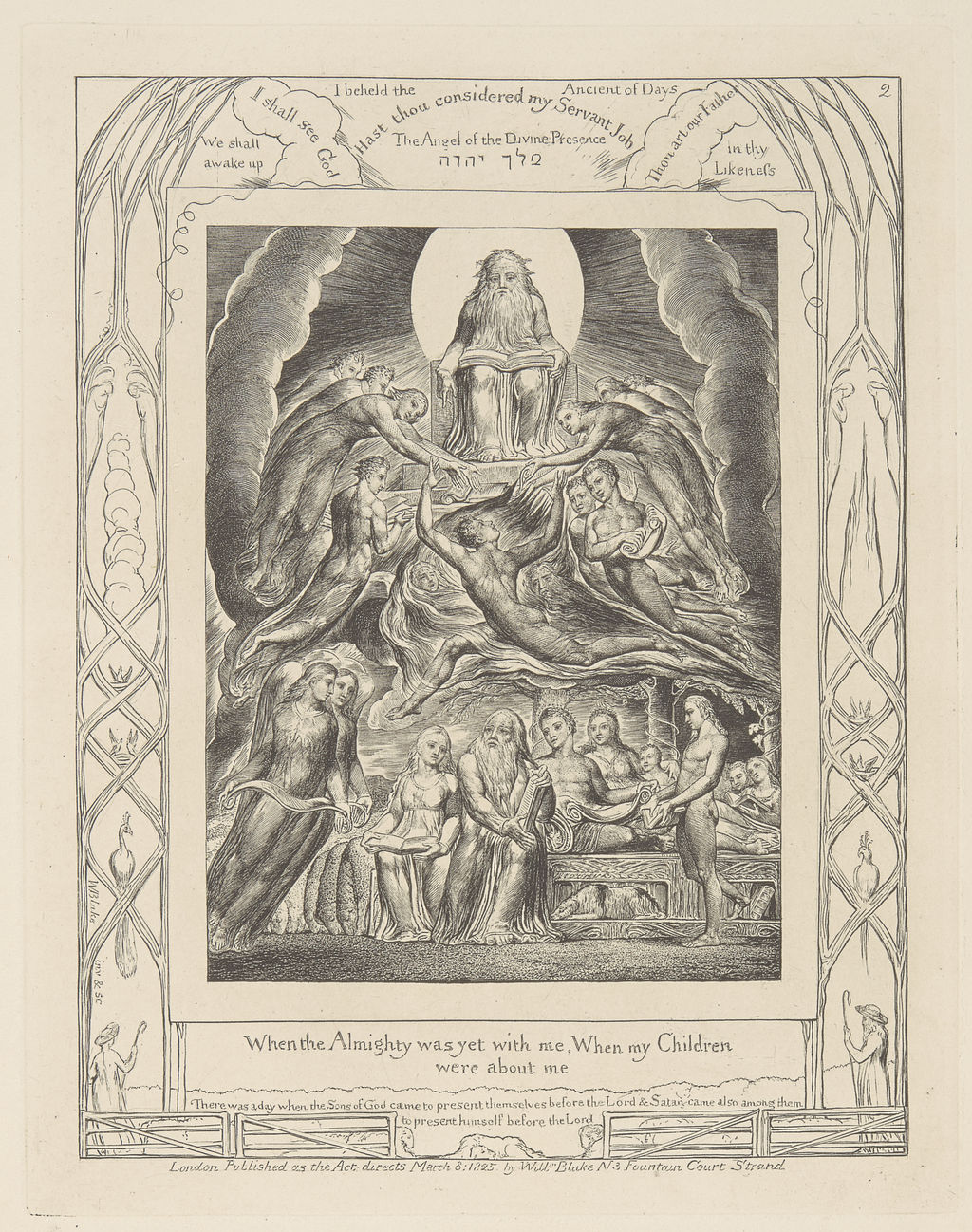
Satan before the Throne of God. Yale Center for British Art, B1978.43.1504, identified impression dated 1826. The engraved 1825 publication line is a separate date.
Works and designs directory
Browse separate works, impressions and book components. Dates distinguish versions; six Tate copies after Blake are labelled. These records are not a complete catalogue of unique designs.
| Name | Date | Medium |
|---|---|---|
| A Figure Standing in a Gothic Apse, perhaps the Empress Maud. Verso: Detailed Drawings for ‘The Empress Maud in Bed’ | c.1819 | Pencil drawing |
| A Rolling Stone Is Ever Bare of Moss, from Thornton's "Pastorals of Virgil" | 1821 | Wood engraving |
| A Title Page for The Grave | 1806 | Watercolour |
| A Vision of the Last Judgment | 1808 | Watercolour |
| A Vision: The Inspiration of the Poet (Elisha in the Chamber on the Wall) | c.1819–20? | Watercolour |
| Adam and the Beasts, Frontispiece to Hayley's "Ballads" | June 1, 1802 | Engraving |
| Age Teaching Youth | c.1785–90 | Watercolour |
| Alfred and the Neat-Herd’s Wife (after Henry Fuseli) | 1797, published 1798 | Etching and engraving |
| An Allegory of the Bible. Verso: The Shins of an Écorché Male Figure | c.1780–5, ?c.1780 | Watercolour |
| Angel of the Divine Presence Bringing Eve to Adam (The Creation of Eve: "And She Shall be Called Woman) (recto); Sketch for the same (verso) | ca. 1803 | Watercolour |
| Angel of the Revelation (Book of Revelation, chapter 10) | ca. 1803–5 | Watercolour |
| Antaeus setting down Dante and Virgil in the Last Circle of Hell | 1824–1827 | Watercolour |
| Bathsheba at the Bath | c.1799–1800 | Tempera |
| Beatrice Addressing Dante from the Car | 1824–7 | Watercolour |
| Behemoth and Leviathan | 1825–26 | Engraving |
| Behemoth and Leviathan | 1825, reprinted 1874 | Engraving |
| Behemoth and Leviathan | 1826 | Engraving |
| Blasted Trees and Flattened Crops, from Thornton's "Pastorals of Virgil" | 1821 | Wood engraving |
| Boy Returning Joyfully, with Plough and Oxen, from Thornton's "Pastorals of Virgil" | 1821 | Wood engraving |
| Boy Returning Joyfully, with Plough and Oxen, from Thornton's "Pastorals of Virgil" | 1821 | Wood engraving |
| Catherine Blake. Verso: A Man’s Head and Other Drawings | c.1805 | Pencil drawing |
| Cerberus | 1824–7 | Watercolour |
| Cerberus (second version) | 1824–1827 | Watercolour |
| Chaucer’s Canterbury Pilgrims | 1810, reprinted before 1881 | Engraving |
| Christ Appearing to His Disciples After the Resurrection | c.1795 | Colour print |
| Christ Appearing to the Apostles after the Resurrection | c.1795 | Watercolour |
| Christ Blessing the Little Children | 1799 | Tempera |
| Christ in the Carpenter’s Shop: The Humility of the Saviour (after William Blake) | Date not stated | Watercolour |
| Ciampolo the Barrator Tormented by the Devils | 1826–7, reprinted 1892 | Engraving |
| Ciampolo the Barrator Tormented by the Devils | 1826–7, reprinted 1968 | Engraving |
| Circle of Theives: Agnello Brunelleschi Attacked By a Six-Footed Serpent | ca. 1825–27 | Engraving |
| Clarence's Dream (Shakespeare, Richard III, Act 1, Scene 4) | 1774 | Etching and engraving |
| Colinet Mocked by Two Boys, from Thornton's "Pastorals of Virgil" | 1821 | Wood engraving |
| Colinet Rests by a Stream at Night | c.1821, printed 1830 | Wood engraving |
| Colinet Rests by a Stream at Night | 1821, reprinted 1977 | Wood engraving |
| Colinet with his Shepherd’s Pipe, Mocked by Two Boys | c.1821, printed 1830 | Wood engraving |
| Colinet with his Shepherd’s Pipe, Mocked by Two Boys | 1821, reprinted 1977 | Wood engraving |
| Colinet's Journey, Milestone Marked 'LXII Miles to London', from Thornton's "Pastorals of Virgil" | 1821 | Wood engraving |
| Colinet's Journey: Milestone Marked 'LXII Miles to London', from Thornton's "Pastorals of Virgil" | 1821 | Wood engraving |
| Colinet’s Fond Desire Strange Lands to Know | 1821, reprinted 1977 | Wood engraving |
| Colinet’s ‘Fond Desire Strange Lands to Know’ | c.1821, printed 1830 | Wood engraving |
| Composition Sketch for ‘The Fall of the Rebel Angels’? Verso: Standing Figure with Flaming Hair | ?c.1805–10 | Pencil drawing |
| Composition Sketch, Possibly a Subject from Dante. Verso: A Man Standing over a Figure Reclining on a Bed | ?1824–7, ?c.1800–10 | Pencil drawing |
| Composition Sketch. Verso: Standing Figure Holding a Spear | ?c.1805–10 | Pencil drawing |
| Dante and Virgil Approaching the Angel Who Guards the Entrance of Purgatory | 1824–7 | Watercolour |
| Dante and Virgil Penetrating the Forest | 1824–7 | Watercolour |
| Dante in the Empyrean, Drinking at the River of Light | 1824–7 | Watercolour |
| Dante running from the Three Beasts | 1824–1827 | Watercolour |
| Dante Striking against Bocca Degli Abati | 1826–7, reprinted 1892 | Engraving |
| Dante Striking Against Bocca degli Abati | 1826–7, reprinted 1968 | Engraving |
| David Delivered out of Many Waters | c.1805 | Watercolour |
| David Delivered out of Many Waters (after William Blake) | Date not stated | Watercolour |
| Detailed Drawings for ‘A Figure Standing in a Gothic Apse’ | 1819 | Pencil drawing |
| Elohim Creating Adam | 1795–c.1805 | Colour print |
| Enoch | 1806–7 | Lithograph |
| Epitome of James Hervey’s ‘Meditations among the Tombs’ | c.1820–5 | Watercolour |
| Europe. A Prophecy; Frontispiece | ca. 1820 | Relief etching |
| Evening | c.1820/1825 | Watercolour |
| Every Man also Gave him a Piece of Money | 1825, reprinted 1874 | Engraving |
| Every Man also Gave him a Piece of Money. Verso: God the Father with Attendant Angels | c.1821–3 | Watercolour |
| Every One also Gave Him a Piece of Money | 1826 | Engraving |
| Fertilization of Egypt, from Erasmus Darwin's "The Botanic Garden" | 1791 | Engraving |
| First Book of Urizen pl. 10 | 1796, c.1818 | Etching |
| First Book of Urizen pl. 11 | 1796, c.1818 | Etching |
| First Book of Urizen pl. 15 | 1796, c.1818 | Etching |
| First Book of Urizen pl. 17 | 1796, c.1818 | Etching |
| First Book of Urizen pl. 21 | 1796, c.1818 | Etching |
| First Book of Urizen pl. 6 | 1796, c.1818 | Etching |
| Frontispiece to Jerusalem, the Emanation of the Great Albion | [ca. 1804–20] (?) | Engraving |
| Frontispiece to ‘Visions of the Daughters of Albion’ | c.1795 | Relief etching |
| Frontispiece: Thenot and Colinet | c.1821, printed 1830 | Wood engraving |
| George Cumberland's Message Card | 1827 | Engraving |
| God Judging Adam | ca. 1795 | Relief etching |
| God Judging Adam | 1795 | Relief etching |
| Hiding of Moses, from "Remember Me!, or a Pocket Companion" | 1825 | Engraving |
| Homer and the Ancient Poets | 1824–7 | Watercolour |
| Illustration 1 to Milton’s On the Morning of Christ’s Nativity: The Descent of Peace | c.1814–1816 | Watercolour |
| Illustration 1 to Milton’s Paradise Lost: Satan Calling Up His Legions | 1807 | Watercolour |
| Job accepting Charity | 1825–26 | Engraving |
| Job and his Daughters | 1825–26 | Engraving |
| Job and his Daughters | 1825, reprinted 1874 | Engraving |
| Job and His Daughters | 1826 | Engraving |
| Job and His Family | 1825–26 | Engraving |
| Job and his Family | Reprinted 1874; engraved 1828 date is an error | Engraving |
| Job and His Family | 1826 | Engraving |
| Job and his Family Restored to Prosperity | 1825, reprinted 1874 | Engraving |
| Job and his Wife restored to Prosperity | 1825–26 | Engraving |
| Job rebuked by his Friends | 1825–26 | Engraving |
| Job Rebuked by his Friends | 1825, reprinted 1874 | Engraving |
| Job Rebuked by His Friends | 1826 | Engraving |
| Job's Comforters | 1825–26 | Engraving |
| Job's Comforters | 1826 | Engraving |
| Job's Despair | 1825–26 | Engraving |
| Job's Evil Dreams | 1825–26 | Engraving |
| Job's Evil Dreams | 1826 | Engraving |
| Job's Sacrifice | 1825–26 | Engraving |
| Job's Sons and Daughters Overwhelmed by Satan | 1826 | Engraving |
| Job, his Wife and his Friends: The Complaint of Job. Verso: Job’s Wife and Eight Other Sketches | c.1785 | Watercolour |
| Job’s Comforters | 1825, reprinted 1874 | Engraving |
| Job’s Despair | 1825, reprinted 1874 | Engraving |
| Job’s Evil Dreams | 1825, reprinted 1874 | Engraving |
| Job’s Sacrifice | 1825, reprinted 1874 | Engraving |
| Job’s Sons and Daughters Overwhelmed by Satan | 1825, reprinted 1874 | Engraving |
| John Linnell | 1825 | Pencil drawing |
| Joseph of Arimathea Preaching to the Britons | c.1794/1796 | Relief etching |
| Judas Betrays Him | c.1803–5 | Watercolour |
| King John Absolved by Pandulph (after Henry Fuseli) | 1797, published 1798 | Etching and engraving |
| Lamech and his Two Wives | 1795 | Colour print |
| Landscape near Felpham | c.1800 | Watercolour |
| Lear and Cordelia in Prison | c.1779 | Watercolour |
| Los and Orc | c.1792–3 | Watercolour |
| Lower Half of a Woman Playing a Harp. Verso: Seraphim and Other Drawings | c.1785, c.?1807 | Pencil drawing |
| Menalcus Watching Women Dance, from Thornton's "Pastorals of Virgil" | 1821 | Wood engraving |
| Menalcus Watching Women Dance, from Thornton's "Pastorals of Virgil" | 1821 | Wood engraving |
| Moses Indignant at the Golden Calf | c.1799–1800 | Tempera |
| Nebuchadnezzar | 1795–c.1805 | Colour print |
| Newton | 1795–c.1805 | Colour print |
| Oberon, Titania and Puck with Fairies Dancing | c.1786 | Watercolour |
| Pity | ca. 1795 | Relief etching |
| Pity | c.1795 | Colour print |
| Plate 2 of ‘Urizen’: ‘Teach these Souls to Fly’ | ?1796 | Relief etching |
| Plate 3 of ‘Urizen’: Oh! Flames of Furious Desires’ (after William Blake) | Date not stated | Watercolour |
| Plate 4 of ‘Visions of the Daughters of Albion’ | c.1795 | Relief etching |
| Plutus | 1824–7 | Watercolour |
| Preliminary Sketch for ‘Christ Girding Himself with Strength’. Verso: Standing Figure with One Arm Raised | c.1805, c.1805–10 | Pencil drawing |
| Preludium. "The shadowy daughter of Urthona stood before red Orc..." (Plate 3) | 1793 | Relief etching |
| Queen Elizabeth and Essex (after Henry Fuseli) | 1797, published 1798 | Engraving |
| Sabrina's Silvery Flood, from Thornton's "Pastorals of Virgil" | 1821 | Wood engraving |
| Sabrina's Silvery Flood, from Thornton's "Pastorals of Virgil" | 1821 | Wood engraving |
| Sabrina’s Silvery Flood | c.1821, printed 1830 | Wood engraving |
| Sabrina’s Silvery Flood | 1821, reprinted 1977 | Wood engraving |
| Satan Before the Throne of God | 1825–26 | Engraving |
| Satan before the Throne of God | 1825, reprinted 1874 | Engraving |
| Satan before the Throne of God | 1826 | Engraving |
| Satan calling up his Legions | c.1800–05 | Tempera |
| Satan Exulting over Eve | c.1795 | Colour print |
| Satan Going Forth from the Presence of the Lord, and Job’s Charity | 1825, reprinted 1874 | Engraving |
| Satan Going Forth fron the Presence of the Lord | 1825–26 | Engraving |
| Satan in his Original Glory: ‘Thou wast Perfect till Iniquity was Found in Thee’ | c.1805 | Watercolour |
| Satan Smiting Job with Boils | 1825–26 | Engraving |
| Satan Smiting Job with Sore Boils | 1825, reprinted 1874 | Engraving |
| Satan Smiting Job with Sore Boils | c.1826 | Tempera |
| Satan Smiting Job with Sore Boils | 1826 | Engraving |
| Shepherd Chases Away a Wolf, from Thornton's "Pastorals of Virgil" | 1821 | Wood engraving |
| Shepherd Chases Away a Wolf, from Thornton's "Pastorals of Virgil" | 1821 | Wood engraving |
| Sketch for the Title-Page of the Engraved Illustrations to the Book of Job | c.1823/1826 | Pencil drawing |
| Sketch for ‘The Four and Twenty Elders Casting their Crowns before the Divine Throne’. Verso: Standing Figure with Arms at his Side | c.1803, c.1805–10 | Pencil drawing |
| Sketch for ‘Tiriel Supporting the Dying Myratana’. Verso: Sketch for ‘Tiriel Supporting the Dying Myratana’ | c.1786–9 | Pencil drawing |
| Songs of Experience: A Little Boy Lost | [1794] printed ca. 1825 | Relief etching |
| Songs of Experience: A Little Girl Lost | [1794] printed ca. 1825 | Relief etching |
| Songs of Experience: A Poison Tree | [1794] printed ca. 1825 | Relief etching |
| Songs of Experience: Earth's Answer | [1794] printed ca. 1825 | Relief etching |
| Songs of Experience: Frontispiece | [1794] printed ca. 1825 | Relief etching |
| Songs of Experience: Holy Thursday | [1794] printed ca. 1825 | Relief etching |
| Songs of Experience: Infant Sorrow | [1794] printed ca. 1825 | Relief etching |
| Songs of Experience: Introduction | [1794] printed ca. 1825 | Relief etching |
| Songs of Experience: London | [1794] printed ca. 1825 | Relief etching |
| Songs of Experience: My Pretty Rose Tree, Ah! Sun-Flower, The Lilly | [1794] printed ca. 1825 | Relief etching |
| Songs of Experience: Nurses Song | [1794] printed ca. 1825 | Relief etching |
| Songs of Experience: The Angel | [1794] printed ca. 1825 | Relief etching |
| Songs of Experience: The Chimney Sweeper | [1794] printed ca. 1825 | Relief etching |
| Songs of Experience: The Clod & the Pebble | [1794] printed ca. 1825 | Relief etching |
| Songs of Experience: The Fly | [1794] printed ca. 1825 | Relief etching |
| Songs of Experience: The Garden of Love | [1794] printed ca. 1825 | Relief etching |
| Songs of Experience: The Human Abstract | [1794] printed ca. 1825 | Relief etching |
| Songs of Experience: The Little Girl Found (second plate) | [1789] printed ca. 1825 | Relief etching |
| Songs of Experience: The Little Girl Lost | [1789] printed ca. 1825 | Relief etching |
| Songs of Experience: The Little Girl Lost (second plate); The Little Girl Found | [1789] printed ca. 1825 | Relief etching |
| Songs of Experience: The Little Vagabond | [1794] printed ca. 1825 | Relief etching |
| Songs of Experience: The School Boy | [1789] printed ca. 1825 | Relief etching |
| Songs of Experience: The Sick Rose | [1794] printed ca. 1825 | Relief etching |
| Songs of Experience: The Tyger | [1794] printed ca. 1825 | Relief etching |
| Songs of Experience: The Voice of the Ancient Bard | [1789] printed ca. 1825 | Relief etching |
| Songs of Experience: Title-page | [1794] printed ca. 1825 | Relief etching |
| Songs of Experience: To Tirzah | [1794] printed ca. 1825 | Relief etching |
| Songs of Innocence and of Experience, Shewing the Two Contrary States of the Human Soul: Combined Title-page | [1789–94] printed ca. 1825 | Relief etching |
| Songs of Innocence and of Experience: Infant Sorrow | 1794, reprinted 1831 or later | Relief etching |
| Songs of Innocence: A Cradle Song | [1789] printed ca. 1825 | Relief etching |
| Songs of Innocence: A Cradle Song (second plate) | [1789] printed ca. 1825 | Relief etching |
| Songs of Innocence: A Dream | [1794] printed ca. 1825 | Relief etching |
| Songs of Innocence: Frontispiece | [1789] printed ca. 1825 | Relief etching |
| Songs of Innocence: Holy Thursday | [1789] printed ca. 1825 | Relief etching |
| Songs of Innocence: Infant Joy | [1789] printed ca. 1825 | Relief etching |
| Songs of Innocence: Introduction | [1789] printed ca. 1825 | Relief etching |
| Songs of Innocence: Laughing Song | [1789] printed ca. 1825 | Relief etching |
| Songs of Innocence: Little Boy Lost | [1789] printed ca. 1825 | Relief etching |
| Songs of Innocence: Night | [1789] printed ca. 1825 | Relief etching |
| Songs of Innocence: Night (second plate) | [1789] printed ca. 1825 | Relief etching |
| Songs of Innocence: Nurse's Song | [1789] printed ca. 1825 | Relief etching |
| Songs of Innocence: On Anothers Sorrow | [1789] printed ca. 1825 | Relief etching |
| Songs of Innocence: Spring | [1789] printed ca. 1825 | Relief etching |
| Songs of Innocence: Spring (second plate) | [1789] printed ca. 1825 | Relief etching |
| Songs of Innocence: The Blossom | [1789] printed ca. 1825 | Relief etching |
| Songs of Innocence: The Chimney Sweeper | [1789] printed ca. 1825 | Relief etching |
| Songs of Innocence: The Divine Image | [1789] printed ca. 1825 | Relief etching |
| Songs of Innocence: The Ecchoing Green | [1789] printed ca. 1825 | Relief etching |
| Songs of Innocence: The Ecchoing Green (second plate) | [1789] printed ca. 1825 | Relief etching |
| Songs of Innocence: The Lamb | [1789] printed ca. 1825 | Relief etching |
| Songs of Innocence: The Little Black Boy | [1789] printed ca. 1825 | Relief etching |
| Songs of Innocence: The Little Black Boy (second plate) | [1789] printed ca. 1825 | Relief etching |
| Songs of Innocence: The Little Boy Found | [1789] printed ca. 1825 | Relief etching |
| Songs of Innocence: The Shepherd | [1789] printed ca. 1825 | Relief etching |
| Songs of Innocence: Title Page | [1789] printed ca. 1825 | Relief etching |
| St Christopher, Copy from an Engraving? Verso:Part of a Face: Copy from a Plaster Cast: a Daughter of Niobe? | ?c.1779–80 | Pencil drawing |
| The Agony in the Garden | c.1799–1800 | Tempera |
| The Angel Appearing to Zacharias | 1799–1800 | Tempera |
| The Ascent of the Mountain of Purgatory | 1824–7 | Watercolour |
| The Baffled Devils Fighting | 1826–7, reprinted 1892 | Engraving |
| The Baffled Devils Fighting | 1826–7, reprinted 1968 | Engraving |
| The Bard, from Gray | ?1809 | Tempera |
| The Beggar's Opera, Act III | July 1, 1790 | Etching and engraving |
| The Beggar's Opera, Act III | July 1, 1790 | Engraving |
| The Beggar's Opera, Act III | 1790 | Engraving |
| The Blasphemer | c.1800 | Watercolour |
| The Blighted Corn | c.1821, printed 1830 | Wood engraving |
| The Blighted Corn | 1821, reprinted 1977 | Wood engraving |
| The Body of Abel Found by Adam and Eve | c.1826 | Tempera |
| The Body of Christ Borne to the Tomb | c.1799–1800 | Tempera |
| The Book of Job: Title Page | 1825 | Engraving |
| The Book of Thel pl. 6 | 1796, c.1818 | Etching |
| The Circle of Corrupt Officials: The Devils Mauling Each Other | ca. 1825–27 | Engraving |
| The Circle of Corrupt Officials: The Devils Tormenting Ciampolo | ca. 1825–27 | Engraving |
| The Circle of the Lustful: Francesca da Rimini (‘The Whirlwind of Lovers’) | 1826–7, reprinted 1892 | Engraving |
| The Circle of the Lustful: Francesca da Rimini (‘The Whirlwind of Lovers’) | 1826–7, reprinted 1968 | Engraving |
| The Circle of the Lustful: Paolo and Francesca | ca. 1825–27 | Engraving |
| The Circle of the Thieves; Buoso Donati Attacked by the Serpent | ca. 1825–27 | Engraving |
| The Circle of Traitors: Dante's Foot Striking Bocca degli Abbate | ca. 1825–27 | Engraving |
| The Complaint and the Consolation; or, Night Thoughts | 1797 | Etching and engraving |
| The Creation | 1825–26 | Engraving |
| The Crucifixion | c.1825–7 | Pencil drawing |
| The Crucifixion: ‘Behold Thy Mother’ | c.1805 | Watercolour |
| The Dance of Albion (Glad Day) | c.1803/1810 | Engraving |
| The Death of Lucretia, from Allen's "New and Impartial Roman History" | 1797 | Engraving |
| The Death of Saint Joseph | 1803 | Watercolour |
| The Death of the Virgin | 1803 | Watercolour |
| The Descent of Peace [recto] | c.1815 | Pencil drawing |
| The Destruction of Job's Sons | 1825–26 | Engraving |
| The Devils, with Dante and Virgil by the Side of the Pool | 1824–7 | Watercolour |
| The Entombment | c.1805 | Watercolour |
| The Fall of Rosamond (after Thomas Stothard) | 1783 | Etching and engraving |
| The Fall of Satan | 1825–26 | Engraving |
| The Fall of Satan | 1825, reprinted 1874 | Engraving |
| The Fall of Satan | 1826 | Engraving |
| The Four and Twenty Elders Casting their Crowns before the Divine Throne | c.1803–5 | Watercolour |
| The Ghost of a Flea | c.1819–20 | Tempera |
| The Good and Evil Angels | 1795–?c.1805 | Colour print |
| The Good Farmer, Probably the Parable of the Wheat and the Tares. Verso: Rough Sketch of Two or Three Figures in a Landscape | c.1780–5 | Watercolour |
| The Great Red Dragon and the Beast from the Sea | c.1805 | Watercolour |
| The Great Red Dragon and the Woman Clothed with the Sun | c.1805 | Watercolour |
| The Head of the Ghost of a Flea. Verso: A Profile and a Reduced Drawing of Milton’s First Wife | c.1819 | Pencil drawing |
| The Hermit’s Dog, from William Hayley’s "Ballads" | 1805 | Etching and engraving |
| The Hiding of Moses | 1824 | Engraving |
| The House of Death | 1795–c.1805 | Colour print |
| The House of Death | c.1790 | Watercolour |
| The Hypocrites with Caiaphas. Verso: Sketch of a Stooping Figure | 1824–7 | Watercolour |
| The Inscription over the Gate | 1824–7 | Watercolour |
| The Laborious Passage along the Rocks | 1824–7 | Watercolour |
| The Last Trumpet (recto); Two studies of a right eye, a profile of an open-mouthed young man, the head of an eagle, and the head of a lion (verso) | 1780–85 | Pencil drawing |
| The Lord Answering Job out of the Whirlwind | 1825–26 | Engraving |
| The Lord Answering Job out of the Whirlwind | 1825, reprinted 1874 | Engraving |
| The Man Who Taught Blake Painting in his Dreams (counterproof) (after William Blake) | after c.1819–20 | Pencil drawing |
| The Marriage of Heaven and Hell pl. 16 | 1796, c.1818 | Etching |
| The Messengers tell Job of his Misfortunes | 1825–26 | Engraving |
| The Messengers tell Job of his Misfortunes | 1825, reprinted 1874 | Engraving |
| The Night of Enitharmon’s Joy (formerly called ‘Hecate’) | c.1795 | Colour print |
| The Parable of the Wise and Foolish Virgins | ca. 1799–1800 | Watercolour |
| The Parable of the Wise and Foolish Virgins (after William Blake) | Date not stated | Watercolour |
| The Pastorals of Virgil, with a Course of English Reading, Adapted for Schools, Vol. I | 1821 | Wood engraving |
| The Penance of Jane Shore in St Paul’s Church | c.1793 | Watercolour |
| The Pit of Disease: The Falsifiers | 1826–7, reprinted 1892 | Engraving |
| The Pit of Disease: The Falsifiers | 1824–7 | Watercolour |
| The Pit of Disease: The Falsifiers | 1826–7, reprinted 1968 | Engraving |
| The Primaeval Giants Sunk in the Soil | 1824–7 | Watercolour |
| The Punishment of the Thieves | 1824–7 | Watercolour |
| The Raising of Lazarus (after William Blake) | Date not stated | Watercolour |
| The Rest on the Flight into Egypt (The Repose of the Holy Family in Egypt) | 1806 | Watercolour |
| The River of Life | c.1805 | Watercolour |
| The Rock Sculptured with the Recovery of the Ark and the Annunciation | 1824–7 | Watercolour |
| The Serpent Attacking Buoso Donati | 1826–7, reprinted 1892 | Engraving |
| The Serpent Attacking Buoso Donati | 1826–7, reprinted 1968 | Engraving |
| The Serpent Attacking Buoso Donati. Verso: A Man with a Transparent Hood (?) over his Head | 1824–7 | Watercolour |
| The Simoniac Pope | 1824–7 | Watercolour |
| The Six-Footed Serpent Attacking Agnolo Brunelleschi | 1826–7, reprinted 1892 | Engraving |
| The Six-Footed Serpent Attacking Agnolo Brunelleschi | 1826–7, reprinted 1968 | Engraving |
| The Soul Hovering over the Body Reluctantly Parting with Life | c.1805 | Pencil drawing |
| The Spiritual Form of Nelson Guiding Leviathan | c.1805–9 | Tempera |
| The Spiritual Form of Pitt Guiding Behemoth | ?1805 | Tempera |
| The Sun at His Eastern Gate | c.1816–1820 | Watercolour |
| The Temple of Mirth, after Thomas Stothard | 1784 | Engraving |
| The Temptation and Fall of Eve | 1807 | Watercolour |
| The Temptation and Fall of Eve (Illustration to Milton’s Paradise Lost) | 1808 | Watercolour |
| The Thieves and Serpents | 1824–1827 | Watercolour |
| The Vision of Christ | 1825, reprinted 1874 | Engraving |
| The Vision of Eliphaz | 1825–26 | Engraving |
| The Vision of Eliphaz | 1825, reprinted 1874 | Engraving |
| The Vision of God | 1825–26 | Engraving |
| The Wood of the Self-Murderers: The Harpies and the Suicides | 1824–7 | Watercolour |
| The Wrath of Elihu | 1825–26 | Engraving |
| The Wrath of Elihu | 1825, reprinted 1874 | Engraving |
| Thenot and Colinet | 1821, reprinted 1977 | Wood engraving |
| Thenot and Colinet at Supper | c.1821, printed 1830 | Wood engraving |
| Thenot and Colinet at Supper | 1821, reprinted 1977 | Wood engraving |
| Thenot and Colinet Converse Seated between Two Trees | c.1821, printed 1830 | Wood engraving |
| Thenot and Colinet Converse Seated between Two Trees | 1821, reprinted 1977 | Wood engraving |
| Thenot and Colinet Eat Their Evening Meal, from Thornton's "Pastorals of Virgil" | 1821 | Wood engraving |
| Thenot and Colinet Folding their Flocks together at Sunset | c.1821, printed 1830 | Wood engraving |
| Thenot and Colinet Folding their Flocks together at Sunset | 1821, reprinted 1977 | Wood engraving |
| Thenot and Colinet Lead Their Flocks Together, from Thornton's "Pastorals of Virgil" | 1821 | Wood engraving |
| Thenot and Colinet Lead Their Flocks Together, from Thornton's "Pastorals of Virgil" | 1821 | Wood engraving |
| Thenot Remonstrates with Colinet | c.1821, printed 1830 | Wood engraving |
| Thenot Remonstrates with Colinet | 1821, reprinted 1977 | Wood engraving |
| Thenot Remonstrates With Colinet, from Thornton's "Pastorals of Virgil" | 1821 | Wood engraving |
| Thenot Remonstrates With Colinet, from Thornton's "Pastorals of Virgil" | 1821 | Wood engraving |
| Thenot Remonstrates with Colinet, Lightfoot in the Background, from Thornton's "Pastorals of Virgil" | 1821 | Wood engraving |
| Thenot Remonstrates with Colinet: Lightfoot in the Distance | 1821, reprinted 1977 | Wood engraving |
| Thenot Remonstrates with Colinet; Lightfoot in the Distance | c.1821, printed 1830 | Wood engraving |
| Thenot Under a Fruit Tree, from Thornton's "Pastorals of Virgil" | 1821 | Wood engraving |
| Thenot, with Colinet Waving his Arms in Sorrow | c.1821, printed 1830 | Wood engraving |
| Thenot, with Colinet Waving his Arms in Sorrow | 1821, reprinted 1977 | Wood engraving |
| Title Page: Illustrations of the Book of Job | 1825–26 | Engraving |
| Title-Page of ‘The Book of Job’ | 1825, reprinted 1874 | Engraving |
| Tornado–Zeus Battling Typhon, from Erasmus Darwin's "Botanic Garden" | August 1, 1795 | Engraving |
| Tornado–Zeus Battling Typhon, from Erasmus Darwin's "The Botanic Garden" | August 1, 1795 | Engraving |
| Two Figures in a Decorative Border | c.1790 | Pencil drawing |
| Unyok'd Heifers, Loitering Homeward (Return of the Shepherd), from Thornton's "Pastorals of Virgil" | 1821 | Wood engraving |
| Virgil Girding Dante’s Brow with a Rush | 1824–7 | Watercolour |
| Wat Tyler and the Tax-Gatherer (after Henry Fuseli) | 1797, published 1798 | Etching and engraving |
| When the Morning Stars Sang Together | 1825, reprinted 1874 | Engraving |
| When the Morning Stars Sang Together | 1826 | Engraving |
| Winged Figure Flying Through Clouds, from Bell's "Poets" | 1790 | Etching and engraving |
| Winter | c.1820–5 | Tempera |
| ‘A Rolling Stone is ever Bare of Moss’ | c.1821, printed 1830 | Wood engraving |
| ‘A Rolling Stone is ever Bare of Moss’ | 1821, reprinted 1977 | Wood engraving |
| ‘And Unyok’d Heifers, Loitering Homeward, Low’ | c.1821, printed 1830 | Wood engraving |
| ‘And Unyok’d Heifers, Loitering Homewards, Low’ | 1821, reprinted 1977 | Wood engraving |
| ‘Europe’: Fragment of Pages 3 and 4 | 1794–c.1830–5 | Relief etching |
| ‘For him Our Yearly Wakes and Feasts We Hold’ | c.1821, printed 1830 | Wood engraving |
| ‘For him Our Yearly Wakes and Feasts We Hold’ | 1821, reprinted 1977 | Wood engraving |
| ‘Nor Fox, nor Wolf, nor Rat among our Sheep’ | c.1821, printed 1830 | Wood engraving |
| ‘Nor Fox, nor Wolf, nor Rat among our Sheep’ | 1821, reprinted 1977 | Wood engraving |
| ‘Songs of Innocence and of Experience’: ‘Infant Sorrow’ | 1794, reprinted 1831 or later | Relief etching |
| ‘Songs of Innocence and of Experience’: ‘Spring’ | 1794, reprinted 1831 or later | Relief etching |
| ‘Songs of Innocence’: Title-Page | 1789, reprinted 1831 or later | Relief etching |
| ‘Songs of Innocence’: Title-Page | 1789, reprinted 1831 or later | Relief etching |
| ‘With Songs the Jovial Hinds Return from Plow’ | c.1821, printed 1830 | Wood engraving |
| ‘With Songs the Jovial Hinds Return from Plow’ | 1821, reprinted 1977 | Wood engraving |
Frequently Asked Questions
In chapter 29 it is a later recollection. Blake places that retrospective voice beneath the earlier household. [2]
Essick records Divine Presence and its Hebrew wording as additions in the eighth and final prepublication proof state. [15]
Discussion
Look again at the images and ideas explored in Satan Before the Throne of God by William Blake. These editorial prompts invite your observations.
Reader Insights
Three levels bring divine conversation into the same scene as family life. The viewer can connect what the household cannot yet know.
Job’s later memory speaks beneath people who remain intact. The caption lets loss enter before the pictured disaster.
The final proof-state additions keep interpretation open during engraving. Words continued to shape the work as its copper developed.
Join the Conversation
Share a detail, comparison or question about Satan Before the Throne of God by William Blake below.
References
- Tate / Martin Butlin. William Blake, Satan before the Throne of God, A00013. Current object fields and complete catalogue entry, including the shared Illustrations to the Book of Job account; originally published in William Blake 1757–1827, Tate Gallery Collections V (1990). Object identity, inscriptions, interpretation, series and printing history. The individual A00027 catalogue entry was also consulted for the brief plate sixteen comparison. View plate two; view plate sixteen. View source 1. View source 2.
- The Holy Bible, King James Version. Job 1–2, 19 and 29; Daniel 7; Isaiah 63–64; Psalms 10, 17, 47 and 97, complete chapters. Primary encounter, household memory and contexts of Blake’s adapted marginal texts. Project Gutenberg, ebook 10. Read the source edition. View source.
- Society of Antiquaries of London. “William Blake's drawings of Westminster Abbey,” collection highlight, apprenticeship and antiquarian drawings. View source.
- The Morgan Library & Museum. “175. Poetical Sketches,” 1783, copy X, PML 61487, William Blake's World. View source.
- William Blake. Songs of Innocence and of Experience , title pages; “Introduction,” “The Lamb,” both “The Chimney Sweeper” poems, “The Tyger” and “London,” Erdman digital transcription, Arizona State University. View source.
- William Blake. To the Public , prospectus dated 10 October 1793, E692–693. David V. Erdman edition, electronic transcription. View source.
- Tate; Martin Butlin. Newton , 1795/c.1805, N05058, collection record and catalogue entry in William Blake 1757–1827 , Tate Gallery Collections V (London: Tate Gallery, 1990). View source.
- Sir John Soane's Museum. Edward Young, The Complaint, and the Consolation; or, Night Thoughts (London: R. Noble for R. Edwards, 1797), library reference 3653, collection catalogue. View source.
- William Blake. Exhibition advertisements, conditions of sale and A Descriptive Catalogue , 1809, especially preface and nos. I–V, IX and XI–XVI, E527–550. David V. Erdman edition, electronic transcription. View source.
- Tate; Martin Butlin. The Ghost of a Flea , c.1819–20, N05889, collection record and catalogue entry in William Blake 1757–1827 , Tate Gallery Collections V (1990), including discussion of Varley and Cunningham's testimony. View source.
- Tate; Martin Butlin. Job and his Family , A00012, catalogue introduction to Illustrations to the Book of Job: Engravings , in William Blake 1757–1827 , Tate Gallery Collections V (1990), agreement, publication and textual borders. View source.
- Tate; Martin Butlin. Dante and Virgil Penetrating the Forest , 1824–27, N03351, collection record, 2023 display caption and catalogue entry in William Blake 1757–1827 , Tate Gallery Collections V (1990). View source.
- Tate / Martin Butlin. William Blake, Satan before the Throne of God , A00013. Current object fields and complete catalogue entry, including the shared Illustrations to the Book of Job account; originally published in William Blake 1757–1827 , Tate Gallery Collections V (1990). Object identity, inscriptions, interpretation, series and printing history. The individual A00027 catalogue entry was also consulted for the brief plate sixteen comparison. View source.
- Penelope Minney. Job’s Gethsemane: Tradition and Imagination in William Blake’s Illustrations for the Book of Job, M.Litt. thesis, Durham University (1997), pp.66–71 and 84–89. Books and scrolls, the earlier Butts family composition and competing interpretations of God and Satan; the watercolour focus remains distinct from the engraved margins. Read the thesis. View source.
- Robert N. Essick. “Blake’s Job: Some Unrecorded Proofs and Their Inscriptions”, Blake/An Illustrated Quarterly 19.3 (Winter 1985–86), pp.96–102, especially p.99 note 4 and p.100 note 6. The Divine Presence phrase, its Isaiah source, the late proof-state addition and the Hebrew spelling question. Read the archived article. View source.
- David V. Erdman. “Redefining the Texts of Blake (another temporary report)”, Blake/An Illustrated Quarterly 17.1 (Summer 1983), p.14, “Postscript on Blake’s Hebrew lettering”. Stephen Mitchell’s observation of the omitted aleph and Erdman’s correction of Damon’s identification. Read the archived article. View source.
- Yale Center for British Art. William Blake, Satan before the Throne of God, B1978.43.1504, Paul Mellon Collection. Complete official IIIF manifest for tms:2434, identifying the impression as 1826, and recto image. View the official image record. View source.


