 by Tom Gurney
Tom Gurney BSc (Hons) is an art history expert with over 20 years experience
Published on June 19, 2020 / Updated on October 14, 2023
Email: tomgurney1@gmail.com / Phone: +44 7429 011000
Moll’s Wake: Introduction
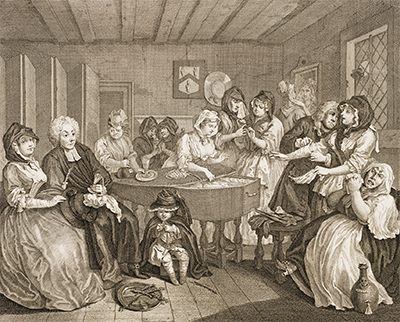
In William Hogarth’s Moll’s Wake, a drinking glass stands on the lid of an open coffin. The young woman inside is Moll Hackabout, the fictional protagonist of A Harlot’s Progress. Her mourners have gathered before the burial, and the coffin takes up the centre of the room. Yet the people nearest it are busy with a glass, a glove, a ring and a handkerchief. Hogarth makes it possible to follow each of these small transactions while barely catching sight of Moll. The Metropolitan Museum of Art dates its third-state impression, an etching and engraving, to April 1732. This is the sixth and final plate of the series. [1]
At a Glance
- ArtistWilliam Hogarth
- Series positionPlate 6 of 6 in A Harlot’s Progress
- MediumEtching and engraving
- Third-state impressionApril 1732, The Metropolitan Museum of Art, 91.1.133
- First-state impressionBefore April 1732, The Metropolitan Museum of Art, 32.35(7)
This work across William Hogarth’s career
Assembly at Wanstead House
1728–31The Heir
1734The Marriage Settlement
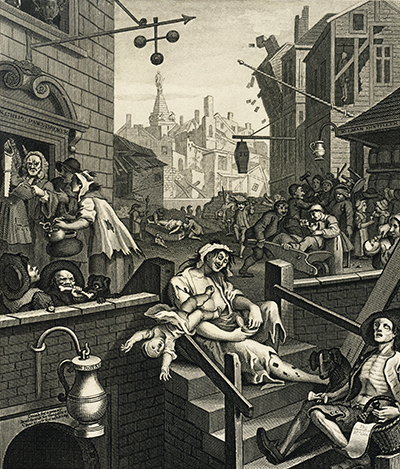
about 1743Gin Lane
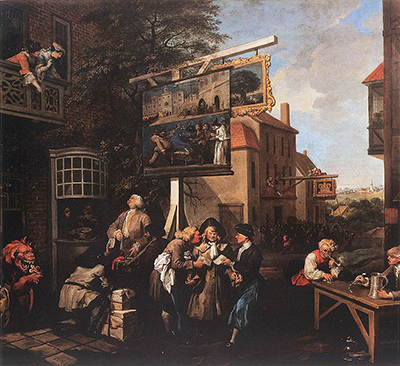
1751Canvassing for Votes
1754–55Contents
- A name on the coffin
- Gifts, drink and diverted hands
- The boy in the foreground
- Reading the printed sheet
A name on the coffin
The lid lies askew. It covers much of the opening and leaves a strip of pale, ruffled fabric visible towards the right. A woman in a light cap leans over the exposed portion, one hand hanging over the edge. The coffin’s long, dark side faces the spectator, with a handle near the right end. Hogarth gives that broad surface very little incident. Above it, where light catches caps, cuffs and hands, almost every figure is doing something. The adult company seems to form a single group until you follow where each person is looking. [1]
A small ornament on the lid supplies what the glimpse into the coffin cannot. Colonial Williamsburg reads the name as M. Hackabout and the age as twenty-three, with a death date in September 1731. The museum leaves the day uncertain in its transcription. In 1785 John Nichols gave the day as the second. His reading belongs to the history of how people deciphered the print. September 1731 is the date of Moll’s death within the story, while April 1732 is the date the Met assigns to its third-state impression. [1] [2] [3]
The name and age give a young woman a specific place in a scene where so much else competes for the eye. Sarah Ann Essex Hoile’s study of London burials records more than 1,200 coffin plates from 1740 to 1853, including finds from St Bride’s and St Marylebone. The documented assemblage starts after Hogarth’s print and shows how inscriptions on coffins formed part of a wider practice of commemoration. In Moll’s case, the small emblem with the particulars of her death shares a surface with a vessel put down for someone else’s convenience. The two uses of the lid are close enough to take in at a glance. [1] [4]
Gifts, drink and diverted hands
The clergyman on the left is recognisable by the white bands at his throat. Liquid runs from his tilted glass towards his lap as he sits close to the woman beside him. In his account of the prints, published in French in 1746, Jean-André Rouquet explained the spill as a consequence of the clergyman’s distraction by his neighbour. Colonial Williamsburg reads him as apparently drunk. The evidence shared by both accounts is the spill itself. Hogarth gives it a thin bright line that is easy to miss among the larger white shapes of the bands and the cloth over his knee. [1] [2] [5]
Drink had a place at real London funerals. The historian Peter Earle describes mourners gathering at the house, where wine could be offered before the coffin was closed and the procession formed. Some households set limits on refreshments. The tailor Samuel Chambers asked for only a glass of wine to be offered, while the brewer William Mackley requested gloves and rosemary and expressly ruled out wine. Earle also describes the 1731 funeral bill for the Westminster tobacconist John Hatfield. Gloves, cloaks, hatbands and rings cost about £16 of a total of about £47. These were choices made by particular households. They help explain why a glass and a plate of greenery could belong at a funeral, and why clothing and small gifts could occupy mourners’ hands. Colonial Williamsburg identifies the sprigs on the dish in front of the boy as rosemary. [2] [6]
Rouquet describes an undertaker who arranges proceedings up to the grave and explains that gloves were among the articles distributed to guests. On the right, the man Rouquet identifies as the undertaker bends towards a woman’s extended arm as he tries a glove on her. She draws a handkerchief from his pocket with her other hand. The two actions take place at nearly the same height. Her arm across his body gives him something to attend to and leaves the theft in full view of the spectator. Hogarth uses an ordinary act of funeral service to show how one person’s concentration becomes another’s opportunity. [1] [5]
Watch Hogarth’s paintings and prints
Five films on Hogarth’s painted stories, prints, drawing methods and work for the Foundling Hospital.
In 60 seconds: Hogarth's 'Gin Lane' & 'Beer Street'
A short introduction to the contrasting streets, the shops and the people in Hogarth’s paired prints.
Watch on YouTubeBehind the coffin, a woman raises a cloth to her eye while two hands meet near her shoulder. Rouquet reads the exchange as the presentation of a mourning ring. The ring itself is hard to make out at first, but a surviving example helps explain what such a gift carried. The London Museum holds a gold and enamel ring, dated 1724, commemorating John Bancks. An inscription inside records his name, his date of death and his age, also twenty-three. That ring belonged to a real act of commemoration. In the print, the tiny exchange has its own audience, while the inscription on Moll’s coffin is left for the spectator to read. [1] [5] [7]
The boy in the foreground
The child at the foot of the coffin has a broad hat with a mourning scarf, which Colonial Williamsburg calls a weeper. He looks down at a spinning top in his hands. Hogarth leaves an opening around him between the adults’ crowded skirts and coats, with the boards of the floor visible in front of his shoes. The boy is near the body and dressed for the occasion, but his attention is on a child’s task. His absorption has a different effect from the undertaker’s distraction. It gives him something familiar to do in a room where adults can put on the signs of mourning and still take advantage of one another. [1] [2] [5]
In the previous stage, A Harlot’s Progress, Plate 5, the boy is low beside the hearth while two practitioners argue and a woman searches a chest. Moll is still visible above him, wrapped up and slumped in a chair. [8] In the wake the child moves into the foreground, and the adults’ competing activities occupy the height at which Moll’s figure previously appeared. Rouquet treated the fifth plate as the end of the tragedy and the sixth as a comic afterpiece. The change of tone is plain in the business with the glove and handkerchief. Keeping the boy in view also lets the consequences of the earlier scene carry through the comedy. The print ends while the company is still inside the room and leaves the child’s future open. [1] [5]
The first plate gives Moll a place in a similarly busy arrangement, at the inn where she meets a woman who takes her by the chin. Moll stands and looks back. A pale, broad-brimmed hat on the wall of the wake recalls the hat she wears at that first encounter. It hangs just beside the shield, high above the coffin. The resemblance gives the viewer a way back to the girl at the inn. There her face and her response matter to the encounter. Here one of the closest figures looks down through the opening in the coffin, while the others carry on around it. [1] [9]
Reading the printed sheet
The number at the lower left of the Met impression identifies its place in the sequence. The credit at the lower right names Hogarth in three roles, as the deviser, painter and engraver of the subject. A small cross sits between the two inscriptions. Princeton University Library lists the six etchings and engravings together under 1732 in its Sin & the City exhibition checklist. The Met also holds a separate first-state impression of the wake, 32.35(7), which it dates before April 1732. The museum describes 91.1.133, the impression discussed here, as the third of three states. A state identifies a stage in the life of the printing plate. The sixth plate is the last scene whether the sheet comes from the first or the third state. [1] [10] [11]
The Fitzwilliam Museum likewise records a first and a third state of this subject under catalogue number 126. Sir John Soane’s Museum identifies 126 as the catalogue number of the final scene in Ronald Paulson’s third revised edition of Hogarth’s Graphic Works (1989). These records distinguish three things a reader may see beside a reproduction of Moll’s Wake. The six belongs to the story, the state belongs to the printing plate and 126 locates the design in Paulson’s catalogue. Within the image Hogarth gives the reader a different task. The coffin fixes the event, but the eye has to travel from the hands of the guests back to the small inscription to recover the person for whom they have gathered. [1] [12] [13] [14]
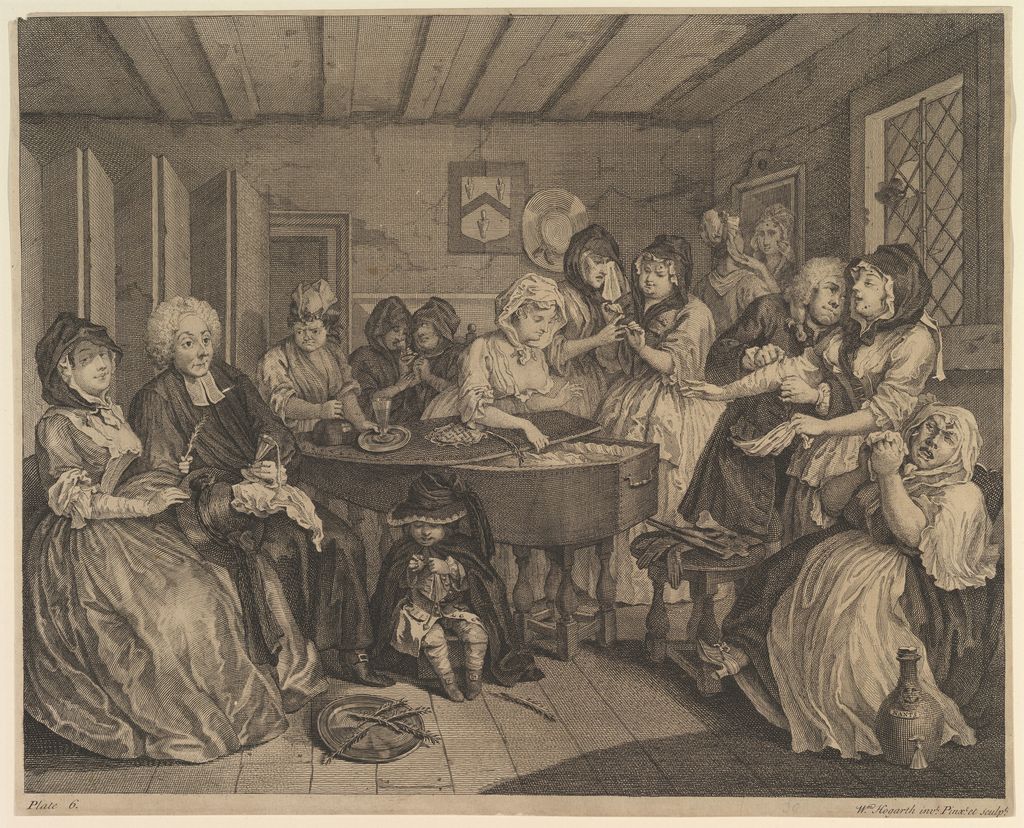
A Harlot's Progress, Plate 6, William Hogarth, before April 1732. Etching and engraving; first state of three. 32.35(7). Harris Brisbane Dick Fund, 1932. Image source. CC0 / Public domain.
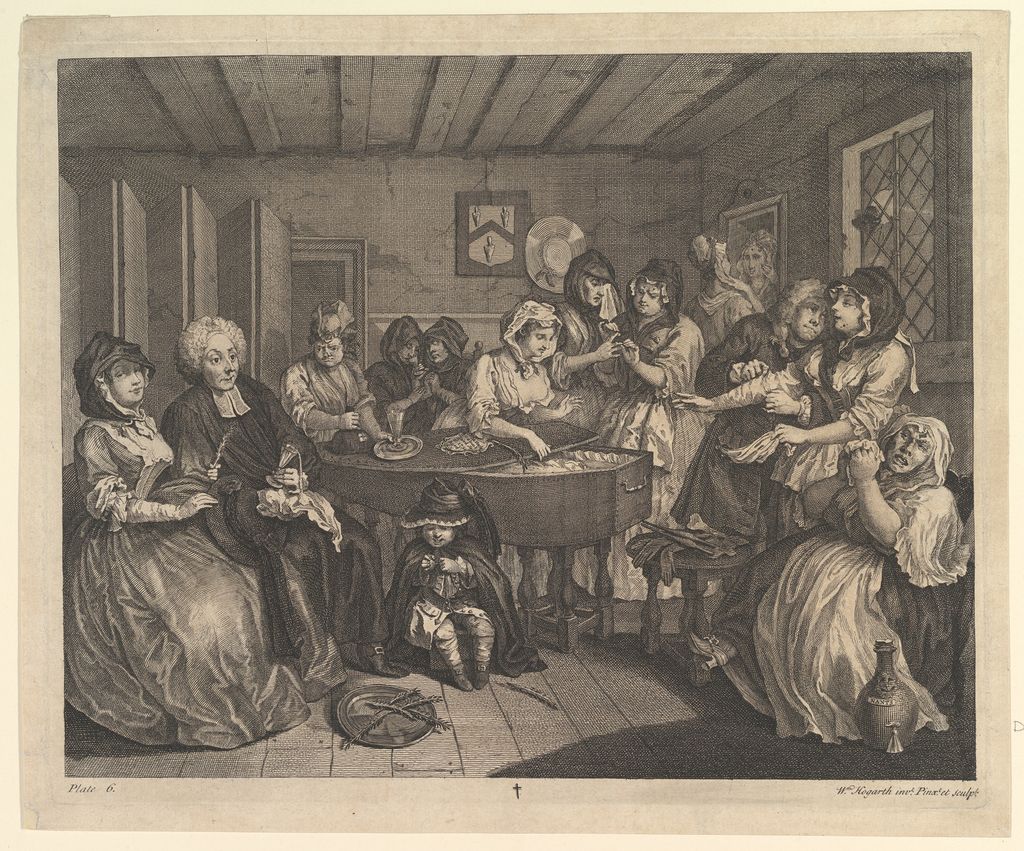
A Harlot's Progress, Plate 6, William Hogarth, April 1732. Etching and engraving; third state of three. 91.1.133. Gift of Sarah Lazarus, 1891. Image source. CC0 / Public domain.
Browse Hogarth’s artworks
All 54 individual artworks and series stages in the approved English cluster
Frequently Asked Questions
A drinking glass stands on the lid. Around it, the mourners are occupied with objects and exchanges of their own. [1]
It is plate 6 of 6 in A Harlot’s Progress. The plate number identifies the design across impressions. [1]
Discussion
Look again at the images and ideas explored in Moll’s Wake. These editorial prompts invite your observations.
Reader Insights
How does the woman’s extended arm direct the undertaker’s attention while she draws out his handkerchief?
How does the boy’s spinning top change the way you read the adults’ gestures around the coffin?
Join the Conversation
Share a detail, comparison or question about Moll’s Wake below.
References
- The Metropolitan Museum of Art, William Hogarth, A Harlot’s Progress, Plate 6, April 1732, third state of three, 91.1.133. View source.
- Colonial Williamsburg Foundation, William Hogarth, A Harlot’s Progress: Plate 6, 1951-87, object record and label. View source.
- John Nichols, Biographical Anecdotes of William Hogarth, third edition, London, 1785, biographical section, parenthetical reading of the coffin inscription. View source.
- Sarah Ann Essex Hoile, Death, Time and Commerce: Innovation and Conservatism in Styles of Funerary Material Culture in 18th–19th Century London, UCL doctoral thesis, 2020, abstract and study assemblages. View source.
- Jean-André Rouquet, Briefe des Herrn Rouquet an einen seiner Freunde in Paris, first letter, 1754 German edition of the 1746 French text, pp. 98–99, transcribed in Charles Davis, ed., FONTES 54, pp. 15–16. View source.
- Peter Earle, The Making of the English Middle Class: Business, Society and Family Life in London, 1660–1730, University of California Press, 1989, pp. 313–314. View source.
- London Museum, Finger Ring, Mourning Ring, John Bancks, 1724, NN6769. View source.
- The Metropolitan Museum of Art, William Hogarth, A Harlot’s Progress, Plate 5, before April 1732, first state, 32.35(6). View source.
- The Metropolitan Museum of Art, William Hogarth, A Harlot’s Progress, Plate 1, April 1732, fourth state, 91.1.128. View source.
- Princeton University Library, Sin & the City, full exhibition checklist, entry for the six 1732 prints of A Harlot’s Progress. View source.
- The Metropolitan Museum of Art, William Hogarth, A Harlot’s Progress, Plate 6, before April 1732, first state of three, 32.35(7). View source.
- The Fitzwilliam Museum, William Hogarth, A Harlot’s Progress Plate VI, I/III, Paulson 126, P.4761-R. View source.
- The Fitzwilliam Museum, William Hogarth, A Harlot’s Progress Plate VI, III/III, Paulson 126, 22.K.3-7. View source.
- Sir John Soane’s Museum, Hogarth’s Works, B5637, items 2–7 and concordance to Ronald Paulson, Hogarth’s Graphic Works, third revised edition, 1989, nos. 121–126. View source.