 by Tom Gurney
Tom Gurney BSc (Hons) is an art history expert with over 20 years experience
Published on June 19, 2020 / Updated on October 19, 2026
Email: tomgurney1@gmail.com / Phone: +44 7429 011000
A Converted British Family Sheltering a Christian Missionary
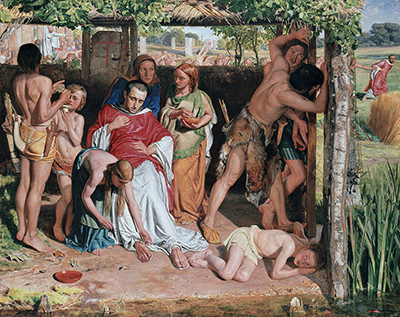
A wounded Christian missionary sits at the centre of a cramped riverside shelter. A family tends to him while figures outside threaten to break in. William Holman Hunt's long title tells the imagined story: a newly converted British family shelters a missionary from the persecution of the Druids. The oil on canvas was made in 1849–50 and exhibited at the Royal Academy in 1850. It is now in the Ashmolean Museum, Oxford, accession WA1894.1. The Royal Academy listing gave it number 553. [1] [2]
Hunt fills the canvas with simultaneous actions. A woman in blue bends near the missionary, who wears red over a pale garment. Another figure lifts a sponge towards his face. At his feet, someone removes a thorn. On the right, two men press against or watch the hut's entrance. A child lies low on the floor, looking towards the danger. Outside, a pursuing group moves across the open land; another threatened priest and a stone circle are visible beyond the shelter. The riverbank's reeds and the roughly built roof put the intimate rescue inside a wider, unsettled landscape. [2] [3]
At a Glance
- ArtistWilliam Holman Hunt (1827–1910)
- TraditionBritish Pre-Raphaelite art
- Work or subjectA Converted British Family Sheltering a Christian Missionary
- ContextIllustrated paintings guide
- Further readingArtist biography
A shelter divided between care and danger
The missionary's body anchors the group. His bare lower legs and extended feet make his weakness visible; the people around him do practical things rather than only express grief. The sponge and the removal of a thorn are small acts that a viewer can locate among the crowded bodies. Hunt made the family's conversion tangible through its response to a stranger in distress. The Ashmolean specifically calls attention to the woman in blue, the sponge and the thorn as symbolic allusions. Their arrangement also makes a compelling human scene before any symbol is decoded. [2]
The men's bodies at the doorway create a second centre of attention. One braces the opening while another looks out, bringing the hostile outside world into the family space. The shelter gives limited protection: its roof is low, its sides open to light and the water lies close by. The child's position on the floor makes the threat to the household especially immediate. This is a domestic act of courage, not a distant battle scene. Hunt asks the viewer to look from the missionary and his carers to the door and then through the landscape to the pursuers.
The painting's title places the threat within a conflict between Christians and Druids, but the picture should be understood as Hunt's historical imagination. Art UK notes that it is unclear exactly when he meant the event to occur. The composition does not document a known incident, and its costumes should not be taken as a dependable reconstruction of one precise moment in early British history. The subject instead lets Hunt stage a moral choice: a household can turn away the vulnerable visitor, or open itself to the risk of protecting him. [3]
Watch: William Holman Hunt
Begin with Hunt’s paintings, then place his work alongside two fellow Pre-Raphaelite founders.
William Holman Hunt Paintings
An overview of Hunt’s paintings from TheHistoryOfArt video archive.
Watch on YouTubeBiblical text around the image
Hunt used the picture's frame to lead viewers toward a Christian reading. Scholar George P. Landow transcribes passages from John 16:2, Romans 3:15, Mark 9:41 and Matthew 25:38 associated with the work. Taken together, they concern persecution, the shedding of blood, giving a drink to someone who belongs to Christ, and welcoming a stranger. The latter two passages help explain the family's small acts of mercy, while the first two direct attention outside the hut. The inscriptions are part of the historical presentation of the painting; they are not a licence to identify every gesture with only one biblical character. [4]
The sponge offered to the missionary and the thorn taken from his foot can evoke episodes in the suffering of Christ. The blue-clad mother, positioned near him, may suggest Mary. The Ashmolean's guide identifies these as symbolic allusions rather than ordinary costume details. They allow Hunt to make the missionary's suffering echo the Christian story that he carries to Britain. Yet the people within the hut remain a family facing its own immediate crisis, which keeps the picture from becoming a simple diagram of biblical correspondences. [2] [4]
There is a difficult historical dimension to that framing. The work's opposition between a converted family and threatening Druids expresses a nineteenth-century Christian account of Britain's past. It should not be repeated as an uncontested account of ancient religion. Landow notes that Hunt himself addressed objections to the historical plausibility of the setting in remarks written for the collector Thomas Combe. The argument over the scene's possibility is part of its reception, and a reason to keep the difference between painted conviction and historical evidence clear. [4]
Hunt at the 1850 Royal Academy
The painting was exhibited in the same Royal Academy room as John Everett Millais's Christ in the House of His Parents. Both pictures drew on early Christian subjects and asked viewers to attend to ordinary bodies, rooms and tools rather than idealised religious figures. Art UK records the shared display and notes that critics attacked the strained poses and overall composition of Hunt's painting. The crowded hut makes that reaction understandable even for a viewer who values its invention: arms and legs overlap, and several episodes compete for attention. Its difficulty is part of what distinguishes it from Hunt's later, more concentrated religious images. [3] [1]
The date also places the canvas just after the Brotherhood's formation in 1848. Hunt had already shown Rienzi at the 1849 Academy. Here he developed a much larger invented scene with religious stakes, dense observation and a highly specific title. The painting's size, about 111 × 141 cm, gave him room for the shelter, its defenders and the threatened open country in one field of view. It was ambitious, even if the number of figures could make the result hard to absorb quickly. [1] [3]
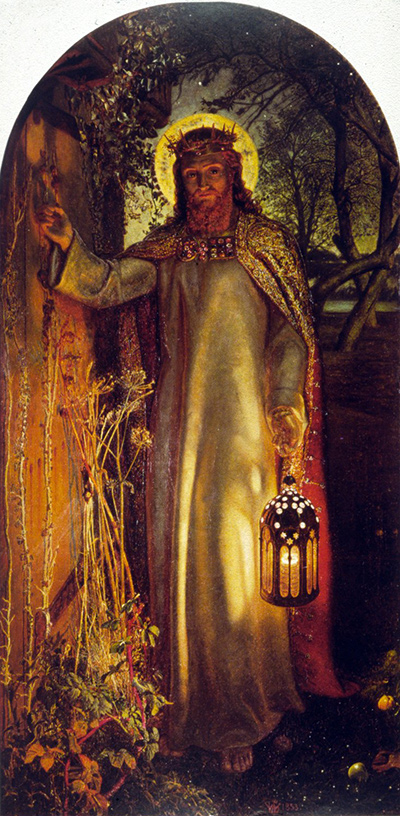
Thomas Combe, the Oxford printer and an early supporter of the Pre-Raphaelites, acquired the picture in 1850. His collection later helped give Oxford a concentration of works by Hunt and his circle. The painting now belongs to the Ashmolean, where its stable accession number is WA1894.1. Its later Oxford home also connects it to Hunt's Light of the World, whose original was given to Keble College by Martha Combe. The two works make different demands on a viewer: this one moves among many threatened people, while Light of the World concentrates on a single figure and door. Jericho history of Thomas Combe[5]; Ashmolean education guide[2]; paintings guide
Discussion
Look closely at A Converted British Family Sheltering a Christian Missionary, then compare your reading with the documented history.
Reader Insights
Which detail in A Converted British Family Sheltering a Christian Missionary most affects your reading?
How do the date, medium and collection records shape that interpretation?
What remains uncertain about this work or its history?
Join the Conversation
Share a close observation or a source-backed question about A Converted British Family Sheltering a Christian Missionary. The prompts above are starting points for discussion.
References
- Rossetti Archive object record. View source.
- Ashmolean education guide. View source.
- Art UK, the Pre-Raphaelite Brotherhood. View source.
- Landow, study of the painting and frame. View source.
- Jericho history of Thomas Combe. View source.