 by Tom Gurney
Tom Gurney BSc (Hons) is an art history expert with over 20 years experience
Published on June 19, 2020 / Updated on October 19, 2026
Email: tomgurney1@gmail.com / Phone: +44 7429 011000
Valentine Rescuing Sylvia from Proteus
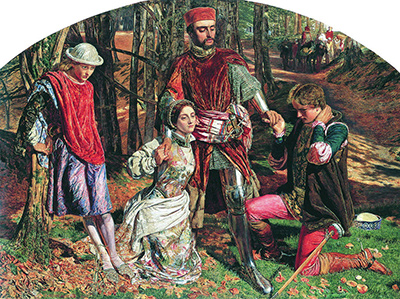
Four figures fill the foreground of William Holman Hunt's Valentine Rescuing Sylvia from Proteus. At the centre, Valentine holds the kneeling Sylvia close and grasps the hand of Proteus, who drops to one knee at the right. On the left, Julia, disguised as a page, leans against a tree. A small group rides through the forest behind them. Hunt took this crowded moment from Act V, scene 4 of Shakespeare's The Two Gentlemen of Verona. Painted across 1850–51 and shown at the Royal Academy in 1851, the oil on canvas now belongs to Birmingham Museums Trust, accession 1887P953. [1] [2] [3]
The title sounds like the close of a rescue story, but the scene is more uncomfortable. Proteus has betrayed his friend Valentine, pursued Sylvia after she repeatedly refused him and then tried to rape her. Valentine interrupts him. The two men exchange words of accusation and remorse while Sylvia and Julia stand within the same tense space. The Folger Shakespeare Library's synopsis and play text[4] make the attempted assault explicit. The painting's gesture of male reconciliation should therefore not make Sylvia's danger disappear from the reader's account.
At a Glance
- ArtistWilliam Holman Hunt (1827–1910)
- TraditionBritish Pre-Raphaelite art
- Work or subjectValentine Rescuing Sylvia from Proteus
- ContextIllustrated paintings guide
- Further readingArtist biography
Reading the four figures
Valentine's bright red clothes and upright body make him the centre of the composition. His arm wraps around Sylvia while his other hand reaches to Proteus. The gesture can read as both protection and a first step toward forgiving the friend who attacked her. Sylvia remains low to the ground, her pale dress and turned head drawing attention to her position between the men. Proteus's bent posture and hand pressed near his face convey shame, though the immediate threat he posed gives his repentance a difficult context. Birmingham's description names him as repentant; Shakespeare's scene gives the reason. [1] [4]
Julia has followed Proteus while disguised as a boy. She stands apart on the left, looking down rather than joining the central embrace. Her presence exposes another betrayal: Proteus had pledged himself to her before becoming obsessed with Sylvia. In the play, Julia's disclosure helps bring the scene to its awkward resolution. Hunt lets her stand as a witness before that resolution has become easy or secure. The British Museum's 1850 pen-and-ink preparatory drawing already sets the four figures in an arched format, with a distant group moving through the trees. Comparing that study with the completed painting shows the scene was constructed through drawing as well as close study of landscape and costume. [2]
The distant figures include Sylvia's father, the Duke of Milan, and his followers, according to Birmingham's account. Their approach promises a public ending to what has happened in the woods. Yet they are much smaller than the people in front. Hunt makes the encounter between Sylvia, Valentine, Proteus and Julia the picture's immediate concern rather than the arrival of an authority figure. [1]
Watch: William Holman Hunt
Begin with Hunt’s paintings, then place his work alongside two fellow Pre-Raphaelite founders.
William Holman Hunt Paintings
An overview of Hunt’s paintings from TheHistoryOfArt video archive.
Watch on YouTubeA Shakespeare scene made visible in a forest
Leaves, bark, grass and costume surfaces compete for attention across the arched canvas. The hard edge of a tree trunk stands behind Julia; patches of light and dark ground lead the eye toward the approaching riders. Hunt's carefully separated colours and textures were characteristic of his early Pre-Raphaelite work. The forest is a setting to examine, but it also confines the group within a dense screen of vegetation. Art UK points to the detailed treatment of the four figures' clothing and surrounding leaves as a clear example of the Brotherhood's visual approach. [5]
The painting's original frame carried passages from the play on its left and right upper corners. On one side Valentine speaks of lost trust; on the other Proteus asks forgiveness. Those selections direct attention toward the exchange between the men. The painting itself, however, also makes the two women unavoidable. A contemporary 1894 exhibition catalogue[6] describes the four foreground figures and the approaching party; the Rossetti Archive[7] transcribes the frame passages.
Models, exhibition and later ownership
Elizabeth Siddal posed for Sylvia, the painter and model later closely associated with Dante Gabriel Rossetti. The Rossetti Archive identifies James Lennox Hannay as Valentine's model and James Aspinal as Proteus's. Such named sitters grounded the theatrical scene in observed faces without making it a portrait of their own relationships. The archive also records Hunt's inscription “W. HOLMAN HUNT 1851. Kent”. Birmingham dates the work 1850–51, allowing for preparation before that inscribed year. [7] [1]
The painting appeared at the Royal Academy in 1851. The British Museum dates its related drawing to about 1850 and identifies the finished work as an 1851 Academy exhibit. A later catalogue, published in 1894 when Birmingham lent the picture, remembered that its first reception had been hostile and quoted John Ruskin's praise of particular painted fabrics. That catalogue is evidence of how the picture was being described later in the century; it should not be mistaken for a complete record of every response in 1851. [2] [6]
The Rossetti Archive records a sale from Hunt to Francis McCracken in November 1851 for 100 guineas. Birmingham's collection acquired the painting in 1887. Its present collection identity is therefore well documented, even though the title has varied between Valentine Rescuing Sylvia from Proteus and Two Gentlemen of Verona. The picture is a useful partner to Hunt's later Shakespeare scene Claudio and Isabella: both compress a moral crisis into bodies, gestures and a closely observed setting. The paintings guide places them among his wider subjects. [7] [1]
The British Museum's study makes the change in Valentine's gesture especially clear. In the c.1850 drawing he seems to repel Proteus; in the finished oil he clasps Proteus's hand as forgiveness enters the scene. That alteration affects how the four figures' crisis is read, even though Sylvia's position and danger cannot be explained away by the men's reconciliation. The museum also records that Edith Holman Hunt donated the preparatory sheet in 1927, giving the drawing a separate collection history from Birmingham's canvas. Looking at both objects shows a decision Hunt made while developing the composition, and why a study can carry evidence that a finished painting alone does not preserve. [2]
Discussion
Look closely at Valentine Rescuing Sylvia from Proteus, then compare your reading with the documented history.
Reader Insights
Which detail in Valentine Rescuing Sylvia from Proteus most affects your reading?
How do the date, medium and collection records shape that interpretation?
What remains uncertain about this work or its history?
Join the Conversation
Share a close observation or a source-backed question about Valentine Rescuing Sylvia from Proteus. The prompts above are starting points for discussion.
References
- Birmingham Museums Trust. View source.
- British Museum study. View source.
- Birmingham object and image record. View source.
- Folger Shakespeare Library's synopsis and play text. View source.
- Art UK, Pre-Raphaelite Brotherhood. View source.
- contemporary 1894 exhibition catalogue. View source.
- Rossetti Archive. View source.