


 by Tom Gurney
Tom Gurney BSc (Hons) is an art history expert with over 20 years experience
Published on June 19, 2020 / Updated on October 19, 2026
Email: tomgurney1@gmail.com / Phone: +44 7429 011000
William Holman Hunt prints
“A Hunt print” can mean several different things. Hunt made a small number of original etchings, in which the printed image comes from a plate he worked. He also supplied designs for illustrations cut or engraved by other hands. Later printmakers reproduced his paintings for a much wider audience. Those roles matter: an etching by Hunt, a wood engraving after his design and a photographic copy of an oil painting are not the same kind of object. This guide follows documented examples and identifies who made each image. [1] [2] [3]
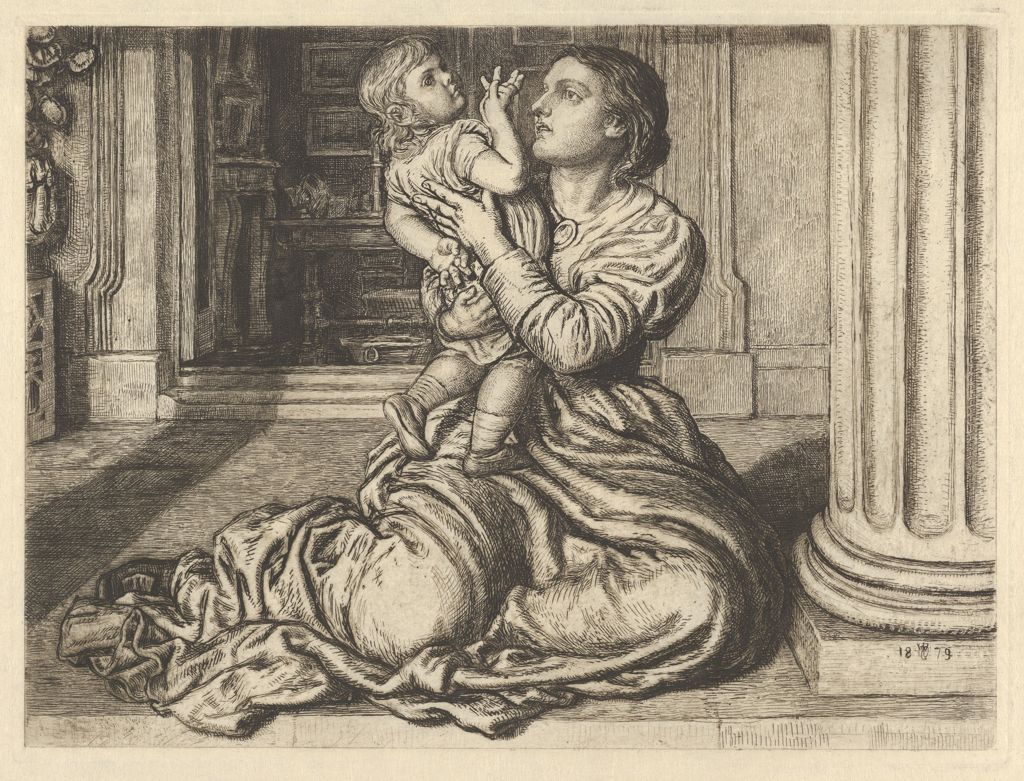
The image at the top is Hunt's own 1879 etching The Father's Leave-Taking, shown in an impression at the Metropolitan Museum of Art[4]. It is an appropriate starting point because it is an original print by the artist, not a modern poster copied from one of his canvases.
At a Glance
- ArtistWilliam Holman Hunt (1827–1910)
- TraditionBritish Pre-Raphaelite art
- PageWilliam Holman Hunt Prints
- ExplorePaintings · Drawings · Watercolours · Prints
Original etchings: ink on paper from Hunt's plate
In etching, lines are bitten into a metal plate and hold ink when the plate is printed. A single design can yield multiple impressions. Hunt's own etchings therefore belong to his artistic practice even though each surviving sheet may have a different paper, state or history. Princeton's record for The Father's Leave-Taking[1] calls it the last of seven etchings Hunt made during his career. The number should be read as the museum's catalogue assessment, not a count of all reproductive prints associated with his name.
An early pair appeared in the Etching Club's 1857 Etchings for the Art-Union of London. The Metropolitan Museum's album record[5] lists Hunt's The Abundance of Egypt and The Desolation of Egypt among works by other artists. Both are described as etching and drypoint, printed on chine collé. The British Museum[6] attributes the making of The Abundance of Egypt directly to Hunt. This is a different relationship from “after Hunt”: he was the printmaker as well as the designer.
The two Egyptian images make a deliberate pair. The Delaware Art Museum[7] says Abundance was designed as a companion to Desolation for the Etching Club's portfolio. Abundance places a woman carrying grain and a vessel before workers and camels; Desolation is a narrow moonlit view of the Giza landscape. Delaware's Desolation record[8] links the scene to Hunt's camp near the pyramids during his 1854 journey, while cautioning that the plate was probably not made on the spot. The prints turn experience and observation into two contrasting images of a place; they should not be presented as documentary snapshots taken at the same instant.
The Father's Leave-Taking: a private subject in a public portfolio
Hunt returned to the Etching Club for The Father's Leave-Taking[4], dated 1879. The Met identifies its example as an etching proof published in The Portfolio of the Etching Club, plate 12. A proof is a particular printed impression, not the metal plate itself. Princeton records another impression and notes the artist's monogram and date worked into the image. These catalogues describe actual historical prints; the local reproduction is a digital image of the Met's sheet. [4] [1]
Princeton also preserves a separately catalogued working proof dated “Oct. 3” (x1994-100) and an etching (x1994-101), both assigned to 1879. The working proof is shown below as a complete sheet, with the etched scene set inside broad paper margins; the image at the top of this page is a much closer view of the Met's different impression. The labels identify three physical sheets, not three different paintings or proof of a particular change to the metal plate. Princeton gives the proof's plate as 18.9 × 25 cm and its sheet as 33 × 47.4 cm. Keeping both measurements separate makes the difference between printed design and surrounding paper tangible. [9] [10]
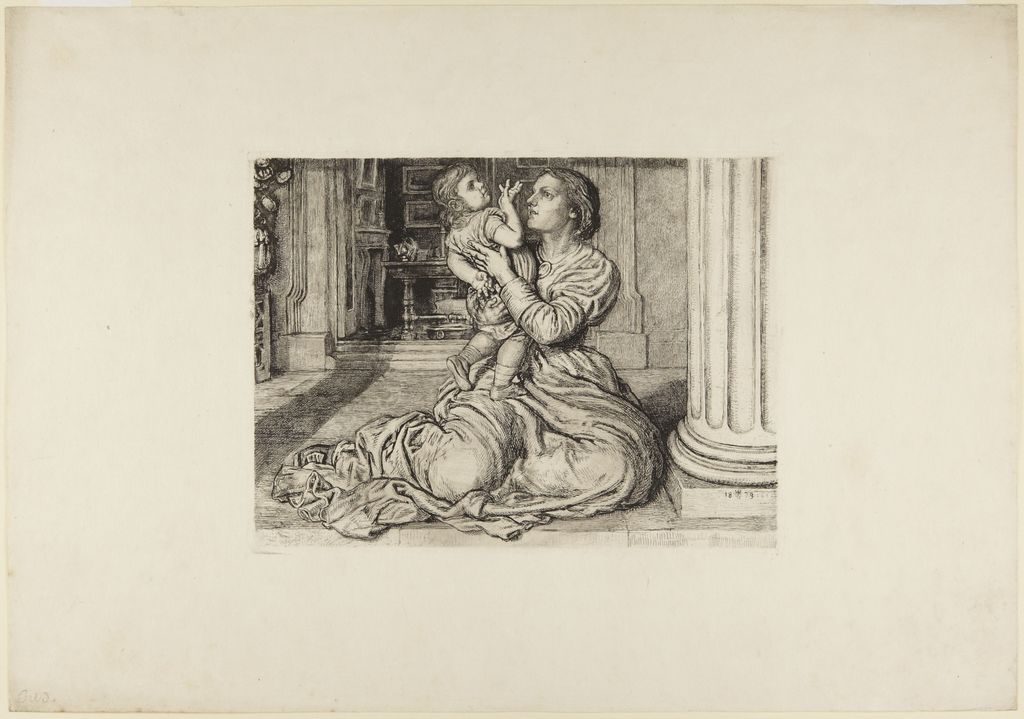
The picture shows a seated woman lifting a small child near a great classical column. A darker interior opens behind them. The child's raised hand and the woman's turned face form a compact exchange, while the drapery spreads across the lower part of the composition. The father of the title is absent. Princeton suggests the departing viewer takes his position, so the scene draws us into a farewell without showing the person who leaves. [1]
Watch: William Holman Hunt
Begin with Hunt’s paintings, then place his work alongside two fellow Pre-Raphaelite founders.
William Holman Hunt Paintings
An overview of Hunt’s paintings from TheHistoryOfArt video archive.
Watch on YouTubeThe Met[4] identifies the pair as Hunt's second wife Edith and their daughter Gladys. The Saint Louis Art Museum[11] says the etching drew on an earlier drawing made while the family lived in Jerusalem. The print is therefore a family image that passed through an earlier design and then into a portfolio intended for circulation. The classical setting is imagined rather than a literal record of the room in which Edith and Gladys sat. The work's intimacy, rich hatching and careful structure help explain why an original print can carry different interests from a full-scale oil painting. [11] [1]
Book illustrations: Hunt as designer, another person as engraver
Hunt also supplied designs that reached readers through wood engraving. The British Museum's record for “Recollections of the Arabian Nights”[2] identifies a vignette in Alfred Tennyson's Poems, published by Edward Moxon in 1857. Its production roles are explicit: after William Holman Hunt, block cut by John Thompson, published by Edward Moxon. The design is associated with Hunt; the physical wood block was cut by Thompson. A catalogue that simply labels the printed sheet “by Hunt” loses that distinction.
The same caution applies to Hunt's Lady of Shalott. The National Gallery of Victoria's study of Hunt's versions[12] separates an early drawing and the 1857 Moxon illustration from his two much later painted versions. A printed design can be a major stage in the development of a subject without being an edition of the later painting. Dates, medium and makers must be checked before images are set side by side.
Prints made after Hunt's paintings
Other people copied Hunt's finished paintings into print. The Ashmolean[3] holds a fragment of an etching after The Light of the World, catalogued as the work of an anonymous British engraver, on wove paper. It was in John Ruskin's Oxford teaching collection. Ruskin used it to discuss the rendering of the picture's details, but the print record does not identify Hunt as the maker of the etched plate. “After William Holman Hunt” names the source painting, not the person who incised the plate.
The distinction had commercial and legal consequences. Elena Cooper's Keble College research on The Light of the World[13] traces engraving, photographic copying and copyright disputes around the painting. A print could carry Hunt's composition far beyond the venue of the original canvas, and reproduction rights were part of how that circulation worked. The image's later fame cannot be measured only by the number of people who stood before the Keble painting. The painting page maps its three physical versions and this history of reproduction.
Another example is the Manchester Art Gallery photogravure after The Triumph of the Innocents[14], accession 1918.1030. The Gallery says Goupil & Co. made the print after Hunt's Walker Art Gallery painting and the Fine Art Society published it in 1887. Its frame was designed by C. R. Ashbee for Thomas Horsfall's Ancoats museum. The collection's maker field also associates Ashbee with engraving, but the fuller prose separates the photogravure from his frame design. Until that role is reconciled, the secure description is Goupil-made photogravure after Hunt, with an Ashbee-designed frame. This is evidence of a painting's reception and reproduction, not another oil version. [14]
Reading the label on a Hunt print
Look first for the medium and the production roles. Etching, drypoint, wood engraving and photogravure refer to processes; “after” tells you that the print follows another artist's composition. A museum record may also distinguish the artist, plate maker, block cutter, publisher and printer. Then check the date of the printed sheet against the date of any related drawing or painting. The Father's Leave-Taking is an original 1879 etching; “Recollections of the Arabian Nights” is a 1857 wood engraving after Hunt's design; the 1887 Triumph photogravure follows a painting. They belong on the same guide only because each clarifies a different way Hunt's work reached viewers. [4] [2] [14]
For original marks made on paper before printing, continue to the drawings guide. For the painted works that printmakers interpreted, use the paintings directory. A modern decorative reproduction may be a legitimate product, but its seller, paper and edition should not be confused with a nineteenth-century impression.
Discussion
What stands out when you compare the works and sources in William Holman Hunt Prints?
Reader Insights
Which work or period changes how you understand Hunt’s career?
How do the cited collection records support or complicate that reading?
What further source would help answer a question left open here?
Join the Conversation
Share a close observation or a source-backed question about William Holman Hunt Prints. The prompts above are starting points for discussion.
References
- Princeton University Art Museum. View source.
- British Museum illustration record. View source.
- Ashmolean print record. View source.
- Metropolitan Museum of Art. View source.
- Metropolitan Museum's album record. View source.
- British Museum. View source.
- Delaware Art Museum. View source.
- Desolation record. View source.
- Princeton working proof. View source.
- Princeton etching. View source.
- Saint Louis Art Museum. View source.
- National Gallery of Victoria's study of Hunt's versions. View source.
- Keble College research on The Light of the World. View source.
- Manchester Art Gallery photogravure after The Triumph of the Innocents. View source.


