


 by Tom Gurney
Tom Gurney BSc (Hons) is an art history expert with over 20 years experience
Published on June 19, 2020 / Updated on October 19, 2026
Email: tomgurney1@gmail.com / Phone: +44 7429 011000
The Children's Holiday
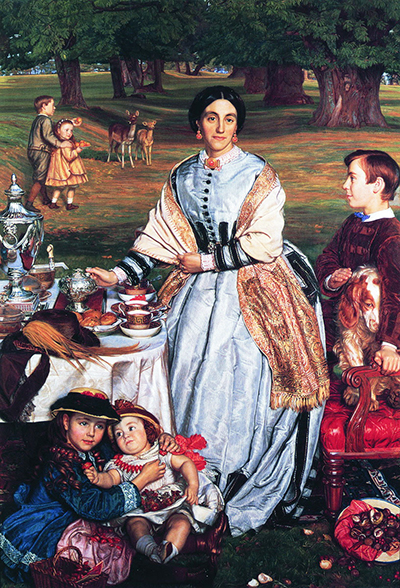
A woman stands at a tea table beneath large trees. Two children sit close together at the lower left; a boy and dog are to her right, while two more children appear farther back beside deer. Hunt's The Children's Holiday is the family portrait also known as Lady Fairbairn with Her Children. The Torre Abbey Museum-linked Art UK object record[1] identifies it as an 1864–65 oil on canvas, 213 × 146 cm, in the museum's collection (A383). Its outdoor setting and domestic objects make a portrait of family life on a grand scale.
The family in the park
The central figure is Allison Fairbairn, née Callaway. She and her five younger children are shown on the grounds of Burton Park, Sussex, in a work made for her husband, Hunt's patron Thomas Fairbairn. The specialist account by Sheilagh Quaile[2] establishes the sitter and the family setting. Torre Abbey’s catalogue names the five children as Thomas, Mary, Constance, James and Arthur. The earlier text on this site counted only three; the collection record establishes five, though this small reproduction does not let us assign each name to a particular figure. [1]
At a Glance
- ArtistWilliam Holman Hunt (1827–1910)
- TraditionBritish Pre-Raphaelite art
- Work or subjectThe Children's Holiday
- ContextIllustrated paintings guide
- Further readingArtist biography
Hunt spreads the figures across different depths rather than lining them up for a formal group likeness. Two small children sit in the shade near the front edge. A boy at the right holds or rests near the dog; at left, two other children stand farther away against the open grass. The mother is the stable centre among their separate activities. She faces the viewer beside the laid table, joining the leisure of the garden with the familiar work of serving tea.
Trees form a broad canopy over the scene. The darker green overhead makes the mother, tablecloth and children's clothes stand out, while the open ground and small deer lead the eye back into the park. Hunt gives the family space to move and play, but he also arranges them around Mrs Fairbairn's presence. The contrast between their scattered positions and her central posture is one of the picture's main organising devices.
Tea and carefully painted things
The tea table is crowded with visible objects: cups, dishes, food and a metal vessel. Quaile identifies the large metal item as a samovar and reads the service, carpet, chair and shawl as expensive domestic goods. These things are not merely decoration. They locate the Fairbairns in a well-resourced household and make an outdoor afternoon feel carefully furnished, almost as if a drawing room had been carried into the park. [2]
The woman's pale dress is edged with dark trim. Over it lies a long shawl with gold-coloured pattern and fringe. The textile creates one of the richest surfaces in the image, alongside reflective metal, white linen, dark foliage and the dog's fur. Quaile argues that the depicted shawl would have signalled status to a Victorian viewer and compares it with costly South Asian textiles. Her research did not locate a surviving exact match. The picture can be read through the social meaning of such a garment without claiming that the particular shawl in it has been identified today.
Watch: William Holman Hunt
Begin with Hunt’s paintings, then place his work alongside two fellow Pre-Raphaelite founders.
William Holman Hunt Paintings
An overview of Hunt’s paintings from TheHistoryOfArt video archive.
Watch on YouTubeThis fabric also makes a link to Hunt's wider interest in detailed dress and material culture. In The Awakening Conscience, a shawl appears in a very different kind of interior and story; Quaile compares the two works while keeping their subjects distinct. The Fairbairn portrait shows a patron's household and children, not the moral crisis of that earlier painting. Hunt's close attention to objects serves different ends in each.
Patronage and portraiture
Thomas Fairbairn's support of Hunt gives this family portrait a place within the artist's working life. Quaile identifies him as a Manchester industrialist, collector and patron who also supported The Awakening Conscience. In The Children's Holiday, Hunt turned that relationship into a picture of Fairbairn's wife and younger children. A commission can be both a record of real people and a carefully staged statement about how a family wished to be seen.
Quaile, drawing on Tim Barringer and Caroline Arscott, interprets Mrs Fairbairn's central role and the luxury goods as an image of respectable domestic life supported by industrial wealth. This is a historical reading of the picture's social language. The canvas itself shows its material evidence—the tea things, shawl, furniture and landscaped grounds—but does not hand us a diary of what Allison thought about each object. The interpretation is strongest when kept alongside the visible details and the patronage record.
The title The Children's Holiday makes the younger figures and their freedom in the grounds especially important. The alternative name, Lady Fairbairn with Her Children, directs attention to their mother. Both describe the same Torre Abbey painting. Neither should lead to another page or a duplicate object in the directory. They are two useful ways to approach one large family image.
The Torre Abbey painting
The full Art UK object record supplied by Torre Abbey Museum[1] places the work in Torquay, gives its accession as A383, and records a 1932 gift from Miss Fairbairn. It measures the canvas 213 × 146 cm. Other published dimensions vary slightly, so that number is attributed to the current collection record rather than treated as a measurement of the web image. The large vertical format makes the foreground tea setting and the distant children parts of a single full-scale scene.
The inherited reproduction is small, yet its main structure is clear. Start with Allison's position at the table, then follow the children and dog across the foreground and into the park. Return to the shawl, samovar and white cloth to see how domestic wealth has been placed outdoors. Hunt made a family portrait that can be read as an afternoon in a garden and as a record of the Fairbairns' social world. The research corrects who is present; the painting's objects show how carefully that world was staged.
Quaile's textile research gives another reason to look closely at the shawl. Hunt had worked as a young pattern designer for a muslin and calico firm and later gathered garments for use in pictures. That background does not prove the Fairbairn shawl was copied from one surviving textile. Quaile searched collections without finding an exact match. It does, however, help explain why its patterned surface receives such sustained attention in a painting already full of precisely described things. The shawl is part of the family's social presentation and part of Hunt's practice of making fabric a visible subject in its own right. [2]
Discussion
Look closely at The Children's Holiday, then compare your reading with the documented history.
Reader Insights
Which detail in The Children's Holiday most affects your reading?
How do the date, medium and collection records shape that interpretation?
What remains uncertain about this work or its history?
Join the Conversation
Share a close observation or a source-backed question about The Children's Holiday. The prompts above are starting points for discussion.
References
- Torre Abbey Museum-linked Art UK object record. View source.
- specialist account by Sheilagh Quaile. View source.







