 by Tom Gurney
Tom Gurney BSc (Hons) is an art history expert with over 20 years experience
Published on June 19, 2020 / Updated on October 19, 2026
Email: tomgurney1@gmail.com / Phone: +44 7429 011000
London Bridge on the Night of the Marriage of the Prince and Princess of Wales
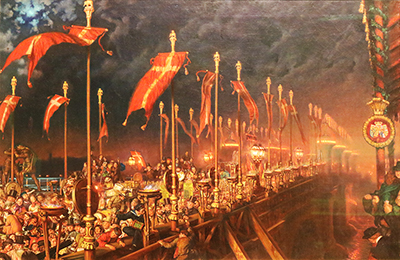
Red flags rise above a tightly packed London Bridge. Lamps run towards a vanishing point, faces and hats crowd the near side, and a dark Thames lies beside the brilliant street. William Holman Hunt painted London Bridge on the Night of the Marriage of the Prince and Princess of Wales after the public celebrations of 10 March 1863. Art UK's Ashmolean-supplied object record[1] identifies the 65 × 98 cm oil on canvas as WA1894.4. A separate National Portrait Gallery list gives WA268 for a closely corresponding Ashmolean picture; the accessible records do not explain the different numbers. Rather than showing a royal ceremony, the painting makes the people who filled the city its subject.
A royal wedding seen from London
Albert Edward, Prince of Wales, and Princess Alexandra of Denmark married at St George's Chapel, Windsor Castle, on 10 March 1863. The date and location are documented by Historic Royal Palaces[2]. Hunt's canvas takes us elsewhere: to the London crowds celebrating that night. The title keeps the marriage in view, but no bride or groom needs to appear. Flags, street lighting and the density of spectators carry the occasion into the public space.
At a Glance
- ArtistWilliam Holman Hunt (1827–1910)
- TraditionBritish Pre-Raphaelite art
- Work or subjectLondon Bridge on the Night of the Marriage of the Prince and Princess of Wales
- ContextIllustrated paintings guide
- Further readingArtist biography
The strong diagonal of the bridge pulls us past one cluster of people after another. At the left foreground, figures press near the railing; more fill the route under repeated flagpoles and lamps. The right side opens towards the river and a darker, less easily measured space. The composition gives a viewer two experiences at once: closeness to bodies and noise, then the long distance suggested by a line of light fading into the night. It is a street scene on the scale of a civic event.
At its small reproduced size, the image invites attention to large patterns before individual identities. Red banners recur against black sky. Warm pools of light mark the roadway, while the river and clouds remain subdued. Hunt balances an ordered sequence of poles against the crowd's restless variety. The scene feels both carefully arranged as a painting and crowded enough to recall an event no one person could take in at once.
Light, spectacle and history
The contrast between artificial and natural light is more than a technical exercise. Art historian Nancy Rose Marshall, in her study “History Illuminated”[3], explains how the bridge's gas illuminations and the moonlit Thames let Hunt depict a historic royal marriage through ordinary spectators. Her argument reads the city's spectacle alongside Victorian ideas about time, industrial life and the sublime. That is a scholarly interpretation of the composition; the visible lamps, crowd, flags and river are the evidence from which it begins.
The bridge is a particularly effective stage because everyone must share a narrow route. People gathered for different reasons are brought into a single view under the same decorations. Hunt does not paint one official procession moving across an empty setting. Instead he shows public celebration as many small encounters, hard to separate at a glance. The eye moves from bright faces near the foreground to tiny lights in the distance and back to the people at hand.
Watch: William Holman Hunt
Begin with Hunt’s paintings, then place his work alongside two fellow Pre-Raphaelite founders.
William Holman Hunt Paintings
An overview of Hunt’s paintings from TheHistoryOfArt video archive.
Watch on YouTubeThis is one reason the painting differs from a straightforward record of a ceremony. It holds a real date and place, but its chief drama comes from lighting and crowd structure. The night setting allows Hunt to set oranges and reds against deep browns and blue-black passages. In a daylight view, the banners and architecture might dominate; here their colour and rhythm seem to emerge from the darkness. A wedding celebrated by a city becomes a study of how a city makes itself visible after dark.
When was the painting made?
Art UK's 1863 catalogue date points to the event shown. Its Ashmolean-supplied description says Hunt sketched the London Bridge crowd that night, completed the painting on 16 May 1864, and retouched it in 1866. That explains why Marshall calls it Hunt's 1864 London Bridge, while the 1912 biographical account[4] includes it in a Hanover Street exhibition in 1866. The pictured night, main completion and later changes should not be collapsed into a single date. [1]
Hunt had portrayed places and figures with patient detail before this work, but a modern urban crowd gave him a different kind of subject. In The Thames at Chelsea, Evening, a smaller river study, light across London water is itself the central event. In The Afterglow in Egypt, warm light on a figure answers a very different setting. Marshall notes that London Bridge and an Afterglow work were presented together in the 1860s. Their comparison shows how Hunt could use changing light to shape different historical and pictorial meanings.
Faces in the crowd and later ownership
The National Portrait Gallery's catalogue[5] records Hunt's own head as only partly visible among the many figures. The Ashmolean-supplied description identifies Thomas Combe at the far left in a top hat, arm in arm with Hunt, and also names Mrs Combe, Millais's father and brother, and artist Robert Braithwaite Martineau among the crowd. The inherited small image is not a secure guide to tracing each face. These identifications come from the collection record, not from guessing at 400-pixel details. [1]
Art UK records that Martha Combe bequeathed the painting in 1893 and gives its current accession as WA1894.4. The NPG specialist list uses WA268; it may reflect an older numbering system, but the accessible records do not establish that explanation. Hunt designed the frame with wedding emblems and the arms of Denmark and England, according to the Ashmolean-supplied description. The collection record establishes ownership, not whether the original is on display at a particular moment. [1] [5]
Begin with the flags and lamps to feel the distance of the bridge. Then look at the near crowd, where the public celebration becomes a collection of separate people. Finally, notice how the dark Thames sits beside all that organised brightness. Hunt's painting turns a royal wedding into a portrait of London's response: intensely local in its faces and street furniture, yet wide enough to suggest a city sharing one night.
Discussion
Look closely at London Bridge on the Night of the Marriage of the Prince and Princess of Wales, then compare your reading with the documented history.
Reader Insights
Which detail in London Bridge on the Night of the Marriage of the Prince and Princess of Wales most affects your reading?
How do the date, medium and collection records shape that interpretation?
What remains uncertain about this work or its history?
Join the Conversation
Share a close observation or a source-backed question about London Bridge on the Night of the Marriage of the Prince and Princess of Wales. The prompts above are starting points for discussion.
References
- Art UK's Ashmolean-supplied object record. View source.
- Historic Royal Palaces. View source.
- “History Illuminated”. View source.
- 1912 biographical account. View source.
- National Portrait Gallery's catalogue. View source.