



 by Tom Gurney
Tom Gurney BSc (Hons) is an art history expert with over 20 years experience
Published on June 19, 2020 / Updated on October 19, 2026
Email: tomgurney1@gmail.com / Phone: +44 7429 011000
May Morning on Magdalen Tower
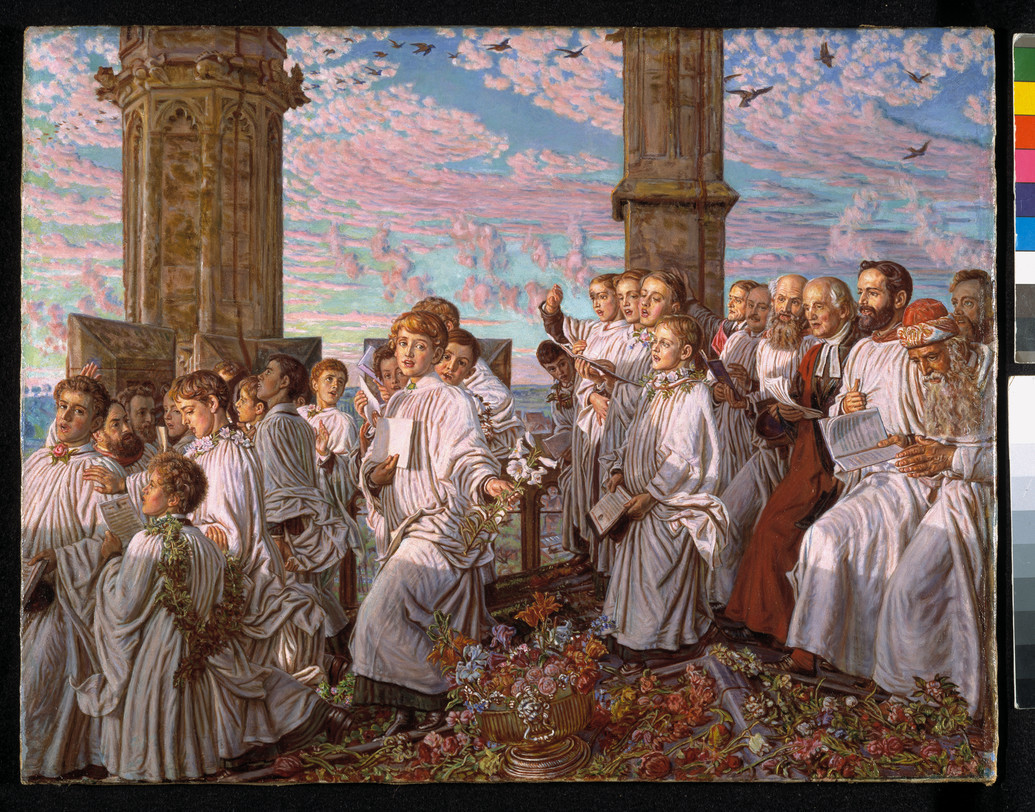
William Holman Hunt's May Morning on Magdalen Tower imagines the instant when an Oxford choir greets the dawn from a college tower. White-robed choristers and adult singers gather between tall stone pinnacles. At the left, the bearded John Varley Roberts conducts; to the right, senior members of Magdalen College sing or watch. Flowers brighten the parapet, birds cross the pale sky and sunlight catches faces and fabric. The large painting shown here belongs to the Lady Lever Art Gallery, Port Sunlight, as part of National Museums Liverpool. It is an oil on canvas begun in 1888 and publicly shown in 1891. A smaller, related painting belongs to Birmingham Museum and Art Gallery. Both must be kept in view when reading dates or descriptions of the subject. [1] [2] [3]
The image joins careful portraiture to a ceremony that Hunt deliberately reshaped. Its choir members are people linked to Magdalen, but the painting is not a photograph of one morning's attendance. Some had held their positions years earlier. One figure, a Parsee priest, stands among the Oxford group for an idea that mattered to Hunt. In a September 1888 letter, he thanked the college organist for a plan showing the tower and singers, then acknowledged that he would take artistic licence with the strict arrangement. That letter is an unusually direct guide to the difference between his research and his finished scene. [1]
At a Glance
- ArtistWilliam Holman Hunt (1827–1910)
- TraditionBritish Pre-Raphaelite art
- Work or subjectMay Morning on Magdalen Tower
- ContextIllustrated paintings guide
- Further readingArtist biography
What happens on May Morning?
The choir of Magdalen College climbs its tower at six in the morning on 1 May to sing over Oxford. The college describes the service as centuries old while cautioning that its exact origins are obscure. A modern account records the singing of Hymnus Eucharisticus, a seventeenth-century hymn associated with Magdalen. The event begins in the thin light of early morning, with listeners gathered below. Hunt brings the viewer up among the singers, where stonework, flowers, bodies and sky occupy nearly the whole field. [4]
The ceremony has changed over time. A lecture published by Magdalen traces how its musical programme and conduct were reshaped in the eighteenth and nineteenth centuries. John Rouse Bloxam, a fellow and historian of the college, helped promote more formal, reverent behaviour in the 1840s, including surplices and turning toward the sunrise. This history matters because the painting can look like a timeless ancient Oxford custom. Hunt instead worked with a living tradition whose precise form had been debated and revised. We need not claim that each detail of his 1888–91 picture had been fixed since the Middle Ages. [5]
From the top of the tower, the choir sings toward a city largely out of sight. Hunt barely gives us Oxford's streets. The open sky and the architectural uprights carry the setting, while the people make the ritual visible. This is a strong choice of viewpoint. An image from street level would have shown spectators, buildings and a remote group high above; this one brings viewers into the ceremony and lets them study individual faces. The singing is suggested through open mouths, raised music and Roberts's conducting gesture. Silent paint cannot deliver the sound, but the painting makes the coordination of people producing it its principal action.
A line of people against the sky
The group extends horizontally across a wide canvas. At the left, Roberts stands with his back partly toward us, directing the singers. Young choristers in pale surplices fill the centre. Adult figures form a denser gathering at the right, some in darker clothing that interrupts the white rhythm. The stone pinnacles divide the sky and give the group a measured architectural setting. This pattern makes the picture legible at a distance: pale robes, warm stone and bright blue-pink dawn are its broad notes. At closer range, each turned head, hand and sheet of music offers another point of attention. [1]
The painting's wealth of faces retains a Pre-Raphaelite interest in particular people. Magdalen's archive identifies the back row at the right as including John Burdon Sanderson, Sir John Stainer, Henry Bramley, Bloxam and Herbert Warren, with Sir Walter Parratt behind the Parsee priest. Roberts is the bearded conductor at left. These identifications make the work partly a portrait of a college community, but they also expose its deliberate gathering of different times. Stainer and Parratt were former college organists; Bloxam was elderly and no longer climbing the tower. The figures belong to Magdalen's memory as well as to a plausible moment of singing. [1]
The choristers' white surplices connect the painting to the ceremony's Christian form. The cloth also gives Hunt a way to show dawn light: white sleeves and folds take on cool and warm tones according to their position. Darker coats, skin and hair keep the choir from merging into one pale band. A few people turn toward the sun, while others consult music or follow the conductor. Hunt presents a collective action made from many different acts of attention.
Roberts, Bloxam and an archive letter
The college archive provides a rare look at how Hunt assembled the scene. In his September 1888 letter to John Varley Roberts, then Magdalen's organist, Hunt thanks him for help and for a plan prepared by a lay clerk, Mr Churms. The plan set out where the singers stood on the tower. Hunt said it would give him a sound basis for organising his groups even where he departed from the ceremony's exact arrangement. He also expected to return to Oxford carrying both the large and small canvases. Those details establish research, negotiation and two simultaneous scales of work rather than a single spontaneous dawn sketch. [1]
Roberts's presence as conductor is therefore personal as well as documentary. He was part of the event and assisted the painter in understanding it. The college archive also preserves Bloxam's report that he saw the developing painting in September 1889, while it was unfinished. Hunt had given him a place in the picture even though, in frail health, Bloxam no longer went up the tower. The painting can honour him in a way the actual ceremony of the late 1880s could not. The resulting image is an imagined fellowship, built from current performers and people whose work had shaped the tradition. [1]
Hunt's letter also cautions against using the canvas as an exact diagram of ritual practice. The figures may be individually recognisable, but positions and presence have been edited. That is not a flaw to conceal. It is part of the picture's purpose: he wanted the ceremony's history and meaning to appear in a single visual moment. The specific plan gave his invention a credible structure. His artistic licence made room for an argument about what the event stood for.
Flowers and the chosen dawn
The lower part of the composition is strewn with flowers. Their dense red, pink and pale forms enliven the line of the parapet and answer the changing colour of the sky. A study of lilies related to May Morning survives separately. Sotheby's connects the study to a flower held by a central chorister and cites a July 1890 letter in which Hunt worried about finding spring blossoms out of season while he continued work on the painting. The problem is revealing: he was labouring over a May subject well beyond May itself, and accurate flowers required separate search and study. [6]
Watch: William Holman Hunt
Begin with Hunt’s paintings, then place his work alongside two fellow Pre-Raphaelite founders.
William Holman Hunt Paintings
An overview of Hunt’s paintings from TheHistoryOfArt video archive.
Watch on YouTubeHunt told Barrow Cadbury, in a letter discussed by art historian George P. Landow, that he had increased the flowers, removed an unattractive rail and left out the distracting antics of students. He defended flowers by reference to older descriptions of the observance. The point was to convey what he considered the ceremony's poetic character, not to count every bouquet present on one visit. His careful observations of a place and its people served a selected, heightened account. [7]
The sky gives the chosen moment its atmosphere. It is lit but not yet ordinary daytime blue. Pink and pale orange clouds cross behind the vertical stone elements; birds are small dark movements high above. We need not assign a fixed allegorical meaning to each bird. Their visible role is to open the space and set the human singing within the awakening outdoors. The light touching robes and faces gives the choir a shared direction, even as the portrait details distinguish one singer from the next.
Why include a Parsee priest?
Among the figures at the right stands a Parsee priest, identified by Magdalen College and Landow. He was not an ordinary Magdalen choir member. Hunt inserted him as an imaginative comparison: a worshipper associated with a different religious tradition stands among Christians greeting sunrise. Landow reads this as a way of extending the ritual beyond its immediate Oxford setting. The person should not be mistaken for evidence that a Zoroastrian priest regularly joined the college choir. [1] [7]
His inclusion complicates a straightforward account of religious difference. Hunt, a Victorian Christian painter, could use another tradition as an emblem within his own picture. A present-day viewer may question how much that figure represents a real person's beliefs and how much it serves Hunt's symbolic argument. The sources available here support the fact of the figure and Hunt's poetic intention, not a claim that the pictured priest endorsed the comparison. Keeping that distinction visible allows us to examine the painting's breadth and its limits.
In earlier religious works such as The Light of the World, Hunt gives a symbolic meaning to observed things in a relatively concentrated scene. May Morning gathers many people and traditions into one public ritual. The dawn is actual light, but it also invites ideas of renewal and devotion. The Parsee presence makes the scene more than a record of college music; it asks how different forms of reverence might meet under the same sun. That is an interpretation prompted by Hunt's unusual addition, not a statement of Magdalen's official theology.
Two versions, two scales
The painting reproduced here is the large Lady Lever oil, usually dated 1888–90 or 1888–91 in institutional and scholarly sources. National Museums Liverpool identifies it as LL3599 in a National Gallery of Australia exhibition record. Its landscape shape and near-human scale allow the many figures to hold their place across the tower. Published dimensions differ slightly, but they agree on a canvas about two metres wide. Its size matters more to the experience of the gathered choir than a millimetre-perfect figure. [2] [7]
The smaller Birmingham painting is a separate oil on canvas, about 38.8 × 48.9 cm. A specialist history of Hunt's frames describes its origin as an outdoor study made at dawn on the tower; later development continued toward 1893. Magdalen's 1888 letter independently establishes that Hunt was working with both canvases while he planned the groups. The small one therefore should not be introduced merely as a late reduced copy of the Lady Lever work. It has its own making history and later handling. [8] [1]
The Birmingham version is reproduced below from Birmingham Museums Trust's image bank[9], which identifies it as 1907P132. Compare its closely related grouping of singers, stone columns and flowers with the large Lady Lever painting at the top of this page. Their resemblance is strong; the collection records, dimensions and working history establish why they are two canvases, not one image under two names.
Birmingham version of May Morning, 1907P132. Photo by Birmingham Museums Trust, licensed under CC0. [9].
The Birmingham work also has its own display history. A near-contemporary account says Barrow Cadbury gave it to Birmingham Art Gallery in 1907. Its frame is a conspicuous round design that differs from the large painting's presentation. The two paintings share the May Morning subject, but their scale, construction and histories make them independent objects. A label giving the Birmingham date through 1893 is not proof that the Lady Lever canvas remained unfinished for the same interval. [10] [8]
From studio to one-picture exhibition
After several years of work, the large canvas was shown in a one-picture exhibition in Old Bond Street, London, in 1891. Such a display invited visitors to give sustained attention to a single ambitious work, instead of finding it among hundreds in a crowded annual exhibition. Hunt had previously used concentrated exhibitions and explanatory materials for pictures whose meanings he wanted to establish carefully. Here the challenge was different from a biblical narrative: the large work offered portraits of living and remembered Oxford figures, a particular performance and a broader meditation on sunrise. [3] [10]
The college archive records that Hunt invited Magdalen people to see the finished painting in London. An explanatory leaflet and print price list accompanied the exhibition. That combination places the work between a local community, a wider public and a market for reproductions. The participants could recognise colleagues and predecessors; unfamiliar visitors could learn why the ceremony mattered. Prints allowed the scene to circulate beyond the gallery. None of those uses makes the canvas a neutral document: its power came from Hunt's arrangement of observed and invented elements. [1]
Finishing the picture was physically demanding. In Bronkhurst's catalogue essay on another Hunt work, a letter from November 1891 describes his exhausted health after the display. This belongs to the making history rather than to a claim that a particular brushstroke was done on a specific day. By the early 1890s he was pursuing major paintings while his health and eyesight became increasingly important constraints. May Morning remained a large and intricately populated late-career achievement. [3]
Looking at a living tradition
The easiest way to read May Morning is to begin with its collective action. Roberts's movement gathers the choir; pale robes catch dawn light; the group sings among the tower's stone uprights. Then look for the portraits and the exceptions. Bloxam brings an earlier phase of the custom into the same moment. The Parsee priest brings in an imagined comparison from outside Oxford. Flowers intensify the season, while the actual documentation shows Hunt searching for them as he worked. The picture is exacting in its particulars and selective in the world it builds from them.
This is why the painting still offers more than a charming view of a college custom. It asks what an artist can do with a repeated ceremony: observe its current performers, remember people who shaped it, adjust what distracts from it and give its morning light an emotional meaning. Hunt's 1888 letter lets us see that balance clearly. He wanted a credible arrangement of singers, and he knew he would change it. The result is a portrait of Magdalen's May Morning as Hunt understood and imagined it, made to be looked at as carefully as it was planned.
Discussion
Look closely at May Morning on Magdalen Tower, then compare your reading with the documented history.
Reader Insights
Which detail in May Morning on Magdalen Tower most affects your reading?
How do the date, medium and collection records shape that interpretation?
What remains uncertain about this work or its history?
Join the Conversation
Share a close observation or a source-backed question about May Morning on Magdalen Tower. The prompts above are starting points for discussion.
References
- Magdalen College Archives, Hunt and May Morning. View source.
- National Gallery of Australia, exhibition object record. View source.
- Christie's, catalogue essay by Judith Bronkhurst. View source.
- Magdalen College, May Morning account. View source.
- Magdalen College, Peter Davidson May Lecture. View source.
- Sotheby's, Study of Lilies for May and Hunt's 1890 letter. View source.
- George P. Landow, Hunt's letter to Cadbury and the painting. View source.
- Lynn Roberts, The Frame Blog , two versions. View source.
- Birmingham Museums Trust's image bank. View source.
- Dictionary of National Biography , Hunt entry. View source.


