


 by Tom Gurney
Tom Gurney BSc (Hons) is an art history expert with over 20 years experience
Published on June 19, 2020 / Updated on October 19, 2026
Email: tomgurney1@gmail.com / Phone: +44 7429 011000
Fanny Waugh Hunt
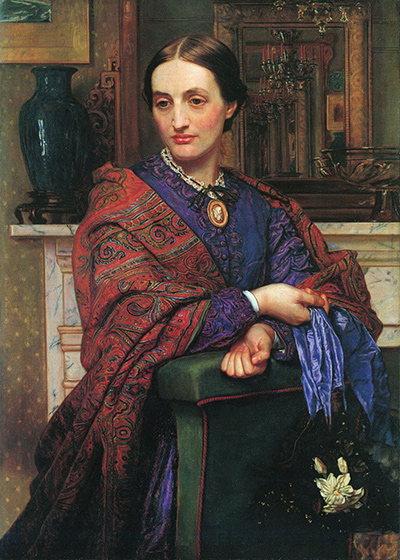
Fanny sits behind a green chair, looking slightly away as patterned red cloth wraps around her purple dress. A cameo brooch holds the dress near her throat. Mirrors, porcelain, glass and framed objects crowd the room, yet William Holman Hunt gives her face a quiet presence at its centre. The Toledo Museum of Art calls this portrait Fanny Waugh Hunt and dates it 1866–1868. It is an oil on canvas, 104 × 73 cm, in Toledo's collection as 1977.34. Fanny was Hunt's first wife; the painting was begun while she was alive and finished after her death. [1]
A portrait interrupted by loss
The museum records that Hunt began painting Fanny in Florence in the late summer of 1866. She posed behind the chair so that her pregnancy was concealed. Their son was born in October, and Fanny died in December from complications following the birth. Hunt returned to London with the portrait unfinished. He continued it from memory and a photograph, bringing back her paisley shawl, purple dress and cameo brooch from Florence so that he could paint those things before him. This account explains why the work's date extends into 1868 and why its careful description of fabric and ornament carries a personal history. [1]
At a Glance
- ArtistWilliam Holman Hunt (1827–1910)
- TraditionBritish Pre-Raphaelite art
- Work or subjectFanny Waugh Hunt
- ContextIllustrated paintings guide
- Further readingArtist biography
Those facts change how we read the portrait, but the canvas does not need to be turned into a single symbol of grief. Fanny appears alert and composed. Her gaze moves away from the viewer, while one hand rests on the chair and the other touches fabric across her body. The pose has the stillness of a formal portrait and the specificity of a person settled among familiar objects. Hunt had to complete the painting without further sittings, yet he did not replace her with an anonymous memorial figure. The face and hands remain recognisably individual.
The green chair is more than an accessory. It makes a strong dark form across the lower half of the picture, separating the viewer from the sitter while giving her arms a place to rest. The museum's account of its use during the first sittings adds another function: the chair concealed Fanny's pregnancy. Its visible role in the finished composition therefore carries a practical circumstance that a viewer could not infer from paint alone. It is a good example of why object records can deepen a close reading without asking every item to stand for an abstract idea.
Shawl, dress and brooch
The red shawl's paisley pattern spreads over Fanny's shoulders and down the left side of the canvas. Its dense curves meet the finer folds of the purple dress. A narrow gleam from the brooch concentrates attention at her throat, close to her face. Hunt's different treatments of woven pattern, satin sheen and hard jewellery give each material its own weight. The Toledo record says he retrieved all three of these actual belongings from Florence after her death. Their visual accuracy was therefore achieved through surviving objects as well as memory and the photograph. [1]
Watch: William Holman Hunt
Begin with Hunt’s paintings, then place his work alongside two fellow Pre-Raphaelite founders.
William Holman Hunt Paintings
An overview of Hunt’s paintings from TheHistoryOfArt video archive.
Watch on YouTubeThe fabrics make an unusually strong colour structure. Red and purple cover much of the figure, while the green chair and dark vase steady them. Gold and cream around the room provide small bright intervals. Hunt avoids a plain backdrop, but the colours do not dissolve Fanny into decoration. Her pale face and hands remain readable because the richer surfaces frame them. The picture shows the painter using the material world to keep a particular person present.
It is tempting to treat the cameo as a clue to a hidden story, but the museum's record establishes it first as something Fanny owned and wore for the portrait. Its small, light oval gives the eye a place to pause before moving back to her expression. The same caution applies to the shawl: its surviving physical identity matters more securely than any invented symbolic meaning for every fold. Knowing that Hunt had it brought back from Florence makes the painted textile poignant without requiring it to encode a fixed message.
An interior of reflections
Toledo's label identifies a Chinese porcelain vase, Venetian glass bowl and chandelier, Persian pottery dish, gold mirror frame and framed watercolours. These objects reflect the cultivated interiors admired by Hunt and his circle. They also make the room visually layered. Forms reappear in mirrors, and the eye passes from Fanny to objects behind her and into spaces suggested by the glass. The museum reads the receding reflections as evoking both eternity and memory dimming with time. That is a persuasive interpretation, especially in light of the portrait's completion after Fanny's death, but it is a reading offered by the museum rather than an instruction written into the painting. [1]
The mirrors complicate the apparent intimacy of the portrait. Fanny is close to us, but the reflected room seems to continue behind her. Hunt's insistence on accurate props gives the setting density, while those repeated spaces keep the picture from feeling entirely settled. We can move around its surfaces and still return to the woman's face. The room holds visible evidence of an affluent artistic household; the portrait's emotional force comes from the relation between that carefully made environment and the person it was arranged to honour.
Fanny, Edith and Toledo
The sitter's names can cause confusion. She was Fanny Waugh before marrying Hunt and Fanny Holman Hunt afterward. Her sister Edith Waugh later became Hunt's second wife and appears in a separate portrait, The Birthday. The sisters should not be merged simply because both were painted by Hunt and later titles use “artist's wife.” Toledo's object title names Fanny directly, and its label fixes her Florence sittings in 1866. [1] [2]
The Toledo Museum purchased the portrait with funds from the Libbey Endowment and records it as object 1977.34. The museum's detailed description gives a rare account of a portrait made across the divide of the sitter's death: initial sittings in Florence, physical belongings carried back, and later work in London. [1]
Look from Fanny's face to the shawl and brooch, then into the mirror and back. The portrait asks for time because it holds both a direct likeness and an elaborate room. Hunt's attention to materials cannot undo the loss that interrupted the work, but it shows one way he tried to finish a picture of someone he knew: through remembered presence, a photograph, and the objects she had worn.
Discussion
Look closely at Fanny Waugh Hunt, then compare your reading with the documented history.
Reader Insights
Which detail in Fanny Waugh Hunt most affects your reading?
How do the date, medium and collection records shape that interpretation?
What remains uncertain about this work or its history?
Join the Conversation
Share a close observation or a source-backed question about Fanny Waugh Hunt. The prompts above are starting points for discussion.
References
- Toledo Museum of Art, object record and label. View source.
- Fine Arts Museums of San Francisco, The Birthday. View source.







