


 by Tom Gurney
Tom Gurney BSc (Hons) is an art history expert with over 20 years experience
Published on June 19, 2020 / Updated on October 19, 2026
Email: tomgurney1@gmail.com / Phone: +44 7429 011000
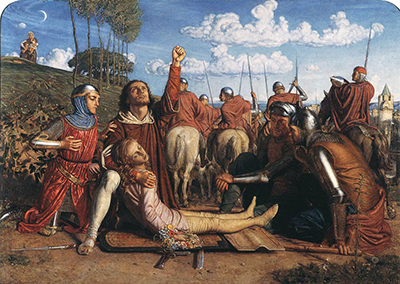
Rienzi Vowing to Obtain Justice for the Death of his Young Brother
William Holman Hunt's Rienzi arrests a violent story at the instant grief becomes a vow. A young man lies across Rienzi's knees, his body stretched along the foreground. Rienzi looks upward and raises one fist; armed figures and horses close around him, while others continue towards the distant town. The clear landscape, brilliant colour and crowded human gestures make the scene both a historical drama and an early statement of Hunt's new artistic allegiance. Completed in 1849, it was among the first exhibited works to carry the initials PRB for the Pre-Raphaelite Brotherhood. The letters appear at the lower right of the painting. [1] [2]
The National Gallery lists the painting as an oil on canvas measuring 83 × 117 cm, inventory L1222. It is on loan from the Ramsbury Manor Foundation. This identifies its display and lender without describing it as property of the National Gallery. The Gallery gives the abbreviated title Rienzi vowing to obtain Justice for his Brother's Death and records a much longer full title specifying the brother's death in a skirmish between the Colonna and Orsini factions. [1]
At a Glance
- ArtistWilliam Holman Hunt (1827–1910)
- TraditionBritish Pre-Raphaelite art
- Work or subjectRienzi Vowing to Obtain Justice for the Death of his Young Brother
- ContextIllustrated paintings guide
- Further readingArtist biography
A vow at the centre of the painting
Hunt has placed Rienzi and his brother in front of the other figures, close enough for the viewer to read the young man's closed eyes and pale clothing. One of Rienzi's hands supports the head while the other rises above the group. The two gestures pull in opposite directions: one holds the dead man near, the other addresses an audience beyond him. Rienzi's face is lifted, so the vow appears to reach past the people who stand immediately around him. The painting does not show a battle in progress. It shows the moral and political consequence of a death.
The brother's sword lies beneath him, with its hilt pointed toward the viewer. A little bunch of flowers near his hand intensifies the contrast between youth and violence. The National Gallery identifies a red anemone and blue hyacinth as flowers associated with tragedy and daisies with innocence. Their meaning is supported by that curatorial reading; the visible flowers also work more simply as fragile objects caught beside a fallen body. Hunt lets them occupy the same foreground as armour, metal and trampled earth. [1]
Around the brothers, people react in different ways. A kneeling armoured figure at the right leans inward. At the left, another figure faces the centre while a woman and children can be seen farther up the slope. Beyond them the mounted party continues. Hunt uses that movement to make the murder feel like an event in a larger conflict, not an isolated family scene. The figures' rich fabrics and armour announce a historical setting, but the foreground confrontation asks the viewer to consider a very direct question: how does a person respond to an apparently needless death?
Bulwer-Lytton's Rienzi and the Italian setting
The subject comes from Edward Bulwer-Lytton's 1835 novel Rienzi, The Last of the Tribunes. The literary Rienzi is based on Cola di Rienzo, the fourteenth-century Roman political leader. In the novel, his brother is killed accidentally by allies during a clash involving the rival Colonna and Orsini families. The loss helps drive Rienzi toward political power. The painting compresses this turn in the story into a single visible oath. It is therefore more precise to call the image a scene from Bulwer-Lytton's historical novel than a direct record of a witnessed medieval event. [1]
Watch: William Holman Hunt
Begin with Hunt’s paintings, then place his work alongside two fellow Pre-Raphaelite founders.
William Holman Hunt Paintings
An overview of Hunt’s paintings from TheHistoryOfArt video archive.
Watch on YouTubeThe historical Cola di Rienzo attracted nineteenth-century interest because of his attack on Rome's aristocratic rule. Hunt began the painting in 1848, a year of revolutions across Europe. The National Gallery connects its appeal to liberal support for Italian unification and notes that Hunt, looking back in his memoir, described the period through ideals of freedom and resistance to oppression. That retrospective account helps explain why this subject could have seemed urgent to him, although the painting's political meaning should not be reduced to a single modern slogan. Its immediate force still depends on a brother's body, a raised hand and people caught between mourning and action. [1]
Outdoor observation and Brotherhood models
Hunt painted much of the landscape from nature on Hampstead Heath, according to the National Gallery. This matters because the picture is not assembled solely from conventions for medieval Italy. Its sharply observed trees, ground and sky give a fictional Roman story the sensation of a place studied directly. The painted setting cannot be taken as a topographical image of fourteenth-century Rome, but its natural detail is part of the young artist's challenge to inherited studio formulas. Compare the related attention to specific vegetation and terrain in Cornfield at Ewell and The Haunted Manor, both painted in 1849. [1]
The faces also carry the Brotherhood's personal network into the historical fiction. Rienzi's face derives from drawings of Dante Gabriel Rossetti; Hunt used drawings of William Michael Rossetti for the knight at the far left. The two brothers came from a family connected with the cause of Italian unification. Their presence is more than a studio convenience: it lets a drama about Roman liberty acquire the features of artists and writers known to Hunt. [1]
The little PRB inscription links these choices to a newly formed group. Hunt, Rossetti and John Everett Millais had helped found the Brotherhood in 1848, seeking a different relationship between close observation, old art and contemporary feeling. The Metropolitan Museum of Art places Rienzi among the initial 1849 pictures marked with the group's initials, alongside Millais's Isabella and Rossetti's The Girlhood of Mary Virgin. The initials were initially cryptic to many viewers; today they help identify the painting as an early public declaration of the movement. [2] [1]
Exhibition and place in Hunt's career
Rienzi was exhibited at the Royal Academy in 1849, catalogue number 324, as recorded in the National Portrait Gallery's Rossetti iconography inventory. It followed Hunt's 1848 Eve of Saint Agnes, for which he made the Study of a Bloodhound. The two paintings show how quickly literary narrative became a testing ground for detailed observation, individual models and highly charged scenes. A later treatment of Keats, The Flight of Madeline and Porphyro, offers another comparison. [3]
The early picture does not yet look like every phase of Hunt's long career. Its emphatic gesture, armed company and literary source differ from the more intimate moral drama of The Awakening Conscience or the sustained religious symbolism of The Light of the World. Yet the bright surface and insistence that small things matter are already visible. The sword, flowers, tree line and figures do not merely decorate Rienzi's oath; together they turn a novel's turning point into a painting a viewer can explore in detail. For more context, see the paintings guide and biography.
Discussion
Look closely at Rienzi Vowing to Obtain Justice for the Death of his Young Brother, then compare your reading with the documented history.
Reader Insights
Which detail in Rienzi Vowing to Obtain Justice for the Death of his Young Brother most affects your reading?
How do the date, medium and collection records shape that interpretation?
What remains uncertain about this work or its history?
Join the Conversation
Share a close observation or a source-backed question about Rienzi Vowing to Obtain Justice for the Death of his Young Brother. The prompts above are starting points for discussion.
References
- National Gallery object record. View source.
- Metropolitan Museum of Art, The Pre-Raphaelites. View source.
- National Portrait Gallery, Rossetti inventory. View source.







