by Tom Gurney
Tom Gurney BSc (Hons) is an art history expert with over 20 years experience
Published on June 19, 2020 / Updated on November 3, 2026
Email: tomgurney1@gmail.com / Phone: +44 7429 011000
Bird: Introduction
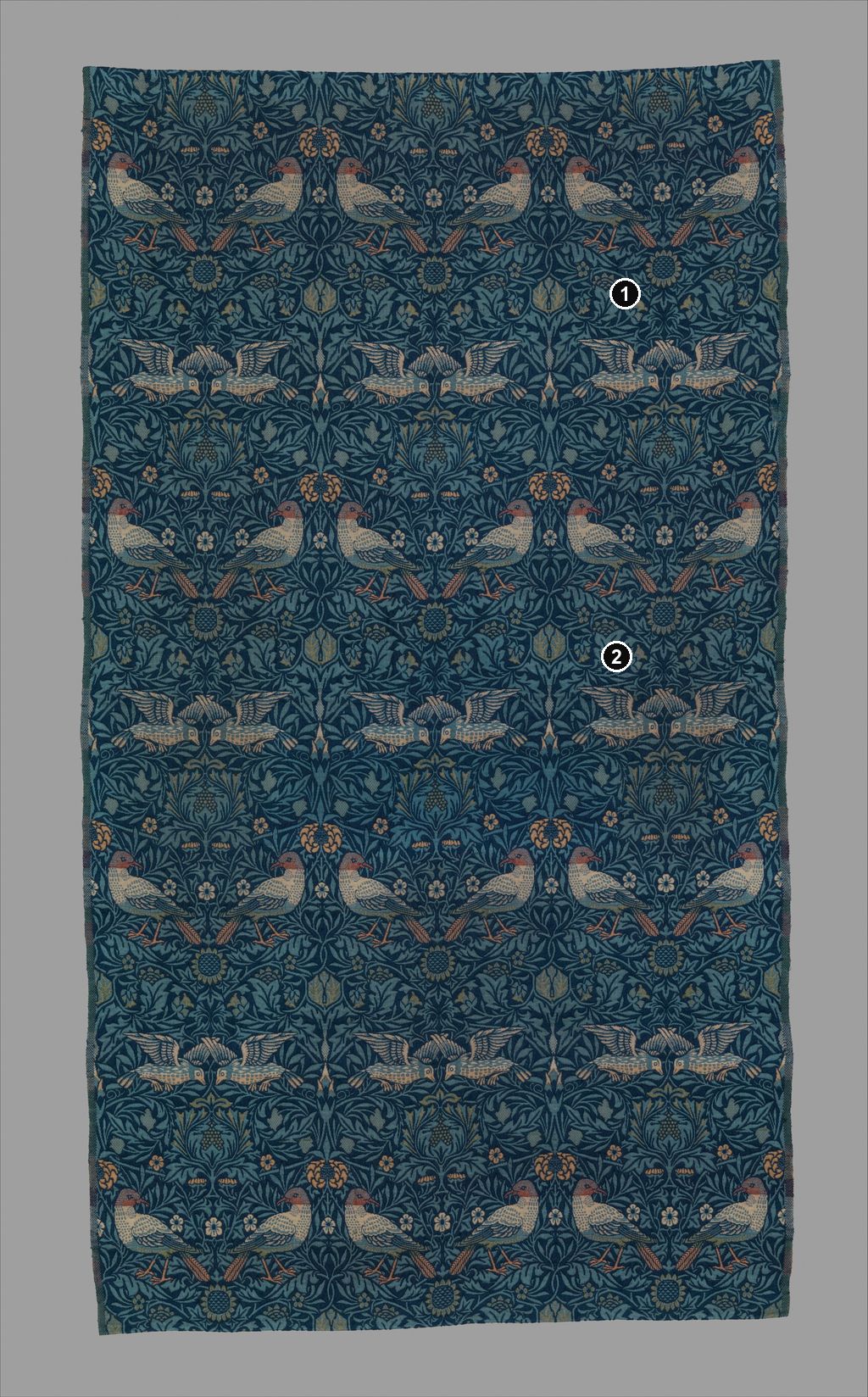
Rows of birds settle and rise through a close-growing world of leaves. Some stand upright, their long tails pointing down towards flowers; others spread their wings and turn their heads towards each other across a slender stem. In the Metropolitan Museum of Art’s length of Bird, pale bodies stand out against deep blue, while softer blue foliage joins almost every part of the surface. The effect changes with distance: a wall of ordered growth resolves into feathers, claws, flower centres and branching veins. William Morris designed this woven wool furnishing fabric in 1878, the year in which its pattern was registered. [1]
Bird occupied an unusually personal place among Morris’s textiles: he used it on the drawing-room walls of Kelmscott House, his London home. Its material matters as much as its imagery. This is a substantial doublecloth, although Morris called this kind of fabric “woven wool tapestry”. Following the birds through the repeat reveals how he gave a recurring woven pattern enough variation to reward close looking and enough structure to hold a room together. [1]
At a Glance
- Design and registration1878; William Morris, woven wool furnishing [1]
- Bird drawingsMorris used his own bird studies, unlike Webb’s contribution to Trellis [2]
- StructureDoublecloth: two layers woven simultaneously and exchanging positions [3]
- Intended settingDrawing-room walls at Kelmscott House, Hammersmith [1]
This work across William Morris’s career
La Belle Iseult
1858 (conventional date) [4]Peacock and Dragon
Design 1878 [7]Bird (current article)
Registered 1878 [8]Strawberry Thief
Design 1883 [9]The Attainment or Vision of the Holy Grail
Designs 1890–1891; Birmingham repeat 1895–1896 [11]The Kelmscott Chaucer
Issued 1896 [12]Contents
- Two kinds of birds, one continuous pattern
- Learning to draw the birds
- What doublecloth means
- Designing within the loom’s limits
- A fabric Morris lived with
- Surviving lengths and their separate histories
- Annotated details
Two kinds of birds, one continuous pattern
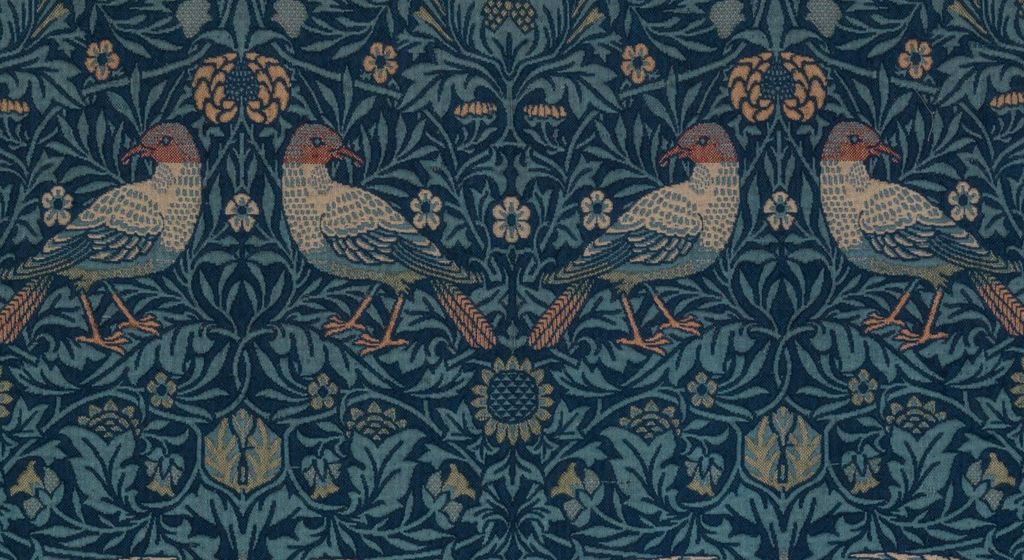
The Met’s cloth, accession 23.163.15, offers a particularly clear view of the design over several repetitions. In its standing birds, the head and neck rise above a rounded breast and folded wing; small feet pick their way across the foliage. The light chest carries rows of blue markings, and the darker wing is divided by pale, curving strokes. Red appears on the head, legs and long tail. These touches make the upright birds easy to find without separating them completely from their surroundings. [1]
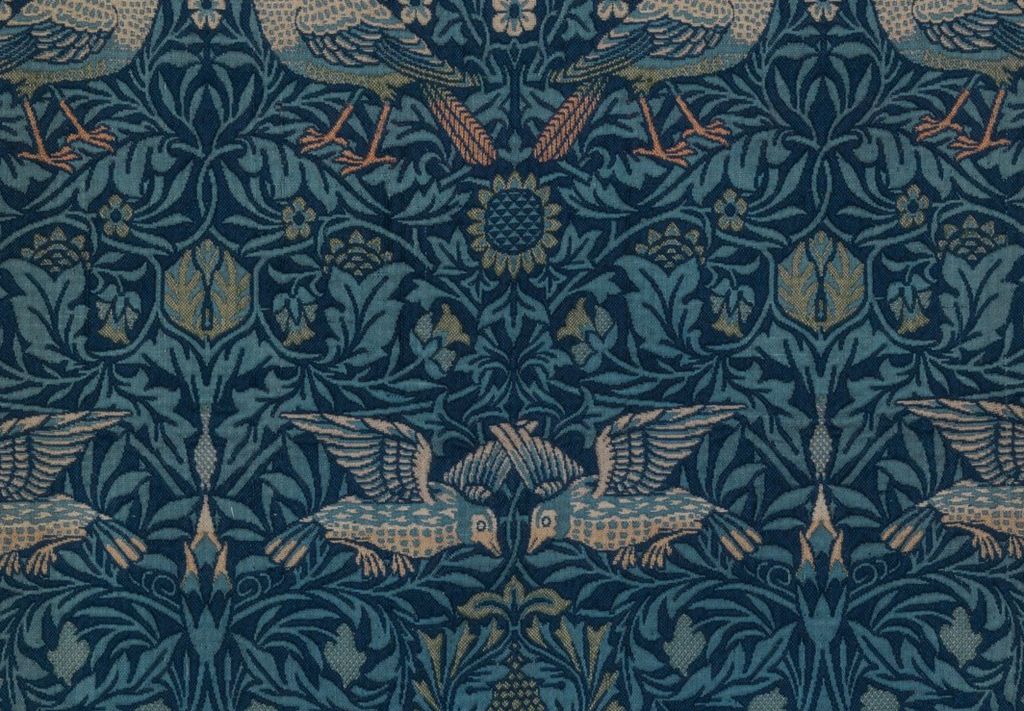
The flying birds have a different silhouette. Their bodies stretch horizontally, with wings raised above their backs and feathers spreading below. Their heads incline towards each other across the centre of a pair. Where the standing birds make a series of upright accents, the flying birds draw the eye sideways. Alternating these two arrangements gives the cloth a rhythm that a single repeated bird could not provide. Flight is conveyed through the placement of the wings and bodies, rather than through a landscape receding behind them. [1]
Look between the birds and the design becomes less like a collection of animal motifs. Long leaves curl around their tails and feet, and stems turn through the spaces between wings. Broad, lobed leaves are filled with narrower internal divisions. Small flowers punctuate the gaps, while larger flower heads establish intervals across the cloth. The William Morris Gallery identifies the main foliage as acanthus and the prominent flowers as sunflowers. Its description also distinguishes the standing and flying pairs. [2]
In the Met colourway, the foliage has enough contrast against the blue ground to remain legible, but less than the pale birds. It supplies a quieter structure beneath the stronger animal shapes. The two levels of attention are linked: a leaf points towards a bird, a tail leads towards a flower, and a stem carries the eye back into the next repeat. There are dark gaps, yet few of them remain empty for long. Even the spaces around a bird’s head contain little flowers or fine leaves that keep it within the patterned field. [1]
Symmetry is particularly useful here. Paired birds and opposed leaves establish centres that can be recognised quickly. Curves and small details complicate those centres when examined closely. The full length shows how the same arrangement can recur without turning into isolated emblems lined up on a blank background. The birds belong to the growth around them: their postures help organise it, and its curves give their bodies places to stand or fly. [1]
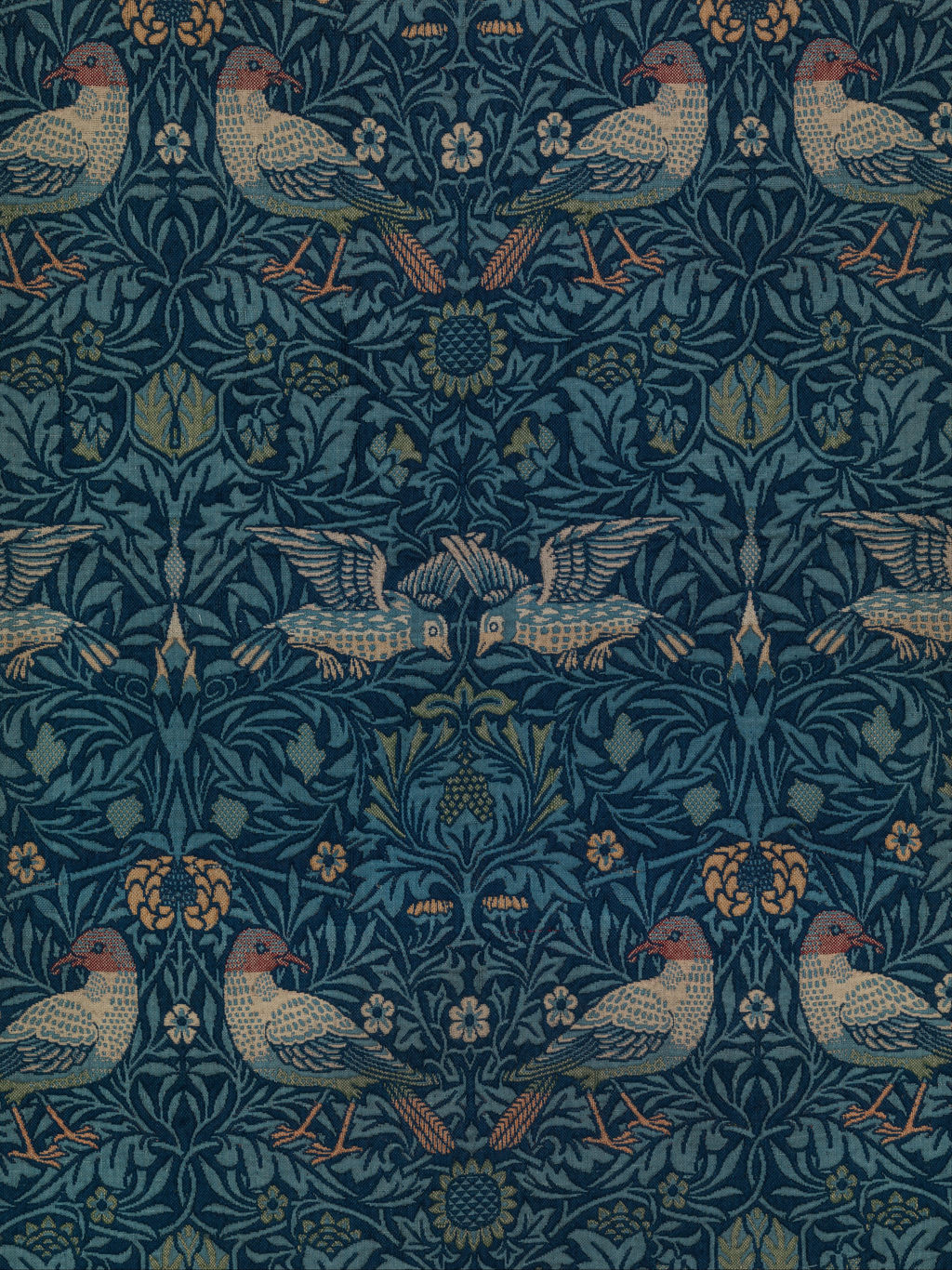
Bird, detail of the Metropolitan Museum of Art textile. A bird pair occupies one part of the repeating field. The Metropolitan Museum of Art. Image source. CC0 / Public domain.
Learning to draw the birds
The birds also mark a specific development in Morris’s design practice. Philip Webb supplied the bird drawings for the earlier Trellis wallpaper. According to the William Morris Gallery, Bird began a sequence of textile designs in which Morris used his own drawings of birds. The Gallery connects this change with a letter to the textile manufacturer Thomas Wardle dated 25 March 1877, in which Morris described studying birds with a future design in mind. This is a practical account of a designer acquiring a new resource for his work. [2]
The distinction is more revealing than a general claim that birds symbolised Morris’s love of nature. In Bird, he had to make animal forms participate in the same ordered surface as flowers and leaves. The folded wing needed to read differently from the open one; the two postures also had to fit the spaces available in a repeat. The resulting forms are recognisable through selected features—beaks, feet, feather divisions and body outlines—even though the arrangement gives no illusion of watching a flock in an actual garden. [1]
The Gallery identifies the original design as D31 in the William Morris Society’s collection. That sheet and the surviving woven cloths represent different stages of the work: drawing the proposed arrangement and realising it through yarn. The Gallery’s account of the letter helps explain Morris’s developing bird drawing; it does not identify every bird in the finished pattern by species. [2]
Historical textiles supplied another part of his visual education. The Japanese exhibition resource The World of William Morris relates Bird to sixteenth- and seventeenth-century Italian silks in the South Kensington Museum. It does not identify one particular silk as the sole model. This account places the design within a study of older woven ornament, alongside the study of living forms. The paired creatures and enclosing foliage can be appreciated as an arrangement adapted to cloth, without treating them as a coded personal message. [13]
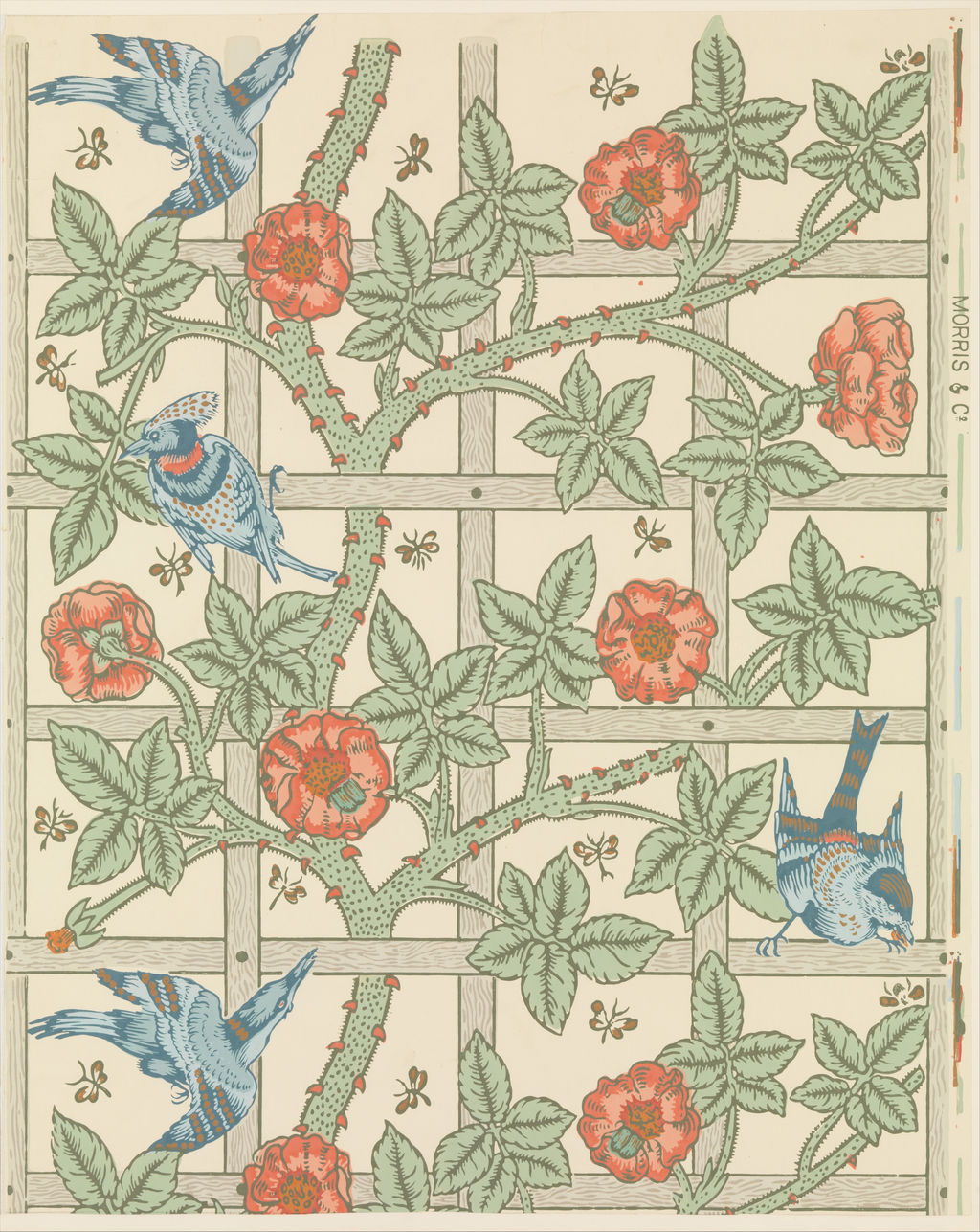
Trellis wallpaper in the Metropolitan Museum of Art. Morris designed the pattern; Philip Webb supplied its birds. The sheet is distinct from the original working drawing. Purchase, Edward C. Moore Jr. Gift, 1923. Image source. CC0 / Public domain.
What doublecloth means
A doublecloth is made by weaving two layers together. The Fitzwilliam Museum’s terminology record explains that the layers are woven simultaneously, one above the other; in patterned double weave they change position according to the design. The relationship between the layers helps create the figure and ground. This is a construction within the fabric, giving the word “double” a material meaning beyond the paired birds visible on its face. [3]
The Met identifies Bird specifically as doublecloth and cautions that its historical “tapestry” name does not describe a tapestry weave. Detroit’s separate example is likewise catalogued as woollen double cloth. The distinction matters because a richly patterned wool hanging can look tapestry-like in its function, weight and imagery while being made by another weaving method. A product name, the purpose of covering a wall and the structure of the threads answer different questions about the same textile. [1] [14]
Another term associated with Bird is Jacquard: the Japanese exhibition resource describes it as handwoven Jacquard wool. Jacquard refers to the apparatus controlling the pattern, rather than to the doublecloth structure itself. In the historical mechanism, punched cards govern which warp threads are raised. The Science Museum Group’s record of a surviving Jacquard hand loom demonstrates that this form of pattern control could be used on a loom operated by a person. “Jacquard” and “handwoven” are therefore compatible descriptions. That museum’s teaching loom is an illustration of the principle, not a loom documented as having woven Bird. [13] [15]
The distinction also helps separate Bird from individually woven high-warp tapestry. In his 1893 essay “Textiles”, Morris treated tapestry and mechanical weaving as different branches of textile work. He described tapestry’s coloured threads as covering the warp, and praised the scope it gave for detailed wall decoration. His account of mechanical weaving, by contrast, begins with recurring patterns and restricted colour choices. Bird belongs to the story of figured furnishing cloth, even though its surface could serve some of the decorative purposes associated with tapestry. [16]
A close view of the Met cloth brings that material distinction back to the eye. The edges of feathers and leaves resolve into small intersections of yarn. The pale parts of a bird contain blue marks; the blue foliage shows its own tiny changes of texture. This is a coloured woven surface whose detail is inseparable from its threads. At this scale, even a firm outline retains the small irregularities of a textile surface. [1]
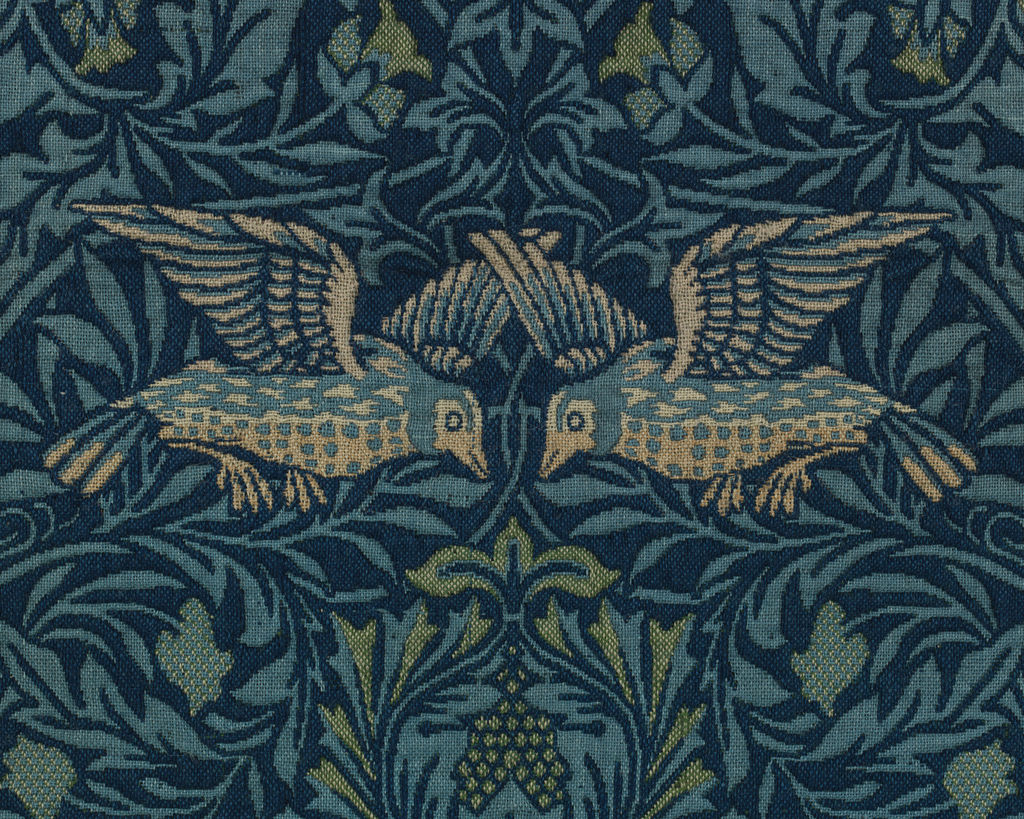
Bird, a museum close-up showing the woven surface around a bird and the surrounding leaves. The Metropolitan Museum of Art. Image source. CC0 / Public domain.
Annotated Details from Bird
The numbered points identify visible features discussed in this article. Return from each detail to the whole composition. Bird woven furnishing fabric. The surviving length shows several repetitions of paired birds and dense foliage. The Metropolitan Museum of Art. Image source. CC0 / Public domain. Resized only; supplied image appearance and documentary edges retained. No colour, sharpening, reconstruction or other appearance changes.
Details from BIRD
Compare the cropped details with the complete images above. Notice how their colours, shapes and positions contribute to the larger compositions.
Upright birds in the repeat
Two pale birds stand above a large leaf form. Their upright necks and long tails make a different silhouette from the downward-turning birds in the next band.
The pair turned downwards
Here the birds turn their heads down and inward. Their broader wings spread out above them, giving this band a different shape from the more upright pair.
Designing within the loom’s limits
Morris’s “Textiles” essay offers a useful way of thinking about Bird, although it appeared fifteen years after the design. He argued that mechanical weaving generally imposed limits on the repeat and on the number of colours available. His proposed response was a controlled relationship between figure and ground, enlivened where appropriate by stronger outlines or carefully placed accents. These are general principles of design, not a surviving specification for Bird’s loom, thread count or exact number of yarn colours. [16]
In the Met length, the broad blue relationship of foliage to ground makes the warmer bird heads and flower petals especially effective. Their colour occupies relatively small areas but establishes points the eye can find again across the fabric. The wing and breast markings then provide a smaller scale of variation within the large animal forms. Studying these changes helps explain how a limited palette can sustain a densely worked surface: the colours do several jobs through placement, proportion and adjacency. [1]
Morris also wanted a pattern’s geometry to be evident enough to prevent distracting accidental shapes. This can sound surprising if a natural pattern is expected to hide all signs of repetition. His concern was for a coherent arrangement in which each part seemed to grow from another. In Bird, the stems rising between paired animals and the repeated flower centres make the organisation discoverable. Once found, that organisation gives the foliage direction; it does not remove the pleasure of exploring its smaller turns. [16]
His final remarks distinguish woven goods from flat painted decoration and wallpaper. Cloth commonly falls into folds, interrupting the pattern and changing how its details are seen. He therefore recommended combining strong structure with abundant smaller detail, and argued that a well-composed large pattern could be restful. These statements help explain the design problem a furnishing fabric must solve: it needs to survive an incomplete view. A fold might hide one bird or divide a pair, but a strong wing, flower or leaf can still make sense locally. [16]
Morris’s essay also makes forceful judgements about historical styles and commercial manufacture. They are his arguments as a nineteenth-century designer and critic. The enduringly useful part for looking at Bird is his insistence that knowledge of a material should generate the design. Its weave, repeat, palette and scale are active conditions of the work. The birds become compelling through the way those conditions are used, as much as through the subject chosen. [16]
A fabric Morris lived with
Morris’s own use of Bird gives these questions of scale and repetition a concrete setting. The Met records the drawing-room walls of Kelmscott House in Hammersmith as its intended context. This was his family’s London home from 1878, distinct from Kelmscott Manor in Oxfordshire. A length seen against a neutral background is only part of that story: in a furnished room, the pattern would have been encountered around furniture and objects, across interruptions and at different distances. [1]
The Japanese exhibition account preserves a useful description attributed to May Morris. In its Japanese rendering, she associated the design with a settled, familiar domestic life and with beautiful possessions gathered carefully over time. That is later recollection mediated through the exhibition essay, but it adds a specific response to the dense ornament. Her reported emphasis falls on living comfortably with it. Alongside the account’s Italian silk comparison, this domestic recollection suggests how historical richness could become familiar through daily use. [13]
The design continued in production after Morris & Co. established textile manufacture at Merton Abbey in 1881. The Met also records three historical colourways. Consequently, the date 1878 identifies the design and registration, rather than proving that every surviving length was woven in that year. Nor should the blue appearance of the Met specimen stand for every historical version. The balance between birds, flowers and foliage depends partly on the colours in which their shapes are realised. [1]
Surviving lengths and their separate histories
Museum collections preserve pieces of cloth with individual histories. Detroit’s Bird, accession F1986.48, measures 152.4 by 133.4 centimetres. Its published provenance runs from Charles Canning Winmill through the Fine Art Society in London to the museum’s purchase in 1986. Those names describe this length’s recorded passage into a collection; they do not establish that it came from Morris’s drawing room. [14]
The Musée d’Orsay holds another hanging, OAO 1249 1, measuring 208 by 165 centimetres. Its record dates the model to 1877–78 and records acquisition in 1992 from the Haslam & Whiteway gallery in London. The slightly broader design-date wording can coexist with the Met’s 1878 registration: the conception of a pattern and its registration are different events. Orsay’s account also follows its own cloth into later exhibitions, including the 1996 Morris exhibition at the Victoria and Albert Museum and the 2022–23 exhibition at La Piscine in Roubaix. [17]
These records give Bird a history beyond a single famous interior. They preserve different lengths, dimensions, ownership sequences and encounters with later audiences. The most instructive comparison begins by knowing which object is being examined. In the Met length described here, the alternating standing and flying birds remain especially easy to follow across the full cloth. At close range, the raised wings break into rows of feathers and the broad leaves into curling lobes; farther away, those details join the steady, repeated framework that lets the pattern extend across a wall. [1]
Works and designs directory
This directory brings together 365 design, edition and collection records, plus 208 individually listed samples from three historical sample books. Design families, surviving objects, later printings and book editions have separate entries. It covers the research assembled for these articles, rather than the full output of Morris and his associates. Dates and attributions follow the named catalogues; differences are retained where they matter. Search by title, designer, material, collection, accession or colourway.
| Name | Date | Medium |
|---|---|---|
| Blackberry | Design: early twentieth century; specimens catalogued 1903 | Wallpaper |
| Hyacinth | Design: c.1900–12 | Wallpaper |
| Horn Poppy | Design: c.1885 | Wallpaper |
| Chrysanthemum | Design: 1877; some later catalogues say 1876 | Wallpaper |
| Fruit or Pomegranate | Design dates reported: 1862 / 1865–66 | Wallpaper |
| Jasmine | Design: 1871–72; wallpaper issued 1872 | Wallpaper |
| Larkspur | Design/issue dates reported: 1872–75 | Wallpaper |
| Marigold | Design: 1873–75; registered 1875 | Wallpaper |
| Pimpernel | Design/registration: 1876 | Wallpaper |
| Willow | Design: 1874 | Wallpaper |
| Wreath | Design: c.1876 | Wallpaper |
| Trellis | Design: November 1862; registered 1864 | Wallpaper |
| Bird | Design: 1877–78; registered 1878 | Textile |
| Bird — Met 23.163.15 | Design: 1877–78; registered 1878; specimen: unknown | Textile |
| Bird — DIA F1986.48 | Specimen: 1878 | Textile |
| Bird — WMG F283b | Design: 1877–78; registered 1878; specimen: unknown | Textile |
| Bird — Orsay OAO 1249 1 | Design: 1877–78; registered 1878; specimen: unknown | Textile |
| Cabbage and Vine | Design: 1879 | Textile |
| Cabbage and Vine — SAL KM032 | Specimen: 1879 | Textile |
| Cabbage and Vine — V&A E.45-1940 | Drawing/cartoon: 1879 | Drawing |
| Cabbage and Vine — V&A E.3472-1932 | Drawing/cartoon: 1879 | Drawing |
| Evenlode | Registered: 2 September 1883 | Textile |
| Evenlode — WMG F325a | Registered: 2 September 1883; specimen: unknown | Textile |
| Evenlode — Cincinnati 1993.144 | Specimen: 1883–1900 | Textile |
| La Belle Iseult | Painting: conventionally dated 1858 | Painting |
| Study for La Belle Iseult — Christie’s lot 5807506 | Study date: unknown | Drawing |
| Membland Hall Tile Panel | Design: 1876; Orsay model c.1876–77 | Drawing |
| Membland Hall Tile Panel — V&A C.36-1972 | Design/panel: 1876 | Ceramics |
| Membland Hall Tile Panel — WMG C176 | Design/panel: 1876 | Ceramics |
| Design for Membland Hall tile panel — WMG A31 | Drawing: 1876 | Drawing |
| Membland Hall Tile Panel — Orsay OAO 1210 | Model: c.1876–77; specimen: unknown | Ceramics |
| Membland Hall Tile Panel — Cologne E04941 | Design: 1876; specimen: unknown | Ceramics |
| Peacock and Dragon | Design: 1878 | Textile |
| Peacock and Dragon — WMG F26cii | Design: 1878; specimen: unknown | Textile |
| Peacock and Dragon — Met 30.95.52 | Design: 1878; specimen: unknown | Textile |
| Snakeshead | Design: 1876 | Textile |
| Snakeshead — WMG F345 | Design: 1876; specimen: unknown | Textile |
| Snakeshead — Huntington 2000.5.525 | Specimen: c.1876 | Textile |
| Snakeshead — Birmingham 1941M398 | Specimen: 1876–77 | Textile |
| Snakeshead — WMG F366 | Design: 1876; specimen printed after 1917 | Textile |
| Strawberry Thief | Design: 1883 | Textile |
| Strawberry Thief — WMG F422b | Design: 1883; specimen: unknown | Textile |
| Strawberry Thief — Huntington 2000.5.523 | Specimen: c.1883 | Textile |
| Strawberry Thief — Cleveland 1937.696 | Specimen: c.1936 | Textile |
| Tulip and Willow | Design: 1873 | Textile |
| Tulip and Willow — WMG F3 | Design: 1873; specimen printed after 1883 | Textile |
| Tulip and Willow — V&A CIRC.91-1933 | Catalogue date: 1873; manufacture unknown | Textile |
| The Attainment or Vision of the Holy Grail | Design cycle: 1890–91 | Textile |
| The Attainment or Vision of the Holy Grail — Birmingham 1907M131 | Specimen: 1895–96 | Textile |
| The Attainment or Vision of the Holy Grail — Stanmore original Attainment | Woven by 1893 (original Attainment) | Textile |
| The Attainment or Vision of the Holy Grail — McCulloch repeat group | Specimen: 1898–99 | Textile |
| The Attainment or Vision of the Holy Grail — Beecham Attainment/Summons | Specimen: 1927–32 | Textile |
| Wandle | Design: 1884 | Textile |
| Wandle — WMG F50 | Design: 1884; specimen: unknown | Textile |
| The Kelmscott Chaucer | Edition: 1896; issued 26 June | Book |
| The Kelmscott Chaucer — WMG K20 | Specimen: 1896 | Book |
| The Kelmscott Chaucer — Morgan PML76849 | Edition: 1896; issued 26 June; specimen: unknown | Book |
| The Kelmscott Chaucer — Birmingham special-bound copy | Edition: 1896; issued 26 June; specimen: unknown | Book |
| The Kelmscott Chaucer — UMD2010acquisition | Edition: 1896; issued 26 June; specimen: unknown | Book |
| Woodpecker Tapestry | Design/tapestry: 1885 | Textile |
| Woodpecker Tapestry — WMG F139 | Specimen: 1885 | Textile |
| Larkspur — V&A E.468-1919 | Design/issue dates reported: 1872–75; specimen: unknown | Wallpaper |
| Marigold — V&A E.478-1919 | Design: 1873–75; registered 1875; specimen: unknown | Wallpaper |
| Willow — V&A E.488-1919 | Specimen: 1874 (Produced) | Wallpaper |
| Pimpernel — V&A E.497-1919 | Design/registration: 1876; specimen: unknown | Wallpaper |
| Wreath — V&A E.501-1919 | Specimen: 1876 (Produced) | Wallpaper |
| Chrysanthemum — V&A E.802-1915 | Specimen: 1877 (made) | Wallpaper |
| Fruit — V&A E.2210-1913 | Specimen: 1866 (produced) | Wallpaper |
| Blackberry — V&A E.2793-1980 | Specimen: 1903 (made) | Furniture |
| Blackberry — V&A E.2794-1980 | Specimen: 1903 (made) | Furniture |
| Blackberry — V&A E.2839-1980 | Specimen: 1903 (made) | Furniture |
| Blackberry — V&A E.1415-1979 | Specimen: c. 1955 (printed) | Wallpaper |
| Hyacinth — V&A E.1416-1979 | Specimen: c. 1955 (printed) | Wallpaper |
| Trellis — V&A E.452-1919 | Specimen: 1864 (manufactured) | Wallpaper |
| Willow Bough | Design: 1887 | Wallpaper |
| Willow Bough — V&A E.558-1919 | Specimen: 1887 (made) | Wallpaper |
| Blackberry — B179 | Specimen: c.1960s | Wallpaper |
| Hyacinth — B101 | Specimen: 1968 | Wallpaper |
| Horn Poppy — B155 | Specimen: 1885–1920 | Wallpaper |
| Horn Poppy — B112b | Design: c.1885; specimen: unknown | Wallpaper |
| Chrysanthemum — B172 | Specimen: c.1960 | Wallpaper |
| Fruit — B9a | Design dates reported: 1862 / 1865–66; specimen: unknown | Wallpaper |
| Larkspur — B11c | Design/issue dates reported: 1872–75; specimen: unknown | Wallpaper |
| Marigold — B40 | Specimen: before 1940 | Wallpaper |
| Pimpernel — B13 | Specimen: before 1940 | Wallpaper |
| Willow — B69 | Specimen: before 1940 | Wallpaper |
| Willow Bough — B22 | Specimen: after 1940; presented 1950 | Wallpaper |
| Poppy or Wreath — B15 | Specimen: c.1950 | Wallpaper |
| Wreath — 20032D1 | Specimen: c.1876 | Drawing |
| Design for Chrysanthemum — A33 | Drawing: 1877 | Drawing |
| Design for Trellis — BLA472 | Drawing: 1862 | Drawing |
| Trellis — B31 | Specimen: before 1940 | Wallpaper |
| Larkspur printing block — R253 | Design/issue dates reported: 1872–75; specimen: unknown | Printing block |
| Jasmine — 23.163.4j | Catalogue date: 1872; manufacture unknown | Wallpaper |
| Marigold — 23.163.4c | Catalogue date: 1875; manufacture unknown | Wallpaper |
| Willow Bough — 23.163.4k | Catalogue date: 1887; manufacture unknown | Wallpaper |
| Larkspur — 23.163.4i | Catalogue date: 1875; manufacture unknown | Wallpaper |
| Fruit or Pomegranate — 23.163.4g | Catalogue date: c.1866; manufacture unknown | Wallpaper |
| Chrysanthemum drawing — 2000.5.61 | Specimen: c.1877 | Drawing |
| The Pimpernel — HH3016 | Specimen: c.1876 | Wallpaper |
| Marigold — M.2003.6.2 | Design: 1873–75; registered 1875; specimen: unknown | Wallpaper |
| Marigold textile — 1937.699 | Specimen: twentieth century | Textile |
| An Angel with a Harp — Tate A00815 | Work date: unknown | Drawing |
| An Angel with a Pipe — Tate A00816 | Work date: unknown | Drawing |
| A Girl with a Flute — Tate A00817 | Work date: unknown | Drawing |
| Design for Tapestry — Tate A00818 | Work date: unknown | Drawing |
| The Archangel Raphael — Tate A00819 | Work date: unknown | Drawing |
| The Archangel Gabriel — Tate A00820 | Work date: unknown | Drawing |
| La Belle Iseult — Tate N04999 | Work: 1858 | Painting |
| The Archangel Gabriel — Tate N05219 | Work date: unknown | Drawing |
| Figure of Guinevere — Tate N05221 | Work: c.1858 | Drawing |
| Guinevere and Iseult: Cartoon for Stained Glass — Tate N05222 | Work: 1862 | Drawing |
| Angel of the Resurrection: Cartoon for Stained Glass — Tate N05223 | Work: 1862 | Drawing |
| Daisy tile | Specimen: c. 1870 | Ceramics |
| Alceste tile | Specimen: c. 1862 | Ceramics |
| The Labours of the Month | Specimen: 1862 | Ceramics |
| Trellis — Met 23.163.4h | Catalogue date: 1864; manufacture unknown | Wallpaper |
| Trellis — William Morris Gallery B132a | Design: November 1862; registered 1864; specimen: unknown | Wallpaper |
| Trellis — Standen NT1213907 | Design: November 1862; registered 1864; specimen: unknown | Wallpaper |
| Trellis — loose sample-book page B133 | Specimen: printed before 1917 | Wallpaper |
| Sussex armchair — G29 | Design: c.1860s; specimen: unknown | Furniture |
| Sussex chair — G51 | Specimen: c.1868 | Furniture |
| Round-seated Sussex chair — 1214043.2 | Specimen: c.1870 | Furniture |
| Oval centre table — 1213993 | Specimen: c.1870 | Furniture |
| The Backgammon Players — 26.54 | Specimen: 1861 | Painting |
| Table de travail — OAO450 | Specimen: c.1860–68 | Furniture |
| King David the Poet — 1998.231 | Specimen: 1863 | Stained glass |
| Eve and the Virgin cartoon — A8 | Drawing: 1864 drawing; window installed 1865 | Drawing |
| Design for Mermaid woven fabric — A32b | Drawing: c.1880; mermaid figures 1875 | Drawing |
| Wreath carpet point paper — BlA477 | Drawing: c.1870 | Drawing |
| A Note by William Morris on His Aims in Founding the Kelmscott Press — K260 | Edition: March 1898; exact date statements differ | Book |
| Oak cabinet for Kelmscott Press books — no accession supplied | Design: unknown; specimen: unknown | Furniture |
| Stained-glass quarry design, Diplacus punicus / Nihil Desperandum — WMG BLA444 | Drawing date: unknown | Drawing |
| House of Retreat, Crowborough: rose window design — WMG BlA405 | Drawing: c.1913 | Drawing |
| Circular embroidery design with flower and butterfly — WMG A993 | Drawing date: unknown | Drawing |
| Aquilegia quarry design — WMG BLA447 | Drawing date: unknown | Drawing |
| Carnation textile design — WMG A1070 | Drawing: c.1875 | Drawing |
| Wallpaper design with roses and acanthus — WMG BlA503 | Drawing: c. 1880-1900 | Drawing |
| Rottingdean Grail cartoon, fourth panel — WMG A208.4 | Drawing: 1886 | Drawing |
| Rottingdean Grail cartoon, second panel — WMG A208.2 | Drawing: 1886 | Drawing |
| Rottingdean Grail cartoon, third panel — WMG A208.3 | Drawing: 1886 | Drawing |
| Thisbe embroidery design — WMG A211 | Drawing: c. 1863-4 | Drawing |
| Prophet predella cartoon for Jesus College Chapel — WMG A256 | Drawing: 1877 | Drawing |
| Rottingdean Grail cartoon, first panel — WMG A208.1 | Drawing: 1886 | Drawing |
| Designs for embroidery frames — WMG A307 | Drawing: c.1910s | Drawing |
| Flower Garden embroidery design — WMG A218 | Drawing: c.1892 | Drawing |
| Design possibly for painted panelling — WMG A476 | Drawing: 2.1.1886 | Drawing |
| Annunciation cartoon for St Michael and All Angels, Brighton — WMG A4 | Drawing: 1862 | Drawing |
| Design for reversible embroidered table cover — WMG BlA456 | Drawing: c. 1880 | Drawing |
| Combe Court panelled ceiling design — WMG A294 | Drawing: 1890s | Drawing |
| Circular embroidery design with flowers and leaves — WMG A249 | Drawing: 1880-90s | Drawing |
| Carpet design for Miss Beardmore — WMG BLA458 | Drawing: 1875-1877 | Drawing |
| Acanthus embroidery design — WMG A459 | Drawing: 1870s | Drawing |
| Stained-glass quarry design for Jesus College, Cambridge — WMG BlA439 | Drawing: 1873 | Drawing |
| Stained-glass quarry design for Duke of Westminster — WMG BlA440 | Drawing: 1876 | Drawing |
| Stained-glass roundel design with seated young man — WMG BLA487a | Drawing: c. 1930s | Drawing |
| Design for tapestry sofa upholstery — WMG A34 | Drawing: 1880s/early 1900s | Drawing |
| King Arthur and Sir Lancelot stained-glass design — WMG A262 | Drawing: 1862 | Drawing |
| Peacock embroidery-frieze design — WMG A209 | Drawing: c.1875 | Drawing |
| Drawing-room cornice, 9 Chesterfield Gardens — WMG A301 | Drawing: 1880s | Drawing |
| The Flight into Egypt stained-glass design — WMG A260 | Drawing: 1872 | Drawing |
| Lily and Pomegranate wallpaper design — WMG A30 | Drawing: 1886 | Drawing |
| Sideboard inlay design — WMG A1071 | Drawing: c1890 | Drawing |
| Pelican design from the Brampton east window — WMG A136 | Drawing: c.1880 | Drawing |
| African Marigold textile design — WMG BLA464 | Drawing: 1876 | Drawing |
| Medway textile design — WMG A38 | Drawing: 1885 | Drawing |
| East-window canopy, St John the Apostle — WMG BLA413 | Drawing: 1865 | Drawing |
| Window canopy for Christ Church — WMG BLA416 | Drawing: 1865 | Drawing |
| Canopy tracery design — WMG BlA410 | Drawing: 1863 | Drawing |
| Architectural canopy for All Saints Church — WMG A429 | Drawing: 1862 | Drawing |
| The Orchard embroidery design — WMG D294vi | Drawing: 1888 | Drawing |
| Medway working design for block cutters — WMG BLA453 | Drawing: 1885 | Drawing |
| Swivel woven-textile design — WMG BLA465 | Drawing: 1877 | Drawing |
| Red House corridor stained-glass panel designs — WMG BLA436a & b | Drawing: c.1861 | Drawing |
| Two-light window scale drawing — WMG BLA342 | Drawing date: unknown | Drawing |
| Dundee Parish Church memorial-window design — WMG BLA371 | Drawing: c.1874 | Drawing |
| Good Shepherd and Caritas cartoon — WMG BLA364 | Drawing date: unknown | Drawing |
| St Paul’s Montreal window design — WMG BLA354 | Drawing date: unknown | Drawing |
| Honeycomb carpet design — WMG A39 | Drawing: 11.02.1876 | Drawing |
| Wreath three-ply Kidderminster carpet design — WMG BLA480 | Drawing: 1875-1880 | Drawing |
| St Cecilia, Halewood window design — WMG A519 | Drawing: 1881 | Drawing |
| Stained-glass quarry design for 17 Charles Street — WMG BlA438 | Drawing: 1874 | Drawing |
| Parable of the Vineyard cartoon, A268 — WMG A268 | Drawing: 1861 | Drawing |
| Sailing-ship embroidery design — WMG A250 | Drawing date: unknown | Drawing |
| Parable of the Vineyard cartoon, A267 — WMG A267 | Drawing: c.1861 | Drawing |
| Formal net pattern with leaves and flowers — WMG BLA483 | Drawing date: unknown | Drawing |
| Wallpaper design and tracing with pink flowers — WMG A1424:1 | Drawing: 1908-1910 | Drawing |
| Panel-and-tile scheme for 1 Palace Green — WMG A25 | Drawing: c. 1879-80 | Drawing |
| Frieze scheme for 1 Palace Green — WMG A26 | Drawing: 1868-81 | Drawing |
| The Story of the Glittering Plain (first Kelmscott edition) — A1 | Edition: 1891 | Book |
| Poems by the Way — A2 | Edition: 1891 | Book |
| The Love-Lyrics and Songs of Proteus — A3 | Edition: 1892 | Book |
| The Nature of Gothic — A4 | Edition: 1892 | Book |
| The Defence of Guenevere and Other Poems — A5 | Edition: 1892 | Book |
| A Dream of John Ball and A King's Lesson — A6 | Edition: 1892 | Book |
| The Golden Legend — A7 | Edition: 1892 | Book |
| The Recuyell of the Historyes of Troye — A8 | Edition: 1892 | Book |
| Biblia Innocentium — A9 | Edition: 1892 | Book |
| The History of Reynard the Fox — A10 | Edition: 1892 | Book |
| The Poems of William Shakespeare — A11 | Edition: 1893 | Book |
| News from Nowhere — A12 | Edition: 1893 | Book |
| The Order of Chivalry, and L'Ordene de Chevalrie — A13 | Issued: 12 April 1893; catalogue year 1892 | Book |
| The Life of Thomas Wolsey, Cardinal Archbishop of York — A14 | Issued: 3 May 1893; catalogue year 1892 | Book |
| The History of Godefrey of Boloyne and of the Conquest of Iherusalem — A15 | Issued: 24 May 1893; catalogue year 1892 | Book |
| Utopia. — A16 | Edition: 1893 | Book |
| Maud: A Monodrama — A17 | Edition: 1893 | Book |
| Gothic Architecture: A Lecture for the Arts and Crafts Exhibition Society — A18 | Edition: 1893 | Book |
| Sidonia the sorceress — A19 | Edition: 1893 | Book |
| Ballads and Narrative Poems by Dante Gabriel Rossetti — A20 | Edition: 1893 | Book |
| Sonnets and Lyrical Poems — A20a | Edition: 1894 | Book |
| Of King Florus and the fair Jehane — A21 | Edition: 1893 | Book |
| The Story of the Glittering Plain (illustrated edition) — A22 | Edition: 1894 | Book |
| Of the Friendship of Amis and Amile — A23 | Edition: 1894 | Book |
| The Poems of John Keats — A24 | Edition: 1894 | Book |
| Atalanta in Calydon: a Tragedy — A25 | Edition: 1894 | Book |
| The Tale of the Emperor Coustans and of Over Sea — A26 | Edition: 1894 | Book |
| The Wood Beyond the World — A27 | Edition: 1894 | Book |
| The Book of Wisdom and Lies — A28 | Edition: 1894 | Book |
| The Poetical Works of Percy Bysshe Shelley — A29 | Edition: 1895 | Book |
| Psalmi penitentiales — A30 | Edition: 1894 | Book |
| Epistola de contemptu mundi — A31 | Edition: 1894 | Book |
| The tale of Beowulf — A32 | Edition: 1895 | Book |
| Syr Perecyvelle of Gales — A33 | Edition: 1895 | Book |
| The Life and Death of Jason. A Poem — A34 | Edition: 1895 | Book |
| Child Christopher and Goldilind the Fair — A35 | Edition: 1895 | Book |
| Hand & Soul — A36 | Edition: 1895 | Book |
| Poems Chosen Out of the Works of Robert Herrick — A37 | Edition: 1895 | Book |
| Poems Chosen Out of the Works of Samuel Taylor Coleridge — A38 | Edition: 1896 | Book |
| The Well at the World's End — A39 | Edition: 1896 | Book |
| The Earthly Paradise — A41 | Edition: 1896 | Book |
| Laudes Beatae Mariae Virginis — A42 | Edition: 1896 | Book |
| The Floure and the Leafe / The Boke of Cupide — A43 | Issued: 2 November 1896 | Book |
| The Shepheardes Calendar — A44 | Edition: 1896 | Book |
| The Water of the Wondrous Isles — A45 | Edition: 1897 | Book |
| Froissart Chronicles: specimen pages — A46 | Edition: 1896, 1897 | Book |
| Sire Degrevaunt — A47 | Edition: 1896 | Book |
| Syr Ysambrace — A48 | Edition: 1897 | Book |
| Some German Woodcuts of the Fifteenth Century — A49 | Edition: 1898 | Book |
| The Story of Sigurd the Volsung and the Fall of the Niblungs — A50 | Issued: 25 February 1898 | Book |
| The Sundering Flood — A51 | Issued: 25 February 1898; catalogue year 1897 | Book |
| Love is Enough, or the Freeing of Pharamond — A52 | Issued: 24 March 1898; catalogue year 1897 | Book |
| A Note on Aims / A Short Description of the Press — A53 | Issued: 24 March 1898 | Book |
| Wandle — 23.163.10 | Specimen: printed 1917–23 | Textile |
| Snakeshead — 1937.695 | Specimen: early twentieth century | Textile |
| Evenlode curtain — F325b | Registered: 2 September 1883; specimen: unknown | Textile |
| Snakeshead — 1972.395 | Specimen: manufactured 1925–40 | Textile |
| Helen (Flamma Troiae) drawing — E.571-1940 | Caption date: c. 1860; manufacture date unknown | Drawing |
| Lotus wall hanging — T.192-1953 | Caption date: 1875–1880; manufacture date unknown | Textile |
| Wall hanging made by Ada Phoebe Godman — T.166-1978 | Caption date: 1877; manufacture date unknown | Textile |
| Acanthus wall hanging — T.153-1979 | Caption date: c. 1880; manufacture date unknown | Textile |
| Flowerpot embroidered picture — T.68-1939 | Caption date: 1878–1880; manufacture date unknown | Textile |
| Small Stem furnishing textile — T.37-1979 | Caption date: c. 1868; manufacture date unknown | Textile |
| Jasmine Trellis — T.70-1953 | Caption date: 1868–1870; manufacture date unknown | Textile |
| Marigold textile — CIRC.496-1965 | Caption date: 1875; manufacture date unknown | Textile |
| Honeysuckle textile — CIRC.491-1965 | Caption date: 1876; manufacture date unknown | Textile |
| Rose and Thistle — T.634-1919 | Caption date: 1881; manufacture date unknown | Textile |
| Strawberry Thief — T.586-1919 | Caption date: 1883; manufacture date unknown | Textile |
| Cray — CIRC.82-1953 | Caption date: 1884; manufacture date unknown | Textile |
| Tulip and Rose — CIRC.390A-1970 | Caption date: 1876; manufacture date unknown | Textile |
| Peacock and Dragon curtains — T.64&A-1933 | Caption date: 1878; manufacture date unknown | Textile |
| Granada — T.4-1919 | Caption date: 1884; manufacture date unknown | Textile |
| The Forest — T.111-1926 | Caption date: 1887; manufacture date unknown | Textile |
| The Orchard tapestry — 154-1898 | Caption date: 1890; manufacture date unknown | Textile |
| Tulip and Lily — T.101-1953 | Caption date: 1875; manufacture date unknown | Textile |
| Artichoke carpet — T.188-1984 | Caption date: 1875–1880; manufacture date unknown | Textile |
| Floral tile — C.58-1931 | Caption date: 1862; manufacture date unknown | Ceramics |
| Sleeping Beauty tile panel — CIRC.520-1953 | Caption date: 1862–1865; manufacture date unknown | Ceramics |
| Table designed by Philip Webb — W.45-1926 | Caption date: c. 1865; manufacture date unknown | Furniture |
| St George Cabinet — 341:1–8-1906 | Caption date: 1861–1862; manufacture date unknown | Furniture |
| Sideboard — CIRC.540:1–5-1963 | Caption date: c. 1862; manufacture date unknown | Furniture |
| Sunflower — E.513-1919 | Caption date: 1879; manufacture date unknown | Wallpaper |
| St James’s — E.528-1919 | Caption date: 1881; commission 1880; manufacture date unknown | Wallpaper |
| Balmoral — CIRC.16-1961 | Work date: unknown | Wallpaper |
| Pink and Rose — E.708-1915 | Caption date: c. 1890; manufacture date unknown | Wallpaper |
| Compton — CIRC.290-1959 | Caption date: 1896; manufacture date unknown | Wallpaper |
| Tulip frieze (wallpaper design) | Design: unknown | Wallpaper |
| Branch (wallpaper design) | Design: unknown | Wallpaper |
| Daisy (wallpaper design) | Design: 1862 | Wallpaper |
| Scroll (wallpaper design) | Design: c. 1872 | Wallpaper |
| Lily (wallpaper design) | Design: unknown | Wallpaper |
| Powdered (wallpaper design) | Design: c. 1874 | Wallpaper |
| Vine (wallpaper design) | Design: c. 1873 | Wallpaper |
| Acanthus (wallpaper design) | Design: unknown | Wallpaper |
| Honeysuckle (wallpaper design) | Design: 1883 | Wallpaper |
| Wild Tulip (wallpaper design) | Design: unknown | Wallpaper |
| Garden Tulip (wallpaper design) | Design: 1885 | Wallpaper |
| Iris (wallpaper design) | Design: c. 1887 | Wallpaper |
| Autumn Flowers (wallpaper design) | Design: unknown | Wallpaper |
| Norwich (wallpaper design) | Design: c. 1862-96 | Wallpaper |
| Double Bough (wallpaper design) | Design: c. 1884 | Wallpaper |
| Flora (wallpaper design) | Design: late nineteenth century | Wallpaper |
| Blackthorn (wallpaper design) | Design: unknown | Wallpaper |
| Compton (wallpaper design) | Design: 1896 | Wallpaper |
| Celandine (wallpaper design) | Design: late nineteenth century | Wallpaper |
| Golden Lily (wallpaper design) | Design: c. 1880-1917 | Wallpaper |
| Orchard (wallpaper design) | Design: unknown | Wallpaper |
| Seaweed (wallpaper design) | Design: early twentieth century | Wallpaper |
| Daffodil (wallpaper design) | Design: unknown | Wallpaper |
| Meadow Sweet (wallpaper design) | Design: c. 1904 | Wallpaper |
| Persian (wallpaper design) | Design: late 19th century | Wallpaper |
| Sweet Pea (wallpaper design) | Design: c. 1908 | Wallpaper |
| Harebell (wallpaper design) | Design: c. 1911 | Wallpaper |
| Leicester (wallpaper design) | Design: c. 1911-12 | Wallpaper |
| Sweet Briar (wallpaper design) | Design: c. 1912 | Wallpaper |
| Arbutus (wallpaper design) | Design: unknown | Wallpaper |
| Bird and Pomegranate (wallpaper design) | Design: unknown | Wallpaper |
| Brentwood (wallpaper design) | Design: unknown | Wallpaper |
| Indian (wallpaper design) | Design: c. 1868-70 | Wallpaper |
| Morris & Co. Ltd. Wallpaper Pattern Book (post 1917) — B46 | Specimen: after 1917 | Wallpaper |
| Christchurch (wallpaper design) | Design: c. 1882 | Wallpaper |
| Rambler (wallpaper design) | Design: late nineteenth/early twentieth century | Wallpaper |
| Rose (wallpaper design) | Design: 1877 | Wallpaper |
| Brocade (wallpaper design) | Design: late nineteenth century | Wallpaper |
| Triple Net (wallpaper design) | Design: late nineteenth century | Wallpaper |
| Lechlade (wallpaper design) | Design: late nineteenth century | Wallpaper |
| Woodland Weeds (wallpaper design) | Design: late 19th century/early twentieth century | Wallpaper |
| Granville (wallpaper design) | Design: late nineteenth century | Wallpaper |
| Bower (wallpaper design) | Design: c. 1870s | Wallpaper |
| Clover (wallpaper design) | Design: 1903 | Wallpaper |
| Morris & Co. Ltd Wallpaper Pattern Book (c.1913–17) — BlB90 | Specimen: c.1913–17 | Wallpaper |
| Bruges (wallpaper design) | Design: c.1887 (catalogue states 1887–87) | Wallpaper |
| Planet (wallpaper design) | Design: late nineteenth century | Wallpaper |
| Net ceiling (wallpaper design) | Design: 1895 | Wallpaper |
| Sunflower (wallpaper design) | Design: 1879 | Wallpaper |
| Bachelor’s Button (wallpaper design) | Design: 1892 | Wallpaper |
| Bird and Anemone (wallpaper design) | Design: 1881 | Wallpaper |
| Michaelmas Daisy (wallpaper design) | Design: 1912 | Wallpaper |
| Queen Anne (wallpaper design) | Design: c.1868–70 | Wallpaper |
| Borage ceiling (wallpaper design) | Design: 1888-89 | Wallpaper |
| Pink and Rose (wallpaper design) | Design dates reported: c.1890 / 1891 | Wallpaper |
| Poppy (Pink and Poppy) (wallpaper design) | Design: 1880 | Wallpaper |
| Mallow (wallpaper design) | Design: 1879 (Sanderson sample-book catalogue) | Wallpaper |
| Acorn (wallpaper design) | Design: 1879 | Wallpaper |
| Sanderson & Sons Wallpaper Pattern Book (1964) — B89 | Specimen: 1964 | Wallpaper |
| Design for Honeysuckle wallpaper — D7 | Specimen: 1881 (current collection title) | Drawing |
| Arcadia | Design: 1886 | Wallpaper |
| Study of yellow-horned poppy | Specimen: 1882 | Drawing |
| Lily carpet sample — CIRC.65B-1959 | Caption date: c. 1875; manufacture date unknown | Textile |
| Bullerswood carpet — T.31-1923 | Caption date: c. 1889; manufacture date unknown | Textile |
| Design for Oxford Union Ceiling (curved rib of roof) — William Morris Society highlight | Index date: unknown | Drawing |
| Design for Bird, woven wool — William Morris Society highlight | Index date: 1878 | Drawing |
| Design for Windrush printed cotton — William Morris Society highlight | Index date: c.1881 | Drawing |
| Strawberry Thief printed cotton — William Morris Society highlight | Index date: design 1883 | Textile |
| Hammersmith rug — William Morris Society highlight | Index date: 1879 | Textile |
| Design for St Radagunda stained-glass window — William Morris Society highlight | Index date: 1866 | Drawing |
| Design for Ecce Agnus Dei embroidered altar frontal — William Morris Society highlight | Index date: 1868 | Drawing |
| Design for Lamb and Flag embroidered altar frontal — William Morris Society highlight | Index date: 1868 | Drawing |
| Westward Ho! embroidery — William Morris Society highlight | Index date: 1885 | Textile |
| Minstrel with Cymbals embroidery — William Morris Society highlight | Index date: 1885 | Textile |
| Sussex chair — William Morris Society highlight | Index date: c.1865 | Furniture |
| Socialist League membership card — William Morris Society highlight | Index date: 1885 | |
| Stained-glass quarries for Sandroyd — William Morris Society highlight | Index date: 1861 | Stained glass |
| Sussex chair — 2003.14 | Specimen: c.1870 | Furniture |
| Violet and Columbine reclining chair — 2005.2 | Specimen: c.1880 | Furniture |
| Cinderella tile panel — 2000.5.1872 | Specimen: 1862–65 | Ceramics |
| David Healey memorial window, Heywood — 2000.5.530 | Specimen: 1898 | Stained glass |
| Invitation for tapestry viewing — 2000.5.1554 | Design: unknown; specimen: unknown | |
| Pink and Rose printing block — 2000.5.1874 | Design: unknown; specimen: unknown | Printing block |
| Flower Garden embroidered panel — 1983.160a | Commissioned: 30 May 1892 | Textile |
| Flower Garden companion panel — 1983.160b | Commissioned: 30 May 1892 | Textile |
| Fruit Garden pair — Boston accession reported as 1893.160c & d | Design: before 1890; commissioned 30 May 1892 | Textile |
| The Orchard embroidered panel — CIRC.206-1964 | Specimen: 1894 | Textile |
| Peacock embroidery frieze — F430 | Design: unknown; specimen: unknown | Textile |
| Hammersmith rug belonging to Dorothy Walker — 02344 | Design: unknown; specimen: unknown | Textile |
| Garden Tulip original design — 1941p412 | Drawing date: unknown; related textile design 1885 | Drawing |
| Tulip frieze — B46, sample 1 | Sample book: after 1917 | Wallpaper |
| Tulip frieze — B46, sample 2 | Sample book: after 1917 | Wallpaper |
| Willow — B46, sample 3 | Sample book: after 1917 | Wallpaper |
| Willow — B46, sample 4 | Sample book: after 1917 | Wallpaper |
| Willow — B46, sample 5 | Sample book: after 1917 | Wallpaper |
| Willow — B46, sample 6 | Sample book: after 1917 | Wallpaper |
| Willow — B46, sample 7 | Sample book: after 1917 | Wallpaper |
| Willow — B46, sample 8 | Sample book: after 1917 | Wallpaper |
| Willow — B46, sample 9 | Sample book: after 1917 | Wallpaper |
| Willow — B46, sample 10 | Sample book: after 1917 | Wallpaper |
| Willow Bough — B46, sample 11 | Sample book: after 1917 | Wallpaper |
| Willow Bough — B46, sample 12 | Sample book: after 1917 | Wallpaper |
| Willow Bough — B46, sample 13 | Sample book: after 1917 | Wallpaper |
| Willow Bough — B46, sample 14 | Sample book: after 1917 | Wallpaper |
| Branch — B46, sample 15 | Sample book: after 1917 | Wallpaper |
| Daisy — B46, sample 16 | Sample book: after 1917 | Wallpaper |
| Daisy — B46, sample 17 | Sample book: after 1917 | Wallpaper |
| Daisy — B46, sample 18 | Sample book: after 1917 | Wallpaper |
| Daisy — B46, sample 19 | Sample book: after 1917 | Wallpaper |
| Fruit (Four Fruits or Pomegranate) — B46, sample 20 | Sample book: after 1917 | Wallpaper |
| Fruit (Four Fruits or Pomegranate) — B46, sample 21 | Sample book: after 1917 | Wallpaper |
| Fruit (Four Fruits or Pomegranate) — B46, sample 22 | Sample book: after 1917 | Wallpaper |
| Fruit (Four Fruits or Pomegranate) — B46, sample 23 | Sample book: after 1917 | Wallpaper |
| Fruit (Four Fruits or Pomegranate) — B46, sample 24 | Sample book: after 1917 | Wallpaper |
| Trellis — B46, sample 25 | Sample book: after 1917 | Wallpaper |
| Scroll — B46, sample 26 | Sample book: after 1917 | Wallpaper |
| Scroll — B46, sample 27 | Sample book: after 1917 | Wallpaper |
| Jasmine — B46, sample 28 | Sample book: after 1917 | Wallpaper |
| Jasmine — B46, sample 29 | Sample book: after 1917 | Wallpaper |
| Lily — B46, sample 30 | Sample book: after 1917 | Wallpaper |
| Larkspur — B46, sample 31 | Sample book: after 1917 | Wallpaper |
| Larkspur — B46, sample 32 | Sample book: after 1917 | Wallpaper |
| Larkspur — B46, sample 33 | Sample book: after 1917 | Wallpaper |
| Powdered — B46, sample 34 | Sample book: after 1917 | Wallpaper |
| Vine — B46, sample 35 | Sample book: after 1917 | Wallpaper |
| Acanthus — B46, sample 36 | Sample book: after 1917 | Wallpaper |
| Acanthus — B46, sample 37 | Sample book: after 1917 | Wallpaper |
| Pimpernel — B46, sample 38 | Sample book: after 1917 | Wallpaper |
| Chrysanthemum — B46, sample 39 | Sample book: after 1917 | Wallpaper |
| Honeysuckle — B46, sample 40 | Sample book: after 1917 | Wallpaper |
| Honeysuckle — B46, sample 41 | Sample book: after 1917 | Wallpaper |
| Honeysuckle — B46, sample 42 | Sample book: after 1917 | Wallpaper |
| Wild Tulip — B46, sample 43 | Sample book: after 1917 | Wallpaper |
| Wild Tulip — B46, sample 44 | Sample book: after 1917 | Wallpaper |
| Wild Tulip — B46, sample 45 | Sample book: after 1917 | Wallpaper |
| Wild Tulip — B46, sample 46 | Sample book: after 1917 | Wallpaper |
| Garden Tulip — B46, sample 47 | Sample book: after 1917 | Wallpaper |
| Garden Tulip — B46, sample 48 | Sample book: after 1917 | Wallpaper |
| Garden Tulip — B46, sample 49 | Sample book: after 1917 | Wallpaper |
| Iris — B46, sample 50 | Sample book: after 1917 | Wallpaper |
| Iris — B46, sample 51 | Sample book: after 1917 | Wallpaper |
| Autumn Flowers — B46, sample 52 | Sample book: after 1917 | Wallpaper |
| Autumn Flowers — B46, sample 53 | Sample book: after 1917 | Wallpaper |
| Norwich — B46, sample 54 | Sample book: after 1917 | Wallpaper |
| Norwich — B46, sample 55 | Sample book: after 1917 | Wallpaper |
| Double Bough — B46, sample 56 | Sample book: after 1917 | Wallpaper |
| Double Bough — B46, sample 57 | Sample book: after 1917 | Wallpaper |
| Double Bough — B46, sample 58 | Sample book: after 1917 | Wallpaper |
| Flora — B46, sample 59 | Sample book: after 1917 | Wallpaper |
| Blackthorn — B46, sample 60 | Sample book: after 1917 | Wallpaper |
| Compton — B46, sample 61 | Sample book: after 1917 | Wallpaper |
| Compton — B46, sample 62 | Sample book: after 1917 | Wallpaper |
| Celandine — B46, sample 63 | Sample book: after 1917 | Wallpaper |
| Golden Lily — B46, sample 64 | Sample book: after 1917 | Wallpaper |
| Golden Lily — B46, sample 65 | Sample book: after 1917 | Wallpaper |
| Golden Lily — B46, sample 66 | Sample book: after 1917 | Wallpaper |
| Orchard — B46, sample 67 | Sample book: after 1917 | Wallpaper |
| Seaweed — B46, sample 68 | Sample book: after 1917 | Wallpaper |
| Daffodil — B46, sample 69 | Sample book: after 1917 | Wallpaper |
| Meadow Sweet — B46, sample 70 | Sample book: after 1917 | Wallpaper |
| Persian — B46, sample 71 | Sample book: after 1917 | Wallpaper |
| Sweet Pea — B46, sample 72 | Sample book: after 1917 | Wallpaper |
| Harebell — B46, sample 73 | Sample book: after 1917 | Wallpaper |
| Harebell — B46, sample 74 | Sample book: after 1917 | Wallpaper |
| Leicester — B46, sample 75 | Sample book: after 1917 | Wallpaper |
| Sweet Briar — B46, sample 76 | Sample book: after 1917 | Wallpaper |
| Arbutus — B46, sample 77 | Sample book: after 1917 | Wallpaper |
| Bird and Pomegranate — B46, sample 78 | Sample book: after 1917 | Wallpaper |
| Bird and Pomegranate — B46, sample 79 | Sample book: after 1917 | Wallpaper |
| Brentwood — B46, sample 80 | Sample book: after 1917 | Wallpaper |
| Indian — B46, sample 81 | Sample book: after 1917 | Wallpaper |
| Indian — B46, sample 82 | Sample book: after 1917 | Wallpaper |
| Indian — B46, sample 83 | Sample book: after 1917 | Wallpaper |
| Christchurch — BlB90, sample 1 | Sample book: c.1913–17 | Wallpaper |
| Powdered — BlB90, sample 2 | Sample book: c.1913–17 | Wallpaper |
| Powdered — BlB90, sample 3 | Sample book: c.1913–17 | Wallpaper |
| Powdered — BlB90, sample 4 | Sample book: c.1913–17 | Wallpaper |
| Celandine — BlB90, sample 5 | Sample book: c.1913–17 | Wallpaper |
| Rambler — BlB90, sample 6 | Sample book: c.1913–17 | Wallpaper |
| Blackberry — BlB90, sample 7 | Sample book: c.1913–17 | Wallpaper |
| Blackberry — BlB90, sample 8 | Sample book: c.1913–17 | Wallpaper |
| Blackberry — BlB90, sample 9 | Sample book: c.1913–17 | Wallpaper |
| Meadow Sweet — BlB90, sample 10 | Sample book: c.1913–17 | Wallpaper |
| Meadow Sweet — BlB90, sample 11 | Sample book: c.1913–17 | Wallpaper |
| Willow — BlB90, sample 12 | Sample book: c.1913–17 | Wallpaper |
| Willow — BlB90, sample 13 | Sample book: c.1913–17 | Wallpaper |
| Willow — BlB90, sample 14 | Sample book: c.1913–17 | Wallpaper |
| Willow — BlB90, sample 15 | Sample book: c.1913–17 | Wallpaper |
| Willow — BlB90, sample 16 | Sample book: c.1913–17 | Wallpaper |
| Willow — BlB90, sample 17 | Sample book: c.1913–17 | Wallpaper |
| Willow Bough — BlB90, sample 18 | Sample book: c.1913–17 | Wallpaper |
| Willow Bough — BlB90, sample 19 | Sample book: c.1913–17 | Wallpaper |
| Willow Bough — BlB90, sample 20 | Sample book: c.1913–17 | Wallpaper |
| Willow Bough — BlB90, sample 21 | Sample book: c.1913–17 | Wallpaper |
| Willow — BlB90, sample 22 | Sample book: c.1913–17 | Wallpaper |
| Daisy — BlB90, sample 23 | Sample book: c.1913–17 | Wallpaper |
| Daisy — BlB90, sample 24 | Sample book: c.1913–17 | Wallpaper |
| Daisy — BlB90, sample 25 | Sample book: c.1913–17 | Wallpaper |
| Willow — BlB90, sample 26 | Sample book: c.1913–17 | Wallpaper |
| Sweet Briar — BlB90, sample 27 | Sample book: c.1913–17 | Wallpaper |
| Daisy — BlB90, sample 28 | Sample book: c.1913–17 | Wallpaper |
| Sweet Pea — BlB90, sample 29 | Sample book: c.1913–17 | Wallpaper |
| Sweet Pea — BlB90, sample 30 | Sample book: c.1913–17 | Wallpaper |
| Iris — BlB90, sample 31 | Sample book: c.1913–17 | Wallpaper |
| Iris — BlB90, sample 32 | Sample book: c.1913–17 | Wallpaper |
| Iris — BlB90, sample 33 | Sample book: c.1913–17 | Wallpaper |
| Rose — BlB90, sample 34 | Sample book: c.1913–17 | Wallpaper |
| Larkspur — BlB90, sample 35 | Sample book: c.1913–17 | Wallpaper |
| Larkspur — BlB90, sample 36 | Sample book: c.1913–17 | Wallpaper |
| Garden Tulip — BlB90, sample 37 | Sample book: c.1913–17 | Wallpaper |
| Honeysuckle — BlB90, sample 38 | Sample book: c.1913–17 | Wallpaper |
| Hyacinth — BlB90, sample 39 | Sample book: c.1913–17 | Wallpaper |
| Brocade — BlB90, sample 40 | Sample book: c.1913–17 | Wallpaper |
| Leicester — BlB90, sample 41 | Sample book: c.1913–17 | Wallpaper |
| Honeysuckle — BlB90, sample 42 | Sample book: c.1913–17 | Wallpaper |
| Rose — BlB90, sample 43 | Sample book: c.1913–17 | Wallpaper |
| Harebell — BlB90, sample 44 | Sample book: c.1913–17 | Wallpaper |
| Harebell — BlB90, sample 45 | Sample book: c.1913–17 | Wallpaper |
| Scroll (or Scroll and Flower) — BlB90, sample 46 | Sample book: c.1913–17 | Wallpaper |
| Garden Tulip — BlB90, sample 47 | Sample book: c.1913–17 | Wallpaper |
| Garden Tulip — BlB90, sample 48 | Sample book: c.1913–17 | Wallpaper |
| Triple Net — BlB90, sample 49 | Sample book: c.1913–17 | Wallpaper |
| Lechlade — BlB90, sample 50 | Sample book: c.1913–17 | Wallpaper |
| Persian — BlB90, sample 51 | Sample book: c.1913–17 | Wallpaper |
| Persian — BlB90, sample 52 | Sample book: c.1913–17 | Wallpaper |
| Woodland Weeds — BlB90, sample 53 | Sample book: c.1913–17 | Wallpaper |
| Chrysanthemum — BlB90, sample 54 | Sample book: c.1913–17 | Wallpaper |
| Double Bough — BlB90, sample 55 | Sample book: c.1913–17 | Wallpaper |
| Scroll (or Scroll and Flower) — BlB90, sample 56 | Sample book: c.1913–17 | Wallpaper |
| Honeysuckle — BlB90, sample 57 | Sample book: c.1913–17 | Wallpaper |
| Garden Tulip — BlB90, sample 58 | Sample book: c.1913–17 | Wallpaper |
| Granville — BlB90, sample 59 | Sample book: c.1913–17 | Wallpaper |
| Granville — BlB90, sample 60 | Sample book: c.1913–17 | Wallpaper |
| Flora — BlB90, sample 61 | Sample book: c.1913–17 | Wallpaper |
| Flora — BlB90, sample 62 | Sample book: c.1913–17 | Wallpaper |
| Bower — BlB90, sample 63 | Sample book: c.1913–17 | Wallpaper |
| Bower — BlB90, sample 64 | Sample book: c.1913–17 | Wallpaper |
| Clover — BlB90, sample 65 | Sample book: c.1913–17 | Wallpaper |
| Compton — B89, sample 1 | Sample book: 1964 | Wallpaper |
| Norwich — B89, sample 2 | Sample book: 1964 | Wallpaper |
| Pimpernel — B89, sample 3 | Sample book: 1964 | Wallpaper |
| Golden Lily — B89, sample 4 | Sample book: 1964 | Wallpaper |
| Seaweed — B89, sample 5 | Sample book: 1964 | Wallpaper |
| Fruit (Four Fruits or Pomegranate) — B89, sample 6 | Sample book: 1964 | Wallpaper |
| Honeysuckle — B89, sample 7 | Sample book: 1964 | Wallpaper |
| Vine — B89, sample 8 | Sample book: 1964 | Wallpaper |
| Celandine — B89, sample 9 | Sample book: 1964 | Wallpaper |
| Chrysanthemum — B89, sample 10 | Sample book: 1964 | Wallpaper |
| Persian — B89, sample 11 | Sample book: 1964 | Wallpaper |
| Garden Tulip — B89, sample 12 | Sample book: 1964 | Wallpaper |
| Garden Tulip — B89, sample 13 | Sample book: 1964 | Wallpaper |
| Harebell — B89, sample 14 | Sample book: 1964 | Wallpaper |
| Sweet Briar — B89, sample 15 | Sample book: 1964 | Wallpaper |
| Bruges — B89, sample 16 | Sample book: 1964 | Wallpaper |
| Bruges — B89, sample 17 | Sample book: 1964 | Wallpaper |
| Planet — B89, sample 18 | Sample book: 1964 | Wallpaper |
| Planet — B89, sample 19 | Sample book: 1964 | Wallpaper |
| Indian — B89, sample 20 | Sample book: 1964 | Wallpaper |
| Indian — B89, sample 21 | Sample book: 1964 | Wallpaper |
| Net ceiling — B89, sample 22 | Sample book: 1964 | Wallpaper |
| Net ceiling — B89, sample 23 | Sample book: 1964 | Wallpaper |
| Sunflower — B89, sample 24 | Sample book: 1964 | Wallpaper |
| Sunflower — B89, sample 25 | Sample book: 1964 | Wallpaper |
| Sunflower — B89, sample 26 | Sample book: 1964 | Wallpaper |
| Willow Bough — B89, sample 27 | Sample book: 1964 | Wallpaper |
| Willow — B89, sample 28 | Sample book: 1964 | Wallpaper |
| Willow — B89, sample 29 | Sample book: 1964 | Wallpaper |
| Horn Poppy — B89, sample 30 | Sample book: 1964 | Wallpaper |
| Horn Poppy — B89, sample 31 | Sample book: 1964 | Wallpaper |
| Marigold — B89, sample 32 | Sample book: 1964 | Wallpaper |
| Marigold — B89, sample 33 | Sample book: 1964 | Wallpaper |
| Marigold — B89, sample 34 | Sample book: 1964 | Wallpaper |
| Bachelor’s Button — B89, sample 35 | Sample book: 1964 | Wallpaper |
| Bachelor’s Button — B89, sample 36 | Sample book: 1964 | Wallpaper |
| Bird and Anemone — B89, sample 37 | Sample book: 1964 | Wallpaper |
| Bird and Anemone — B89, sample 38 | Sample book: 1964 | Wallpaper |
| Bird and Anemone — B89, sample 39 | Sample book: 1964 | Wallpaper |
| Michaelmas Daisy — B89, sample 40 | Sample book: 1964 | Wallpaper |
| Michaelmas Daisy — B89, sample 41 | Sample book: 1964 | Wallpaper |
| Queen Anne — B89, sample 42 | Sample book: 1964 | Wallpaper |
| Queen Anne — B89, sample 43 | Sample book: 1964 | Wallpaper |
| Indian — B89, sample 44 | Sample book: 1964 | Wallpaper |
| Indian — B89, sample 45 | Sample book: 1964 | Wallpaper |
| Indian — B89, sample 46 | Sample book: 1964 | Wallpaper |
| Larkspur — B89, sample 47 | Sample book: 1964 | Wallpaper |
| Larkspur — B89, sample 48 | Sample book: 1964 | Wallpaper |
| Larkspur — B89, sample 49 | Sample book: 1964 | Wallpaper |
| Larkspur — B89, sample 50 | Sample book: 1964 | Wallpaper |
| Borage ceiling — B89, sample 51 | Sample book: 1964 | Wallpaper |
| Borage ceiling — B89, sample 52 | Sample book: 1964 | Wallpaper |
| Pink and Rose — B89, sample 53 | Sample book: 1964 | Wallpaper |
| Pink and Rose — B89, sample 54 | Sample book: 1964 | Wallpaper |
| Poppy (Pink and Poppy) — B89, sample 55 | Sample book: 1964 | Wallpaper |
| Poppy (Pink and Poppy) — B89, sample 56 | Sample book: 1964 | Wallpaper |
| Poppy (Pink and Poppy) — B89, sample 57 | Sample book: 1964 | Wallpaper |
| Mallow — B89, sample 58 | Sample book: 1964 | Wallpaper |
| Mallow — B89, sample 59 | Sample book: 1964 | Wallpaper |
| Acorn — B89, sample 60 | Sample book: 1964 | Wallpaper |
Frequently Asked Questions
Bird was designed and registered in 1878. It was used on the drawing-room walls at Kelmscott House in Hammersmith. [1]
For Bird, Morris used his own bird studies. Webb’s contribution to the earlier Trellis design should not be transferred to this woven furnishing. [2]
Two layers are woven at the same time and exchange positions to form the pattern. This technical structure distinguishes Bird from tapestry weave. [3]
Discussion
Look again at the images and ideas explored in Bird. These editorial prompts invite your observations.
Use the details, comparisons and questions below to begin your own reading of Bird.
Reader Insights
Compare the upright and outstretched birds. How do their poses organise the field?
What does the close-up reveal about the relation between woven texture and drawn contour?
Compare Bird with Trellis. How do the birds relate to foliage and framework in each?
Join the Conversation
Share a detail, comparison or question about Bird below.
References
- The Metropolitan Museum of Art, Bird, designed by William Morris; manufactory Morris & Company, designed 1878, wool, 23.163.15. Object record, curatorial commentary and five photographs of the same length; accessed 29 October 2026. View source.
- William Morris Gallery, Bird woven wool, designed 1878, F283b. Object record and interpretation, including its account of Morris’s letter to Thomas Wardle, 25 March 1877, and identification of the original design as William Morris Society D31; accessed 29 October 2026. View source.
- The Fitzwilliam Museum, “Double weave”, terminology scope note, Getty AAT 3000227826; accessed 29 October 2026. View source.
- Tate, La Belle Iseult, William Morris, 1858, N04999, oil paint on canvas. Historical Tate collection metadata, record n04999-10322, including acquisition year and credit line. This is Tate’s published collection dataset, not a consultation of its current online catalogue or conservation file. Accessed 29 October 2026. View source.
- Victoria and Albert Museum. “Trellis.” Wallpaper, museum no. E.452-1919, system no. O78220. Detailed collection record: pattern designed November 1862; registered 1 February 1864; manufactured 1864. Collection entry; complete museum catalogue data. Accessed 28 October 2026. View source.
- William Morris Gallery, Pimpernel wallpaper, B13, designed 1876, manufactured before 1940. Object record and its quotation from May Morris's 1936 recollection; the original book passage has not been independently consulted. Accessed 29 October 2026. View source.
- The Metropolitan Museum of Art, “Peacock and Dragon”, designed by William Morris, manufactory Morris & Company, designed 1878, wool, 133.3 × 170.8 cm, object 30.95.52; Theodore M. Davis Collection, Bequest of Theodore M. Davis, 1915. Collection record, Open Access API metadata and four object photographs. Accessed 29 October 2026. View source.
- The Metropolitan Museum of Art, Bird, designed by William Morris; manufactory Morris & Company, designed 1878, wool, 23.163.15. Object record, curatorial commentary and five photographs of the same length; accessed 29 October 2026. View source.
- Cleveland Museum of Art, Strawberry Thief, c.1936, accession 1937.696; plain-weave cotton, discharge printed; object details, description and image. Accessed 29 October 2026. The account quotes May Morris retrospectively; her original publication has not been independently checked here. View source.
- William Morris Gallery, “Woodpecker Tapestry”, 1885, catalogue F139. Complete collection text and object fields; source for the inscription transcription and the gallery’s report of the 1888 exhibition catalogue, no. 50h. Accessed 29 October 2026. View source.
- Birmingham Museums Trust, 1907M131 Quest for the Holy Grail Tapestries — Panel 6 — The Attainment, object description, maker fields, dimensions and credit line. Accessed 29 October 2026. View source.
- William Morris Gallery, The Works of Geoffrey Chaucer, 1896, K20; full object description and catalogue fields. Accessed 29 October 2026. View source.
- The World of William Morris, Brain Trust exhibition resource, “小鳥(テキスタイル) / Textile ‘Bird’” (in Japanese), object essay and bibliography. Historical silk comparison and May Morris recollection reported through this source; accessed 29 October 2026. View source.
- Detroit Institute of Arts, Bird, William Morris, dated 1878, woollen double cloth, F1986.48. Object details, provenance and published references; accessed 29 October 2026. View source.
- Science Museum Group, Jacquard Hand Loom, W. Archer, Bolton, c.1910, Y1973.43. Object record and mechanism explanation; accessed 29 October 2026. View source.
- William Morris, “Textiles”, in Arts and Crafts Essays, Arts and Crafts Exhibition Society (London: Rivington, Percival & Co., 1893), pp.22–38. Complete online transcription consulted; accessed 29 October 2026. View source.
- Musée d’Orsay, Bird, William Morris, model created 1877–78, OAO 1249 1. French catalogue fields within the museum’s English interface, including provenance and exhibition history; accessed 29 October 2026. View source.
- Splash image, Bird woven furnishing fabric. The surviving length shows several repetitions of paired birds and dense foliage. The Metropolitan Museum of Art. Image source. CC0 / Public domain.


 William Morris.jpg)