


 by
Tom Gurney
Tom Gurney BSc (Hons) is an art history expert with over 20 years experience
Published on June 19, 2020 / Updated on October 22, 2026
Email:
tomgurney1@gmail.com
/ Phone:
+44 7429 011000
The Innsbruck Castle Courtyard without Clouds: Introduction
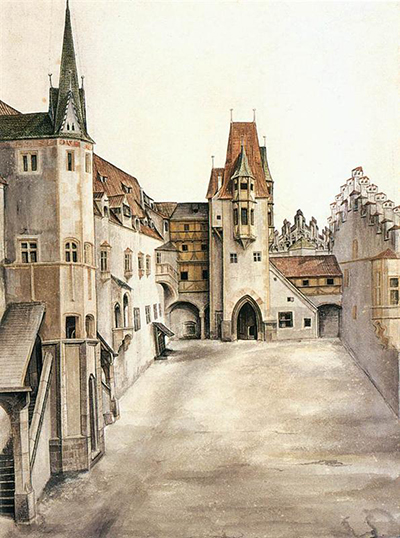
A broad, empty yard leads towards a pointed gateway, while a needle of green roofing rises almost to the top of the sheet. Between them, Albrecht Dürer packs the walls with windows, projecting bays, covered passages and sharply changing rooflines. The space is quiet enough for each feature to register. Yet some of the most consequential evidence lies in the nearly blank sky, where faint preliminary lines record architecture that never received its full covering of paint.
The ALBERTINA in Vienna catalogues this watercolour and opaque-colour drawing as Hof der Innsbrucker Burg (ohne Wolken) , around 1495. It measures 36.8 × 26.9 centimetres and bears inventory number 3057. The view looks south through the Hofburg courtyard. Its familiar English title distinguishes it from Dürer’s northward view of the same enclosure, usually called the courtyard “with clouds”. [1] [2]
At a Glance
- Current date About 1495 [1]
- Materials Watercolour and opaque colour [1]
- Collection ALBERTINA, Vienna; 3057 [1]
This work across Albrecht Dürer’s career
Young Hare
1502Praying Hands
1508Melencolia I
1514Four Apostles
1526Contents
- Walking through the picture
- A palace of connected buildings
- Looking from the other end
- The roof that remained a drawing
- Why the date remains debated
- Marks left after the view
- Frequently Asked Questions
Walking through the picture
The composition gives the ground an unusually large share of the page. Pale brown and grey washes spread towards us, becoming darker and more broken near the lower edge. A few irregular marks suggest a used surface, without describing every stone or patch. There are no passing courtiers, animals or carts to tell us how large the yard is. We judge its dimensions through the buildings: the tall doorway, the small upper windows and the increasingly compressed architecture at the back.
The gateway provides the clearest destination. Its pointed opening is dark, but the doors and inner surfaces remain distinguishable. Directly above it, a projecting timber bay interrupts the otherwise plain wall. The bay’s small, steep roof sits against a much larger red one, producing a building whose upper part seems busier and lighter than its base. Tiny finials continue the movement upwards. The structure works simultaneously as an entrance we can imagine approaching and as an intricate silhouette to examine from a distance.
On the left, the nearer polygonal projection is more slender still. Its long pale faces rise through several levels, with dark openings set at different heights. Small changes of colour separate one face from the next; darker edging gives the corners additional definition. At its foot, the roof of a covered stair cuts across the lower corner of the composition. Farther along the wall, little bays and roofed doorways produce alternating projections and recesses. Dürer makes the wall readable through these interruptions.
The right side offers a different rhythm. A relatively unbroken grey wall draws the eye back towards a stepped gable, whose repeated ornamental uprights form a jagged crest against the sky. Behind the lower red roof, another elaborate gable appears. These overlapping shapes make it difficult to take in the courtyard as one simple box. The enclosure is assembled from parts, each with its own height, roof and decorative emphasis.
A palace of connected buildings
Architectural historian G. Ulrich Großmann identifies the distant gateway as the tower opening towards the Hofgasse. The richly treated gable behind it belongs to a house in the street beyond the castle. His reading matters because the picture admits pieces of the surrounding town through its enclosing architecture. He also identifies painted corner blocks and an incompletely articulated heraldic frieze on the near projecting tower. Looking closely, its small red accents give that tall pale surface a decorative finish very different from the plain expanse of yard below. [2]
The fine tower should not automatically be imagined as a spiral staircase. Großmann examined the relationship between its entrances and floor levels; Nicole Riegel likewise cautions against identifying the courtyard’s polygonal tower as a stair tower. The neighbouring roofed stair is a more immediately legible route upwards. Visually, this distinction helps us separate the impressive vertical accent from the practical means of moving between floors. A pointed roof can advertise a building without explaining the use of every room beneath it. [2] [13]
Maximilian inherited substantial buildings from Sigmund in 1490; work on the new Frauenzimmer had begun by 1492. Riegel distinguishes the hall and chapel range from northern residential additions, while leaving parts of the circulation and room functions uncertain. The southward view consequently shows a section of a larger complex. Its entrances and passages imply connections beyond the rectangle of open ground, although they do not let us reconstruct the entire court household from the image alone. [13]
That combination of ornament and practical connection is one of the drawing’s pleasures. A covered stair, a plain wall and an elaborate bay can sit almost shoulder to shoulder. The attention given to them encourages a slower kind of looking than a distant view of a palace façade would allow. We can follow the small changes where one part meets another: roof tiles against plaster, timber framing over an arch, a deep shadow underneath a projecting window.
Looking from the other end
The clouded courtyard view makes the arrangement easier to understand. The tall polygonal feature that stands close to the left edge here appears on the right there. The covered stair changes sides with it. Turning the viewpoint also replaces the southward gateway with a broad transverse passage, above which a much busier group of red roofs and projecting windows rises. These recurring features allow the two views to be related without mistaking them for the same composition under different weather. [2] [13]
They also reveal how strongly the choice of direction shapes the picture. In this sheet, the foreground tower and the gate create two separated vertical accents. The long intervening roofline drops towards the centre before rising again. The almost vacant sky gives their unequal heights room to register. With no dark cloud mass overhead, the viewer can move from one architectural peak to the next without encountering a second, competing pattern in the heavens.
The elevated viewpoint opens up the yard like a shallow container. We see its surface extending beneath the upper windows, while the converging sides guide us towards several different openings. The eye can choose the pointed gateway, the rounded arch to its left or the smaller passage to the right. This branching movement is more engaging than a single straight corridor. The buildings constrain our imagined walk but keep offering glimpses of another space.
The roof that remained a drawing
The pale upper field rewards especially close attention. Faint lines extend beyond the painted roof of the near tower. Riegel records Christof Metzger’s identification of silverpoint traces of the Wappenturm roof beyond, possibly omitted to keep the courtyard view clear. The coloured silhouette preserves only part of what the preliminary drawing records. [13]
A fully painted roof in that position would have changed the balance considerably. The narrow green spire now rises into open space. Another substantial roof behind it would gather the left-hand architecture into a denser cluster, reducing the separation between the near projection and the distant skyline. This is a compositional consequence we can imagine from the surviving lines; it does not establish the artist’s unrecorded intention. The distinction between the faint drawing and the painted surface nevertheless gives us something more precise than a general impression of incompleteness.
It also changes how an absence can be used as historical evidence. In his 2007 discussion, Großmann inferred from the missing painted Wappenturm that it had not yet risen high enough to be visible. The later recognition of its preliminary outline complicates that inference. A building can have been observed and then left out of the coloured image. The visible result and the initial survey of the site need not contain exactly the same information. [2]
Why the date remains debated
The ALBERTINA’s current approximate date coexists with a later proposal in Christof Metzger’s 2012 catalogue text. He connects the unfinished Wappenturm outline with the tower’s construction and argues for observations made on a return journey around the turn of 1496–97. This is a scholarly interpretation of the evidence, rather than a date inscribed by Dürer on the sheet. [1]
Riegel explains the qualification: a 1496 inscription survives through an eighteenth-century engraving by Salomon Kleiner. Whether its position below the roof dates a completed building or an earlier construction stage affects the chronology. She places the courtyard views around or shortly after the mid-1490s, expressly leaving their dating uncertain. The drawing is therefore best approached with its approximate museum date and the later dating argument both visible. [13]
The paper adds a different kind of comparison. Its watermark, a small crown with a hanging cross and triangle, is associated in the museum record with Briquet 4773, documented in 1499–1504, and with Strauss’s broader recorded uses in 1494–95 and 1503. Meder connects this motif with early woodcuts, including the Apocalypse . Those differing ranges make it unwise to turn the motif into a precise calendar. Nor does the clear sky identify a particular season or day. The page preserves a worked image of a place; its stages of observation, drawing and colouring cannot all be assigned to one documented sitting. [1]
Marks left after the view
The small AD at the lower centre is a later addition by another hand. It sits in the darkest foreground, where it is easily passed over on a first inspection. Its status matters for authentication of that mark, but it does not by itself make the surrounding architecture a later fabrication. The picture and the added lettering have separate histories. [1]
The museum lists probable ownership by Rudolf II, followed by the imperial treasury, the imperial court library from 1783 and transfer to Duke Albert of Saxe-Teschen in 1796. That later collecting history brings us from a court residence represented on paper to the preservation of the sheet itself. [1]
What remains most absorbing is the relationship between the little things carefully painted and the large thing left faint. Window divisions, roof edges and the projecting gate bay give the enclosure its convincing physical presence. Above them, the unused outline reminds us that making such a view involved selection. The quiet courtyard holds both the architecture Dürer chose to show and a trace of the fuller prospect he considered.
Frequently Asked Questions
Artworks directory
These 187 records include individual works, reverse sides, detail views, paired panels and reconstructed arrangements. Three additional catalogue images repeat works already listed. Related views are not counted as separate originals; qualified attributions and published dating are retained.
Discussion
Look again at the images and ideas explored in The Innsbruck Castle Courtyard without Clouds. These editorial prompts invite your observations.
Reader Insights
Which detail or idea in The Innsbruck Castle Courtyard without Clouds most changed your reading, and why?
How does the discussion of “Walking through the picture” affect your understanding?
What comparison would you bring to the discussion of “Marks left after the view”?
Join the Conversation
Share a detail, comparison or question about The Innsbruck Castle Courtyard without Clouds below.
References
- ALBERTINA , Vienna, Hof der Innsbrucker Burg (ohne Wolken) , inventory 3057. Current object record, last edited 24 January 2025, including Christof Metzger’s text from Eva Michel and Maria Luise Sternath, eds., Kaiser Maximilian I. und die Kunst der Dürerzeit (Vienna, 2012), pp. 140–141 and catalogue 7. German. View source .
- G. Ulrich Großmann , “Albrecht Dürer in Innsbruck. Zur Datierung der ersten italienischen Reise”, in G. Ulrich Großmann and Franz Sonnenberger, eds., Das Dürer-Haus. Neue Ergebnisse der Forschung (Nuremberg: Germanisches Nationalmuseum, 2007), especially pp. 230–234. German; English abstract. View source .
- ALBERTINA, Selbstbildnis als Dreizehnjähriger, inv. 4839 (German). View source.
- Metropolitan Museum, Four Horsemen from The Apocalypse, 19.73.209 (English). View source.
- Bayerische Staatsgemäldesammlungen, Selbstbildnis im Pelzrock, inv. 537 (German). View source.
- ALBERTINA, Feldhase, inv. 3073 (German). View source.
- ALBERTINA, Das große Rasenstück, inv. 3075 (German). View source.
- Metropolitan Museum, Adam and Eve, 19.73.1 (English). View source.
- ALBERTINA, Betende Hände, inv. 3113 (German). View source.
- Metropolitan Museum, Knight, Death, and the Devil, 43.106.2 (English). View source.
- Metropolitan Museum, Melencolia I, 43.106.1 (English). View source.
- Bayerische Staatsgemäldesammlungen, inventory 545: current collection record (German; descriptive citation). View source.
- Nicole Riegel , “Bausteine eines Residenzprojekts. Kaiser Maximilian I. in Innsbruck”, in Herbert Karner, Ingrid Ciulisová and Bernardo J. García García, eds., The Habsburgs and their Courts in Europe, 1400–1700: Between Cosmopolitism and Regionalism , PALATIUM e-Publications 1 (2014), pp. 28–45; here pp. 28–35 and note 11, p. 43. German. View source .
- Germanisches Nationalmuseum, Barbara Dürer (German and English). View source.
- Web Gallery of Art, Tucher–Rieter reverse (English). View source.
- National Gallery of Art, Portrait of a Clergyman (English). View source.
- Dürer Art, Portrait of a Man (English). View source.
- Hessen Kassel Heritage, Elsbeth Tucher (German). View source.
- Web Gallery of Art, Hans Tucher (English). View source.
- Germanisches Nationalmuseum, Emperor Maximilian I (German and English). View source.
- National Gallery of Art, Lot and His Daughters, reverse (English). View source.
- Bayerische Staatsgemäldesammlungen, Glim Lamentation (German). View source.
- Museo Nacional del Prado, Portrait of a Man (Spanish). View source.
- Bayerische Staatsgemäldesammlungen, Madonna of the Carnation (German). View source.
- Städel Museum, Job on the Dungheap (German). View source.
- Wallraf-Richartz-Museum, Piper and Drummer (German). View source.
- Italian Ministry of Culture / Uffizi, Head of Saint James (Italian). View source.
- Klassik Stiftung Weimar, Dresden Altarpiece (German). View source.
- Staatliche Museen zu Berlin, Girl with a Red Beret (German and English). View source.
- Dresden State Art Museums / Roland Enke, Bernhard von Reesen (German). View source.
- Royal Collection Trust, Burkhard von Speyer (English). View source.
- Dresden State Art Museums, Seven Sorrows of the Virgin (English). View source.
- Bayerische Staatsgemäldesammlungen, Mater Dolorosa (German). View source.
- Bayerische Staatsgemäldesammlungen, Lucretia (German). View source.
- Städel Museum, Young Woman with Her Hair Down (English). View source.
- ALBERTINA, Portrait of a Young Man (German). View source.







