


 by
Tom Gurney
Tom Gurney BSc (Hons) is an art history expert with over 20 years experience
Published on June 19, 2020 / Updated on October 22, 2026
Email:
tomgurney1@gmail.com
/ Phone:
+44 7429 011000
Monkey: an Escorial Animal Study: Introduction
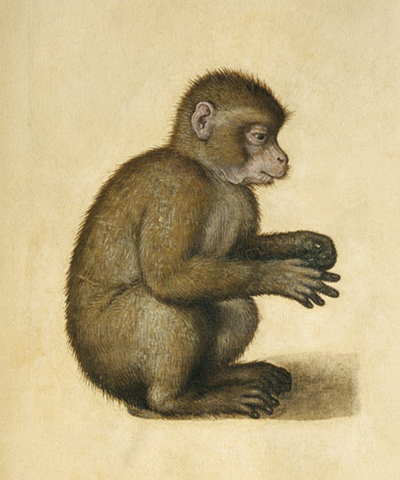
The monkey sits with its back rounded and its hands extended, almost as though a small task has interrupted its stillness. Fine strands of brown fur cover the body; the face, ear and long fingers give the image its particular character. Often reproduced under Albrecht Dürer’s name, this small animal study has a more uncertain authorship. Almudena Pérez de Tudela and Annemarie Jordan Gschwend published the matching picture in 2007 as the work of an anonymous, possibly Flemish painter, in Philip II’s quarters at El Escorial. The Royal Collections’ January 2025 exhibition notice likewise includes a work called Mono among nature studies by a follower of Dürer. [1] [2]
That distinction changes the story worth telling. The picture offers both an absorbing encounter with an animal and a glimpse of the difficulties surrounding a celebrated artist’s reputation. Its appeal begins in the body’s carefully organised shapes, while its history leads into the collecting and display of small paintings at the Spanish court.
At a Glance
- Published attribution Anonymous, possibly Flemish painter; later museum notice identifies a Dürer follower [1] [2]
- Collection El Escorial [1]
- TypeDrawing [1]
This work across Albrecht Dürer’s career
Monkey: an Escorial Animal Study (current article)
Date uncertainYoung Hare
1502Praying Hands
1508Melencolia I
1514Four Apostles
1526Contents
- The animal’s folded body
- A small picture in a royal collection
- How the old labels accumulated
- Dürer’s monkeys and this monkey
- Frequently Asked Questions
The animal’s folded body
The figure faces right, leaving the broad curve of its back uninterrupted. From the crown, the outline descends through the shoulders to the rounded haunch, then turns beneath the feet. This enclosing curve makes the animal seem compact and settled. Within it, the painter separates the nearer shoulder, forearm, thigh and bent leg through changes in the direction and brightness of the fur. The body is a set of overlapping masses, each legible without a hard outline around every part.
Much of the effect depends on the balance between a solid centre and projecting extremities. The torso and haunch occupy the lower left of the sheet, while the muzzle, hands and toes point into the space on the right. The nearer forearm crosses the body and carries the eye outward towards the spread fingers. The other hand rests above it, more tightly closed. The narrow interval between them creates a small pocket of empty space at the centre of the gesture. Nothing clearly identifiable is held there, so the movement remains open to interpretation.
The head receives a different kind of attention. Its short, upright hairs break the outer edge, while the pale ear curls against the darker hair behind it. A light band above the eye continues towards the muzzle. The eye looks down and forward, following the general direction of the hands, rather than meeting the viewer. The small mouth and pale cheek soften the face without giving it a human smile. Its apparent concentration comes from the relationship between eye, muzzle and gesture.
Individual strokes also distinguish the surfaces. On the back, short light marks emerge from darker brown; across the thigh, the strands curve around a fuller volume. The hands and feet look darker and smoother, with elongated digits clearly divided at their tips. The painter lets the viewer move from the coarse outer covering towards the more exposed details of the face and extremities. This is the source of the picture’s tactile appeal: the fur seems to lie over a body whose weight and folded joints remain understandable.
The setting contributes very little narrative. A muted shadow spreads beneath the feet and towards the right, giving the seated figure a surface to occupy. Above it, the pale background remains largely unbroken. There is no surrounding vegetation, furniture or human companion to explain the animal’s circumstances. The absence concentrates attention on the one body, but cannot tell us whether its model was alive, preserved or known through an earlier image. The finished pose offers an impression of life; it does not record the circumstances of a sitting.
A small picture in a royal collection
The scholarly caption of 2007 describes the work as oil on paper, measuring 22 by 16 centimetres. Jordan Gschwend’s later illustrated essay supplies the inventory number PN 10034449 and proposes a date of about 1566. That dating belongs to her account; the Royal Collections’ 2025 notice gives no individual execution date. The scale is intimate. At little more than the height of a hand, the sheet rewards looking at the transitions between minute hairs and the larger shapes they cover. [1] [13] [2]
Pérez de Tudela and Jordan Gschwend place the monkey among animal pictures commissioned by Philip II and displayed in his private quarters. Their discussion connects such images with the court’s possession and exchange of unusual animals, including birds sent from Portugal. This is a collecting context, rather than an identification of the monkey itself. It leaves the animal’s species, source and individual owner unresolved. [1]
The plain background makes sense within that context of concentrated attention. The animal has been given enough space to show its form, yet little that competes with it. A viewer can enjoy the lifelike surface and inspect the parts of the body in the same act of looking. There is no need to choose between curiosity about a creature and admiration for the painter’s handling: the two responses reinforce one another.
How the old labels accumulated
The picture’s association with Dürer sits within a longer history of shifting names. In his 1857 Escorial catalogue, Vicente Poleró y Toledo placed a collective entry for natural-history studies under Juan Holbein. He described birds, quadrupeds, fish, flowers and a landscape, painted in tempera on paper or vellum attached to panels. The entry treats the collection as an ensemble; it does not give this monkey an individual description or date. [14]
Writing in 1923, José María Florit rejected Poleró’s Holbein attribution and declared the animal studies unquestionably Dürer’s. His confidence is revealing because later scholarship does not sustain it. Florit also transcribed earlier delivery records: eight small panels of fish, birds and other animals in 1571–72, followed by nine in 1574. Crucially, he said that a monkey and a bat were added at an unknown date. Those group records therefore cannot establish a 1574 delivery for this particular sheet. [15]
Florit’s account gives the pictures a material and spatial history, too. He described paper attached to panels and the small works separated by mouldings within one glazed frame. He reported finding the ensemble in a back room or porter’s room near the library and explained its placement in the royal apartment through his reconstruction of older descriptions. This is evidence of the collection’s presentation and interpretation in his time; his attribution and his account of Philip II’s intentions require separate judgement. [15]
His account of tempera or gouache also differs from the oil-on-paper description in the 2007 publication. The words should retain their dates and authorities. Neither the brown colour nor the fine brushwork visible in a reproduction can resolve the binding medium. Nor should the dimensions of Poleró’s collective entry be mistaken for those of this one small picture. [1] [15] [14]
Dürer’s monkeys and this monkey
There are firm reasons why a monkey can seem at home beside Dürer’s art. His engraving of the Virgin and Child with a Monkey , made about 1498, places the animal in the foreground of a larger religious landscape. The British Museum identifies it as a work by Dürer and draws attention to the print’s varied textures. Here the animal occupies the whole image, allowing its rounded back, face and hands to carry the composition. The comparison explains a familiar visual association, while leaving the Escorial painter’s identity open. [16]
Dürer’s Netherlands diary offers another tempting connection. In the Antwerp entries following his return from Zeeland in December 1520, he records buying a small monkey for four gulden. In Rudolf Tombo’s English translation, the purchase appears amid payments for panels, fish, dinners, pamphlets and a messenger. The entry places an actual monkey within the artist’s everyday transactions. It does not mention this painting, describe the purchased animal’s appearance or establish a route from Dürer’s household to El Escorial. [17]
Keeping those distinctions allows the picture to remain interesting on its own terms. The anonymous painter has made a strongly contained image from an apparently slight subject. A few open fingers disturb the closed outline of the body; a small eye and a pale ear interrupt the dense covering of hair. The empty ground lets each of these decisions register. Dürer’s name belongs to the work’s history of attribution and reception, but the seated animal continues to invite close attention even while its maker remains unnamed.
Frequently Asked Questions
Artworks directory
These 187 records include individual works, reverse sides, detail views, paired panels and reconstructed arrangements. Three additional catalogue images repeat works already listed. Related views are not counted as separate originals; qualified attributions and published dating are retained.
Discussion
Look again at the images and ideas explored in Monkey: an Escorial Animal Study. These editorial prompts invite your observations.
Reader Insights
Which detail or idea in Monkey: an Escorial Animal Study most changed your reading, and why?
How does the discussion of “The animal’s folded body” affect your understanding?
What comparison would you bring to the discussion of “Dürer’s monkeys and this monkey”?
Join the Conversation
Share a detail, comparison or question about Monkey: an Escorial Animal Study below.
References
- Almudena Pérez de Tudela and Annemarie Jordan Gschwend , “Renaissance Menageries: Exotic Animals and Pets at the Habsburg Courts in Iberia and Central Europe,” in Karl A. E. Enenkel and Paul J. Smith, eds., Early Modern Zoology: The Construction of Animals in Science, Literature and the Visual Arts (Leiden: Brill, 2007), pp. 419–445, especially p. 428 and fig. 3, p. 430. Publication PDF. English. View source .
- Galería de las Colecciones Reales , “Rotación en la Galería. El Beato de Liébana se exhibe en el ámbito dedicado a El Escorial y Felipe II,” 23 January 2025. Royal Collections notice. Spanish. View source .
- ALBERTINA, Selbstbildnis als Dreizehnjähriger, inv. 4839 (German). View source.
- Metropolitan Museum, Four Horsemen from The Apocalypse, 19.73.209 (English). View source.
- Bayerische Staatsgemäldesammlungen, Selbstbildnis im Pelzrock, inv. 537 (German). View source.
- ALBERTINA, Feldhase, inv. 3073 (German). View source.
- ALBERTINA, Das große Rasenstück, inv. 3075 (German). View source.
- Metropolitan Museum, Adam and Eve, 19.73.1 (English). View source.
- ALBERTINA, Betende Hände, inv. 3113 (German). View source.
- Metropolitan Museum, Knight, Death, and the Devil, 43.106.2 (English). View source.
- Metropolitan Museum, Melencolia I, 43.106.1 (English). View source.
- Bayerische Staatsgemäldesammlungen, inventory 545: current collection record (German; descriptive citation). View source.
- Annemarie Jordan Gschwend , “A Brazilian Marmoset, a Spanish Princess, and the Paintrix Sofonisba Anguissola,” Habsburg Women , 5 February 2022, updated 22 October 2023, fig. 1. Illustrated essay. English. View source .
- Vicente Poleró y Toledo , Catálogo de los cuadros del Real Monasterio de San Lorenzo, llamado del Escorial (Madrid: Imprenta de Tejado, 1857), pp. 76–77, no. 260. Digitised original. Spanish. View source .
- José María Florit , “Los aposentos de Felipe II en San Lorenzo del Escorial,” Boletín de la Sociedad Española de Excursiones 31 (December 1923), pp. 296–300, especially p. 298. Original issue PDF. Spanish. View source .
- British Museum , Virgin and Child with a Monkey , c. 1498, engraving, museum number E,4.68. Collection record. English. View source .
- Albrecht Dürer , Records of Journeys to Venice and the Low Countries , translated by Rudolf Tombo (1913), “Diary of a Journey in the Netherlands,” Antwerp entries, December 1520–April 1521. Diary text. English translation of German. View source .
- Germanisches Nationalmuseum, Barbara Dürer (German and English). View source.
- Web Gallery of Art, Tucher–Rieter reverse (English). View source.
- National Gallery of Art, Portrait of a Clergyman (English). View source.
- Dürer Art, Portrait of a Man (English). View source.
- Hessen Kassel Heritage, Elsbeth Tucher (German). View source.
- Web Gallery of Art, Hans Tucher (English). View source.
- Germanisches Nationalmuseum, Emperor Maximilian I (German and English). View source.
- National Gallery of Art, Lot and His Daughters, reverse (English). View source.
- Bayerische Staatsgemäldesammlungen, Glim Lamentation (German). View source.
- Museo Nacional del Prado, Portrait of a Man (Spanish). View source.
- Bayerische Staatsgemäldesammlungen, Madonna of the Carnation (German). View source.
- Städel Museum, Job on the Dungheap (German). View source.
- Wallraf-Richartz-Museum, Piper and Drummer (German). View source.
- Italian Ministry of Culture / Uffizi, Head of Saint James (Italian). View source.
- Klassik Stiftung Weimar, Dresden Altarpiece (German). View source.
- Staatliche Museen zu Berlin, Girl with a Red Beret (German and English). View source.
- Dresden State Art Museums / Roland Enke, Bernhard von Reesen (German). View source.
- Royal Collection Trust, Burkhard von Speyer (English). View source.
- Dresden State Art Museums, Seven Sorrows of the Virgin (English). View source.
- Bayerische Staatsgemäldesammlungen, Mater Dolorosa (German). View source.
- Bayerische Staatsgemäldesammlungen, Lucretia (German). View source.
- Städel Museum, Young Woman with Her Hair Down (English). View source.
- ALBERTINA, Portrait of a Young Man (German). View source.







