by
Tom Gurney
Tom Gurney BSc (Hons) is an art history expert with over 20 years experience
Published on June 19, 2020 / Updated on October 22, 2026
Email:
tomgurney1@gmail.com
/ Phone:
+44 7429 011000
Portrait of Jakob Fugger the Wealthy: Introduction
Jakob Fugger looks past the viewer, his face held above a broad brown fur collar. There is no desk, ledger or pile of coins to identify his occupation. The portrait gives almost all its attention to his head and the dark, enclosing shape of his clothes. The Bayerische Staatsgemäldesammlungen catalogues it as a work by Albrecht Dürer of about 1520: a Tüchlein on plain-weave canvas, 69.4 × 53 centimetres, inventory 717, assigned to the Staatsgalerie in the Katharinenkirche, Augsburg. Behind this apparently straightforward likeness lies a more complicated relationship between a drawing from life, painted versions and a surviving cloth whose original purpose remains uncertain. [1]
At a Glance
- Current date About 1520 [1]
- Object Tüchlein on plain-weave canvas [1]
- Collection Bavarian State Painting Collections; inventory 717 [1]
- TypePainting [1]
This work across Albrecht Dürer’s career
Young Hare
1502Praying Hands
1508Melencolia I
1514Four Apostles
1526Contents
- A face above the fur
- How the wealthy merchant appears
- The charcoal likeness
- A cloth with an open question
- Frequently Asked Questions
A face above the fur
The head turns towards our left, allowing us to see one ear clearly while the far side of the face narrows beside the nose. The eyes follow the same direction. Their small dark centres give a concentrated point of focus to an otherwise restrained image. The mouth is closed, its horizontal line interrupted by the slight modelling of the lips; beneath it the chin makes a firm, rounded ending. A shadow runs down the side of the cheek and under the jaw, while the forehead and the front of the neck remain light.
These changes are particularly easy to follow because the face is bare. There is no beard to soften the transition from cheek to chin, and little hair distracts from the outline of the skull. The cap fits closely above the forehead, then swells towards the back of the head. Its warm brown colour joins the flesh and fur against the cooler blue-grey background. The colour arrangement holds together without an elaborate setting: warmth occupies the centre, coolness surrounds it, and the darkest areas gather below.
The clothing supplies much of the picture's weight. One long sweep of fur descends diagonally across the chest; another spreads towards the right edge. The shoulders nearly fill the width of the image, while the cap has breathing space above it. A small opening of white shirt, directly below the neck, interrupts the dark clothing. That bright shape guides the eye upwards to the face. With the hands omitted, there is no gesture to compete with the direction of Fugger's gaze. The portrait's apparent stillness depends on a carefully varied arrangement of diagonals, curves and small changes of light.
How the wealthy merchant appears
Jakob Fugger, who lived from 1459 to 1525, developed his family's Augsburg business through linked dealings in metals, merchandise and finance. The Fugger foundations' own account stresses his connections with the Habsburgs and his enduring charitable foundations. His public standing belonged to a network of business, dynasty and religious provision. These facts explain why a likeness of him mattered, but they do not make every feature in it a coded illustration of his career. [12]
His clothes are a more immediate guide to the image he presents. Claus Grimm identifies the distinctive headwear as a Venetian gold cap and reads such caps, costly outer garments and fur as signs of wealth and cosmopolitan standing. In the painting, the cap looks much quieter than the words “gold cap” might suggest. Its muted appearance and the broad fur collar make expense seem habitual. The sitter does not need to hold up an object for us to notice what he wears. Nor can a serious mouth establish the personal honesty, ruthlessness or ambition of the man behind it. The image controls how we encounter him; his inner thoughts remain his own. [13]
Another portrait shows how differently that public identity could be shaped. In a colour woodcut by Hans Burgkmair and Jost de Negker, dated probably about 1512 by Berlin's Kupferstichkabinett, Fugger appears in profile beneath a Latin inscription identifying him as a citizen of Augsburg. Pia Littmann describes the print's combination of black and brown printing with added colour. Its sharply projecting nose and patterned cap form a striking silhouette. In the painted portrait, we turn further around the head: both eyes become visible, the nose occupies the face rather than defining its outer edge, and the fur spreads into a much larger supporting mass. Fugger's recognisable appearance could serve several different kinds of portrait. [14]
The charcoal likeness
The most revealing comparison is with Dürer's surviving drawing in Berlin. The Kupferstichkabinett dates this charcoal portrait on paper to about 1518 and records its size as 35.2 × 29.4 centimetres, inventory KdZ 8465. Here too the head faces towards our left. The familiar outline of the forehead, the long nose, the prominent ear and the closed mouth immediately connect the two images. [15]
Yet the experience of looking is different. The drawing places the pale head against vigorous dark strokes. Those marks press close to the head's outline and continue across the surrounding sheet. They make the pale expanse of the forehead feel especially open. The cap is described by looping, intersecting lines; we can follow individual turns of its pattern. Below the face, the clothing is comparatively lightly stated, with curved edges and small decorative details. The drawing directs attention towards the information gathered in the head while allowing different parts of the sheet different degrees of finish.
In the painting, the blue-grey ground makes a quieter surround. Fur replaces much of the drawing's lightly indicated clothing, and the small white shirt opening sits within a substantially darker arrangement. Colour changes the balance between head and body. The painted head looks smaller in relation to the enclosing costume, even though the whole painted object is larger than the sheet. Comparing the two prevents us from treating the picture as merely the charcoal drawing filled in with colour. The likeness has been placed in a new visual structure.
The sheet itself also has a history. Grimm describes abrasion, reinforced lines and an altered cheek contour. Its surviving appearance therefore needs care: every visible mark cannot automatically be taken as an untouched record of Dürer's first encounter with Fugger. Even so, the resemblance preserves a valuable link between the close observation of a particular head and its later painted presentation. [13]
Dürer's Augsburg visit during the imperial Diet of 1518 provides the likely occasion for the sitting, according to Grimm. That likely encounter and the canvas's present dating of about 1520 describe different stages. A portrait drawing could preserve a likeness after the sitter was no longer present. Agreement between the images does not require us to imagine Fugger sitting again throughout the painting's execution. [13] [1]
Annotated Details from The charcoal study of Jakob Fugger
These details show the separate charcoal study discussed above. Photograph: Jörg P. Anders / Kupferstichkabinett, Staatliche Museen zu Berlin (public domain).
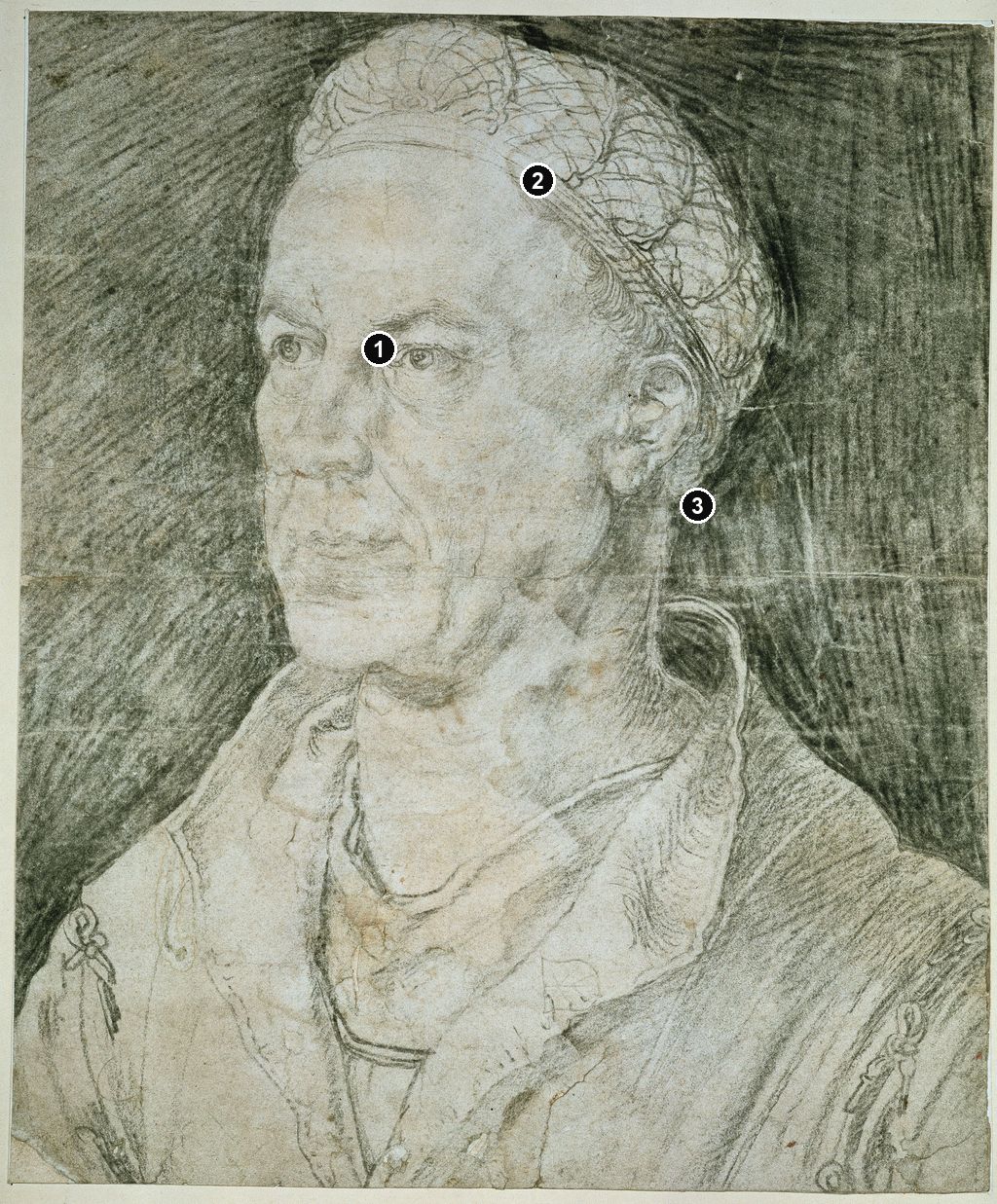
Details from THE CHARCOAL STUDY OF JAKOB FUGGER
Compare the fine marks around the eyes with the loops of the cap and the broad strokes surrounding the head.
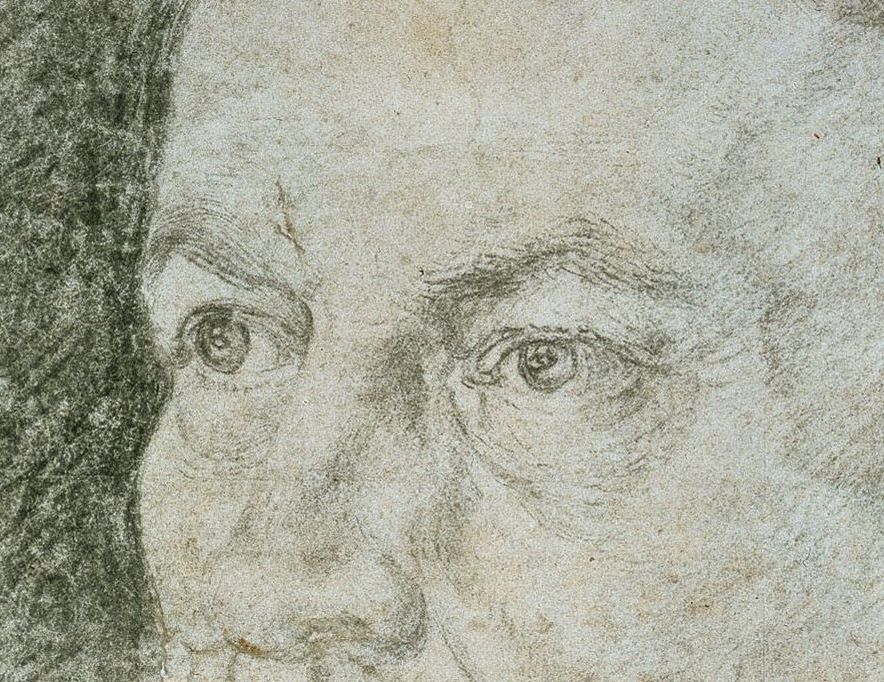
Eyes and the bridge of the nose
Fine lines follow the brows and the lower edges of the eyes. Lighter marks suggest the bridge of the nose, leaving broad areas of the paper visible.
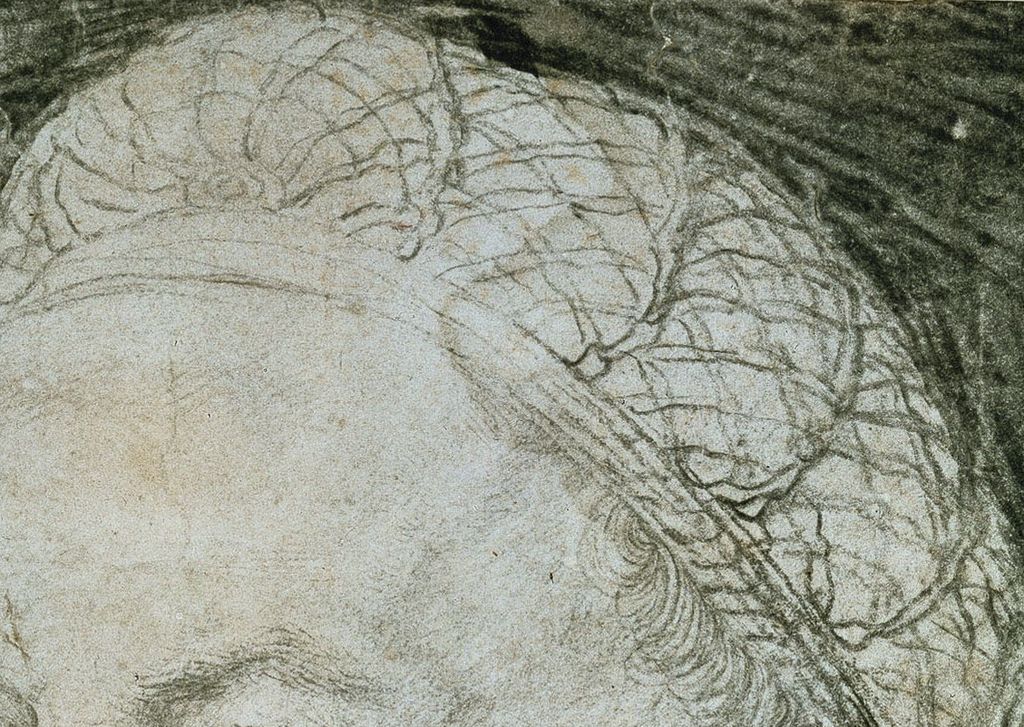
Loops above the forehead
Loose curved lines run across the cap above the forehead. Behind them, broad diagonal strokes darken the surrounding space.
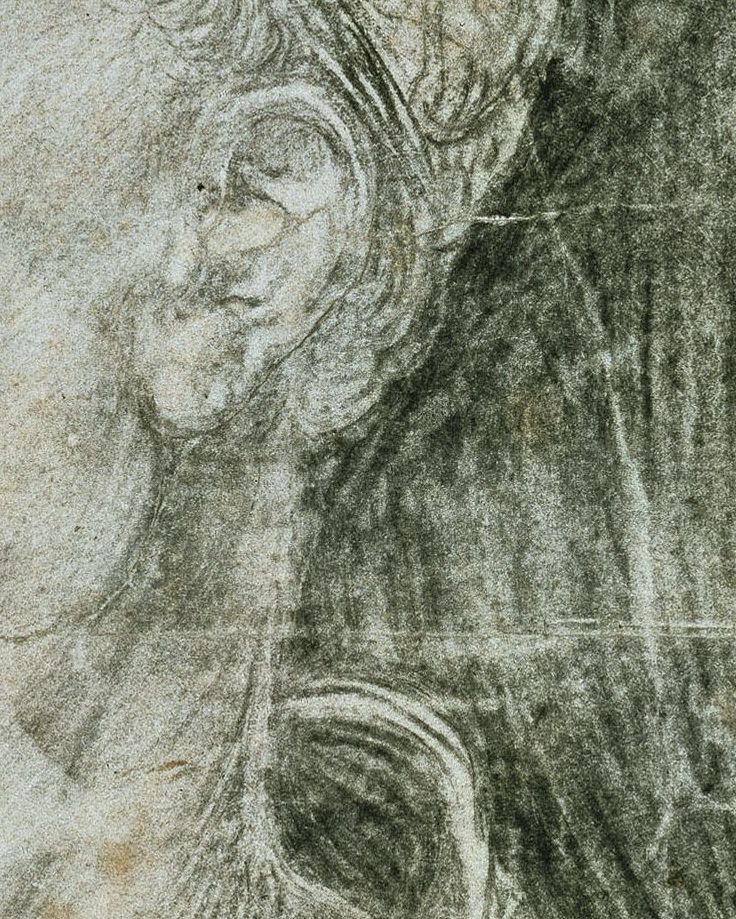
The ear against the dark ground
The ear is described with small curves beside the lightly marked cheek. Its pale outer edge meets a much darker field of broad strokes.
A cloth with an open question
The 2010 exhibition catalogue Bayern–Italien explains the painting's matt surface through thin colour on ungrounded canvas, while leaving the original function of such Tüchlein painting unresolved. Cloth matters here. A reader accustomed to thinking of Dürer's portraits as wooden panels can easily miss the distinction concealed by a photograph. The support belongs to the object's identity, even when a reproduction makes canvas and panel look equally flat and solid. [16]
One historical explanation, recorded by the Haus der Bayerischen Geschichte, treats this cloth as a modello for a lost panel portrait, known through two copies with changed clothing. A modello would have allowed someone to judge a proposed image before its final execution. But that proposed role is not a settled account of this object's making. The relationship between versions has also been used to question whether the cloth itself was painted by Dürer. [17]
Grimm's 1997 catalogue entry argues from specific physical observations. He reports transfer points around the nose, mouth and eyelid, and concludes that the cloth version stands further from Dürer's likeness than the version originally painted on wood. He classifies the painted versions under workshop or following. These observations concern the mechanics of repeating a face, alongside judgments of quality. They give the disagreement more substance than a general claim that the portrait feels too stiff. The current owner continues to catalogue the canvas under Dürer's name. Its attribution and its proposed preparatory function should therefore be understood as related questions with a history of debate. [13] [1]
The later history adds another change of appearance. The Haus der Bayerischen Geschichte records a possible identification in the additions to the 1641–42 Munich chamber-gallery inventory of Elector Maximilian I of Bavaria, secure documentation in 1760, and a dark-green background repaint applied that year and removed in 1928–29. The blue-grey field we now encounter has thus emerged from a history of intervention. Looking back at Fugger's face, its reserve seems all the more striking: the likeness remains immediate even while the object's route from sitting to surviving painting is still being examined. [17]
Frequently Asked Questions
Artworks directory
These 187 records include individual works, reverse sides, detail views, paired panels and reconstructed arrangements. Three additional catalogue images repeat works already listed. Related views are not counted as separate originals; qualified attributions and published dating are retained.
Discussion
Look again at the images and ideas explored in Portrait of Jakob Fugger the Wealthy. These editorial prompts invite your observations.
Reader Insights
Which detail or idea in Portrait of Jakob Fugger the Wealthy most changed your reading, and why?
How does the discussion of “A face above the fur” affect your understanding?
What comparison would you bring to the discussion of “A cloth with an open question”?
Join the Conversation
Share a detail, comparison or question about Portrait of Jakob Fugger the Wealthy below.
References
- Bayerische Staatsgemäldesammlungen , “Bildnis Jakob Fugger der Reiche,” inventory 717, current collection record, updated 21 April 2026. German. View source .
- ALBERTINA, Selbstbildnis als Dreizehnjähriger, inv. 4839 (German). View source.
- Metropolitan Museum, Four Horsemen from The Apocalypse, 19.73.209 (English). View source.
- Bayerische Staatsgemäldesammlungen, Selbstbildnis im Pelzrock, inv. 537 (German). View source.
- ALBERTINA, Feldhase, inv. 3073 (German). View source.
- ALBERTINA, Das große Rasenstück, inv. 3075 (German). View source.
- Metropolitan Museum, Adam and Eve, 19.73.1 (English). View source.
- ALBERTINA, Betende Hände, inv. 3113 (German). View source.
- Metropolitan Museum, Knight, Death, and the Devil, 43.106.2 (English). View source.
- Metropolitan Museum, Melencolia I, 43.106.1 (English). View source.
- Bayerische Staatsgemäldesammlungen, inventory 545: current collection record (German; descriptive citation). View source.
- Fürstlich und Gräflich Fuggersche Stiftungs-Administration , “Kaufmann, Stifter, Visionär”. German. View source .
- Claus Grimm , “Jakob Fugger der Reiche,” catalogue 22a–c, in Josef Kirmeier et al., eds., “… wider Laster und Sünde”: Augsburgs Weg in die Reformation (Cologne, 1997), pp. 105–107. German. View source .
- Pia Littmann , “Farben schaffen Formen – Der Farbtondruck im Kupferstichkabinett”, Museum and the City , Staatliche Museen zu Berlin, 1 March 2018. German. View source .
- Staatliche Museen zu Berlin , Kupferstichkabinett, “Jakob Fugger der Reiche,” KdZ 8465, collection record. German. View source .
- “M. Sch.,” “Jakob Fugger der Reiche,” catalogue M57 , Bayern–Italien (Haus der Bayerischen Geschichte, 2010), p. 289. German. View source .
- Haus der Bayerischen Geschichte , “Bildnis des Jakob Fugger, genannt der Reiche,” inventory 717, historical portrait-gallery entry. German. View source .
- Germanisches Nationalmuseum, Barbara Dürer (German and English). View source.
- Web Gallery of Art, Tucher–Rieter reverse (English). View source.
- National Gallery of Art, Portrait of a Clergyman (English). View source.
- Dürer Art, Portrait of a Man (English). View source.
- Hessen Kassel Heritage, Elsbeth Tucher (German). View source.
- Web Gallery of Art, Hans Tucher (English). View source.
- Germanisches Nationalmuseum, Emperor Maximilian I (German and English). View source.
- National Gallery of Art, Lot and His Daughters, reverse (English). View source.
- Bayerische Staatsgemäldesammlungen, Glim Lamentation (German). View source.
- Museo Nacional del Prado, Portrait of a Man (Spanish). View source.
- Bayerische Staatsgemäldesammlungen, Madonna of the Carnation (German). View source.
- Städel Museum, Job on the Dungheap (German). View source.
- Wallraf-Richartz-Museum, Piper and Drummer (German). View source.
- Italian Ministry of Culture / Uffizi, Head of Saint James (Italian). View source.
- Klassik Stiftung Weimar, Dresden Altarpiece (German). View source.
- Staatliche Museen zu Berlin, Girl with a Red Beret (German and English). View source.
- Dresden State Art Museums / Roland Enke, Bernhard von Reesen (German). View source.
- Royal Collection Trust, Burkhard von Speyer (English). View source.
- Dresden State Art Museums, Seven Sorrows of the Virgin (English). View source.
- Bayerische Staatsgemäldesammlungen, Mater Dolorosa (German). View source.
- Bayerische Staatsgemäldesammlungen, Lucretia (German). View source.
- Städel Museum, Young Woman with Her Hair Down (English). View source.
- ALBERTINA, Portrait of a Young Man (German). View source.