


 by Tom Gurney
Tom Gurney BSc (Hons) is an art history expert with over 20 years experience
Published on June 19, 2020 / Updated on November 5, 2026
Email: tomgurney1@gmail.com / Phone: +44 7429 011000
La Pia de’ Tolomei
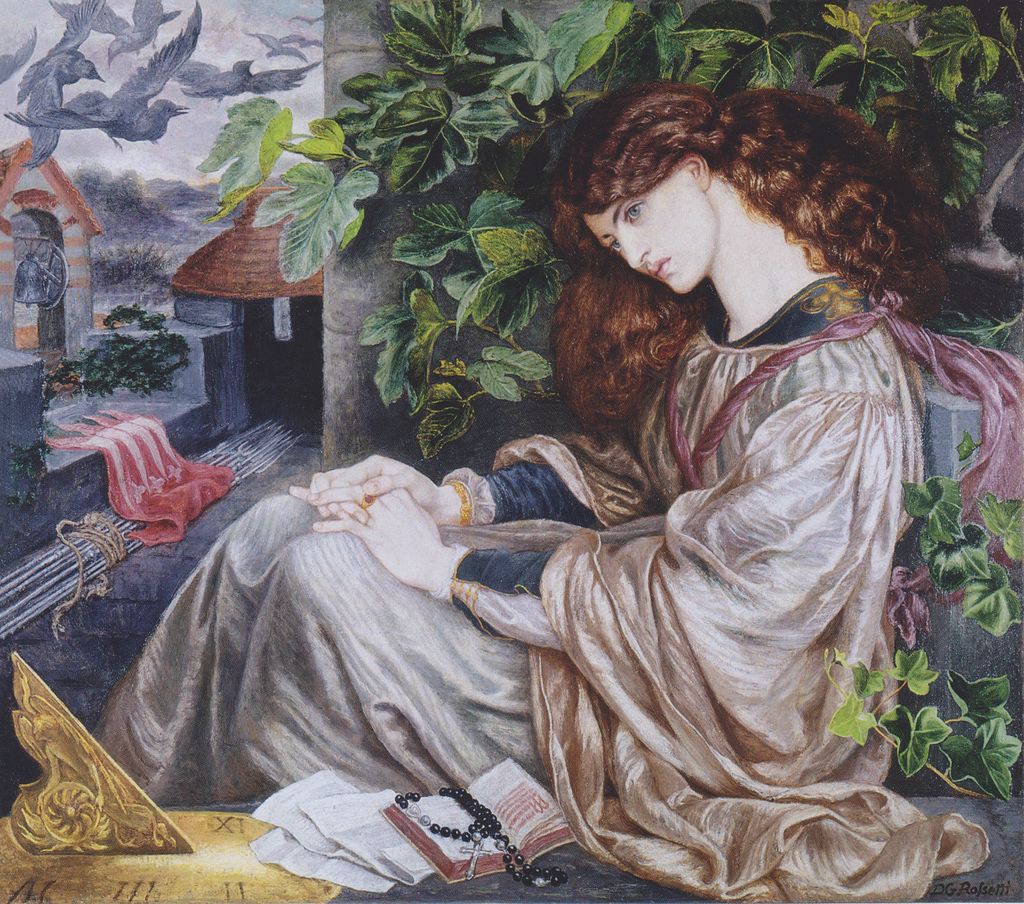
A woman sits among heavy folds of silver and rose-coloured fabric, turning a ring between her fingers. Beyond her, black birds wheel above a castle wall. The difference in movement is unsettling: the birds have the sky, while her body seems gathered into the narrow space beneath the leaves. Dante Gabriel Rossetti’s La Pia de’ Tolomei gives a long, silent interval to a woman whose appearance in Dante’s Purgatorio occupies only seven lines. Painted in oil on canvas between 1868 and 1880, the work belongs to the Spencer Museum of Art at the University of Kansas. Its canvas measures 104.8 × 120.6 centimetres; its accession number is 1956.0031. [1] [2]
At a Glance
Early and late subjects in Rossetti’s career
Contents
The woman Dante remembers
Pia speaks at the very end of Canto V of the Purgatorio. Dante and Virgil have encountered souls who suffered violent deaths and turned to God at the last moment. They ask the living traveller to carry news of them back into the world, where remembrance and prayer can connect the living with the dead. After the much longer accounts of Iacopo del Cassero and Bonconte da Montefeltro, Pia’s voice arrives almost as an afterthought. Her brevity makes the encounter particularly piercing. [3]
She first thinks of Dante’s journey: when he has returned to the world and rested, she asks him to remember her. Then comes the compressed statement “Siena mi fé, disfecemi Maremma”: Siena made her; Maremma unmade her. The repeated sounds bring birth and destruction into a single balanced line. Her final words identify the man who knows what happened through the jewel with which he married her. Marriage supplies both the object she recalls and the indirect means of pointing towards his responsibility. She gives no detailed account of her death. [3]
The familiar story fills those silences with a husband, a castle and a deliberate killing. Danteworlds, the University of Texas at Austin’s guide to the poem, presents the death in 1295 at the orders of Nello de’ Pannocchieschi as an allegation. It also records conflicting accounts of how Pia died and a possible motive involving another marriage. These traditions help explain the subject Rossetti inherited, but their particulars should not be mistaken for details narrated by Pia herself. [4]
Rossetti chose to show her before death, still inside the earthly setting from which Dante’s speaker has escaped. That decision changes the viewer’s position. We see someone who cannot yet tell her story, while the poem gives us the voice with which she will eventually ask to be remembered. The ring joins those two moments. It is a small object carrying an enormous burden: the promise made at the wedding and the knowledge withheld at the poem’s close. [2] [3]
A landscape beyond reach
Pia’s lowered head, sloping shoulders and knees form a continuous curve across the picture. Her hands interrupt that curve near its centre. The ring is so small that the gesture needs a second look; once noticed, it draws attention back from the expansive costume to her concentrated fingers. Her eyes remain open, but they do not engage the viewer. The pose allows us to study her without receiving any answering acknowledgement. [2]
The pale gown is among the painting’s most active surfaces. Highlights crease and ripple across the sleeves, then broaden over the knees before breaking into folds below. Blue cuffs and collar bring depth to this shimmering fabric, while a rose-coloured tie trails from the neck. Against it, the great mass of dark hair and the foliage above seem almost weighty enough to press the figure down. These are visual effects of colour, pattern and placement; they make the enclosure palpable before its literary story is understood. [2]
At the left, the opening provides a much smaller picture within the picture. Roofs, masonry, a bell and distant terrain lead the eye away from Pia, but the crowded birds trouble the pale sky. A bundle of long shafts lies below, crossed by a drooping red textile. The clustered diagonals make this side restless. On the right, ivy reaches around the seated woman and along the stone. The contrast between spreading vegetation and her contained posture gives the scene an uneasy abundance. There is growth and movement everywhere around her. [2]
The architecture also directs the gaze. A vertical pier divides the narrow exterior view from the broad area occupied by Pia. In front, the parapet carries objects towards the viewer, bringing their small surfaces almost within reach. Her world is richly furnished and closely bounded. Rossetti makes a prison without needing bars across her face. [2]
Ring, letters and measured time
The foreground requires a slower kind of looking. A triangular metal projection rises from the sundial at the lower left. Nearby, loose papers spread beneath a small open book, and black beads loop over the pages before falling towards the edge. The Spencer Museum identifies love letters, a devotional book and rosary, and reads the sundial as a reminder of passing time. Its older label connects the devotional objects with the meaning of Pia’s name, “the pious one.” [1] [2]
These objects bring different kinds of duration together. The sundial measures hours; the letters preserve words from another time; the ring renews the memory of a vow. The book and rosary introduce the repeated acts of reading and prayer. Seen beside Pia’s hands, the objects suggest how an extended confinement might be experienced through small, recurring actions. This is a reading of their arrangement, rather than evidence for a particular daily routine. [2]
The image also makes written communication conspicuous while withholding its content. The papers are visible, yet we cannot read them as a letter addressed to us. Their folded edges and pale surfaces tell us that words exist within Pia’s world, even as she remains silent. The writing on the surrounding frame answers that silence by letting her speak beyond the painted boundary. [2]
Jane Morris and the limits of resemblance
Jane Morris modelled for Pia. Jerome McGann’s account of the painting records sittings between March and July 1868, when the composition was already well advanced. Her recognizable features give the imagined medieval woman the presence of a particular nineteenth-century sitter. [5]
The relationship between Jane, her husband William Morris and Rossetti has inevitably shaped interpretations of this captive wife. Anne Anderson discusses that reading in her study of Rossetti’s gifts to Jane, while emphasizing that crucial letters have been destroyed and the exact nature of their relationship remains uncertain. She also records an alternative interpretation, associated with J. B. Bullen, that brings Rossetti’s dead wife Elizabeth Siddal into the emotional associations of the picture. Such readings are possibilities within its history, rather than a transparent explanation of Jane’s own feelings. [6]
A more tangible connection lies in jewellery. Anderson identifies the bracelet worn in La Pia with jewellery associated with Jane and subsequently bequeathed by May Morris to the Victoria and Albert Museum; she also notes a ruby ring worn by the painted Pia. These links matter because they connect the elaborate costume to objects in the sitter’s world. The medieval character was assembled through the visible resources of Rossetti’s studio and his circle. [6]
Twelve years and a speaking frame
The date range records an interrupted undertaking. McGann traces preparatory studies to early 1868, a suspension of work in 1870 and its resumption in 1880. He cites Rossetti’s correspondence for the return to the painting and the announcement to his mother late in December that it was finished. The long interval is part of the work’s history; it does not mean that Rossetti painted continuously for twelve years. [5]
Rossetti’s surviving 1880 manuscript of La Pia combines an explanation of the subject with his English version of Dante’s lines. Its prose describes an innocent woman confined by a cruel husband in the Maremma, dying from malaria or, in an uncertainly transcribed passage, possibly poison. This document shows how fully the painter adopted the story of imprisonment that grew around Dante’s spare text. It also preserves a distinction between the poet’s words and the explanatory narrative Rossetti supplied. [7]
The original frame, designed by Rossetti, carries verses from Dante and his English rendering. In the museum photograph, the inscriptions occupy the lower rail on either side of paired circular ornaments. Their modest scale asks us to step closer after taking in the figure. One English line reads “From Siena sprung and by Maremma dead.” Place and fate become part of the physical object, surrounding the painted woman with the words through which her story survived. [1] [2] [7]
F. G. Stephens, writing in 1894, described an autograph version of the translation and discussed a difference between manuscript and frame wording. His account is a useful reminder that Rossetti worked on the verbal accompaniment as well as the image. The inscription belongs to the painting’s expressive structure: its first-person voice gives Pia an appeal that the silent, downward-looking figure cannot make on her own. [8]
From a private collection to Kansas
The painting’s patron was the collector F. R. Leyland. McGann’s provenance records its later passage through the collections of John Bibby and Russell Rea, followed by the Rea family and Leger Galleries. The Spencer Museum records the acquisition as a museum purchase, accessioned in 1956, and describes it as Rossetti’s last major completed canvas. [1] [5]
The work rewards being considered as a complete framed object. The broad gold surround gives a ceremonial stillness to an intimate action, while the lettering makes looking turn into reading. Pia’s clasped fingers and the distant birds hold us between arrested movement and possible escape. Dante gave her the power to ask for remembrance; Rossetti made that request take the form of a material presence, with a face, a ring and a carefully bounded world. [2] [3]
Artworks directory
Three paintings documented in the collection records and Rossetti scholarship used here. The extended date of La Pia de’ Tolomei reflects its long development. This is a source-bound selection, not a complete catalogue. Additional entries labelled “Tate” come from the museum’s October 2014 catalogue. They retain its historical titles, dates and attributions; newer collection records are used where available. The list brings together selected records from these sources. [10]
| Name | Date | Medium |
|---|---|---|
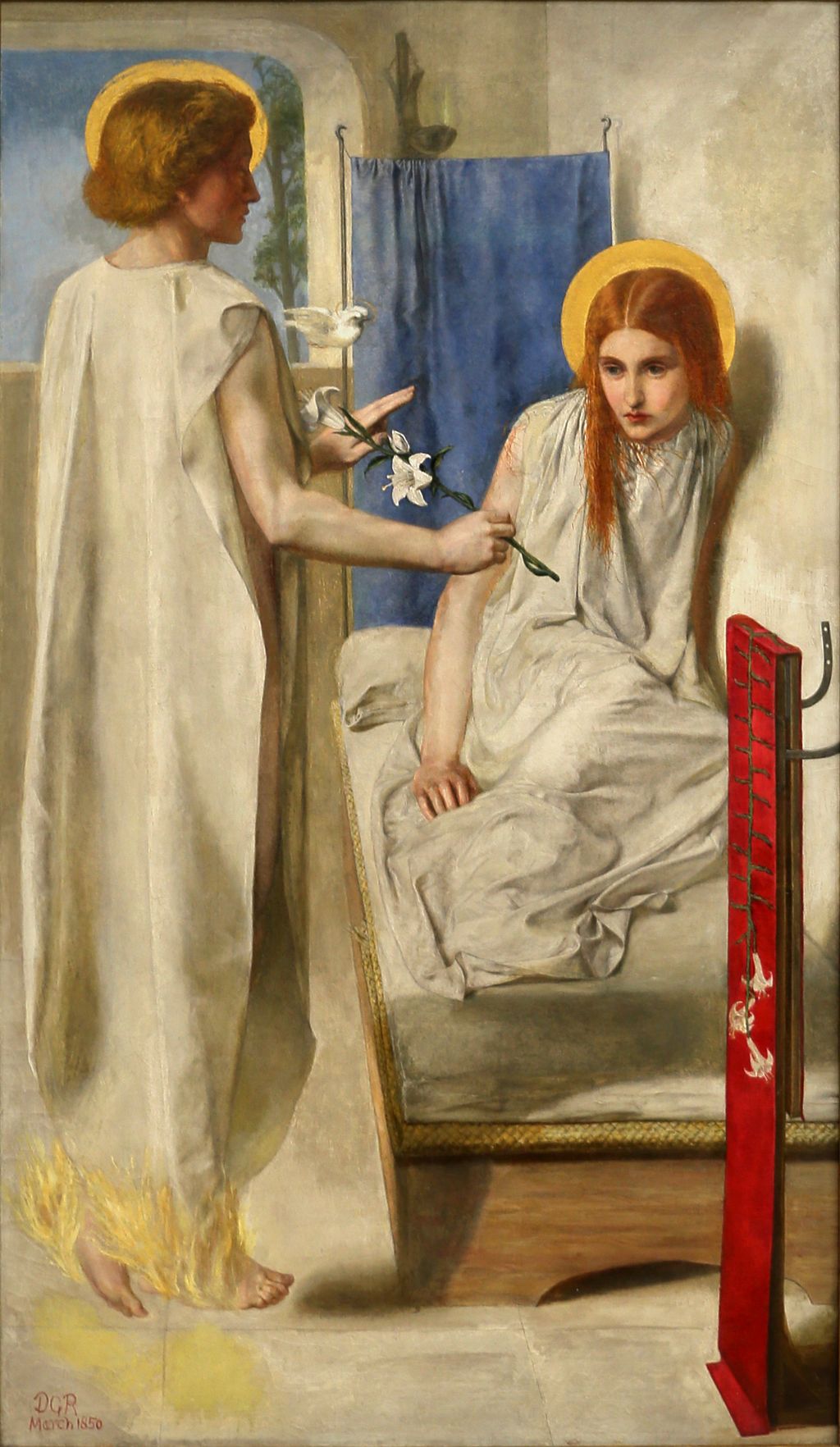
| Ecce Ancilla Domini! (The Annunciation) | 1849–50 | Painting |
| The Girlhood of Mary Virgin | 1848–49 | Painting |
| La Pia de’ Tolomei | 1868–80 | Painting |
| David (Tate A00842) | 1858–64 | Drawing |
| The Adoration (Tate A00843) | 1858–64 | Drawing |
| King David (Tate A00844) | 1858–64 | Drawing |
| Fanny Cornforth (Tate A00845) | 1859 | Drawing |
| Study of a Man Smoking a Long Pipe (Tate A00846) | c.1849 | Drawing |
| Beata Beatrix (Tate N01279) | c.1864–70 | Painting |
| Rosa Triplex (Tate N01702) | 1867 | Drawing |
| Sancta Lilias (Tate N02440) | 1874 | Painting |
| Monna Pomona (Tate N02685) | 1864 | Drawing |
| Mary Magdalene leaving the house feasting (Tate N02859) | 1857 | Drawing |
| Mary Nazarene (Tate N02860) | 1857 | Drawing |
| Miss Robertson (Mrs Fernandez) (Tate N03038) | c.1866 | Drawing |
| The Beloved (‘The Bride’) (Tate N03053) | 1865–6 | Painting |
| Monna Vanna (Tate N03054) | 1866 | Painting |
| Aurelia (Fazio’s Mistress) (Tate N03055) | 1863–1873 | Painting |
| Paolo and Francesca da Rimini (Tate N03056) | 1855 | Drawing |
| The Blue Closet (Tate N03057) | 1857 | Drawing |
| The Wedding of St George and Princess Sabra (Tate N03058) | 1857 | Drawing |
| The Tune of the Seven Towers (Tate N03059) | 1857 | Drawing |
| The Chapel before the Lists (Tate N03060) | 1857–64 | Drawing |
| The Damsel of Sanct Grael (Tate N03061) | 1857 | Drawing |
| The Heart of the Night (Mariana in the Moated Grange) (Tate N03062) | 1862 | Drawing |
| Lucrezia Borgia (Tate N03063) | 1860–1 | Drawing |
| The Passover in the Holy Family (Tate N03156) | 1856 | Drawing |
| Arthur’s Tomb (Tate N03283) | 1860 | Drawing |
| Dantis Amor (Tate N03532) | 1860 | Painting |
| Dr Johnson at the Mitre (Tate N03827) | 1860 | Drawing |
| Maids of Elfen-Mere, engraved by the Dalziel Brothers (Tate N03971) | published 1855 | |
| The Palace of Art, engraved by the Dalziel Brothers (Tate N04058) | published 1857 | |
| Roman de la Rose (Tate N04089) | 1864 | Drawing |
| Study for ‘Giotto Painting the Portrait of Dante’ (Tate N04283) | 1852 | Drawing |
| Study for ‘The Bride’ (Tate N04284) | 1865 | Drawing |
| Study for the Head of Love, for ‘Dante’s Dream at the Time of the Death of Beatrice’ (Tate N04285) | 1870 | Drawing |
| St Catherine (Tate N04603) | 1857 | Painting |
| Hesterna Rosa (Tate N04626) | 1853 | Drawing |
| Taurello’s First Sight of Fortune (Tate N04627) | 1849 | Drawing |
| Elizabeth Siddall in a Chair (Tate N04628) | date not known | Drawing |
| Elizabeth Siddall Plaiting her Hair (Tate N04629) | date not known | Drawing |
| Study for ‘Desdemona’s Death Song’ (Tate N04911) | 1870 | Drawing |
| Proserpine (Tate N05064) | 1874 | Painting |
| Dante’s Vision of Rachel and Leah (Tate N05228) | 1855 | Drawing |
| Dante’s Dream at the Time of the Death of Beatrice (Tate N05229) | 1856 | Drawing |
| Mary in the House of St John (Tate N05230) | 1859 | Drawing |
| St George and Princess Sabra (Tate N05231) | 1862 | Drawing |
| Bethlehem Gate (Tate N05232) | 1863 | Drawing |
| Woman in Yellow (Tate N05233) | 1863 | Drawing |
| How Sir Galahad, Sir Bors and Sir Percival Were Fed with the Sanct Grael; but Sir Percival’s Sister Died by the Way (Tate N05234) | 1864 | Drawing |
| Joan of Arc (Tate N05235) | 1864 | Drawing |
| Faust: Margaret in the Church (Tate N05745) | 1848 | Drawing |
| Carlisle Wall (The Lovers) (Tate N05921) | 1853 | Drawing |
| Study for ‘Ecce Ancilla Domini! (The Annunciation)’ (Tate T00287) | c.1849 | Drawing |
| Mrs Vernon Lushington (Tate T00333) | 1865 | Painting |
| Sketch of Angels’ Heads (Tate T03817) | ?c.1875 | Drawing |
Frequently Asked Questions
It belongs to the Spencer Museum of Art at the University of Kansas, accession 1956.0031. [1]
Discussion
Follow the ring, the distant birds and the words on the frame through Pia’s enclosed world.
Reader Insights
Which detail first suggests the woman’s confinement?
How does reading Dante change your response to her hands?
What does the frame’s written voice add to the painted figure?
Join the Conversation
Share a detail, comparison or question about La Pia de’ Tolomei below.
References
- Spencer Museum of Art, University of Kansas. “La Pia de’ Tolomei, Dante Gabriel Rossetti.” Collection record 1956.0031, including historical labels and object details. Accessed 28 October 2026. View source.Splash image: La Pia de’ Tolomei, 1868–1880. Unframed reproduction. Public domain, via Wikimedia Commons
- Spencer Museum of Art. “La Pia de’ Tolomei: full framed object photograph.” Photograph supplied through collection record 1956.0031. Accessed 28 October 2026. View source.
- Dante Alighieri. “Purgatorio, Canto V,” especially lines 46–57 and 130–136. Divina Commedia, fourteenth century; Italian text, Wikisource (in Italian). Accessed 28 October 2026. View source.
- University of Texas at Austin, Danteworlds. “La Pia: Ante-Purgatory, Purgatorio 5.” Commentary on Pia and competing traditions about her death. Accessed 28 October 2026. View source.
- Jerome McGann. “Dante Gabriel Rossetti, La Pia De’ Tolomei (1868–1880).” Rossetti Archive Galleries, COVE, 7 March 2020; adapted from the Rossetti Archive. Production and textual history, patronage and provenance. Accessed 28 October 2026. View source.
- Anne Anderson. “‘I thank you so much for thinking me still worthy of making so lovely a present to’: Gifts from Dante Gabriel Rossetti to Jane Morris.” The Journal of William Morris Studies 21, no. 3 (2015), pp. 4–21, especially pp. 4 and 7. Accessed 28 October 2026. View source.
- Dante Gabriel Rossetti. “La Pia.” 1880, holograph fair copy in pencil; prose explanation and verse translation, transcribed by the Rossetti Archive, electronic edition 1. Accessed 28 October 2026. View source.
- F. G. Stephens. “Dante Gabriel Rossetti.” London: Seeley and Co.; New York: Macmillan and Co., 1894, p. 72, footnote. Digitized book. Accessed 28 October 2026. View source.
- Tate, Ecce Ancilla Domini! (The Annunciation), N01210, collection fields, 1849–50 dating and January 2025 gallery label. Accessed 28 October 2026. View source.
- Tate, Tate Collection metadata, artwork_data.csv, October 2014 snapshot, released under CC0. Repository readme states that this dataset is no longer maintained. Downloaded and artist rows inspected 28 October 2026. View source.


