


 by Tom Gurney
Tom Gurney BSc (Hons) is an art history expert with over 20 years experience
Published on June 19, 2020 / Updated on April 28, 2026
Email: tomgurney1@gmail.com / Phone: +44 7429 011000
The Ballet Class: Discipline, Observation, and the Reality of Dance
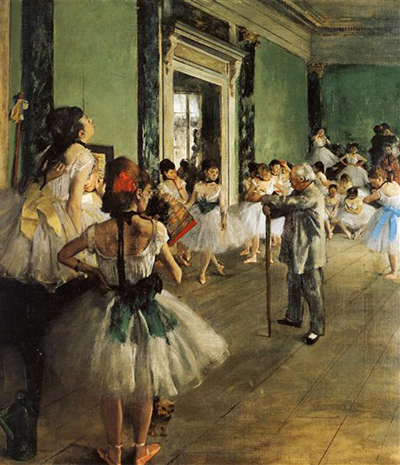
The Ballet Class (c.1874-1876) by Edgar Degas offers a remarkably intimate view of ballet training in 19th-century Paris. Rather than depicting a polished stage performance, Degas turns his attention to the rehearsal room — a space defined by repetition, fatigue, and quiet concentration.
At the right of the composition stands the ageing ballet master Jules Perrot, leaning on his cane as he observes a dancer in the centre. Around him, the rest of the class appears scattered and informal. Some dancers watch attentively, while others stretch, adjust their clothing, or simply rest. This contrast between discipline and distraction lies at the heart of the painting.
The scene captures a moment at the end of a lesson, when exhaustion begins to replace focus. Degas was particularly interested in these transitional moments — not the spectacle of performance, but the reality behind it.
- Artist: Edgar Degas
- Title: The Ballet Class
- Date: c.1874–1876
- Medium: Oil on canvas
- Movement: Impressionism
- Subject: Ballet rehearsal
- Key Figure: Jules Perrot
- Location: Musée d'Orsay, Paris
- Significance: Realistic depiction of ballet training and modern life
What is happening in The Ballet Class?
The painting shows a group of young ballerinas being evaluated during a private lesson. The central dancer performs for the instructor, while the others form a loose arc around the room.
Unlike traditional academic compositions, the figures are not arranged symmetrically. Instead, they appear dispersed and individualised. Some lean against the wall, others converse quietly, and one dancer stretches her back in a moment of fatigue.
This sense of informality is deliberate. Degas presents the dancers not as idealised figures, but as working professionals — tired, distracted, and human.
Composition and Perspective
One of the most striking features of The Ballet Class is its unusual composition. Degas avoids a central, balanced arrangement, instead pushing the main action slightly off-centre.
The viewer's eye is drawn diagonally across the room, from the foreground dancer with her back turned, through the central figure, and toward the instructor at the right. This creates a sense of movement and depth, as though the scene has been captured in passing.
The large mirror at the back reflects light into the room, enhancing the sense of space. At the same time, the cropped edges and asymmetrical framing suggest the influence of photography — a key element in Degas's modern approach to composition.
Realism and the Modern World
Degas's ballet paintings are often associated with beauty and elegance, but The Ballet Class reveals a more complex reality. The dancers are not presented as glamorous performers, but as young women engaged in a demanding and repetitive profession.
By focusing on rehearsal rather than performance, Degas highlights the labour behind the art. The relaxed postures, absent-minded gestures, and moments of fatigue all suggest the physical strain of training.
This approach reflects Degas's broader interest in modern life. Like his paintings of cafés, laundresses, and milliners, his ballet scenes show people at work — observed with precision rather than idealisation.
Key Details in The Ballet Class
- Jules Perrot: The elderly ballet master at the right, marking time with his cane.
- The central dancer: Performing for evaluation, becoming the focal point of the composition.
- Resting dancers: Figures stretching, adjusting costumes, or chatting — emphasising realism.
- The mirror: Expands the space and reflects light into the studio.
- The dog: A small, almost incidental detail reinforcing the informality of the scene.
These elements combine to create a scene that feels observed rather than staged — one of Degas's defining artistic qualities.
Are there multiple versions of The Ballet Class?
Yes — The Ballet Class exists in more than one version, and this often causes confusion.
This painting (the Musée d'Orsay version) was created between 1874 and 1876 and shows the class at the end of a lesson. A closely related work, often titled The Dance Class (1874), is held in the Metropolitan Museum of Art in New York.
Although the two compositions are similar, they are not identical. Degas frequently revisited the same subject, adjusting figures, poses, and spatial arrangements to refine his ideas.
Why The Ballet Class is Important
The Ballet Class is one of Degas's most important works because it captures the essence of his artistic vision.
Rather than presenting an idealised image of ballet, Degas reveals the discipline and reality behind it. He combines careful observation with innovative composition, creating a painting that feels both immediate and carefully constructed.
This balance between realism and design is what makes Degas one of the most distinctive artists of the Impressionist period.
FAQs
The Ballet Class shows a group of young dancers at the end of a lesson being observed by the ballet master Jules Perrot. One dancer performs in the centre while others rest, stretch, or watch, revealing the discipline and fatigue behind ballet training.
Edgar Degas was fascinated by movement, discipline, and modern life. Ballet allowed him to study the human body in motion while also capturing the reality behind performance, including rehearsal, fatigue, and repetition.
No, they are closely related but separate works. The Ballet Class usually refers to the Musée d’Orsay version painted around 1874–1876, while The Dance Class (1874) is a similar composition held in the Metropolitan Museum of Art in New York.
The teacher is Jules Perrot, a renowned 19th-century ballet master who is shown standing at the right of the painting, leaning on his cane as he evaluates the dancers.