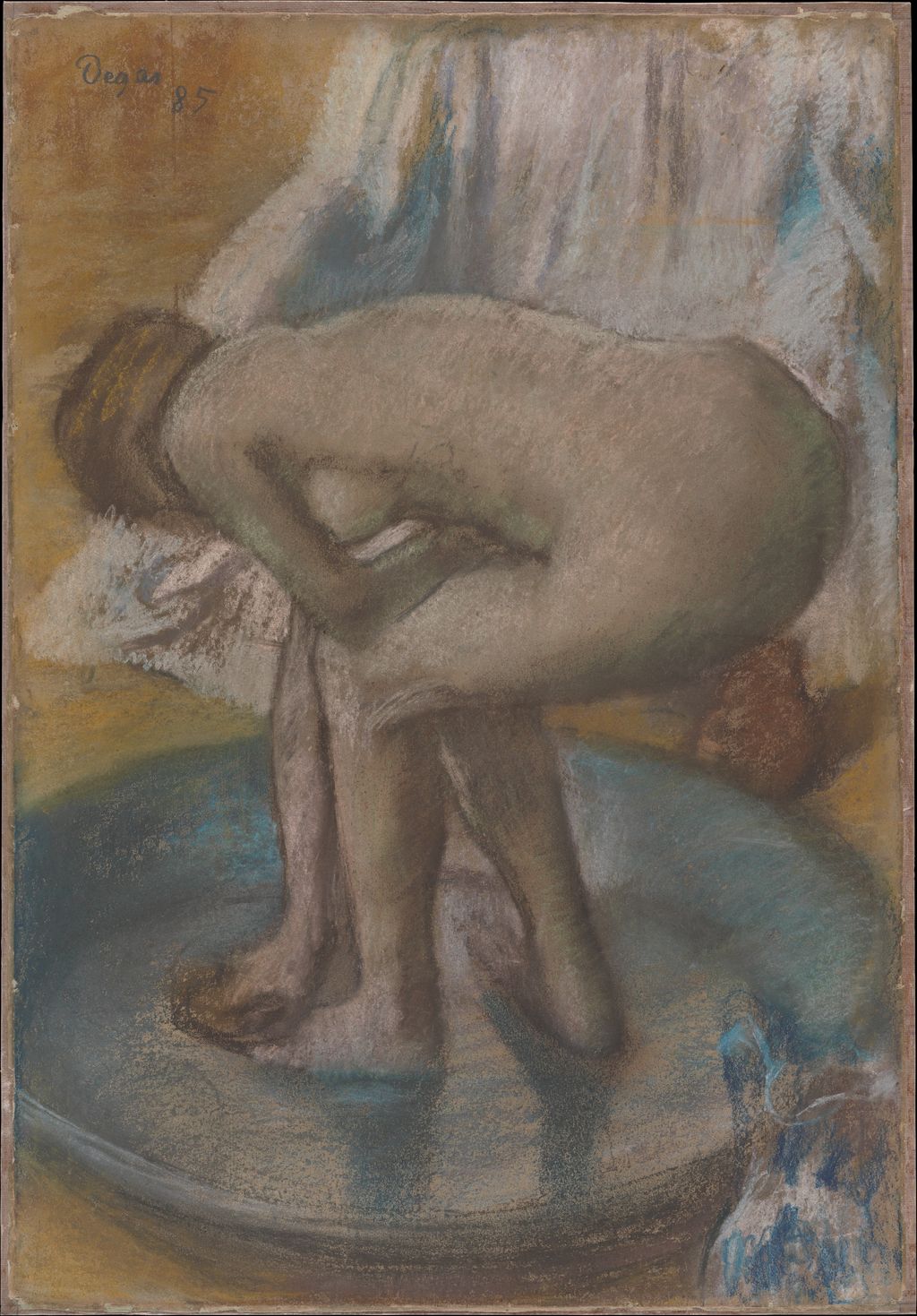
A woman bends forward inside a shallow basin. Her back makes a broad arc; her face turns away; both feet touch the tub's floor. The Metropolitan Museum of Art calls this work Woman Bathing in a Shallow Tub. Edgar Degas made it in 1885 with charcoal and pastel on paper later laid on silk bolting, and exhibited it in the final Impressionist exhibition the following year. It is a strong place to begin with his bathers because it asks us to look closely while revealing little about the woman herself. We can describe the pose, basin and colour. We cannot infer her name, occupation or experience from the drawing. [1][11]
Washing, drying and hair care occupied Degas repeatedly from the late 1870s onward. Some images are quick and spare; others fill a large surface with colour, cloth and furniture. The works considered here include pastels, charcoal drawings, oil paintings and sculpture. The subject joins careful study of a bending body to a more difficult question: why does a viewer seem to have access to an act usually kept private? Degas's compositions can create that sensation through viewpoint and framing. The sensation belongs to the artwork. It should not be mistaken for evidence that a specific model was secretly watched. [2][3][4]
Degas's Bathers at a Glance
Recurring actionsBathing, drying, combing and having hair tended
Important public momentA suite of women washing or grooming at the eighth Impressionist exhibition, 1886
Media in this surveyCharcoal, pastel, oil and original wax sculpture
Common viewpointNear, above or behind the figure, sometimes making the viewer feel intrusive
Key limitThe apparent private moment is a composed image; a model's identity or state of awareness needs independent evidence
First identity checkMuseum, accession, date, medium and full title, especially for works called The Tub or After the Bath
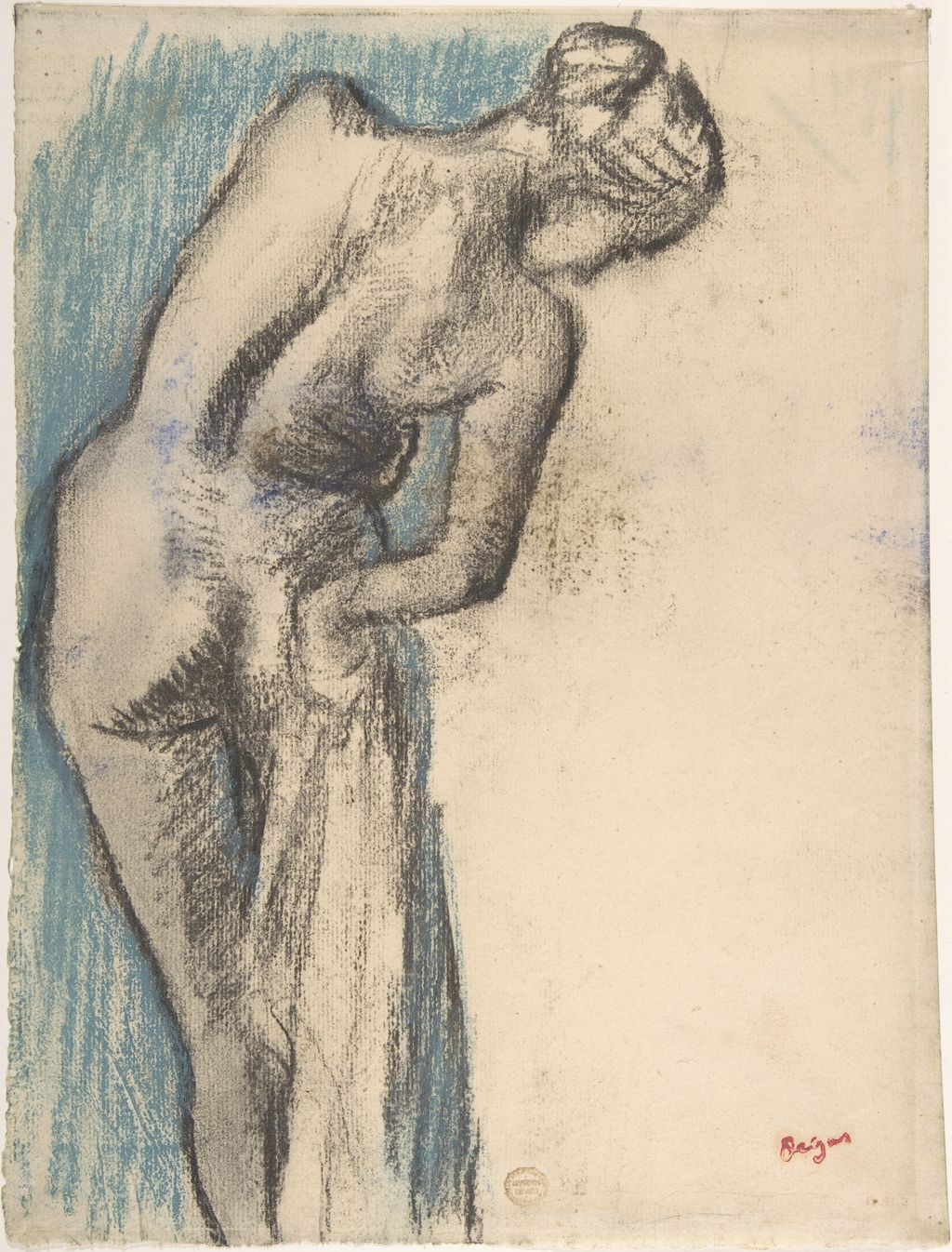
Edgar Degas, Bather Drying Herself, c. 1883–84, charcoal and pastel on off-white laid paper. The Metropolitan Museum of Art, 19.51.2. Collection record.
Musée d'Orsay describes Degas's turn toward women washing, combing their hair and resting as a major part of his treatment of the nude. The 1886 Impressionist exhibition gave that interest a conspicuous public form. He presented a group, often called a suite, of female bathers. The display prompted discussion of their ordinary actions and bodies as much as of his drawing. The fact that one group was shown in 1886 is useful, but it does not turn every bather he made before or after that year into an exhibited member. [2]
The Met identifies Woman Bathing in a Shallow Tub, accession 29.100.41, as one of the 1886 exhibits. It also records an unusually specific episode after the exhibition: Degas exchanged the work with Mary Cassatt for her Girl Arranging Her Hair. That exchange tells us something about artists' engagement with each other's work. It does not tell us what the bather thought as she posed, or how directly the image came from one sitting. The object record is evidence for the drawing's public and collecting history, not a biography of the depicted woman. [1]
An earlier Met sheet, Bather Drying Herself, dates to about 1883–84. Its standing figure leans forward, one hand against a leg while the other works with cloth. Blue pastel occupies part of the left ground; black charcoal carries much of the figure. At roughly 32 by 25 centimetres, it is smaller and less furnished than many later bathers. It shows Degas testing the action before the 1886 display, without being presented by the Met as one of that exhibition's items. [3]
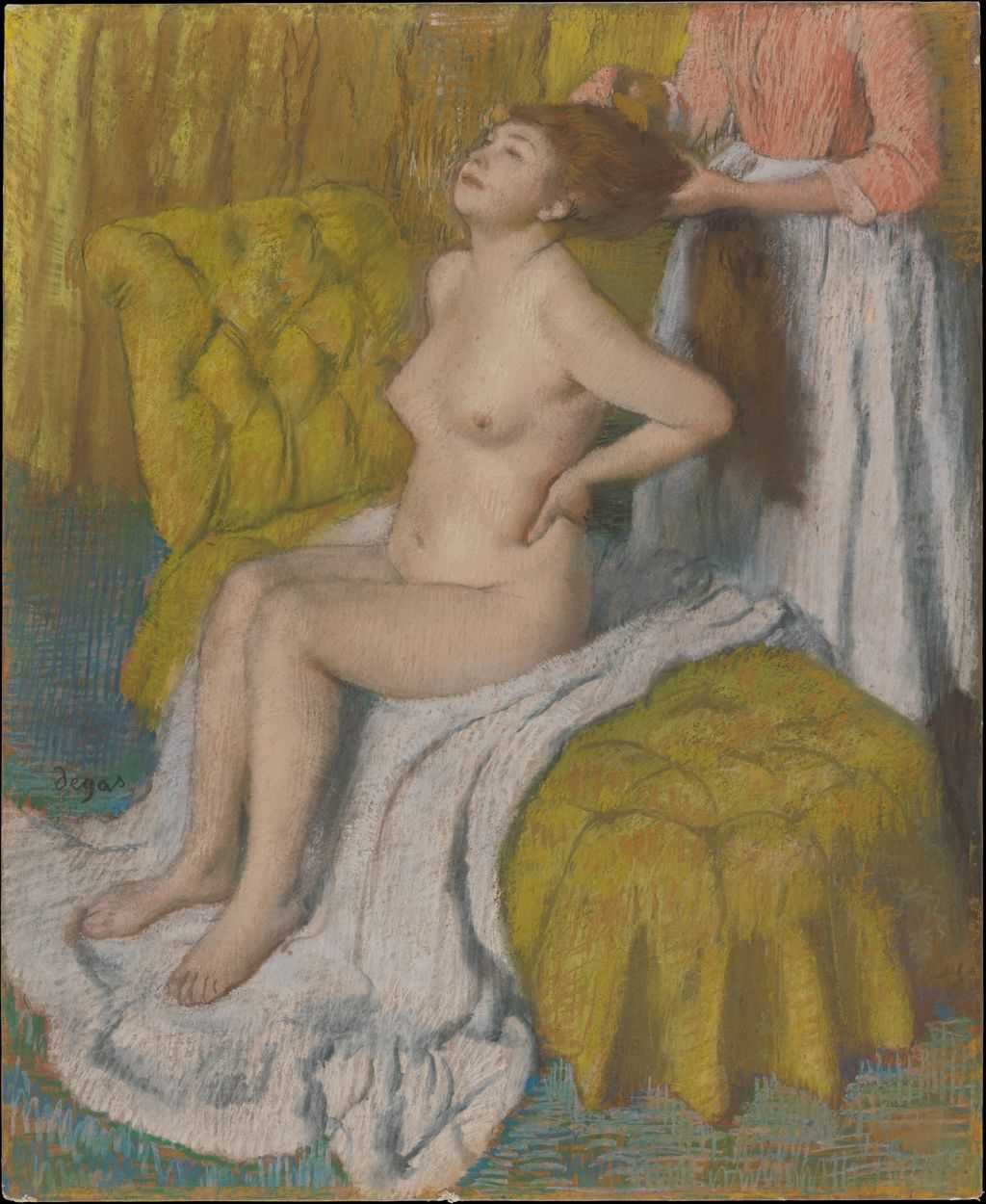
The dating of Woman Having Her Hair Combed is different again: about 1886–88. A seated woman bends while another person tends her hair. Its large field of pastel and furniture make grooming a relationship between figures, not simply an isolated body. The Met suggests Degas may have intended it for the 1886 suite, but whether it was actually shown there remains uncertain. It would be tempting to place every visually related work into a tidy exhibition set. The owner record leaves this one open, and the uncertainty belongs in its story. [4]
The Shallow Tub and a View from Above
In Woman Bathing in a Shallow Tub, a high viewpoint lets the viewer see both the woman's back and the dark oval of the basin. The curve of her body is echoed by the tub's rim, while the broad wall and cloth behind her make the scene feel compressed. Charcoal gives the central form weight; pastel makes the blue-green bath and warm surrounding surfaces distinct. Nothing in that description requires us to know where the paper was made into the image or the name of the person who posed. The image's closeness is constructed through angle, scale and the relation of body to basin. [1]
Musée d'Orsay's Le Tub is another work from 1886, accession RF 4046, and was also shown at the final Impressionist exhibition. It is pastel on cardboard. Orsay draws attention to the steep view into the room, the nearby toilet articles and the unusual geometry of the figure inside the tub. The museum also compares her pose with the ancient Crouching Venus. That comparison matters: Degas could make a contemporary bathing action look strikingly direct while drawing on a long history of posed nudes. Modern subject and older artistic source coexist in one picture. [5]
These two tub pictures should not be collapsed because their English titles sound alike. The Met work is a charcoal-and-pastel sheet of 1885, 29.100.41. Orsay's Le Tub is a pastel on cardboard of 1886, RF 4046. Their owners give different accessions and supports. Their shared interest in a raised viewpoint makes comparison worthwhile, but it does not make them the same object or one picture copied in a different format. [1][5]
What Does the Viewer Know?
The Met's note on Bather Drying Herself describes a close view whose intimacy approaches voyeurism. That is a description of the viewer's experience and the picture's framing. Its narrow space and bent body make it easy to feel as though one has entered a place without invitation. Yet the paper cannot reveal the model's awareness, terms of work or thoughts. A visual effect can be real without supplying a literal account of the sitting. [3]
The National Gallery in London makes the distinction particularly clear for its later pastel After the Bath, Woman drying herself, NG6295, dated about 1890–95. It says the apparently unguarded pose was made with a model in Degas's studio, who held the position for a preparatory drawing. The finished work can still give a viewer the uneasy sense of looking into a private room. The museum's evidence for a posed study and its interpretation of an intrusive viewpoint belong together. They let us examine the device without imagining that the artist caught a stranger unaware. [6]
This distinction does not settle every ethical question raised by these works. We can ask why a picture arranges a woman's washing or dressing for public view, why her face may be hidden, and how the artist's and viewer's positions differ from hers. We can also notice when descriptions of a figure become more confident than the records allow. Orsay's account of the 1886 reception includes hostile and stereotyped responses from contemporary critics. Those reactions are part of the exhibition's history, not neutral descriptions of the women shown. [2][6]
Degas's own framing and later museum interpretations deserve careful attribution. A high angle, a cropped body or an exposed bath can make a viewer feel like an intruder. None of these devices identifies the sitter as a laundress, dancer or sex worker unless independent evidence does so for a particular object. The woman in a work need not be turned into a fictional character for the work's composition and social implications to be understood. [1][3][6]
Grooming and the Presence of Another Person
Edgar Degas, Woman Having Her Hair Combed, c. 1886–88, pastel on light green wove paper, now discolored to warm gray, affixed to original pulpboard mount. The Metropolitan Museum of Art, 29.100.35. Collection record.
Bathing was only one way Degas explored the body's ordinary preparation. In the Met's Woman Having Her Hair Combed, an attendant draws the seated woman's hair while she leans forward. The two figures make a small working arrangement: one provides the labour of combing, the other adjusts her body to it. Their relationship is visible as action, but their names and exact social relation are not established by the museum title. The work's c. 1886–88 date and uncertain exhibition status also warn against reading it solely as an illustration of the 1886 suite. [4]
The motif had earlier forms outside the later nude group. The National Gallery's Beach Scene, about 1869–70, shows a woman having her hair combed at the seaside. She is clothed, and the picture is not one of the later nude bathers. The gallery explains that Degas completed it in the studio and connects aspects of its arrangement with Japanese prints. Those facts make it a useful comparison: hair care, a helper and seemingly casual activity could be composed through deliberate pictorial decisions over a long span of Degas's career. They do not prove that one later bather directly derived from this beach picture. [7]
Compare that scene with Woman Having Her Hair Combed. The earlier setting offers beach, figures and space around the action; the later pastel draws the bodies and furnishings into a much closer encounter. What persists is Degas's interest in a moment of preparation. What changes is how near the viewer stands and how much of the surrounding world remains available. The ballet dancers page considers similar attention to preparation in a very different social setting. [4][7]
Watch: Edgar Degas
Explore his paintings, drawings and sculpture in three short videos.
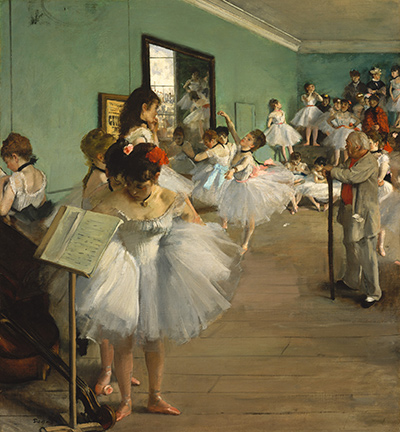
Degas, The Dance Class
Smarthistory
Look closely at Degas’s off-duty dancers and his unusual view into the rehearsal room.
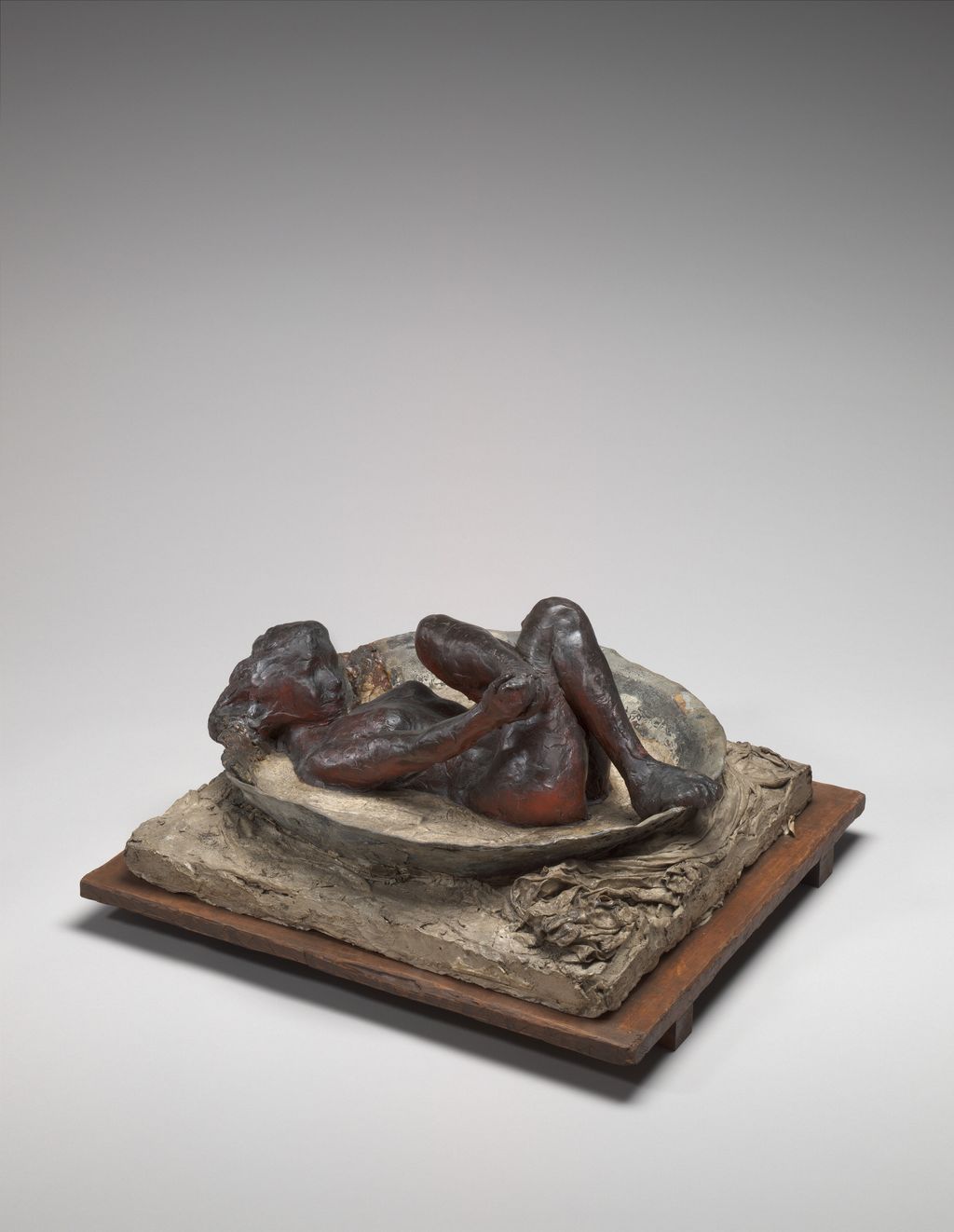
Edgar Degas, The Tub, c. 1889, pigmented beeswax, plastiline, plaster, lead, wood, cloth, cork, wire, on wooden base. National Gallery of Art, Washington, 1985.64.48. Collection record.
Degas also gave a bather a physical basin. The National Gallery of Art in Washington holds The Tub, an original sculpture dated about 1889, accession 1985.64.48. Its figure is made of pigmented beeswax and other modeling materials. She lies in an actual lead basin. Plaster stands in for water, and the bath rests on a base incorporating cloth and wood. The result has the same problem of a body turning within a bounded space as the pastel tubs, but here a viewer can move around the object and see the rim, base and figure from different angles. [8]
The NGA describes the contrast between the round tub and square base when seen from above. Its account of the materials is important because the dark figure can resemble bronze in a photograph. This object is an original wax model, not one of the posthumous bronze casts. It also must not be confused with Orsay's 1886 pastel Le Tub, which has a different date, medium and accession. A title alone cannot distinguish among the artist's many returns to a bathtub. [5][8]
In sculpture the bath is not just an outlined oval or a patch of colour. Real lead gives the rim mass, while the modeled figure twists within it. Degas could investigate how limbs, torso and container occupy space, even as the work remains a constructed representation rather than a record of a particular person's bath. The sculptures page follows his original models and their later casting history in detail. Here the wax Tub makes one point vivid: the bather subject was not tied to a single flat medium. [8]
A Late Oil Bather and an Older Nude Tradition
The Getty's After the Bath, accession 2001.20, is an oil painting dated about 1895. Its exhibition material discusses Degas's late bather and the built-up painted surface. Oil remained available to him as he worked on bath subjects in pastel and other media. This work is another reason not to tell a simple story in which oil ended and pastel began on one fixed date. The museum's collection checklist confirms its title, date, medium and accession. [9][10]
Orsay's comparison of its pastel Le Tub with the Crouching Venus, and the National Gallery's discussion of pose in its later After the Bath, place these modern washing scenes beside older traditions of the nude. Degas changed the setting and the apparent relation of viewer to model, but he did not erase the history of bodies arranged for art. That makes the work more complex than either a purely candid glimpse or a purely classical exercise. The ordinary act, the artist's study and the inherited pose each contribute to what a viewer sees. [5][6]
The recurrence of a title can obscure those distinctions. London's After the Bath, Woman drying herself is a c. 1890–95 pastel, NG6295; Getty's After the Bath is a c. 1895 oil, 2001.20. They are separate works, as are the Met and Orsay tub images and the NGA wax tub. Looking at a current museum record is the fastest way to avoid turning one artist's recurring subject into one imaginary master picture. [5][6][8][9][10]
How to Read a Degas Bather
Begin with the action. Is the figure washing in a basin, drying, combing her own hair, or receiving help? Then consider where the viewer appears to stand. A view from above can expose the shape of a tub; a close crop can hide the room and increase a feeling of intrusion. Ask what the work actually shows before supplying a narrative about how the scene happened. The National Gallery's evidence of a posed study for NG6295 is a useful reminder that a composed image may feel spontaneous. [1][3][5][6]
Next read the object label. Charcoal and pastel on paper, pastel on cardboard, oil on canvas and original mixed-material wax are different material decisions. The drawings and pastels pages explain marks and dry colour at greater length. On this page the media help show how far Degas carried one subject: from an abbreviated standing figure to a large coloured interior and a basin built in three dimensions. [1][3][4][5][8][9]
Finally, use title, owner, accession and date together. The 1886 suite is documented, but later bathers and works of uncertain exhibition status should keep their own histories. The woman's private life does not become knowable because a scene brings us near her. What these works do show is Degas repeatedly arranging bodies, tools, rooms and viewpoints around ordinary acts, inviting close looking while also making that act of looking part of the subject. [1][2][4][6]
A selected index of documented works, combining owner records with entries sampled across Michel Schulman’s digital catalogue raisonné. It is not a complete catalogue. View the full catalogue
What does the viewpoint let you see, and what remains unknown?
Context
How do grooming scenes differ when an attendant is present?
Open Question
How does the original wax tub change the relation of figure and basin?
Join the Conversation
Share your reading of these works below.
References
Metropolitan Museum of Art, Woman Bathing in a Shallow Tub, 1885, charcoal and pastel on paper laid on silk bolting, accession 29.100.41. View source
Musée d'Orsay, Degas and the Nude, 2012 exhibition presentation. View source
Metropolitan Museum of Art, Bather Drying Herself, c. 1883–84, charcoal and pastel on laid paper, accession 19.51.2. View source
Metropolitan Museum of Art, Woman Having Her Hair Combed, c. 1886–88, pastel on paper affixed to original pulpboard mount, accession 29.100.35. View source
Musée d'Orsay, Le Tub, 1886, pastel on cardboard, accession RF 4046. View source
National Gallery, London, After the Bath, Woman drying herself, c. 1890–95, pastel on paper mounted on board, accession NG6295. View source
National Gallery, London, Beach Scene, c. 1869–70, oil essence on paper mounted on canvas, accession NG3247. View source
National Gallery of Art, Washington, The Tub, c. 1889, original mixed-material wax, accession 1985.64.48. View source
J. Paul Getty Museum, Degas at the Getty exhibition material, 2006, with discussion of the late oil After the Bath. View source
J. Paul Getty Museum, Nineteenth-Century Art: Collection Highlights checklist, listing After the Bath, c. 1895, oil on canvas, accession 2001.20. View source
Splash image: Edgar Degas, Woman Bathing in a Shallow Tub, 1885, charcoal and pastel on light green wove paper, now discolored to warm gray, laid down on silk bolting. The Metropolitan Museum of Art, 29.100.41. Collection record. View source
Tom Gurney is an art history expert. He received a BSc (Hons) degree from Salford University, UK, and has also studied famous artists and art movements for over 20 years.
Tom has also published a number of books related to art history and continues to contribute to a number of different art websites. You can read more on Tom Gurney here.



 Buy Art Prints Now
 by Tom Gurney