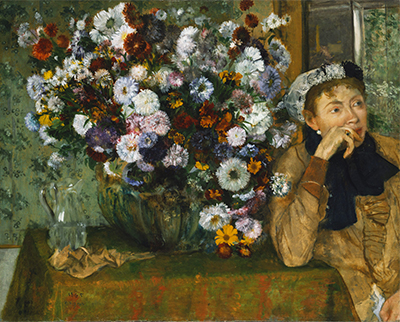
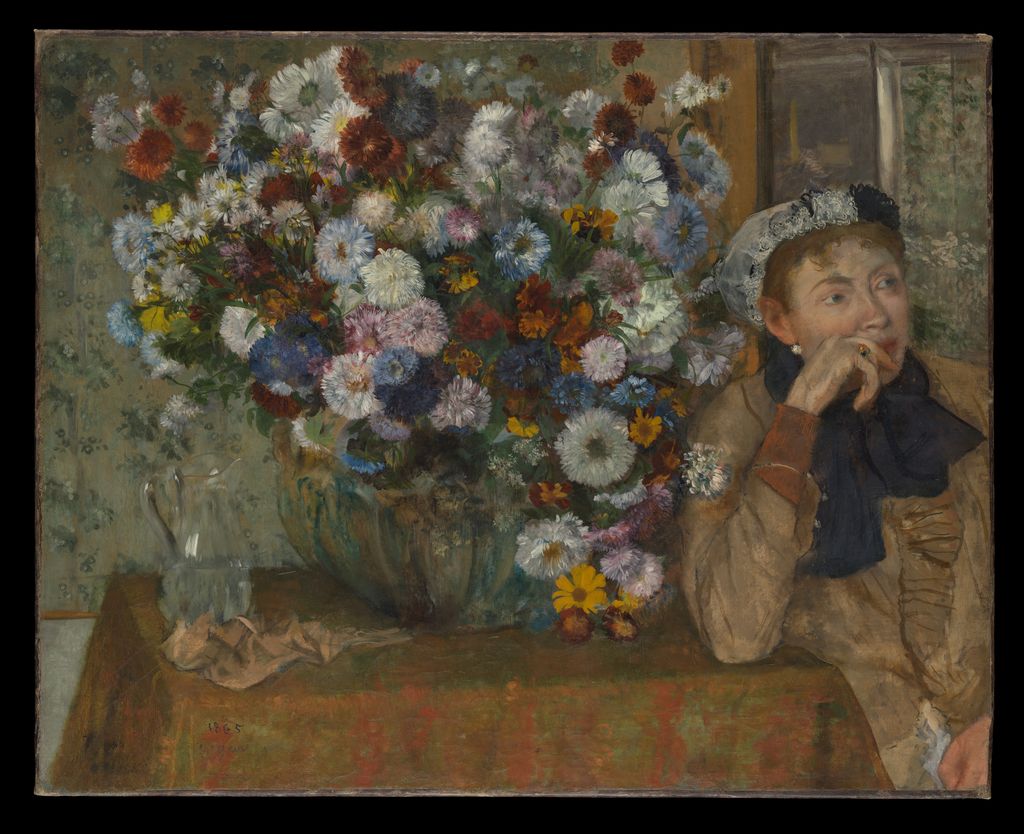
Flowers fill the centre of Edgar Degas’s A Woman Seated beside a Vase of Flowers. The seated woman is at the right edge, partly screened by the large bouquet. The Metropolitan Museum of Art identifies her as probably Madame Paul Valpinçon; even the museum’s full title keeps a question mark after her name. Degas made a preparatory pencil drawing of the figure, then gave the flowers as much visual weight as the person. Is this a portrait with an unusually prominent still life, or a still life that includes a portrait? The Met asks much the same question. Either way, a tentative name and a striking arrangement are different kinds of information. One concerns who may have sat; the other is what anyone can see on the canvas. [1][11]
Degas portrayed himself, relatives, friends and people whose names remain uncertain. Some sitters meet the viewer’s gaze; others listen, turn away or share the frame with another person. A painting can show a recognizable face and still resist a simple account of that person’s feelings. This page follows portraiture from an early self-portrait and family pictures through a printed portrait, an image of a museum visitor and a late photograph. It asks what their poses, surroundings and surfaces reveal, and where the evidence stops. [2][3][4][5][6][7][8][9][10]
Degas’s Portraiture at a Glance
People representedDegas himself, relatives, friends, associates and some unidentified or tentatively identified sitters
Examples in this surveyThe Bellelli Family, Madame René de Gas, Edmondo and Thérèse Morbilli and the woman beside a vase of flowers
MediaOil painting, etching and drypoint, and a late gelatin silver photograph
Date cautionOrsay dates the Bellelli Family 1858–69; the Met dates the Lerolle photograph probably 1895–96
Identity cautionThe vase-portrait sitter is probably Madame Paul Valpinçon; the museum visitor is likely Mary Cassatt
Best first checkRead the owning museum’s title, accession, date, medium and wording about the sitter
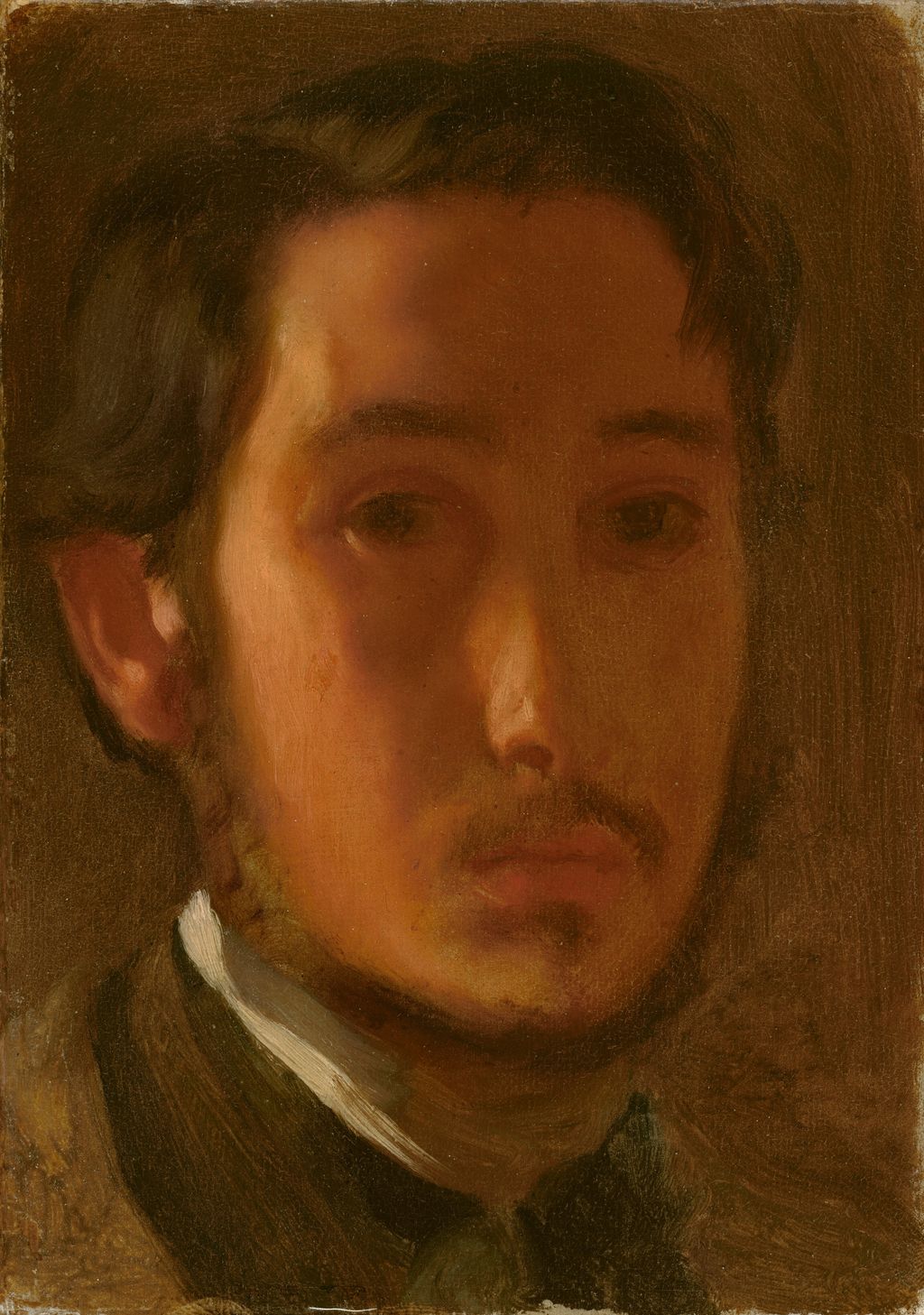
Edgar Degas, Self-Portrait with White Collar, c. 1857, oil on paper on canvas. National Gallery of Art, Washington, 1995.47.7. Collection record.
An early oil self-portrait gives us an unmistakable sitter: Degas himself. In the National Gallery of Art’s Self-Portrait with White Collar, made about 1857, the young artist turns toward the viewer against a dark background. His light collar and face draw attention within a compact picture. The support is oil on paper laid on canvas, a useful reminder that even an oil portrait need not have begun as paint applied directly to stretched canvas. We can describe the turn of the head and the contrast of light and dark. We cannot read a private declaration of confidence, doubt or ambition from his expression. [3]
Family members occupy some of his most ambitious early pictures. The large Portrait de famille, commonly called The Bellelli Family, brings his aunt Laure, her husband Gennaro and their daughters together in an interior. The National Gallery of Art’s unfinished Edmondo and Thérèse Morbilli depicts Degas’s sister and her husband. An etching and drypoint shows another sister, Marguerite. These works differ in size, medium, finish and setting, but each represents someone connected to the artist by a known family relationship. That documented connection matters more than a general claim that all of their expressions must be autobiographical clues. [2][5][8]
Nor did his interest in a person’s presence simply end when he turned to dancers, racecourses, baths or other modern subjects. In 1871–72 he pictured his father listening to a singer. In New Orleans in 1872/1873 he painted Estelle de Gas. Later he represented a woman visiting a museum, perhaps Mary Cassatt, and in the 1890s photographed himself with two young women from a friend’s family. These examples do not make one continuous series. They show that a person’s identity, position and relation to others remained subjects Degas could approach in different settings and media. [4][7][9][10]
The Bellelli Family: Four People in One Room
The Bellelli Family deserves its long date range. Musée d’Orsay gives 1858–69 for the painting, accession RF 2210. A single year would imply a certainty that the owning museum does not claim. The picture’s scale and the number of figures also distinguish it from the small self-portrait: Laure stands near her daughters Giulia and Giovanna, while Gennaro sits apart. A likeness of Degas’s grandfather Hilaire de Gas appears within the room. The picture therefore joins the living family with an image of an absent relative. [2]
Orsay reads tension in the distance and poses of the adults. That is a museum interpretation of the arrangement, worth considering alongside the visible picture. The standing mother and seated father do not face one another in a conventional united group. Their daughters occupy the space between them, but their positions do not explain what anyone thought during a sitting, or prove an entire history of the marriage. A reader can register both the formal separation and Orsay’s reading without treating the painting as a transcript of a private conversation. [2]
The grandfather’s portrait complicates the idea of a portrait as one likeness made at one moment. His represented face is a picture inside Degas’s picture. The women, girls, man, furniture and framed image each help organize the room. A family portrait can thus represent relationships through placement as well as faces. For a closer account of this single work and its extended making, see The Bellelli Family. [2]
Flowers, a Figure and an Uncertain Name
The Met dates A Woman Seated beside a Vase of Flowers (Madame Paul Valpinçon?) to 1865 and records it as an oil painting on canvas, accession 29.100.128. Its arrangement resists the expectation that a portrait’s face must dominate. The flowers rise through the foreground and occupy much of the visual field. The woman sits to the right, looking beyond the bouquet rather than posing squarely in front of it. Degas’s documented pencil study of the figure shows deliberate work on her position; it does not settle which part of the finished canvas should count as its principal subject. [1]
The question mark in the title is as important as the flowers. The museum says the sitter was probably Madame Paul Valpinçon. Her possible identification should not disappear when the title is shortened for a caption. Nor should the name be treated as a complete explanation of the composition. We can compare the size and placement of woman and flowers, notice the play between portrait and still life, and still leave the sitter’s identification at the confidence level the owner gives it. The page on this painting follows the object in greater detail. [1]
Another Met painting, Two Men, about 1865–69, makes uncertainty even more visible in its record. The man on the right may be the painter Émile Lévy. The other man has not been identified. A possible studio setting and the informal grouping invite questions about Degas’s artistic circle, but neither question supplies a definite name for the unidentified figure. This is still a useful portrait even though the owner cannot tell us precisely who both people are. The painting preserves a meeting of bodies, faces and space without giving the viewer every part of their biographies. [6]
A Family Picture Left Unfinished
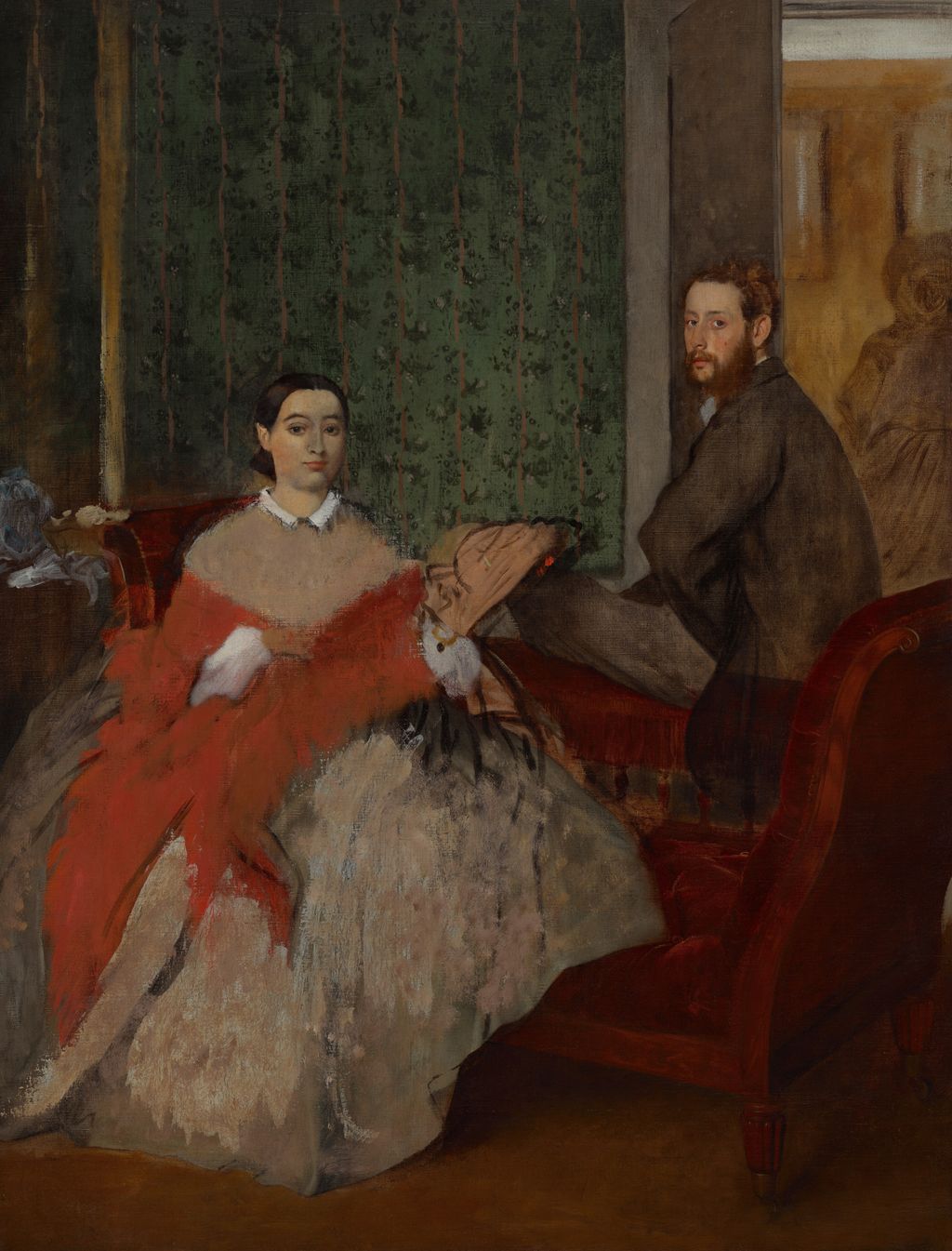
Edgar Degas, Edmondo and Thérèse Morbilli, c. 1865, oil on canvas. National Gallery of Art, Washington, 1963.10.125. Collection record.
The NGA’s Edmondo and Thérèse Morbilli, about 1865, presents Degas’s sister and brother-in-law together. Their faces appear more resolved than parts of their clothing. The gallery describes passages of clothes that were scraped or rubbed down, exposing the process of revision. The canvas remained unfinished in Degas’s studio at his death. These are concrete facts about the object’s surface and later location. They let us look at how a portrait was being worked over, even though they do not tell us why the artist stopped. [5]
That distinction matters because an unfinished family portrait can tempt a biographical story. It would be easy to turn rough clothing into proof of a difficult relationship between the couple, or between them and Degas. The owner record does not establish such a cause. Compare instead what is present: the more settled faces, the less settled garments, and the double grouping. In a finished work, paint can conceal many changes. Here the visible alterations make the acts of selection and revision part of what a viewer encounters. [5]
The name Morbilli also occurs among older site routes and related titles. The NGA’s accession, 1963.10.125, identifies this precise double portrait. Similar family names alone are not enough to turn every Morbilli image into the same object. An accession and current owner are especially helpful when a portrait is unfinished and may have circulated under varied titles. [5]
Watch: Edgar Degas
Explore his paintings, drawings and sculpture in three short videos.
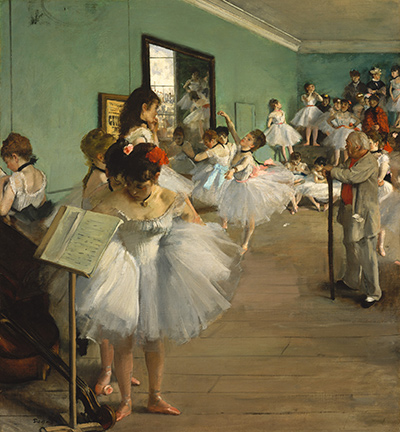
Degas, The Dance Class
Smarthistory
Look closely at Degas’s off-duty dancers and his unusual view into the rehearsal room.
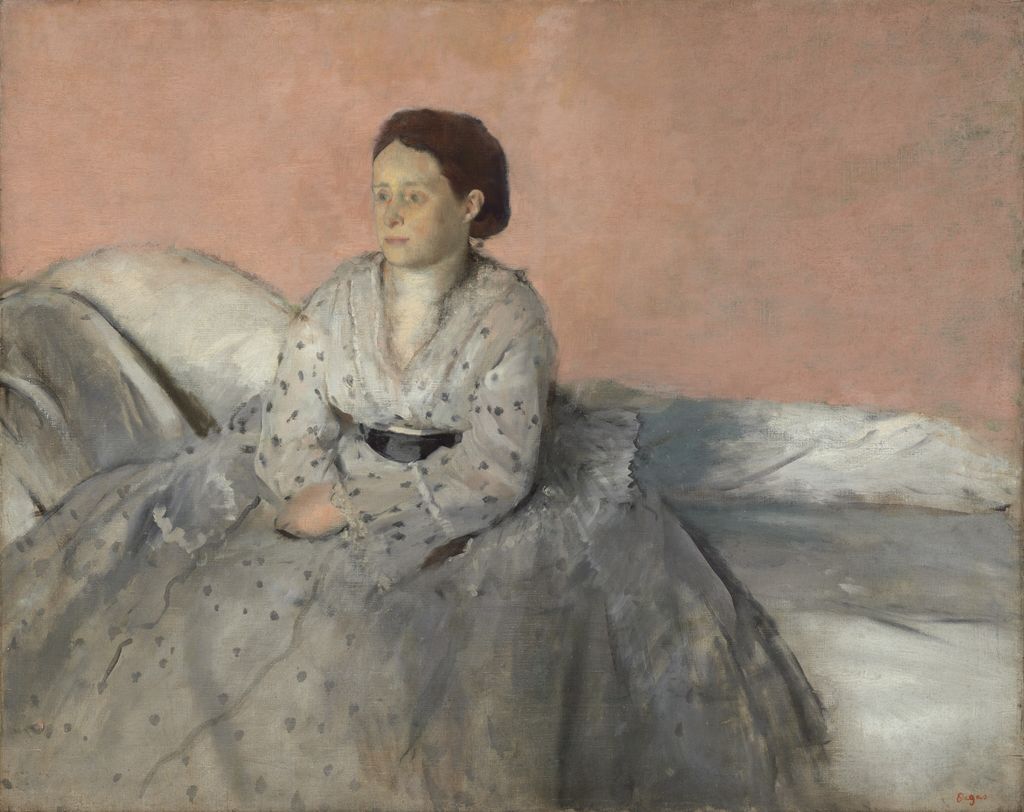
Edgar Degas, Madame René de Gas, 1872/1873, oil on canvas. National Gallery of Art, Washington, 1963.10.124. Collection record.
In 1872/1873 Degas painted Madame René de Gas, now NGA accession 1963.10.124. The sitter was Estelle de Gas, his first cousin and sister-in-law, during his stay in New Orleans. Her pale dress and the dark surrounding tones make her face and upper body stand out. She is an identified person in a documented family network; the title uses her married name. This is a portrait of a specific woman, not simply an anonymous example of a social type. [4]
The gallery records that Estelle had severe visual impairment. It also warns that the painting cannot disclose her inner experience. Those two points must be kept together. The museum’s biographical information can help identify her circumstances, but her gaze in a painting does not let a viewer know what she saw or felt. To treat her eyes as an exact report of her sight, or as a metaphor she herself chose, would add a claim the object cannot carry. [4]
The New Orleans work broadens a history sometimes confined to Degas’s Paris subjects. It also shows why an identified sitter is not an entirely knowable sitter. Family relation, place, date and medium can be established from records. A portrait may offer clues to how the artist arranged a figure in a room; it cannot stand in for the person’s own account. The biography supplies the wider chronology of Degas’s visit, while this picture asks how much a likeness can responsibly tell us about Estelle herself. [4]
Portraits Organized Around Looking and Listening
Portraits need not show a person facing the viewer. In Orsay’s Lorenzo Pagans et Auguste de Gas, painted in 1871–72, Degas’s father listens to the singer Lorenzo Pagans. The relation between the two figures gives the scene its action. Orsay’s account of Degas and the Opéra connects his father with musical gatherings, helping explain why a portrait of listening could matter within this family’s cultural life. The picture need not be an exact record of a named evening to show the act of attending to music. [7]
The NGA’s Woman Viewed from Behind (Visit to a Museum), dated about 1879–85, turns the sitter away from us. The gallery identifies her as likely Mary Cassatt. That tentative wording should travel with the painting when it is discussed. In the gallery setting, she appears as someone looking at art, while we look at her. The back view withholds the facial likeness a reader might expect from a portrait. It shifts attention toward her act of visiting and the relation between spectator and displayed object. It does not reveal what she knew, whether she noticed being studied, or what she thought of the works before her. [10]
These two pictures are different in date, place and confidence of identification. Together they show how Degas could make a person’s attention visible without making an expression the whole subject. One figure listens; another looks. The actions are represented, while their private responses remain outside what the paint can verify. [7][10]
A Sister in Print and Friends in a Photograph
The Met’s Marguerite De Gas, the Artist’s Sister, made in 1860–62, is an etching and drypoint. The museum identifies its impression as the unique surviving example of the second state of a plate Degas reworked through six states. A portrait in print is therefore not necessarily one fixed image repeated without change. Altering the plate changed how his sister appeared on paper; the surviving impression also has its own place in the object’s history. The prints page explains these processes and states more fully. Here Marguerite’s image extends the family portraits beyond oil paint. [8]
A late Met photograph, [Self-Portrait with Christine and Yvonne Lerolle], has a title in brackets and a date given as probably 1895–96. Degas appears with Christine and Yvonne, daughters of his friend Henry Lerolle. The gelatin silver print belongs to his short period of photographic work. It is tempting to speak of its darkness and grouped faces as if they disclosed the mood or intentions of all three people. The medium and the composition can be described; any claim about their thoughts would require more than the photograph supplies. The bracketed title and probable date likewise signal the museum’s care in naming and dating it. [9]
The print and photograph widen what “Degas portraiture” can mean. A sitter might be formed through incised lines and printed ink, or through a camera exposure and a photographic print. The artist may also appear alongside others rather than alone. Yet the basic task for a viewer remains similar: distinguish who is securely identified, what the owner knows about the object, and what the visual arrangement invites us to consider without proving. [8][9]
How to Read a Degas Portrait
Start with the sitter’s name as the owning museum gives it. Degas is certainly the sitter in Self-Portrait with White Collar; Estelle and the Morbilli couple are identified in their NGA records. The vase portrait’s sitter is probably Madame Paul Valpinçon, the visitor is likely Mary Cassatt, and one of the Met’s Two Men remains unnamed. Words such as “probably,” “likely” and “may be” are part of the information, not clutter to remove from a caption. [1][3][4][5][6][10]
Next read the date and the material. Orsay’s 1858–69 range for the Bellelli Family tells a different story of making from a single date. A small oil on paper laid on canvas, a large oil on canvas, a worked etching plate and a gelatin silver print also have different histories of making. Exact title, owner and accession help separate works that share a surname or recurring subject. The paintings and drawings pages go further into those materials. [2][3][5][8][9]
Finally, describe the arrangement before inventing a story behind it. Who meets a gaze, turns away, shares a room, listens or stands beside a bouquet? Which parts of an image are finished, and which bear the marks of revision? Orsay’s interpretation of tension in the Bellelli Family and NGA’s explicit caution about Estelle show two ways to read closely while respecting the limits of the record. Degas’s portraits give us carefully made relationships between figure, space and viewer. The people in them remain more than what any one likeness can tell. [1][2][4][5][7][10]
A selected index of documented works, combining owner records with entries sampled across Michel Schulman’s digital catalogue raisonné. It is not a complete catalogue. View the full catalogue
What does a sitter’s pose show before you read a name?
Context
Where do furniture and space separate people within one portrait?
Open Question
Which thoughts remain unknowable even when a face is recognizable?
Join the Conversation
Share your reading of these works below.
References
Metropolitan Museum of Art, A Woman Seated beside a Vase of Flowers (Madame Paul Valpinçon?), 1865, oil on canvas, accession 29.100.128. View source
Musée d’Orsay, Portrait de famille / La famille Bellelli, 1858–69, oil on canvas, accession RF 2210. View source
National Gallery of Art, Washington, Self-Portrait with White Collar, c. 1857, oil on paper on canvas, accession 1995.47.7. View source
National Gallery of Art, Washington, Madame René de Gas, 1872/1873, oil on canvas, accession 1963.10.124. View source
National Gallery of Art, Washington, Edmondo and Thérèse Morbilli, c. 1865, oil on canvas, accession 1963.10.125. View source
Metropolitan Museum of Art, Two Men, c. 1865–69, oil on wood, accession 1992.380. View source
Musée d’Orsay, Lorenzo Pagans et Auguste de Gas, 1871–72, oil on canvas, accession RF 3736; Degas at the Opéra, exhibition presentation. View source · View source
Metropolitan Museum of Art, Marguerite De Gas, the Artist’s Sister, 1860–62, etching and drypoint, accession 2020.10. View source
Metropolitan Museum of Art, [Self-Portrait with Christine and Yvonne Lerolle], probably 1895–96, gelatin silver print, accession 2004.335. View source
National Gallery of Art, Washington, Woman Viewed from Behind (Visit to a Museum), c. 1879–85, oil on canvas, accession 1985.64.11. View source
Splash image: Edgar Degas, A Woman Seated beside a Vase of Flowers (Madame Paul Valpinçon?), 1865, oil on canvas. The Metropolitan Museum of Art, 29.100.128. Collection record. View source
Tom Gurney is an art history expert. He received a BSc (Hons) degree from Salford University, UK, and has also studied famous artists and art movements for over 20 years.
Tom has also published a number of books related to art history and continues to contribute to a number of different art websites. You can read more on Tom Gurney here.



 Buy Art Prints Now
 by Tom Gurney