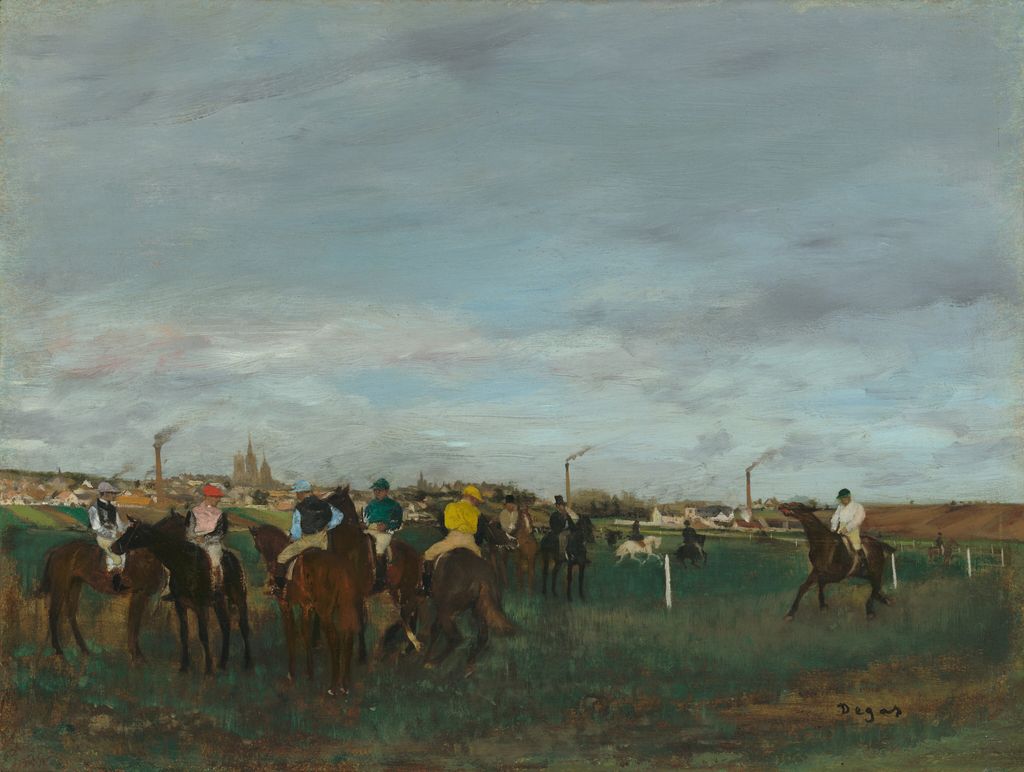
In The Races, a small painting on wood, jockeys in coloured silks gather at the near edge of a grassy course. Another rider approaches them. Farther back, a pair of horses runs along a narrow track, while buildings and smokestacks line the horizon. Edgar Degas made this work in 1871–72; the National Gallery of Art in Washington holds it as accession 1942.9.18. The title promises racing, but the nearest horses have not yet broken into a gallop. The picture gives much of its attention to the seconds around an event, when riders, animals and spectators wait for action to begin. [1][9]
That choice was typical enough for the Metropolitan Museum of Art to contrast Degas with Édouard Manet: Degas often favoured tension before a start, while Manet could make the race itself an eruption of speed. It was not an absolute rule. Degas also painted a fallen jockey and made studies of horses in several media. His racing subjects move between observation at a modern leisure ground, study of earlier art and the reworking of images in the studio. The ballet dancers page shows another subject in which preparation can command more of the picture than a public performance. [2][3][4]
Degas's Racehorses at a Glance
Modern settingParisian racecourses and their social world
Common chosen momentRiders and horses gathering or preparing before a start
Other momentsA steeplechase fall, moving horses and figures returned to in later works
Working methodsOil, pastel, drawing and original wax studies, with revision across time
Important distinctionA horse study is not automatically a documented racecourse scene
First label checksOwning institution, accession number, date, medium and support
Horse and rider were old artistic subjects. In nineteenth-century Paris, the racecourse gave them a contemporary setting. Musée d'Orsay describes racing as a fashionable social pursuit with British and aristocratic roots, taken up by the Parisian bourgeoisie. The Met notes the popularity of tracks at Longchamp and Vincennes on the outskirts of the city. Those places offered spectacle, wagers, crowds, new clothes and the close sight of controlled animal strength. Degas could paint a recognisably modern activity while drawing on a long tradition of equestrian pictures. [2][5]
The artist's early Le Défilé, or Race Horses before the Stands, makes this double interest visible. Orsay dates it between 1866 and 1868 and describes it as oil on paper mounted on canvas, RF 1981. The horses form a diagonal procession; one at the far end moves nervously as the start approaches. Orsay identifies older and English sporting art among Degas's sources, but it also stresses his decision to make this interval before a race the subject. He does not supply enough detail to establish a precise track or horse owner from the painting alone. The modern racecourse appears as a carefully arranged visual problem, not a topographic map. [5]
The Met's account places Degas's first racing pictures in the early 1860s and records a large racing canvas at the Salon of 1866. It also notes that Manet and Degas spent time at the racecourse together. Their different treatments of racing therefore cannot be reduced to one painter knowing the place and the other merely imagining it. Both responded to a fashionable subject. Degas's repeated interest in the pause, the gathering and the horse's restrained energy is a choice within that shared modern world. [2]
Before the Start
Return to the NGA's The Races. Five jockeys in contrasting silks cluster at the left while a sixth approaches from the right. The small moving horses in the middle distance make the foreground riders look comparatively still. The low horizon leaves room for a sky, buildings and smokestacks, so the racecourse does not float in an isolated pastoral world. Yet the owner record does not identify a single real location. The distant structures are visible marks of a settled, working landscape; they are not a reliable address. [1]
Degas gives the approaching rider and the gathered group different directions. Their relation creates an expectation that they may soon move together, even though they remain apart in the image. The mix of bright silks helps a viewer tell riders from one another without naming them. The painting is modest in scale—its panel is about 27 by 35 centimetres—but the space feels larger because the action is distributed from near group to distant track. The NGA's current title is The Races; an earlier exhibition used Before the Race. The older wording catches its mood without replacing the present owner's identity for the work. [1]
Orsay's Le Défilé approaches pre-start suspense differently. It lines up mounts and riders so that repeated legs, backs and shadows carry the eye deep into the course. Orsay describes the final horse's nervous movement as a sign that the event is imminent. In the NGA panel, the meeting and dispersal of small groups matter more than a procession. Neither work needs a finish line to be about racing. Each shows that anticipation can be visible as a pattern of potential motion. [1][5]
This preference deserves a limit. The Races has two horses running in the background, and other Degas works make active movement or its danger central. A page about racehorses cannot say that he never painted a horse at speed. The more precise point is that he often shifted the focus from a victory or a spectacular instant to the relations among horses, riders, ground and surrounding people before or around it. [1][2][3]
The Fallen Jockey and a Painting Reopened
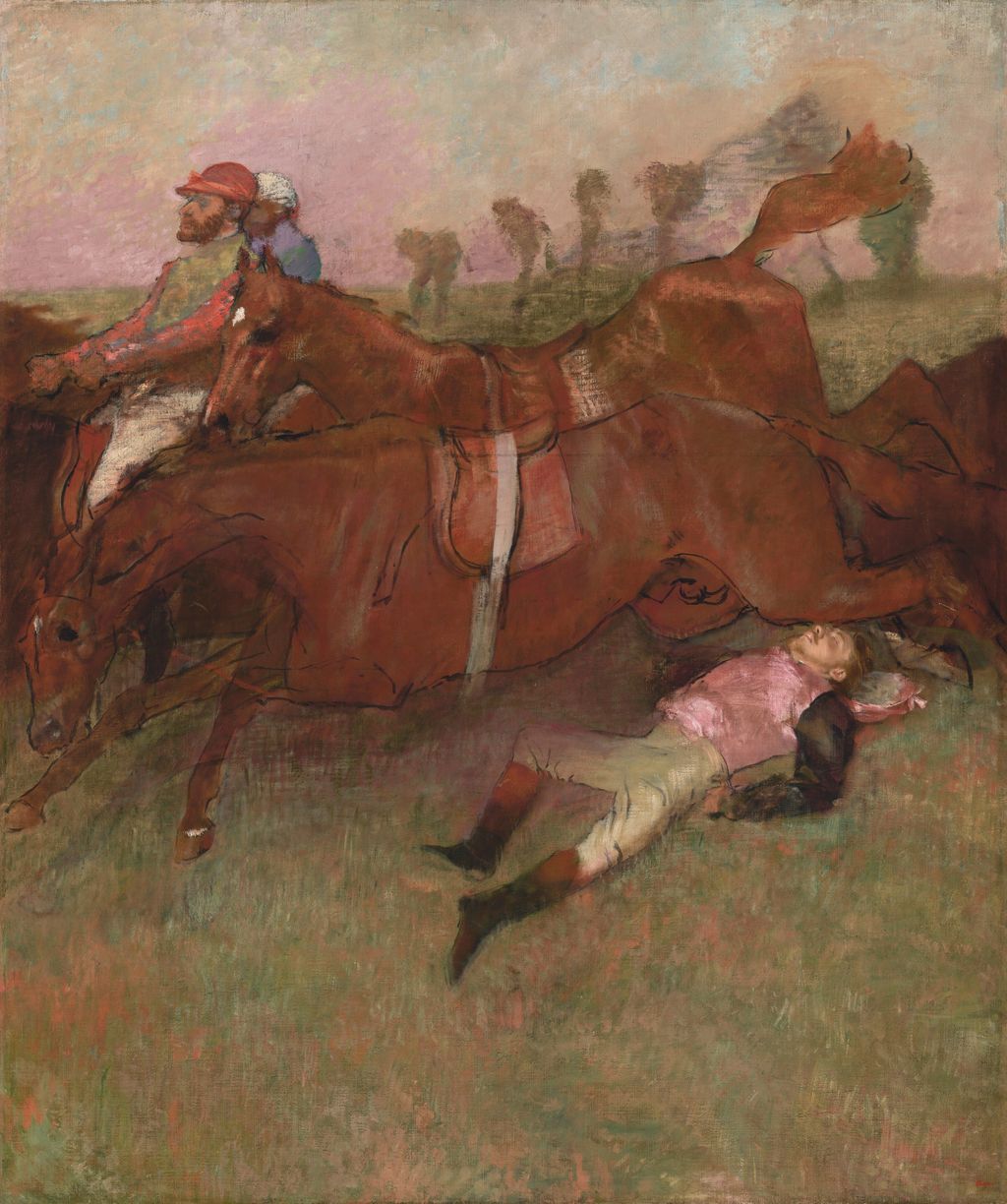
Edgar Degas, Scene from the Steeplechase: The Fallen Jockey, begun 1866, revised later, oil on canvas. National Gallery of Art, Washington, 1999.79.10. Collection record.
Scene from the Steeplechase: The Fallen Jockey gives the subject a different weight. In the NGA painting, a rider lies on the ground beneath a band of horses and other jockeys. The gallery dates the work to 1866, reworked in 1880–81 and about 1897. The span matters: the object now seen is not a pristine record of its first Salon appearance. The artist returned to it at least twice, making significant changes. The NGA notes bits of earlier blue sky and part of a horse later removed from the composition that can still be seen. [3]
Those traces complicate a simple story of capturing an accident. The canvas depicts danger, but the owner record does not establish that it reports one identifiable fall witnessed at a named steeplechase. Degas's later interventions also changed the visual relationships among the fallen body, the horses and the sky. The painting shows a dramatic situation and a history of revision. We should attend to both rather than read its title as proof of a specific real-world event. [3]
The work's long life also challenges a neat chronology in which the early artist studied only motion and the late artist merely repeated old subjects. In this one canvas, early and later decisions coexist physically. That is a different kind of change from a sequence of separate paintings. The paintings page follows revision as a broader part of Degas's oil practice; here the exposed changes matter because they reshape a racing incident. [3]
Reusing Riders in a Pastel on Wood
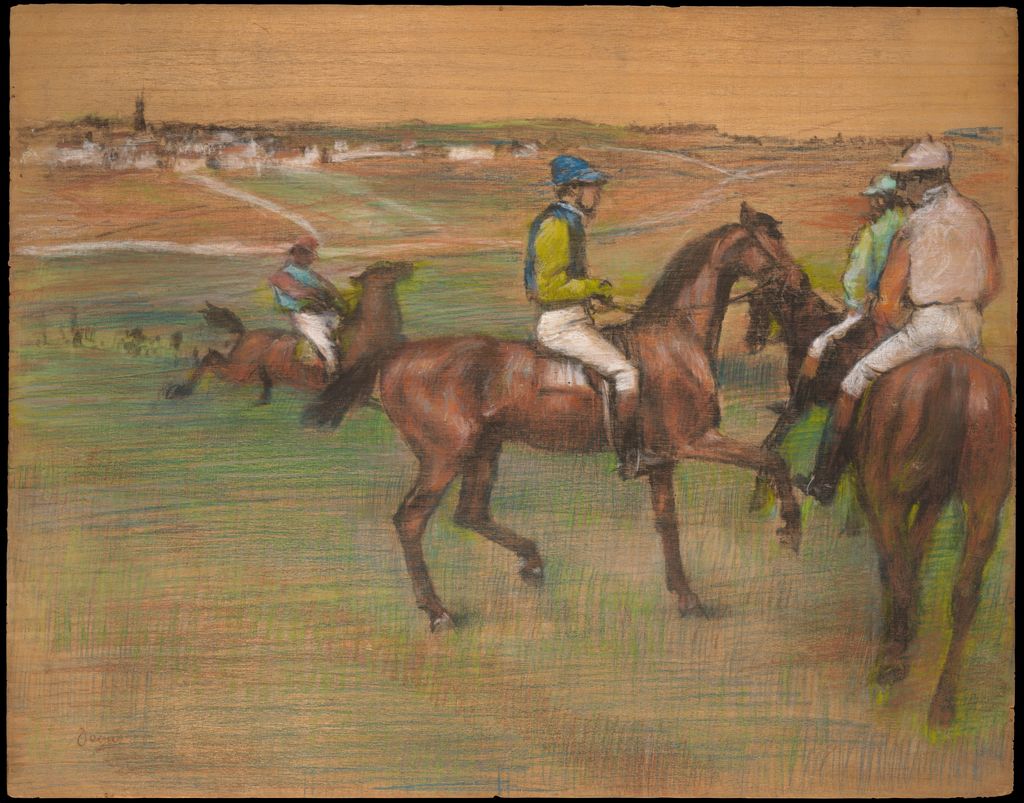
Edgar Degas, Race Horses, c. 1885–88, pastel on unvarnished wood. The Metropolitan Museum of Art, 1999.288.3. Collection record.
The Met's Race Horses, made about 1885–88, brings several mounted figures into a broad, shallow landscape. The museum's record identifies it as pastel on a plain, unvarnished wood panel, accession 1999.288.3. Warm wood is visible through or beside the pastel, helping form the sky, distant land and ground. Its colour is part of the image rather than simply a hidden backing. The medium is specific: this is neither a conventional oil painting nor pastel on paper. [4]
The Met also reports that the horses and jockeys had appeared in earlier Degas works. The prancing central horse and rider can be traced still farther back to Degas's copy, made in 1859, of a figure in Benozzo Gozzoli's Journey of the Magi. A modern racehorse can therefore carry an older pictorial pose. This does not make the later scene a copy of an entire Renaissance composition. Degas transported and recombined figures, changed their setting and worked in a new medium. The source of a pose is one strand in the finished work's history. [4]
The point is useful when a horse appears uncannily poised or familiar. A viewer can ask whether the artist observed the movement, remembered it, studied it in an earlier image, or reused one of his own motifs. The answer differs by object. The Met provides a documented lineage for the central rider in this pastel; it does not authorize the same origin story for every horse Degas drew. The drawings page follows how a study can be carried into another work, while the pastels page explains dry colour as a medium. [4]
Watch: Edgar Degas
Explore his paintings, drawings and sculpture in three short videos.
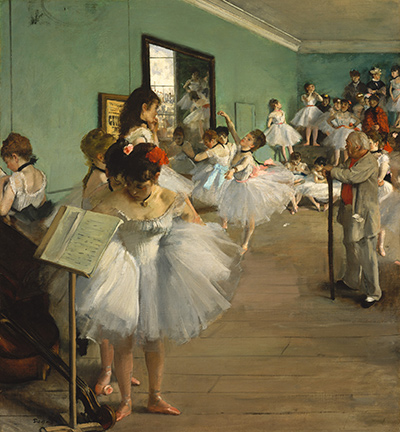
Degas, The Dance Class
Smarthistory
Look closely at Degas’s off-duty dancers and his unusual view into the rehearsal room.
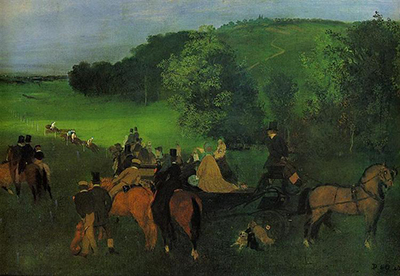
Racing pictures can include people who are not in a contest. Orsay's Le Champ de courses. Jockeys amateurs près d'une voiture places riders near a carriage. The museum dates the oil painting across 1876–87, a range that should stay intact rather than become a guessed single year. Its record names accession RF 1980. Those details distinguish this scene of amateur jockeys by a carriage from other racing pictures with similar English titles. [6]
The carriage also widens the frame of racing culture. The course was a place to gather, watch, ride and be seen. The Met's visiting guide describes mixed crowds and high-stakes leisure at the new tracks. Orsay's object title specifically calls the riders “amateur jockeys,” but that label is attached to its work, not to every rider in the other paintings. A horse's posture, clothing and nearby carriage may suggest a social scene, yet a museum's title and documented history are stronger evidence than an invented biography of a figure. [2][6]
From the Racecourse to a Wax Horse
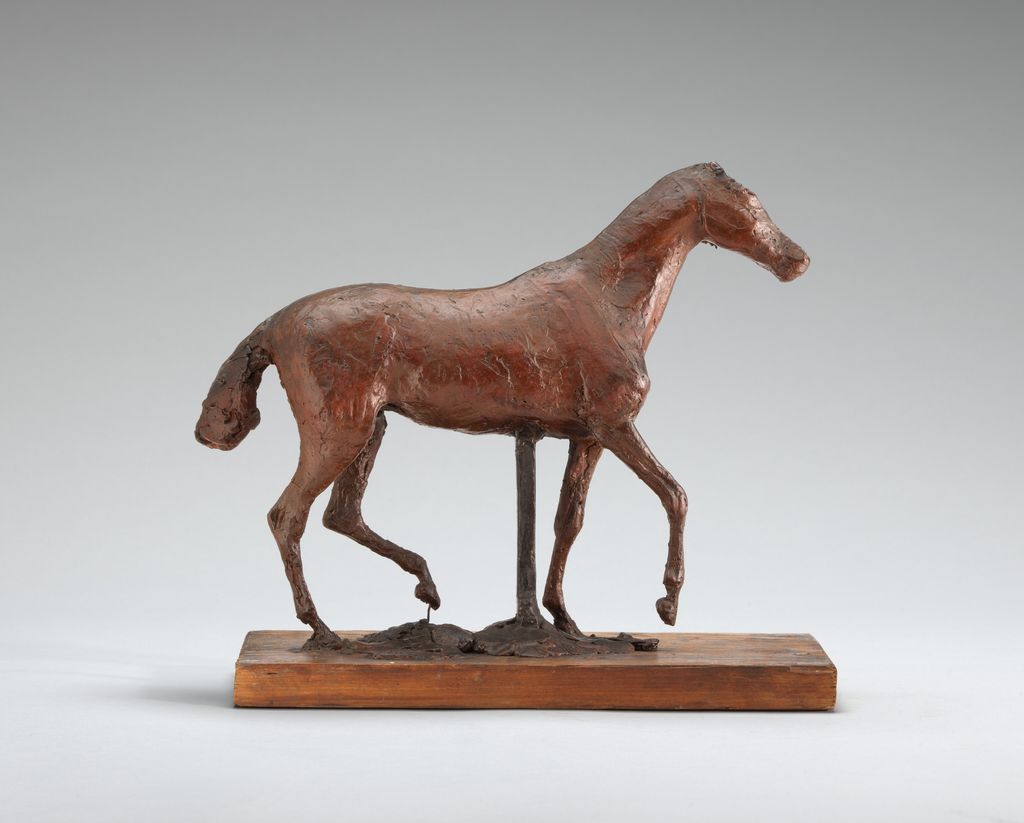
Edgar Degas, Horse Walking, possibly early 1870s, original pigmented beeswax, metal armature and cork. National Gallery of Art, Washington, 1999.80.13. Collection record.
The NGA's Horse Walking is an original Degas model in pigmented beeswax and other materials, possibly from the early 1870s. It is accession 1999.80.13. A raised foreleg and the body's slight forward shift make a single phase of movement available to inspect from more than one side. The animal is not surrounded by jockeys, a track or spectators. It belongs in a conversation about how Degas investigated horses, but its object record does not identify it as a race scene. [8]
The NGA's 1998 Degas at the Races exhibition brought paintings, works on paper and horse sculptures together, including original waxes. That breadth helps explain why the racing subject cannot be surveyed through oil paintings alone. The exhibition page also mentions related later bronzes; the bronze casts and Degas's surviving wax models have different object histories. Horse Walking is one of the original models, so its dark colour should not make it a bronze in the viewer's mind. [7][8]
The sculptures page explains original models and posthumous casts in depth. On this page the wax horse supplies a modest but important comparison: a modeled body in space can test stance and weight in ways a painted silhouette cannot. That does not prove that this particular model was used for a particular racing canvas. Without an object-specific link, the two works remain examples of parallel investigation rather than a known preparatory chain. [7][8]
How to Read a Degas Racing Work
First ask what moment is pictured. Are the horses waiting, assembling, moving, or responding to a fall? A race title does not guarantee the finish or even a gallop in the foreground. Next read the medium and support: oil on a small wood panel in NGA The Races, pastel on bare wood in the Met's Race Horses, and mixed-material wax in NGA Horse Walking produce different ways of holding motion still. [1][4][8]
Then check the object identity. Orsay Le Défilé RF 1981 and Le Champ de courses RF 1980 are separate works, and the latter's long 1876–87 range matters. A current museum title, accession and record make a better anchor than a generic English title or a reused site image. If a record says the artist returned to a canvas, its date may name several working moments rather than one decisive finish. [3][5][6]
Finally, notice what makes the scene modern without assuming the painted location is exact: silks, tracks, carriages, spectators and even distant industry can place horses in nineteenth-century social life. Degas could take that setting, borrow an older pose, assemble a new grouping and revise it years later. His racing works make movement visible partly by showing the charged moment before it happens, and partly by letting a viewer sense how much movement occurred in the making of the image itself. [1][2][3][4][5]
A selected index of documented works, combining owner records with entries sampled across Michel Schulman’s digital catalogue raisonné. It is not a complete catalogue. View the full catalogue
Which signs place the riders in a modern social setting?
Open Question
How does the original wax horse change your view of a painted one?
Join the Conversation
Share your reading of these works below.
References
National Gallery of Art, Washington, The Races, 1871–72, oil on wood, accession 1942.9.18. View source
Metropolitan Museum of Art, Manet/Degas visiting guide, “At the Racecourse”, 2023–24. View source
National Gallery of Art, Washington, Scene from the Steeplechase: The Fallen Jockey, 1866, reworked 1880–81 and c. 1897, oil on canvas, accession 1999.79.10. View source
Metropolitan Museum of Art, Race Horses, c. 1885–88, pastel on wood, accession 1999.288.3. View source
Musée d'Orsay, Le Défilé, 1866–68, oil on paper mounted on canvas, accession RF 1981. View source
Musée d'Orsay, Le Champ de courses. Jockeys amateurs près d'une voiture, 1876–87, oil on canvas, accession RF 1980. View source
National Gallery of Art, Degas at the Races, 1998 exhibition overview. View source
National Gallery of Art, Washington, Horse Walking, possibly early 1870s, original mixed-material wax sculpture, accession 1999.80.13. View source
Splash image: Edgar Degas, The Races, 1871–72, oil on wood. National Gallery of Art, Washington, 1942.9.18. Collection record. View source
Tom Gurney is an art history expert. He received a BSc (Hons) degree from Salford University, UK, and has also studied famous artists and art movements for over 20 years.
Tom has also published a number of books related to art history and continues to contribute to a number of different art websites. You can read more on Tom Gurney here.



 Buy Art Prints Now
 by Tom Gurney