Buy Art Prints Now
from Amazon
* As an Amazon Associate, and partner with Google Adsense and Ezoic, I earn from qualifying purchases.
 by Tom Gurney
Tom Gurney BSc (Hons) is an art history expert with over 20 years experience
Published on June 19, 2020 / Updated on September 28, 2026
Email: tomgurney1@gmail.com / Phone: +44 7429 011000
Degas Young Spartans Exercising: Introduction
Four young women face five young men across an open stretch of ground. One woman reaches or points toward the group opposite her; the men answer with varied poses, some upright, some low to the earth. Farther back, older figures gather against a plain and distant city. Edgar Degas's Young Spartans Exercising looks at first like an episode from ancient history, but its bodies and gestures refuse to settle into one simple story. Is this an athletic challenge, a ritual of courtship, or an image that keeps both possibilities alive? The National Gallery in London leaves that question open. [1] [3]
This page concerns the London painting NG3860, an oil on canvas, 109.5 × 155 cm. The Gallery dates it about 1860, while explaining that Degas returned to the composition around 1879–80 and may have worked on it later. It remained in his studio throughout his life. A different, earlier attempt at the same subject belongs to the Art Institute of Chicago. Understanding which canvas we are looking at matters because Degas's changes over years are part of the London picture's history. The visible work is not a sealed record of one afternoon in 1860. [1][2]
At a glance
- ArtistEdgar Degas
- TitleYoung Spartans Exercising
- Current owner dateAbout 1860; revised around 1879–80, possibly later
- MediumOil on canvas
- Dimensions109.5 × 155 cm
- CollectionNational Gallery, London, NG3860
- AcquisitionBought with the Courtauld Fund, 1924
Contents
- Introduction
- At a Glance
- Girls and boys across the foreground
- Lycurgus, mothers and a distant Sparta
- A history painting made over many years
- Classical subject, modern faces
- Exercise or courtship?
- The painting in Degas's studio
- Looking again
The National Gallery's description connects the subject to Plutarch's Life of Lycurgus. In that ancient account, Spartan girls exercised and challenged boys in activities such as running, wrestling and throwing. Degas wrote about young women and men wrestling in a grove with the aged Lycurgus and mothers nearby. Yet the painting does not simply illustrate a sports manual. Hairstyle and gesture have also prompted a courtship reading. The Gallery presents this as an alternative, not a fact that erases the athletic source. The painted exchange between the groups remains intentionally or productively ambiguous to a modern viewer. [1]
Girls and boys across the foreground
The two foreground groups occupy the canvas like opposing teams. The girls hold together more tightly; the boys' positions vary, with some lounging or crouching. The leading female gesture seems to challenge or summon. It could be aggressive, playful or enticing depending on how one reads the bodies around it. Degas gives the viewer the energy of an encounter without a single prescribed outcome. The young people face each other, but their postures do not mirror each other neatly. [1]
This arrangement unsettles an expectation that a history painting about ancient athleticism would display orderly, ideal bodies. The girls press forward. The boys, who might be expected to show heroic readiness, appear more relaxed and uncertain. The National Gallery sees a subtle reversal of familiar gender conventions in these contrasts. It is safer to say that the picture complicates those conventions than to announce a complete program of social reform on Degas's behalf. The visual evidence is the difference in how the groups occupy space and return one another's attention. [1]
The girl's reaching arm is a hinge for the whole picture. Follow it across the open ground and it joins one group to the other. Yet that crossing remains incomplete. No body has actually made contact in the painted instant. The space between them is charged with possibilities: sport might begin, a taunt might be answered, or a social ritual might continue. Degas suspends the encounter at a point where gesture has a direction but not a settled meaning. That suspension lets viewers compare the groups rather than rush to a narrated result. [1]
The National Gallery notes that the four girls' legs can appear more numerous than expected. Bodies and limbs overlap in an arrangement that resists easy anatomical counting. This is a reminder to look closely at the picture's making rather than treat each figure as a clean classical specimen. The same owner text ties the youths' varied gestures to Degas's long interest in bodies caught in movement, later evident in dancers and other modern subjects. The comparison concerns his formal curiosity, not a claim that a Spartan girl is literally a ballet dancer in costume. [1]
The boys' nude bodies also belong to the tradition of history painting. Degas could demonstrate his skill in drawing the human figure through an ancient subject. But the result is not a procession of polished statues. Their crouched, stretching and uneven postures bring awkwardness into a genre that often idealized anatomy. The tension between classical ambition and ordinary physical behavior gives the foreground its force. We recognize a story about Sparta while noticing figures who can seem startlingly contemporary. [1]
Lycurgus, mothers and a distant Sparta
The middle distance contains a group of women around an older man whom the National Gallery identifies as Lycurgus, the Spartan lawgiver. Beyond them lies the city and a mountain identified as Taygetus. These elements place the foreground youth within a larger civic landscape. The exercise or encounter is not a private game without observers. It is linked to an imagined society, with older figures and laws behind it. [1]
Plutarch's account concerns the training of young Spartans, and Degas knew other later writings about the ancient city as well. The Gallery says he read widely and notes that his notebook paraphrase included mothers and Lycurgus. Those sources help explain the background group. They do not mean every distant contour is an archaeological reconstruction. Degas uses landscape and figures to make a plausible historical world for his encounter; the painting's central drama remains the uncertain relation of the young people at the front. [1]
The Gallery's overview recalls an ancient tradition associating Mount Taygetus with the exposure of unwanted infants. That claim should be understood as part of the classical and later narratives of Sparta that informed the picture, not used here as an unqualified statement of verified social practice. Within the painting, the mountain's immediate visual role is to anchor the distant setting and give the bodies in the foreground a broad, severe landscape. It makes their activity appear public and civic rather than domestic. [1]
Distance also changes how the groups are seen. The foreground youths are individual, awkward and large enough for gestures to matter. The mothers and lawgiver are smaller, more like a social frame around the action. The city is farther still. Our eye moves from body to group to place. This layered structure gives the painting the scale of history painting while keeping its sharpest questions close to the viewer: what are the young people doing to one another, and how should we read their bodies? [1]
A history painting made over many years
Degas returned to Paris in 1859 after several years of study in Italy and sought recognition in the prestigious field of history painting. The National Gallery places Young Spartans Exercising among five large history works he attempted in the first half of the 1860s. The subject offered an ancient text, nude figures and a wide landscape: the materials from which an ambitious Salon picture might be built. Yet this London canvas was never shown at the official Salon and remained in Degas's studio. Its life as a work was longer and less settled than a simple “finished 1860” label suggests. [1]
The Gallery records another attempt at the subject in Chicago. It describes that earlier, grisaille version as abandoned and notes a more detailed landscape and classical building. Degas retained the two facing groups but changed the setting and figures in the London version. The Art Institute's own scholarship has argued that the various Spartan canvases and studies should be understood as phases rather than one body of work made at a single moment. Those scholarly proposals need not displace London's current “about 1860” catalogue date to show why the history of the image is complicated. [1][2]
The Chicago version is useful because it shows that Degas's first solution was not simply a smaller copy of the London painting. Its more explicit architecture places the figures within a recognizable antique setting. In London, the open plain and distant city leave greater pressure on the two groups in the foreground. Remove an architectural marker and the viewer has fewer cues for a familiar history scene. The bodies must do more of the storytelling themselves. This comparison stays at the level established by the museum descriptions: two versions and a shift in compositional emphasis. It does not claim that one entire canvas was mechanically traced onto the other. [1][2]
Working from studies also lets an artist test how limbs and groups meet. The National Gallery describes numerous preparatory drawings for the frieze-like figures. Such drawings are evidence of repeated attention to the same formal problem, not just illustrations made after a finished picture. The arrangement of two facing groups had to carry both the literary subject and the sense of physical action. That explains why even small changes to a girl's arm, a boy's crouch or the interval between them could alter a viewer's reading of the whole encounter. The public record confirms the studies' existence; it does not assign every surviving sheet to one exact painted revision. [1]
The London canvas itself changed. According to the Gallery, Degas replaced more classical faces with more contemporary ones and revised the picture again around 1879–80, perhaps even later. It was never varnished. These facts make the work a record of reconsideration. The artist kept an early historical subject in his studio while his reputation became bound to modern life, dancers, racehorses and urban interiors. He could return to the Spartans with later questions about how bodies should look and behave. [1]
The exact sequence of all alterations cannot be reconstructed from a brief public account alone. We should not treat every face as painted in a named year or say that one visible limb belongs to a precise campaign without technical evidence. The clear point is that an object labelled about 1860 contains later work. A single date identifies its early conception, while the canvas also shows Degas's refusal to leave that conception untouched. [1][2]
An 1880 exhibition listing in the Gallery's older provenance section names the fifth Impressionist exhibition, whereas its interpretive account says the painting was never shown at the Salon. These statements concern different exhibitions. Degas did not submit the London canvas to the official state Salon, yet a record can still place it in an Impressionist exhibition years later. Saying simply “never exhibited” would blur that difference. More importantly, neither event marks a final date when Degas decided the work could never change again. [1]
Watch: Edgar Degas
Explore his paintings, drawings and sculpture in three short videos.
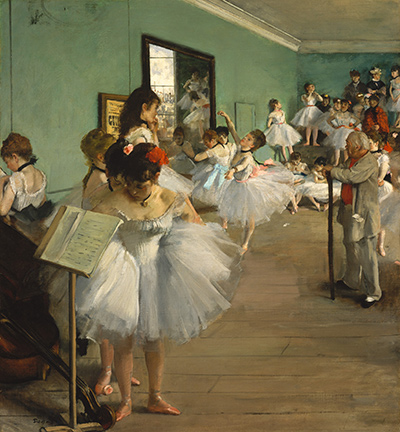
Degas, The Dance Class
Look closely at Degas’s off-duty dancers and his unusual view into the rehearsal room.
Watch on YouTubeClassical subject, modern faces
The ancient story gave Degas an opportunity to draw bodies in a respected tradition. But the National Gallery emphasizes the tension between classical history and modernity. When he changed the adolescents' faces, he reduced their distance from viewers of his own century. Their bodies remain in a Spartan setting, yet they do not fully belong to a timeless ideal. This can make the image feel unresolved: the subject asks for antiquity, while the figures sometimes look close to modern people in awkward interaction. [1]
That unresolved quality is productive. If the scene were a purely archaeological illustration, one could read the landscape and identify the ancient episode. If it were an entirely modern genre scene, the ancient references would disappear. Degas holds the two expectations together. The result makes us ask how a modern painter can represent a past that he knows through texts, art and imagination but cannot observe directly. He tests inherited conventions instead of simply accepting them. [1]
The Gallery connects Degas's history-painting ambition to the influence of Ingres and Delacroix. It describes his attempt to combine disciplined drawing and anatomy with dynamism and color. In Young Spartans, that combination appears in a composition carefully built from groups, yet full of lunging and crouching gestures. It would be too simple to divide one half of the canvas as “Ingres” and another as “Delacroix.” The influences inform the artist's wider practice; this particular work fuses control and movement in its own way. [1]
The apparent oddness of the boys and girls may help explain why Degas kept returning to the picture. Their poses are vivid, but they resist conventional beauty. The girl at front is strong without being an antique marble type; the boys are bare but not uniformly heroic. Such bodies make the viewer work harder to identify tone. Is the challenge serious, teasing or part of a ritual? The painting's style does not resolve a question its subject also leaves open. [1]
The open ground contributes to this problem. It is wide enough to separate the groups but narrow enough for the leading gesture to bridge. If Degas had filled it with a wrestling pair, the event would be settled. If he had moved the youths farther apart, the exchange might lose urgency. The space he left makes the picture hover before contact. Behind them, the older figures and distant settlement lend the interaction public significance, yet they do not intervene. A viewer can sense a society watching its young people without being told exactly what judgment that society will make. [1]
Exercise or courtship?
Plutarch's Life of Lycurgus described girls exercising and challenging boys. That source is a strong reason to see athletic competition in the work. Yet the National Gallery notes that hairstyles and poses can correspond with courtship rituals mentioned in ancient writing. A reaching arm might beckon as well as provoke. The title Young Spartans Exercising is therefore a useful guide, but it should not close off every other reading of the depicted exchange. [1]
The two interpretations need not be forced into a modern opposition. In a society represented through accounts of public training and social rituals, exercise and courtship could be linked in the literary imagination. Degas may have been interested in precisely that ambiguity, or it may arise from his changing composition over time. The current owner record does not certify his private intention. It does show that the gestures permit more than one informed account. The page should let readers see the evidence rather than dictate a verdict. [1]
Look at the girls' compact forward energy and the boys' open, varied responses. A challenge is plausible because one group appears to initiate contact and the other receives it. Courtship is plausible because the figures engage one another as youths in a social setting rather than as athletes in a clearly marked contest. No discus, finish line or wrestling hold supplies a decisive action. The gap between groups is where those readings meet. [1]
This ambiguity is different from factual uncertainty about the object's accession or size. We know this is London's NG3860 and can give its measurements from the owner. What remains open is how to interpret the exchange. Keeping catalogue facts firm makes it easier to leave meaning appropriately flexible. A scholarly page can be exact about the canvas and careful about what its gestures may signify. [1]
The painting in Degas's studio
The National Gallery says Degas kept Young Spartans Exercising in his studio for the rest of his life. It quotes later recollections from friends who saw it displayed prominently in his older years. That attachment is striking because the public often associates him first with dancers. The canvas preserved an early ambition to take on grand historical subjects and formal problems of group composition. It may also have offered a continuing test: could an ancient scene be revised to remain alive under a modern eye? [1]
We should not turn his decision to keep it into a simple emotional confession. The record gives testimony that he valued and displayed the work, not a complete explanation of why. He might have cared about its history-painting ambition, its formal problems, its personal chronology or all of these. The picture itself provides evidence of sustained attention through later changes. Its presence in the studio is a fact; a single private motive is not. [1]
The Gallery bought the work with the Courtauld Fund in 1924. Its move from the studio, through later ownership, into a public collection made a long private experiment available for new interpretations. Today it can be studied alongside the separate Chicago version and preparatory material. Those comparisons show that what appears to be one ancient scene was in fact a continuing project. The Chicago image depicts a separate version from the London canvas. [1][2]
Looking again
Start with the girl whose arm reaches across the open ground. Let the gesture lead to the boys, then compare how tightly the girls stand with how variously the boys crouch and stretch. Move backward to the mothers and Lycurgus, then farther to city and mountain. Finally return to the young figures and ask whether the distant historical frame makes their uncertain gestures easier or harder to read. The painting's depth is built in space, time and interpretation: an ancient story, an early Degas project and later revisions occupy the same canvas. [1]
Young Spartans Exercising is both a history painting and a record of Degas working against the fixed expectations of that genre. He drew on Plutarch and classical ambition, then kept altering the scene and its bodies. Its opposing groups remain vivid without giving away whether their encounter is mainly competition or courtship. The London canvas, NG3860, rewards a reading that is exact about its identity and open about its meaning. For broader context, see Degas's paintings and his drawings. [1][2]
Artworks directory
A selected index of documented works, combining owner records with entries sampled across Michel Schulman’s digital catalogue raisonné. It is not a complete catalogue. View the full catalogue
Discussion
Share what you notice in Degas’s young spartans exercising.
Reader Insights
How do the two foreground groups face one another?
What do the distant figures and landscape add to the ancient setting?
Where does this version still show signs of Degas’s changes?
Join the Conversation
Share your reading of these works below.
References
- National Gallery, London, Young Spartans Exercising, NG3860, object record and in-depth text, accessed 27 September 2026. View source
- Art Institute of Chicago, Devin Burnell, “Degas and His ‘Young Spartans Exercising’,” Museum Studies 4, consulted 27 September 2026. View source
- Edgar Degas, Young Spartans Exercising, about 1860, oil on canvas. National Gallery, London, NG3860. Image: Wikimedia Commons. Collection record. View source