



 by Tom Gurney
Tom Gurney BSc (Hons) is an art history expert with over 20 years experience
Published on June 19, 2020 / Updated on October 30, 2026
Email: tomgurney1@gmail.com / Phone: +44 7429 011000
Interior at Arcachon by Édouard Manet: Introduction
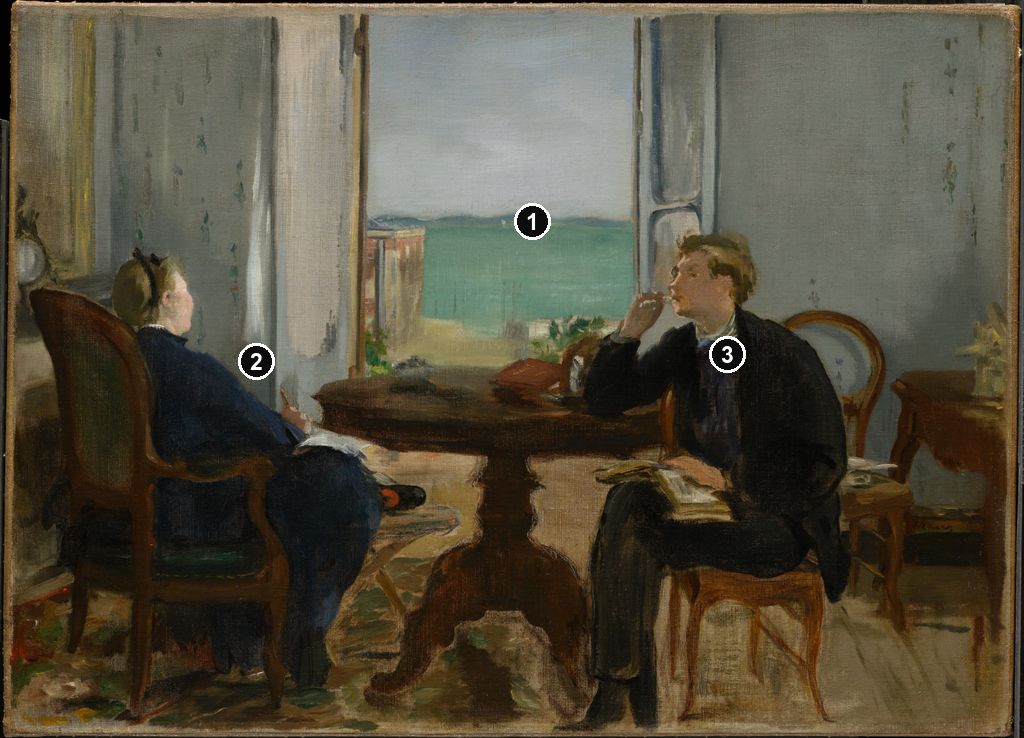
Two figures sit on opposite sides of a broad table, with an open window between them. Beyond its pale leaves lies a stretch of blue-green water. Édouard Manet painted Interior at Arcachon in 1871. The sitters are his wife Suzanne and her son Léon, and the small canvas belongs to the Clark Art Institute in Massachusetts.[1]
Manet stayed with his family at the chalet Servantie in Arcachon during March and April 1871, after their reunion following the Siege of Paris.[2]
At a Glance
- ArtistÉdouard Manet
- TitleInterior at Arcachon; Intérieur à Arcachon
- Date1871.[1]
- MediumOil on canvas
- Dimensions39.2 × 54 cm.[1]
- CollectionClark Art Institute, Williamstown, Massachusetts, 1955.552
- AcquisitionPurchased by Robert Sterling Clark in 1943; Clark Art Institute, 1955.[1]
This work across Édouard Manet’s career
Contents
- Suzanne and Léon
- The Open Window
- Walls and Furniture
- The Loosely Described Floor
- The Related Study
- Drawing and Paint
- The Painting's Collection History
- Annotated details
Suzanne and Léon
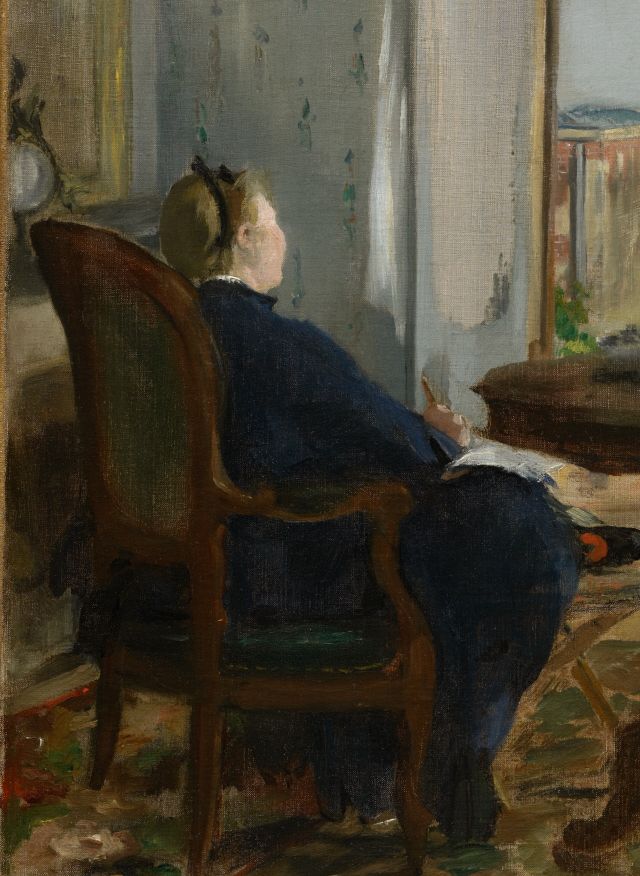
Suzanne occupies the left side of the painting. Her chair turns towards the table, presenting its high curved back to the viewer. A pale profile emerges above her dark blue clothing. The small light shape of her face is clearly separated from the cooler wall behind it.
Her body leans back in the chair, while her forearm angles towards the papers across her lap. A narrow brown shape rises near her hand, contrasting with the white material below. Farther down, a dark shoe projects towards the table. Its reddish accent stands out among the surrounding blue and brown.
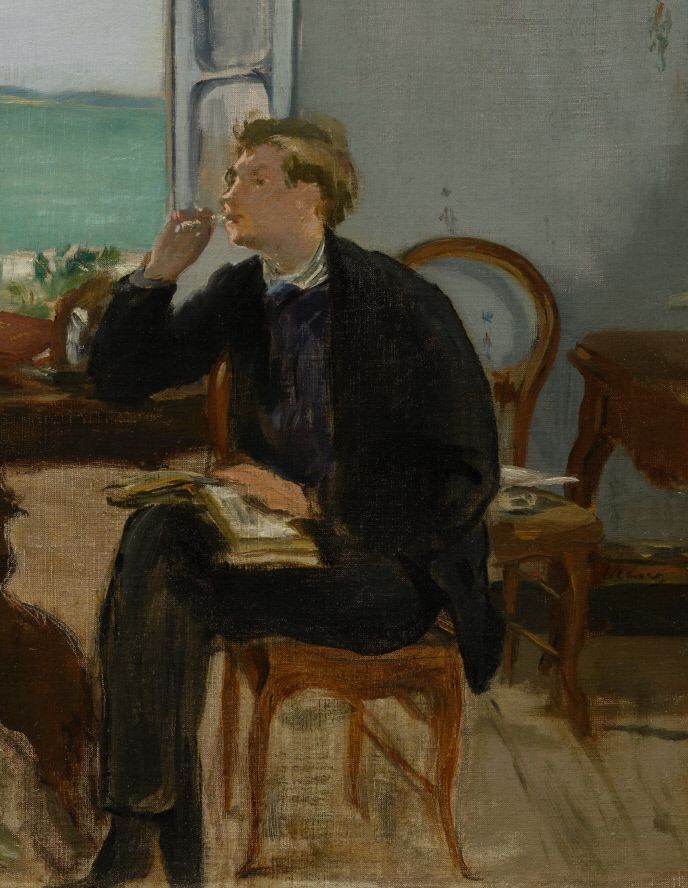
Léon sits on the right, closer to a frontal view. His face turns leftwards, and one raised hand approaches his mouth. The Clark describes him as holding what appears to be a cigarette.[1] A small pale collar separates his head from the dark jacket, while a blue passage runs down the centre of his chest.
An open volume rests across his lap. Its uneven pale edges cut across the darkness of his clothes. Below it, long black and grey shapes extend towards the lower edge, where his shoes meet the lightly described floor. His chair has a rounded wooden back and pale upholstery, making a lighter border around his upper body.
Although their clothes form two large dark areas, the figures have different outlines. Suzanne's body makes an angled shape behind the chair arm. Léon's raised elbow, broad shoulder and descending legs give his side a more upright emphasis. The table joins their positions without making them identical.
The Open Window
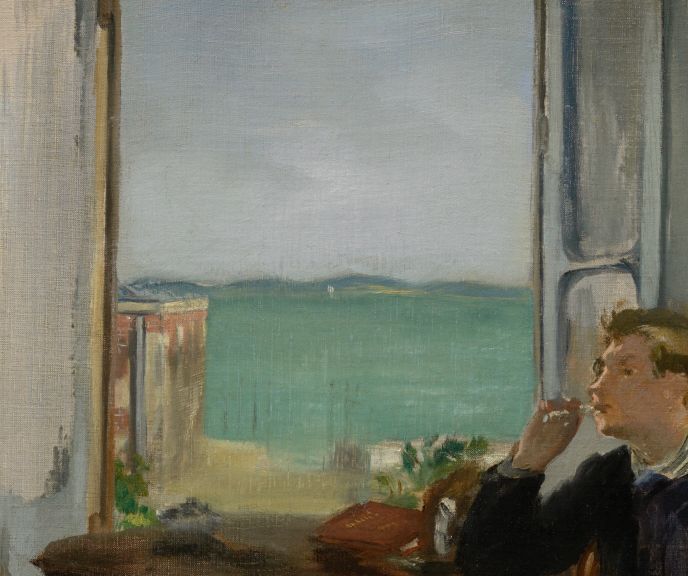
The open window occupies the centre of the background. Its pale leaves extend to either side of the view, creating long vertical boundaries beside the sitters. The right leaf has a curved lower division near Léon's head. On the left, a brighter strip stands between Suzanne and the outdoor scene.
The water forms a wide turquoise band. A low dark strip of land crosses the distance, separating the bay from the pale sky. The horizon remains fairly low within the window, leaving a broad open area above it.
Nearer the house, a reddish structure appears along the left edge of the opening. Its upright divisions contrast with the water's horizontal direction. Pale yellow ground and irregular green marks fill the lower part of the view, just above the table. These warmer and darker touches interrupt the larger cool areas beyond.
The window gives the picture an opening into distance, but it also makes a distinct rectangular shape on the canvas. The table cuts across its bottom, and the figures flank it on both sides. The bright outdoor area remains framed by the room's furniture and walls.
Walls and Furniture
Blue-grey wall areas extend behind both sitters. Small green marks descend in loose vertical groups across them. Their repeated shapes are much less regular than the window's straight edges. On the left, a narrow warmer band runs near the side of the picture; on the right, the wall spreads more widely behind Léon's chair.
The table presents a broad dark oval. Its near edge extends across the centre of the painting, partly obscuring both seated figures. A reddish closed book lies towards Léon's side, its sloping cover visible against the darker surface. Smaller grey and pale marks are scattered farther left.
Below the tabletop, a heavy central pedestal widens towards its base. The outline changes direction repeatedly, forming curves that spread out over the floor. Its dark brown mass divides the open space beneath the table and contrasts with the narrower chair legs on either side.
The chairs repeat rounded shapes at different scales. Suzanne's high back makes a broad enclosing curve; Léon's smaller back rises beside his shoulder. Their brown wooden frames echo the table, while the pale upholstery on the right connects with the light wall and the pages on his lap.
The Loosely Described Floor
The lower part of the room is built from varied patches of brown, cream, grey and muted green. Some follow the direction of floorboards towards the back. Others make broader uneven shapes around the furniture, interrupting a continuous view of the ground.
At the left, pale and reddish touches gather beneath Suzanne's chair. Near the centre, green-grey passages run around the pedestal's base. On the right, longer light strips descend beside Léon's legs and chair.
The contrast between the dark pedestal and the pale floor makes the table's support especially prominent. The broad tabletop and its pedestal create a strong central shape beneath the open window, linking the lower and upper halves of the composition.
Annotated Details from Interior at Arcachon
The numbered points identify visible features discussed in this article. Return from each detail to the whole composition. Édouard Manet, Interior at Arcachon, 1871. Oil on canvas, 39.2 × 54 cm. Clark Art Institute, Williamstown, Massachusetts, 1955.552. Image courtesy Clark Art Institute. Image source. Clark public-domain collection open access; any purpose. Numbers added to a separate overview. Three detail crops from the museum-supplied JPEG; no enlargement, recolouring or retouching.
Details from INTERIOR AT ARCACHON
Follow the window view, compare Suzanne with her papers, then look at Léon and the open book beside the table.
The window and bay
Pale window leaves enclose a broad view of blue-green water and distant land. A reddish structure interrupts the left side.
Suzanne and the papers
Suzanne sits behind the curved chair back. Pale papers cross her lap, contrasting with the dark blue clothing.
Léon and the open book
Léon raises a hand towards his mouth. The open volume makes a light band across his dark clothes beside the table.
The Related Study
Harvard Art Museums holds Manet's Study for Interior at Arcachon, also dated 1871. It combines watercolor, brown ink and graphite on off-white wove graph paper. The museum records two sketchbook pages joined and laid down, measuring 18.5 × 23.7 cm.[3]
Rouart and Wildenstein's catalogue identifies a closely related pen-and-wash study alongside the painting.[4] In the Harvard sheet, the figures occupy more of the space around the table. Dense lines cross the walls, furniture and clothes, while a prominent boat and railings interrupt the view outside.
The painting opens more space between the sitters and reduces the crowded appearance of the window view. Its larger areas of blue-grey wall contrast with the drawing's many overlapping marks. The central tabletop and pedestal remain important in both arrangements.
The relationship need not describe a simple sequence of revisions. The Clark catalogue notes Charles Moffett's suggestion that the drawing may have been modified later.[2] The two works offer distinct versions of the room's arrangement.
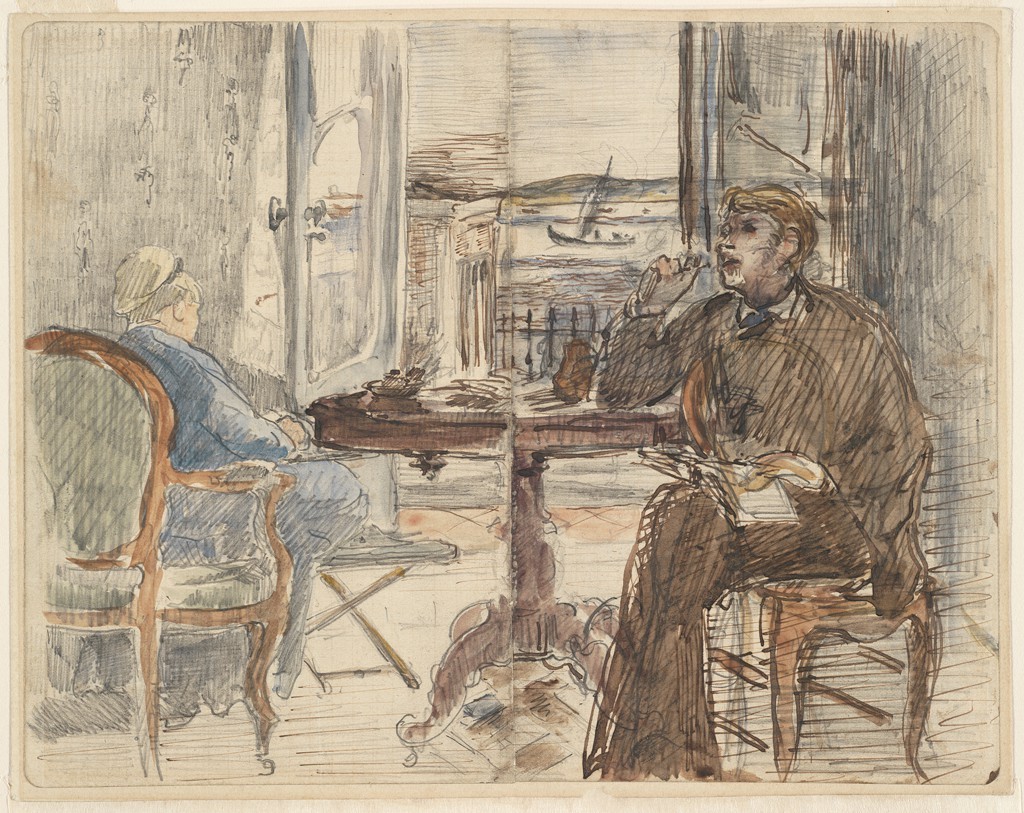
Édouard Manet, Study for Interior at Arcachon, 1871. Watercolor, brown ink and graphite on off-white wove graph paper, 18.5 × 23.7 cm. Two sketchbook pages joined and laid down. Harvard Art Museums/Fogg Museum, Bequest of William G. Russell Allen, 1957.59. Harvard Art Museums/Fogg Museum, via Wikimedia Commons. Image source. Public domain. Whole supplied reproduction resized without cropping or enlargement.
Drawing and Paint
Sandra L. Webber's technical examination for the Clark identifies thin black-ink underdrawing visible both to the eye and through infrared examination. She reports no observed alterations between that drawing and the paint layers of the oil. Thin washes alternate with fluid opaque strokes worked wet into wet, with almost no raised impasto.[2]
This varied handling has a material history. Webber records cleaning in 1988, older abrasion and retouches, while noting that some thin passages may reflect Manet's own technique.[2] The painting's present surface combines the artist's work with later treatment.
The Painting's Collection History
Manet never exhibited Interior at Arcachon, according to the Clark.[1] Its small scale and domestic subject distinguish it from a large public group portrait, while the central window gives the private room a substantial view beyond its walls.
The painting later belonged to the Havemeyer family in New York. It passed to Electra Havemeyer Webb and was sold through Knoedler to Robert Sterling Clark on 12 April 1943. It entered the Clark Art Institute in 1955.[1]
Artworks directory
Explore selected paintings, drawings and prints by Édouard Manet. Search by title or another recorded name.
Frequently Asked Questions
They are Manet's wife Suzanne and her son Léon Leenhoff.[1]
It belongs to the Clark Art Institute in Williamstown, Massachusetts, accession 1955.552. The canvas measures 39.2 × 54 cm.[1]
It is a separate work on paper, made with watercolor, brown ink and graphite. Harvard identifies two sketchbook pages joined and laid down.[3]
Discussion
Look again at the images and ideas explored in Interior at Arcachon by Édouard Manet. These editorial prompts invite your observations.
Reader Insights
Follow the window's pale sides, then compare its broad water and sky with the smaller shapes in the room.
Look beneath the tabletop. How does the pedestal divide the space between the two chairs?
Compare the whole painting with the Harvard study. Where does the drawing appear more crowded?
Join the Conversation
Share a detail, comparison or question about Interior at Arcachon by Édouard Manet below.
References
- Clark Art Institute, Interior at Arcachon, 1871, 1955.552, current object details, commentary and provenance. View source.
- Richard Kendall, with technical report by Sandra L. Webber, Interior at Arcachon, cat. 205, in Sarah Lees, ed., Nineteenth-Century European Paintings at the Sterling and Francine Clark Art Institute, 2012, pp. 474–476. Clark catalogue entry. View source.
- Harvard Art Museums/Fogg Museum, Study for Interior at Arcachon, 1871, 1957.59, current object details, materials and commentary. View source.
- Denis Rouart and Daniel Wildenstein, Édouard Manet: Catalogue raisonné, tome I, 1975, no. 170, pp. 152–153, Intérieur à Arcachon. Digitised catalogue, Wildenstein Plattner Institute. French. View source.
- Splash image, Édouard Manet, Interior at Arcachon, 1871. Oil on canvas, 39.2 × 54 cm. Clark Art Institute, Williamstown, Massachusetts, 1955.552. Image courtesy Clark Art Institute. Image source. Clark public-domain collection open access; any purpose. Resized without cropping or enlargement from the museum's supplied JPEG.


