 by Tom Gurney
Tom Gurney BSc (Hons) is an art history expert with over 20 years experience
Published on June 19, 2020 / Updated on July 5, 2026
Email: tomgurney1@gmail.com / Phone: +44 7429 011000
Introduction
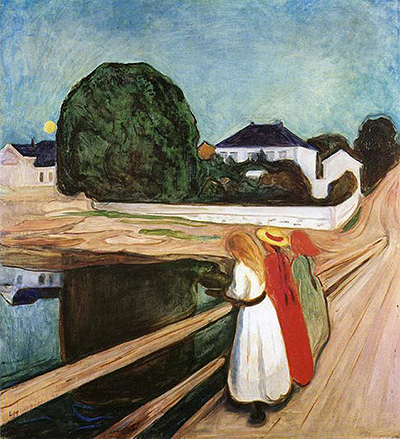
Girls on the Bridge is one of Edvard Munch's most memorable Åsgårdstrand motifs. The principal 1901 version, now associated with the National Gallery / National Museum in Oslo, shows young women gathered on a bridge or jetty, with houses, water and reflections drawing the eye into a bright but strangely suspended scene. [1] [3]
The painting can look calmer than Munch's famous anxiety images, but it should not be dismissed as merely charming. Munch returned to this motif many times, changing colour, grouping and mood. The bridge becomes a stage where youth, place, reflection and memory meet. [3] [6]
At a Glance
- Artist: Edvard Munch
- Title: Girls on the Bridge
- Principal version: 1901
- Medium: Oil on canvas
- Collection anchor: National Gallery / National Museum, Oslo
- Setting: Åsgårdstrand on the Oslofjord
- Cluster role: Landscape, memory and Åsgårdstrand route
Why This Painting Matters
Girls on the Bridge matters because it shows another side of Munch's emotional language. There is no screaming figure and no deathbed. Instead, Munch works with a seaside town, young figures, reflections and a bridge that pulls the viewer into space. [4]
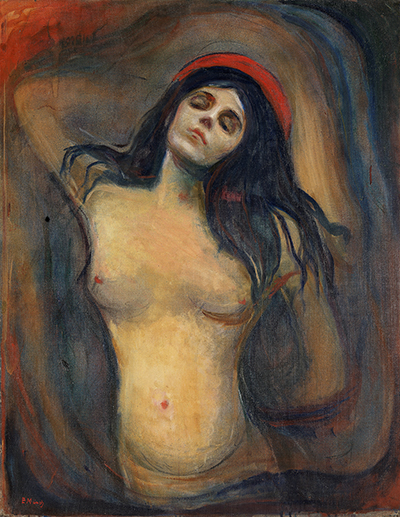
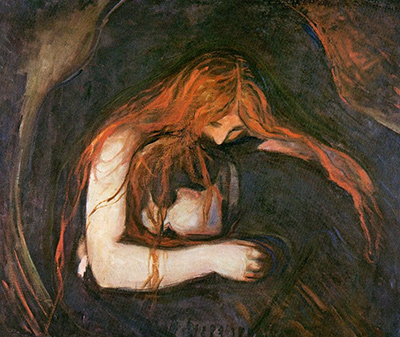
It is also important because Munch repeated the motif across many versions. That repetition makes the work part of his larger method. Like The Scream, Madonna, Vampire and The Sick Child, Girls on the Bridge was not a subject he simply painted once and left behind. [2] [3]
Åsgårdstrand
Åsgårdstrand was central to Munch's imagination. He spent many summers there and bought a house in the town in 1898. The bridge, houses, shoreline and water appear across many works from the period, giving the setting a personal and repeated visual identity. [3] [7]
In Girls on the Bridge, the place is not just background. The diagonal jetty, water, reflected houses and compressed figures create the emotional structure of the painting. The town becomes a memory-place, not just a scenic view. [4]
Looking Carefully
The first thing to notice is the strong diagonal. The bridge or jetty cuts into the picture and creates a pull into depth. This gives the painting movement even though the girls themselves are relatively still. [1]
The figures gather at the railing. They are not presented as individual portraits in the usual sense. Instead, colour, clothing, hair and posture make them part of a patterned group. [4]
The reflections matter. Houses and trees appear in the water, doubling the visible world. That reflection gives the scene a dreamlike quality without turning it into a nightmare. [5]
Versions and Repetition
Munch made multiple versions of Girls on the Bridge and related bridge or jetty images. Some versions change the number and arrangement of figures; others shift the colour and emotional pitch. The 1901 Oslo version is the usual anchor, but the motif continues into later decades. [3] [6]
This repetition is not incidental. Munch often treated a motif as something to be tested rather than finished. Different versions of Girls on the Bridge can feel brighter, darker, more decorative or more psychologically tense depending on colour and composition. [2]
Comparison Works
These comparison routes were checked against the local Edvard Munch sitemap during production. [8]
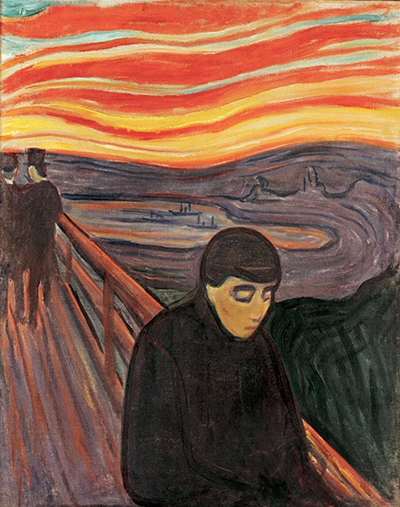
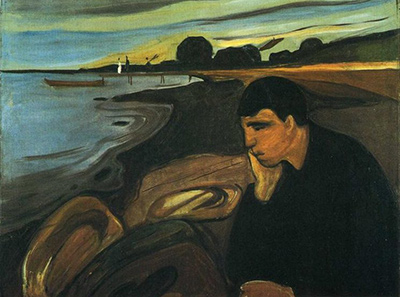
- Melancholy uses shoreline setting and inward mood, but it isolates one brooding figure rather than placing several figures together. [5]
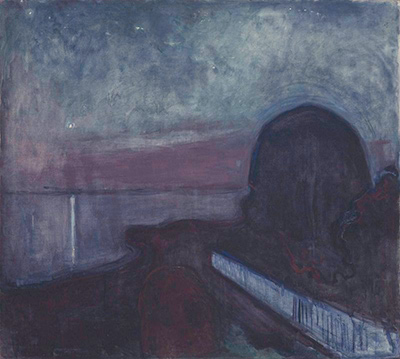
- Summer Night by the Beach and Starry Night belong to the larger mood-landscape route, with water, moonlight and reflection turning place into feeling. [4]
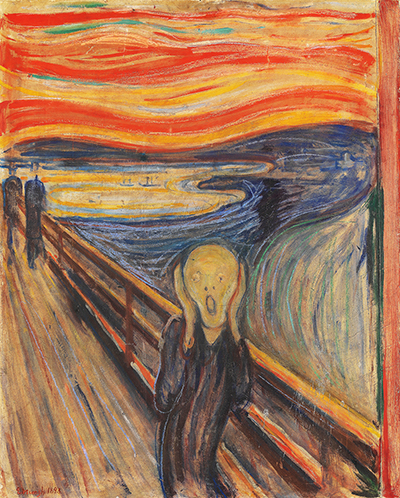
- The Scream is a more dramatic comparison. Both works use a bridge or road-like structure, but Girls on the Bridge holds the viewer in bright suspension while The Scream turns the bridge into a site of crisis. [5]
- Dance of Life also uses shore, grouped figures and rhythm to turn a social scene into a symbolic image. [5]
Things You Might Miss
- The bridge is not just setting. It is the structure that pulls the whole picture together. [1]
- The girls are grouped more by colour and posture than by individual portrait identity. [4]
- The water reflection gives the scene a second, unstable version of itself. [5]
- The painting is calmer than The Scream, but not emotionally empty. [4]
- The motif exists in many versions, so details can differ from one painting to another. [3]
Interpretation
Girls on the Bridge is best read as a painting of place, youth and repetition. It is not a simple image of happiness, even though it is brighter than many Munch works. The girls are present, but not fully accessible. The place is recognisable, but doubled by reflection. The bridge opens space, but also holds the figures in a narrow, staged zone. [4]
This is why the painting belongs in the Munch cluster. It broadens the idea of Munch beyond anxiety and death while still showing his central method: visible places and bodies become carriers of mood. [7]
Timeline
- 1863: Edvard Munch is born. [2]
- 1898: Munch buys a house in Åsgårdstrand, a place that becomes central to his art. [3]
- 1901: The principal Oslo version of Girls on the Bridge is painted. [1]
- 1900s-1930s: Munch continues to return to the bridge/girls motif in multiple versions. [3]
- 1944: Munch dies after a career of more than sixty years. [2]
FAQs
The principal Oslo version is dated 1901, though Munch made several versions of the motif across later years. [1] [3]
The principal 1901 version is associated with the National Gallery / National Museum in Oslo. Other versions are associated with collections including Hamburg, Moscow, Cologne, MUNCH and private collections. [1] [6]
The motif is set in Åsgårdstrand on the Oslofjord, a town closely associated with Munch's summer life and art. [3]
Both paintings use a bridge or road-like structure, but to very different emotional ends. Girls on the Bridge is a mood-landscape of youth, reflection and place; The Scream turns a similar structural device into a scene of crisis. [5]
References
- National Museum of Norway / National Gallery Oslo, The Girls on the Bridge object context, accessed 5 July 2026.
- MUNCH, "Edvard Munch (1863-1944)," official artist page, accessed 5 July 2026.
- Gerd Woll, Edvard Munch: Complete Paintings, London: Thames & Hudson, 2009.
- Patricia G. Berman, ed., Edvard Munch: The Modern Life of the Soul, Museum of Modern Art, 2006.
- Arne Eggum, Edvard Munch: The Frieze of Life, 1993.
- Sotheby's, Girls on the Bridge sale/catalogue context, 2016.
- eMunch, Edvard Munch's Writings: The English Edition, accessed 5 July 2026.
- TheHistoryOfArt.org, Edvard Munch sitemap and local internal-link validation, checked 5 July 2026.